



Managing Late Summer Dust and Pollen With Upgraded HVAC Filtration
The Hidden Threat in August Air: Why Your Current Filter Isn't Enough
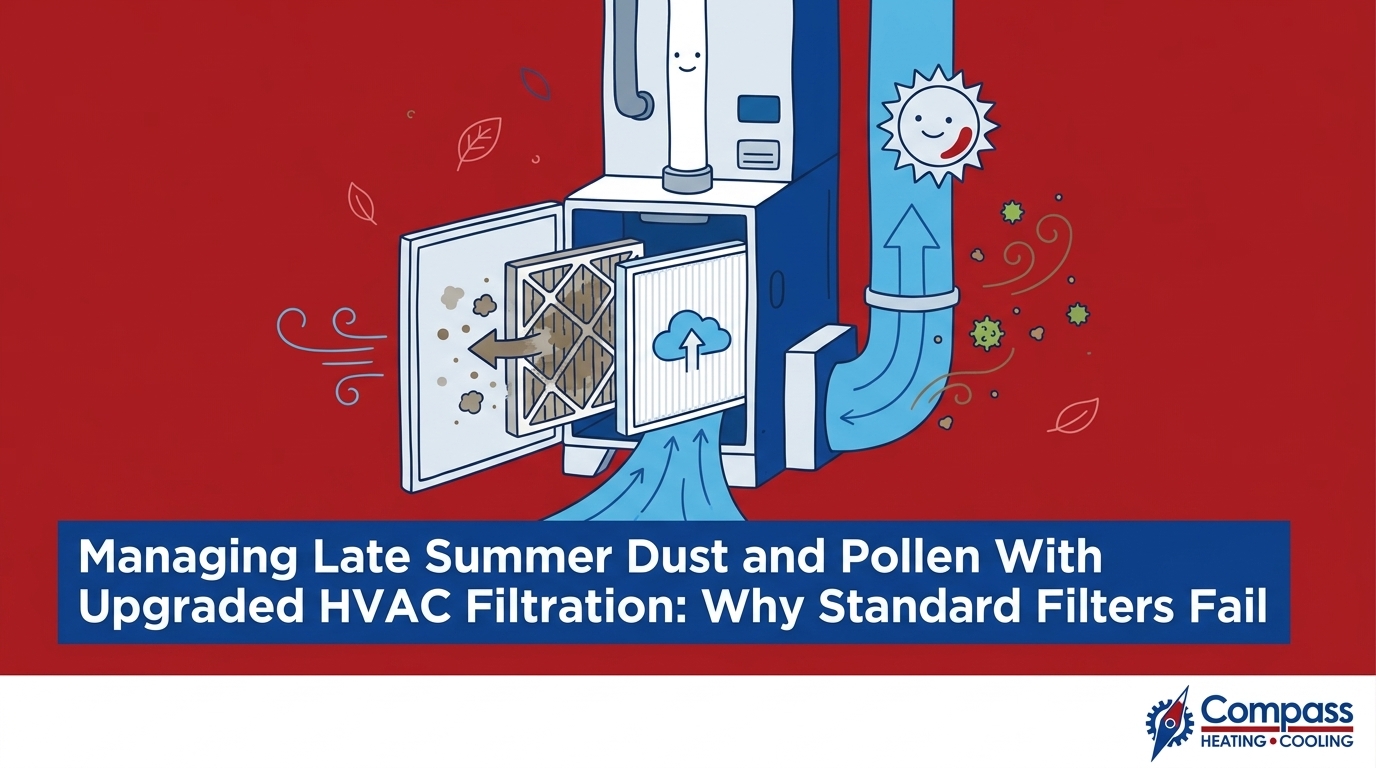
Before the first leaves drop and the back-to-school rush begins, the dry August late-summer conditions peak, meaning managing late summer dust and pollen with upgraded HVAC filtration becomes the most critical step you can take for your home's air quality. You have likely noticed the symptoms already: a fine layer of dust settling on your furniture just days after cleaning, increased sneezing, or an air conditioner that seems to be running longer cycles than it did in June.
During late summer, several environmental factors converge. Weed pollen counts spike, soil moisture drops to its lowest levels, and local agricultural activity kicks into high gear. This combination creates a heavy, sustained particulate load in the air around your home. The core issue most homeowners face is a misunderstanding of their existing equipment. Standard 1-inch fiberglass filters are designed with a single purpose: to protect your blower motor and interior equipment from large, damaging debris like pet hair and lint. They are entirely unequipped to clean the air of fine late-summer particulates.
Upgrading your home's filtration strategy is not just about breathing easier; it is a vital step in protecting your expensive cooling equipment during its heaviest workload of the year. If you are concerned about how your air conditioning system is handling this heavy particulate load, implementing the right mechanical upgrades will safeguard both your comfort and your machinery.
Decoding the Dust: The Front Range's Unique Late-Summer Air Quality
Air quality challenges vary wildly depending on where you live. Generic, national indoor air quality advice often suggests simply swapping out your 1-inch filter more frequently. However, our deep local expertise in mitigating Northern Colorado's unique late-summer air quality challenges reveals that this one-size-fits-all approach drastically underestimates the intense regional particulate load we experience.
The semi-arid climate and naturally low humidity of the Front Range play a massive role in our indoor air quality. In humid environments, moisture in the air binds to dust and pollen, making the particles heavy so they fall to the ground quickly. In our dry climate, fine dust remains suspended in the air for much longer, allowing it to easily drift into your home through open doors, window drafts, and natural ventilation.
When evaluating the air inside Northern Colorado / Loveland agricultural zones, several specific late-summer threats stand out:
• Agricultural harvest dust: As local farms begin cutting and harvesting crops, massive amounts of fine, dry topsoil and fragmented organic matter are kicked into the atmosphere, drifting miles into residential neighborhoods.
• Peak weed pollen: Late August and September mark the highest production periods for ragweed and other invasive weed pollens, which are microscopic and easily bypass basic fiberglass filters.
• Dried organic debris: Leaves, grass clippings, and vegetation dry out rapidly in the August heat, breaking down into a fine particulate powder that gets swept up by afternoon winds.
• Unpaved road dust: Increased late-summer traffic on dry, unpaved county roads contributes significantly to the ambient dust levels surrounding suburban areas.
Because these particles are so fine, they cycle through a standard HVAC system multiple times a day. If you are looking for specialized HVAC services in Loveland, it is crucial to work with professionals who understand how to design a filtration system specifically tailored to these regional agricultural and climatic factors.
The Mechanical Danger: How High-MERV 1-Inch Filters Choke Cooling Equipment
When homeowners realize their standard filter isn't stopping the dust, the most common reaction is to visit a local hardware store and purchase the most expensive, highest-rated 1-inch filter on the shelf. This well-intentioned decision often leads to catastrophic mechanical failures during dry August late-summer conditions.
The Airflow vs. Filtration Dilemma
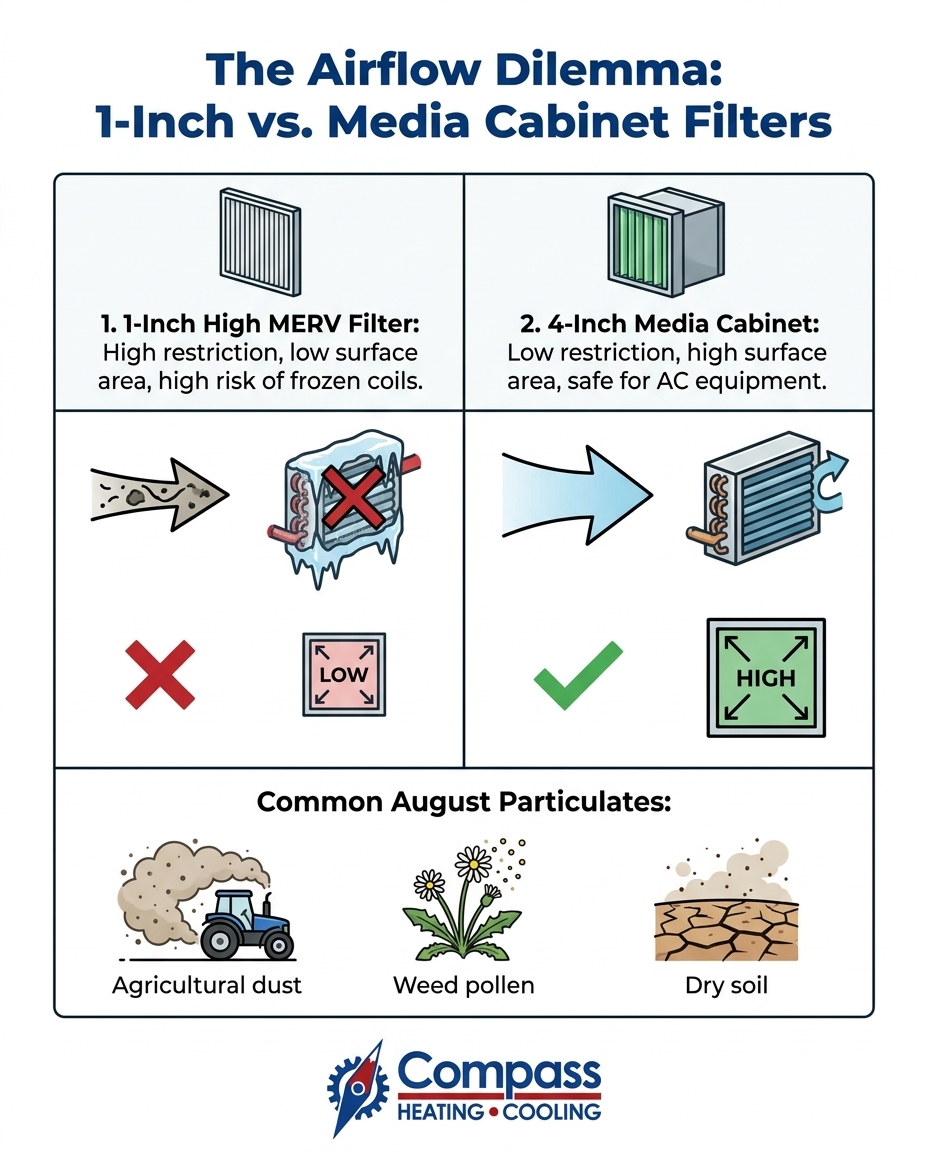
To understand why this happens, you have to look at how filters are rated. The MERV (Minimum Efficiency Reporting Value) scale measures how effectively a filter captures specific particle sizes. A standard fiberglass filter is usually MERV 1 to 4. Premium 1-inch pleated filters can reach MERV 11 or 13, which means they are woven incredibly tight to trap microscopic dust and pollen.
The core problem: Air conditioning systems require a very specific, constant volume of air moving over the indoor evaporator coil to function correctly. When you insert a dense, highly restrictive MERV 13 filter into a 1-inch slot, the blower motor has to work significantly harder to pull air through that tight material. Add a heavy load of agricultural dust, and that dense filter clogs in a matter of days, effectively suffocating your system.
Signs Your Filter is Straining Your System
When airflow is restricted, the delicate balance of your refrigeration cycle collapses. Without enough warm household air blowing over the indoor coil to absorb the cold, the temperature of the refrigerant drops below freezing. The moisture in the air then freezes directly onto the coil.
Watch for these immediate warning signs that your filter is too restrictive or clogged:
• Ice buildup: Visible frost or solid ice forming on the indoor copper refrigerant lines or the outdoor compressor unit.
• Continuous running: The system runs for hours without ever reaching the temperature set on your thermostat.
• Weak vent pressure: The air coming out of your supply registers feels noticeably weaker or warmer than usual.
• Tripped breakers: The blower motor or outdoor compressor draws too much electrical current while straining to move air, causing system shutdowns or blown contactors.
The Media Cabinet Advantage: High Filtration Without the Restriction
If standard filters let dust pass through, and dense 1-inch filters destroy your equipment, how do you actually clean the air? The professional solution utilized throughout Northern Colorado / Loveland agricultural zones is the installation of a dedicated media cabinet.
A media cabinet is a specialized, wider housing unit that is permanently installed directly into your return ductwork, usually right next to the furnace or air handler. Instead of holding a flimsy 1-inch filter, this cabinet accommodates a massive 4-inch or 5-inch deep pleated media filter.
How Pleated Media Filters Outperform Standard Fiberglass
The secret to a media cabinet is surface area. If you were to take a 1-inch pleated filter and stretch the fabric out flat, you might have two or three square feet of material. If you take a 5-inch media filter and stretch out its deep, accordion-style pleats, you often have between 25 and 30 square feet of filtration material.
This exponential increase in surface area completely solves the airflow dilemma. The massive surface area allows the filter to be rated at MERV 11, 13, or even 16—capturing microscopic dust, pollen, and dander—while still providing enough physical space for the air to flow freely through the system.
• Particle Capture — Standard 1-Inch Filter: Only large debris (dust bunnies, hair) — 4-to-5 Inch Media Cabinet: Microscopic dust, pollen, fine ag soil
• Airflow Restriction — Standard 1-Inch Filter: High (if using high MERV ratings) — 4-to-5 Inch Media Cabinet: Very Low (safe for all AC systems)
• Lifespan — Standard 1-Inch Filter: 30 days (less in heavy dust) — 4-to-5 Inch Media Cabinet: 6 to 12 months
• Installation — Standard 1-Inch Filter: Slides into existing return grille — 4-to-5 Inch Media Cabinet: Requires professional ductwork modification
A critical note on installation: Upgrading to a media cabinet is not a do-it-yourself project. It requires a licensed professional to cut into the sheet metal of your existing ductwork, fabricate custom transitions, and permanently seal the new cabinet to ensure no dusty air bypasses the filter. Proper installation guarantees that 100% of the air circulating through your home is forced through the deep-pleated media.
Comprehensive Air Purification for Smoke and Micro-Particulates
While a media cabinet handles heavy agricultural dust and weed pollen beautifully, the late summer season often brings a secondary, more insidious threat: regional wildfire smoke drifting down the Front Range. When dry August late-summer conditions lead to smoke advisories, you are dealing with particles so small they are measured in fractions of a micron.
To combat smoke, volatile organic compounds (VOCs), and biological contaminants, your filtration strategy must evolve from simply trapping particles to actively neutralizing them.
Active vs. Passive Filtration
A media filter is a passive device. It sits in the airstream and acts as a physical net, catching whatever is large enough to get tangled in its fibers. Whole-home air purifiers, on the other hand, are active devices. They integrate directly into your HVAC system and use advanced technologies to alter or destroy contaminants.
For example, integrating UV light air purifiers into your system provides a powerful layer of defense. While the media filter physically traps the dirt and dust, the active purification systems neutralize microscopic biological threats, odors, and the harmful byproducts of smoke that slip through physical barriers. This layered approach—combining passive high-surface-area filtration with active purification—delivers hospital-grade indoor air quality, ensuring your home remains a clean, safe sanctuary regardless of the outdoor air quality index.
Protecting Your Equipment Through the End of the Cooling Season
As summer winds down, the cumulative toll of running your air conditioner through intense heat and heavy dust becomes apparent. Taking proactive steps now ensures your system survives the final heat waves and transitions smoothly into the fall. Because homes in Northern Colorado / Loveland agricultural zones face such unique particulate loads, end-of-season maintenance requires specific attention to detail.
Follow these actionable steps to protect your equipment through the remainder of the cooling season:
1. Monitor filter condition bi-weekly: Even high-capacity filters fill up faster during peak agricultural harvest. Check your filter every two weeks. If it appears uniformly gray or black, or if it feels heavy, it is time for a replacement.
2. Manage natural ventilation: Keep your windows tightly closed during high-wind days, active harvest periods, or when smoke is visible. Rely on your upgraded HVAC filtration to clean the indoor air rather than inviting unfiltered outdoor air inside.
3. Clear the outdoor condenser: The outdoor unit needs to breathe just as much as the indoor unit. Check the metal fins on your outdoor AC condenser. Carefully brush away accumulated cottonwood fluff, dried grass clippings, and caked-on dust that restrict heat transfer.
4. Schedule end-of-season evaluations: Have a professional assess how your system handled the summer workload. This is the perfect time to check refrigerant pressures, calibrate blower speeds, and clean the indoor coil before winter sets in.
By staying vigilant, you can extend the life of your equipment while maintaining pristine indoor air. If you are also dealing with broader seasonal threats, reviewing strategies for preparing your HVAC for wildfire smoke season will ensure you are fully protected from every angle.
Frequently Asked Questions
What is the best MERV rating for dust and pollen?
For capturing dust and pollen effectively without restricting airflow, a MERV 11 to MERV 13 rating is ideal. These ratings trap microscopic agricultural dust and fine weed pollen easily. However, these higher ratings should only be used in 4-inch or 5-inch media cabinets, not in standard 1-inch filter slots.
Can a high MERV filter damage my AC?
Yes, using a highly rated filter in a 1-inch slot can severely damage your air conditioning system. The dense material restricts the necessary airflow, which can cause the indoor evaporator coil to freeze solid. Over time, this constant strain can blow the contactor or burn out the blower motor.
How often should I change my AC filter in summer?
If you use standard 1-inch filters, you must change them every 30 days during the summer, or even every two weeks during heavy agricultural harvesting. If you have upgraded to a 4-inch media cabinet, the massive surface area usually allows the filter to last anywhere from 6 to 12 months, depending on the local dust load.
How do media cabinet filters work?
Media cabinets work by utilizing an exceptionally thick, pleated filter housed in a custom sheet metal box attached to your ductwork. The deep pleats provide exponentially more surface area than a flat filter. This allows the system to capture microscopic particles efficiently while still letting massive volumes of air pass through without resistance.
Why is my house so dusty even with a new AC filter?
Your house remains dusty because standard fiberglass filters are only designed to catch large debris like hair and carpet fibers, letting fine agricultural dust pass right through. Additionally, if your ductwork has leaks, it may be pulling dusty air directly from your attic or crawlspace, bypassing the filter entirely.
Do whole house air purifiers work for agricultural dust?
Yes, whole-home air purifiers are highly effective against agricultural dust when paired with a quality media filter. The physical media filter traps the bulk of the soil and pollen, while the active air purifier neutralizes microscopic VOCs, odors, and organic matter that accompany the dust.
Breathe Easier This August With Professional Filtration Upgrades
Understanding exactly why your current filter struggles against late-summer agricultural dust is the first step toward a cleaner, healthier home. You don't have to settle for constant dusting, allergy flare-ups, or an overworked cooling system. By moving away from restrictive 1-inch filters and embracing high-capacity media cabinets, you ensure your equipment runs efficiently while delivering truly clean air. To keep your system running flawlessly through the end of the season, scheduling routine AC maintenance will provide the professional oversight needed to finalize your home's defense against summer dust.
hear what our satisfied clients have to say
Our clients consistently praise our exceptional service and attention to detail. They appreciate the personalized approach we take to meet their unique needs, ensuring satisfaction every step of the way.
.png)