



The Hard Water Impact on Whole Home Humidifiers After a Single Season
The Hidden Toll of Hard Water on Your Winter Comfort
The hard water impact on whole home humidifiers is a hidden problem that often goes unnoticed until the air inside your house feels uncomfortably dry and your furnace starts working overtime. You turn on your heating system as the chill sets in, expecting a comfortable environment, but instead, you are greeted by static shocks, dry skin, and a strange white crust forming inside your HVAC equipment. This is a frustrating reality for many homeowners as the weather shifts and indoor humidity plummets.
During the late fall / pre-winter heating season, the sudden drop in outdoor humidity means your whole-home humidifier must run continuously to maintain a comfortable indoor climate. While these systems are highly effective at adding necessary moisture to the air, the water feeding them is rarely pure. Most municipal and well water supplies carry dissolved minerals that are completely invisible to the naked eye. Over time, these minerals accumulate, turning a fresh, highly efficient humidifier pad into a solid block of scale in just a few short months.
If you are looking to protect your indoor air quality and overall system health before the freezing temperatures arrive, scheduling professional HVAC services is a smart first step. Neglecting the mineral buildup inside your humidifier does not just lower the humidity in your living spaces; it actively restricts airflow and impacts the efficiency of your entire heating system. Understanding how this happens is the key to preventing unnecessary wear and tear on your equipment.
What Exactly Is Hard Water Doing to Your Humidifier?
Most homeowners don't realize that the water flowing through their plumbing is packed with dissolved solids. Hard water is simply water that contains high concentrations of these natural minerals. In the context of whole-home humidification, this water is constantly flowing over an internal component known as the water panel or humidifier pad. As the warm air from your furnace passes through this wet pad, the water turns into vapor and circulates throughout your home.
The problem with evaporation: When water evaporates, it only takes the pure H2O molecules into the air. The heavy dissolved minerals cannot evaporate. Instead, they are left behind on the surface of the humidifier pad. Over weeks of continuous operation, this creates a thick, crusty, white chalky layer known as calcium and magnesium scale buildup. This is not a malfunction of the humidifier; it is a continuous, compounding chemical process that occurs whenever the system is running.
The Evaporation and Deposition Cycle
To understand why this buildup happens so quickly, it helps to look at the basic mechanics of how moisture is added to the air. Whole-home humidifiers are designed to maximize surface area. The water panel is essentially a dense, multi-layered mesh. This design ensures that the maximum amount of water is exposed to the warm air blowing off the furnace heat exchanger.
• Water delivery: A small valve opens, allowing a steady trickle of water to flow over the top of the humidifier pad.
• Airflow interaction: Hot, dry air from the furnace is forced through the wet mesh of the pad.
• Vaporization: The heat causes the water to change state from a liquid to a gas, raising the humidity of the air.
• Mineral deposition: The calcium and magnesium scale buildup is immediately deposited onto the structural fibers of the pad.
Because the humidifier operates for hours at a time during cold weather, this cycle repeats endlessly. What starts as a microscopic layer of minerals quickly compounds into a visible, physical crust that alters how the entire system functions.
The Shift from Porous Pad to Solid Barrier
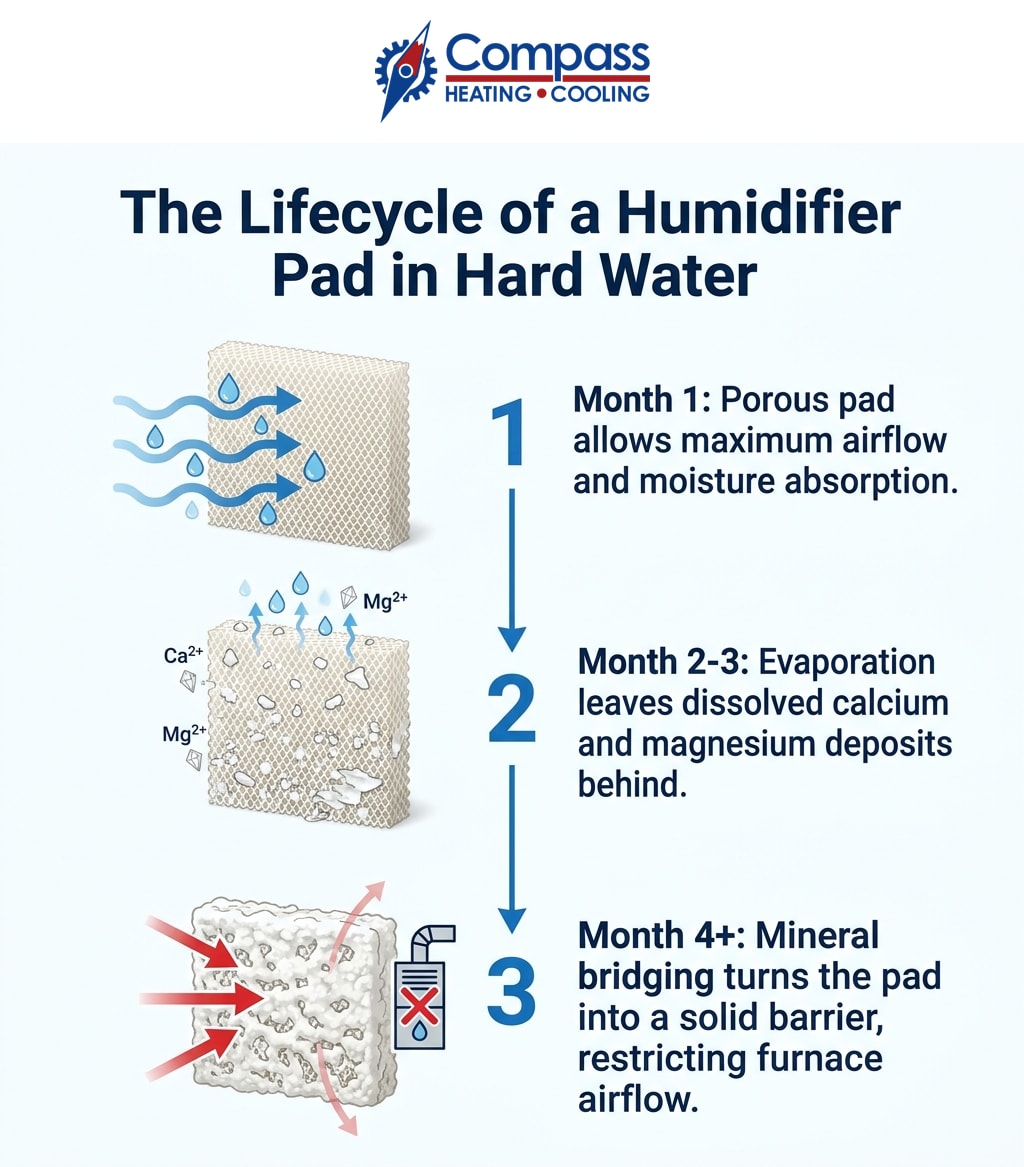
When you take a brand-new humidifier pad out of the box, it is highly porous. It looks and feels somewhat like a lightweight, metallic sponge or a finely woven honeycomb. This open structure is intentional. It allows air to pass through with minimal resistance while holding enough water to effectively humidify the home. However, as the calcium and magnesium scale buildup accumulates, the physical structure of the pad begins to change dramatically.
This transformation is driven by a process known as "mineral bridging." As the scale thickens on the individual fibers of the pad, the deposits begin to reach across the open spaces. Eventually, the minerals bridge the gaps entirely, sealing off the tiny airways that the furnace relies on. What was once a highly breathable mesh becomes a solid, concrete-like barrier.
• Brand New (Month 1) — Airflow Resistance: Very Low — Moisture Delivery: Maximum absorption and evaporation — System Impact: Furnace runs efficiently
• Moderate Scale (Months 2-3) — Airflow Resistance: Increasing — Moisture Delivery: Water begins channeling to the drain — System Impact: Longer run times to reach target humidity
• Solid Barrier (Months 4+) — Airflow Resistance: Severe — Moisture Delivery: Minimal evaporation; mostly wasted water — System Impact: High strain on blower motor
This physical blockage leads to a frustrating scenario: your humidifier will run longer and consume more water, but it will fail to actually raise the indoor humidity. The water simply hits the solid wall of scale and runs straight down into the drain tube. Whether you are using bypass vs fan-powered whole-home humidifiers, the result is the same: the system cannot push air through a solid wall of calcium.
How a Scaled Humidifier Pad Strains Your Furnace
It is easy to view a calcified humidifier pad as an isolated nuisance, but whole-home humidifiers are deeply integrated into your broader HVAC system. They do not have their own powerful fans to distribute air; instead, they rely entirely on the furnace blower motor to push warm air through the water panel and out into your home's ductwork. When that panel is blocked, the entire system suffers.
The mechanics of restricted airflow: HVAC systems are designed to operate within a specific range of static pressure. Think of static pressure like blood pressure for your ductwork. When a solid, calcified pad acts as a wall inside the system, the resistance spikes. The blower motor has to work significantly harder to push the same amount of air. This increased strain forces the motor to draw more electricity and run hotter, which accelerates wear and tear on expensive internal components.
Furthermore, restricted airflow can cause the furnace's heat exchanger to overheat. If the heat exchanger gets too hot because air isn't moving across it fast enough, the system's safety sensors may trigger a shutdown, leaving you without heat during the late fall / pre-winter heating season. Beyond airflow issues, heavy scale buildup can cause chunks of hard calcium to break off and fall into the humidifier's internal drain pan. If these chunks clog the drain line, water will quickly back up and leak out of the unit, potentially causing water damage to the furnace components sitting directly below it.
The Myth of Cleaning Calcified Water Panels
When confronted with a crusty, calcified humidifier pad, a common homeowner instinct is to try and clean it. Many people assume they can simply soak the water panel in vinegar, CLR, or other descaling solutions, just like they would with a coffee maker or a showerhead. Here's the thing: attempting to clean a heavily scaled humidifier pad is not only ineffective, but it typically destroys the pad's ability to function entirely.
Modern humidifier pads are not just bare aluminum or plastic mesh. They feature a highly specific, baked-on clay or synthetic hydrophilic (water-loving) coating. This coating is engineered to grab onto the water as it trickles down, spreading it out evenly across the surface area of the pad so the furnace heat can evaporate it. Without this specialized coating, the water would simply bead up and fall straight through the mesh.
The damage caused by acid soaking: When you soak a humidifier pad in vinegar or harsh acidic cleaners, the acid does dissolve the calcium scale, but it also aggressively strips away the essential moisture-holding clay coating. A "cleaned" pad might look shiny and new, but it is functionally ruined. When reinstalled, the water will channel straight down the bare metal into the drain pan without ever humidifying the air. Because homes in Loveland CO experience such dry winters, humidifiers must run constantly. This heavy usage makes the mineral buildup far too severe for simple cleaning, making outright replacement the only viable option.
Timing Your Pad Replacement Before Peak Winter
Because cleaning is not a viable solution, humidifier pads must be treated as consumable components, much like your furnace filter. They are not lifetime parts, and depending on your local water hardness, they typically only last for a single heating season. The key is timing your replacement correctly so you aren't caught with a failing system when the temperatures drop to their lowest point.
Here is a straightforward approach to managing your humidifier maintenance:
1. Inspect the pad early: Open the humidifier housing during the late fall / pre-winter heating season before you actually need to run the furnace daily.
2. Look for the warning signs: Check for heavy white crusting, flaking scale inside the housing, or a chalky residue around the drain line.
3. Listen for airflow issues: If you hear a whistling sound coming from the humidifier ductwork, it often indicates that air is struggling to squeeze past a calcified pad.
4. Monitor your indoor humidity: If your thermostat indicates the humidity is dropping below 30% despite the humidifier running constantly, the pad is likely blocked.
5. Schedule a replacement: Have a fresh pad installed as part of your comprehensive pre-winter system check.
From a local expert perspective, replacing the humidifier pad is a low-cost protective measure that safeguards your much higher-cost furnace system. Starting the season with a fresh pad ensures maximum moisture delivery and prevents the blower motor from straining against a wall of scale. Incorporating this simple swap into your routine HVAC maintenance plan is the best way to guarantee reliable comfort all winter long.
Broader Steps for Protecting Indoor Air Quality
Managing your indoor humidity is a critical step, but it is just one pillar of maintaining healthy winter indoor air quality. When your home is sealed up tightly against the cold, the air inside simply recirculates. This means that any dust, pet dander, or microscopic mineral dust that makes its way into the ductwork will continually cycle through your living spaces. A well-maintained humidifier works best when it is part of a broader, clean air ecosystem.
Proper air filtration is essential. Upgrading your furnace filter and ensuring routine system cleanings prevents excessive dust from combining with the moisture in your ductwork. When a humidifier pad is heavily scaled, it can sometimes release a fine white mineral dust into the air stream. A high-quality filter helps capture these particles before they settle on your furniture or enter your lungs. In areas like Loveland CO, where winter air is notoriously dry and dusty, a multi-layered approach to air quality is highly recommended.
For homeowners looking to take their indoor environment to the next level, advanced air quality solutions work seamlessly alongside a fresh, efficient humidifier. Technologies like UV air purifiers and upgraded media cabinets help neutralize airborne contaminants. Exploring indoor air quality upgrades ensures that the warm, properly humidified air circulating through your home is as clean and healthy as possible.
Frequently Asked Questions About Hard Water and Humidifiers
How often should I change my humidifier pad with hard water?
If your home has hard water, you should replace the humidifier pad at least once every heating season. In homes with exceptionally high mineral content or where the humidifier runs non-stop, you may need to replace the pad twice a season to prevent severe calcium and magnesium scale buildup.
Why is my whole house humidifier not raising humidity?
The most common reason a whole-house humidifier fails to raise indoor humidity is a heavily calcified water panel. When the pad is blocked by scale, the warm air from the furnace cannot pass through to evaporate the moisture, causing the water to simply run down the drain unused.
Can I clean a calcified humidifier pad?
No, attempting to clean a calcified humidifier pad is not recommended. Soaking the pad in vinegar or descaling solutions will strip away the specialized clay coating that helps the pad hold water, rendering the component useless.
Does hard water ruin whole-home humidifiers?
Hard water does not necessarily ruin the humidifier unit itself, but it does rapidly destroy the consumable water panel. However, if the calcium and magnesium scale buildup is allowed to clog the drain line, it can cause water backups that may damage surrounding HVAC equipment.
What causes the white dust from my HVAC vents in winter?
White dust coming from your vents is often a direct result of hard water minerals being dispersed by your humidifier. While ultrasonic humidifiers are more prone to this, a heavily scaled whole-home humidifier pad can sometimes flake off microscopic mineral dust that gets caught in the ductwork.
Ensure Your System is Ready for the Cold
The short answer is that ignoring the mineral buildup inside your humidifier will eventually compromise your winter comfort and your HVAC system's efficiency. A calcified pad acts as a solid barrier, restricting vital airflow, forcing your furnace to work harder, and leaving your home feeling dry and uncomfortable. Recognizing the signs of scale buildup early is the best way to prevent these cascading issues.
As the late fall / pre-winter heating season approaches, taking proactive steps is essential. Do not wait until the first deep freeze to find out your humidifier is completely blocked by scale. Include a thorough inspection of your humidifier pad and water lines in your seasonal preparations. By scheduling comprehensive heating system maintenance, you can ensure that every component of your HVAC setup is clean, efficient, and ready to deliver reliable, comfortable warmth all season long.
hear what our satisfied clients have to say
Our clients consistently praise our exceptional service and attention to detail. They appreciate the personalized approach we take to meet their unique needs, ensuring satisfaction every step of the way.
