


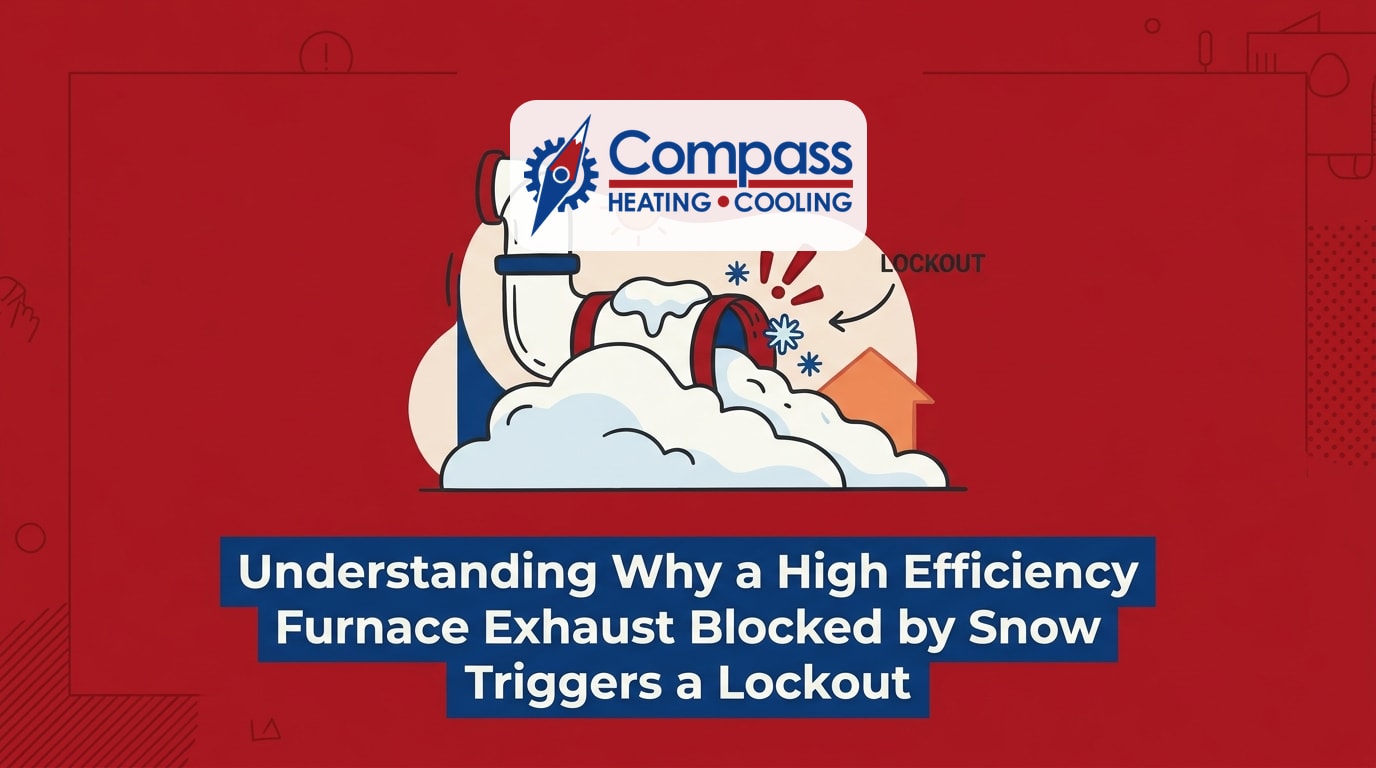
Understanding Why a High Efficiency Furnace Exhaust Blocked by Snow Triggers a Lockout
Caught in the Cold: When Snow Shuts Down Your Heating System
When the first heavy November snowstorms arrive, discovering that your high efficiency furnace exhaust blocked by snow has left you without heat is a highly stressful emergency. At Compass Heating & Cooling, our team fields countless calls every late fall from homeowners who wake up, realize the house is freezing, and immediately check the thermostat. It calls for heat, but the vents remain silent. For many homeowners, the immediate assumption is that the furnace has suffered a catastrophic mechanical failure. However, what feels like a breakdown is often a built-in safety feature actively responding to exterior weather conditions.
Modern heating equipment is designed with strict safety tolerances. When a system detects that it cannot safely vent combustion gases outside, it will deliberately shut itself down. This process is known as a system lockout. The crucial first step in restoring your comfort is identifying whether this lockout is simply due to a snow-blocked exterior vent, or if you are dealing with a complex internal issue that requires professional diagnostics.
Understanding this distinction saves you from unnecessary panic during a winter storm. While a true mechanical failure inside the cabinet requires specialized tools and training to fix, an obstructed exterior pipe is an environmental issue that you can often resolve safely from the outside. By learning how your system breathes and what triggers its defensive shutdown, you can handle sudden winter surprises with confidence. Routine care, combined with professional heating services, ensures your home stays warm and safe no matter what the late fall weather brings.
How High-Efficiency Venting Differs from Standard Systems
To understand why snowdrifts pose such a specific threat to modern heating systems, it helps to look at how heating technology has evolved. In our years of upgrading older systems across Northern Colorado, we've seen firsthand how older, standard-efficiency furnaces operate differently than the systems installed in most contemporary homes. A traditional furnace typically vents its hot exhaust gases vertically, pushing them up through a metal roof flue or a traditional chimney. Because these gases are extremely hot, they rise naturally and exit high above the ground, well out of reach of even the deepest snowdrifts.
However, a 90%+ AFUE condensing furnace with PVC side-wall venting operates on a completely different principle. These modern systems are engineered to extract the maximum possible amount of heat from the combustion process before the exhaust leaves your home. They use a secondary heat exchanger to pull so much thermal energy out of the combustion gases that the resulting exhaust is actually quite cool. Because the exhaust is no longer hot enough to draft upward naturally—and because it contains acidic condensation—it cannot be vented through a standard metal roof pipe.
Instead, this cool exhaust is pushed horizontally through standard plastic PVC piping. This horizontal venting exits directly through the side wall of your home's foundation, placing the pipes very close to ground level. While this design is incredibly energy-efficient, this low clearance makes side-wall venting highly susceptible to being buried during heavy snowfall.
Comparing Furnace Venting Styles
• Venting Material — Standard Efficiency (80% AFUE): Metal flue pipe (galvanized steel) — High-Efficiency (90%+ AFUE): Plastic piping (usually PVC or CPVC)
• Venting Direction — Standard Efficiency (80% AFUE): Vertical (through the roof or chimney) — High-Efficiency (90%+ AFUE): Horizontal (through the side foundation wall)
• Exhaust Temperature — Standard Efficiency (80% AFUE): Very hot (rises naturally) — High-Efficiency (90%+ AFUE): Cool (requires a fan to push outside)
• Snow Vulnerability — Standard Efficiency (80% AFUE): Low (vents high above ground level) — High-Efficiency (90%+ AFUE): High (vents near ground level, easily drifted over)
• Condensation — Standard Efficiency (80% AFUE): Minimal to none — High-Efficiency (90%+ AFUE): High (produces acidic water that must drain)
Because the PVC pipes sit just a foot or two above the soil or patio, even a moderate winter storm can create a drift large enough to cover the openings. Once those pipes are submerged in snow, the furnace loses its ability to breathe, setting the stage for a safety lockout.
The Pressure Switch: Why a Blocked Exhaust Shuts Everything Down
When a 90%+ AFUE condensing furnace with PVC side-wall venting loses access to outside air, it doesn't just struggle to run—it stops completely. This immediate shutdown is governed by a critical internal safety component called the pressure switch. The pressure switch is a small, sensitive device that constantly monitors the draft and airflow moving through both the intake and the exhaust pipes.
Here is how the sequence of operations works: When your thermostat calls for heat, the very first thing that turns on is the inducer draft motor. This small fan creates a draft to push exhaust gases out of the heat exchanger and pull fresh combustion air in. The pressure switch is connected to this system via a small rubber hose. If the inducer motor successfully creates the correct amount of negative pressure, the switch closes its electrical circuit, telling the furnace control board that it is safe to open the gas valve and ignite the burners.
If snow or ice blocks the exterior PVC pipe, the inducer motor cannot create that necessary draft. The pressure switch detects the change in airflow instantly. Because the switch remains open, the control board halts the ignition sequence. To prevent dangerous, odorless carbon monoxide from backing up into your living space, the furnace simply refuses to fire.
Understanding this mechanism is vital because it shifts your perspective. The system isn't broken; it is actively protecting your family from a life-threatening hazard. Recognizing that a lockout is a successful safety intervention is a key part of troubleshooting a furnace that clicks but refuses to ignite. Our technicians frequently remind customers that the click you hear is often the control board attempting to start the sequence, followed by the immediate shutdown when the pressure switch senses the blockage outside.

Identifying and Locating Your Exterior PVC Vents
Before you can clear a blockage, you need to know exactly where your system breathes. We advise homeowners to always locate their exterior PVC pipes during clear weather, long before severe winter conditions hit. Searching for white plastic pipes in the middle of a blinding snowstorm is frustrating and often dangerous.
In the many Loveland CO homes our Compass Heating & Cooling team services, the intake and exhaust pipes are typically found on the side or back of the house, often sticking out a foot or two from the concrete foundation. They usually look like two white PVC pipes, sometimes fitted with curved "gooseneck" fittings pointing downward, or horizontal pipes with specialized concentric vent screens. Depending on the layout of your basement or utility room, they might exit under a deck, near a patio, or alongside a walkway.
What to Look For Outside
• Two distinct pipes: One pipe pulls in fresh air for combustion (intake), while the other pushes out the cooled combustion gases (exhaust). Both must be completely clear for the system to run.
• Concentric vents: Some systems use a "pipe-within-a-pipe" design, where a single large fixture handles both intake and exhaust.
• Proximity to the ground: High-efficiency vents are usually installed just above the anticipated snow line, but extreme weather easily surpasses these minimum clearances.
• Windward accumulation: Loveland, CO experiences heavy, wind-driven snow during winter storms that frequently accumulates against home exteriors on the windward side, burying pipes that seem adequately elevated during calm weather.
If you have recently moved into a new home, take a walk around the perimeter today to map out these locations. If you cannot locate the pipes, or if they are installed in an inaccessible area beneath a low deck, our local Loveland heating technicians can assist in evaluating your system's venting layout and recommending safer, more accessible modifications before the deep freeze sets in.
Safe Steps for Clearing Snow from Furnace Exhaust Pipes
Once you have located the buried pipes, you must clear them carefully. The goal is to restore airflow without damaging the fragile PVC or accidentally pushing packed snow and ice further into the intake system. When the first heavy November snowstorms bury your vents, follow these precise steps our technicians recommend to restore your heat safely.
1. Dress for the weather and locate the general area: Put on warm, highly visible clothing. Navigate to the side of the house where you previously identified your vents. If the snow is deep, look for a slight depression or a small melted pocket in the drift where the exhaust briefly tried to push through.
2. Use your hands, not heavy tools: Always clear snow gently using your gloved hands or a soft-bristled snow brush. Never use a hard metal or plastic shovel near the pipes. PVC becomes brittle in freezing temperatures, and a single misplaced shovel strike can shatter the pipe, turning a simple snow-clearing task into a major repair requiring pipe replacement.
3. Clear a wide perimeter: Do not just poke a hole through the snow to expose the pipe openings. Clear a radius of at least three feet around both the intake and exhaust pipes. This wide clearance prevents immediate re-drifting if the wind continues to blow, and it stops the exhaust gases from recirculating back into the intake pipe.
4. Inspect the openings gently: Look inside the end of the pipes. If there is loose snow just inside the lip, gently brush it out with your fingers. Never jam a broom handle, stick, or tool down the pipe to clear it.
5. Check the thermostat and reset if necessary: Once the exterior snow is completely cleared, head back inside. Check your thermostat. In many cases, the furnace will automatically sense the restored airflow, reset its pressure switch, and resume normal operation within a few minutes. If it does not, you may need to turn the thermostat to "off" or cycle the power switch on the side of the furnace to reset the control board.
Important Warning: Never attempt to pour hot water on the vents to melt snow or ice. The water will quickly freeze inside the pipe, creating a solid, impenetrable ice block that will guarantee a permanent lockout until the weather warms up.
Knowing When to Stop Clearing and Call for Professional Help
While clearing loose snow from exterior vents is a safe and necessary homeowner task, there is a hard line where do-it-yourself efforts must stop. Heating systems are complex, gas-burning appliances, and tampering with internal components or deep blockages carries significant safety risks.
If you clear the snow and discover that solid ice has formed deep inside the PVC pipe, do not attempt to extract it yourself. Ice can form inside the pipe if the furnace was short-cycling before the storm, or if freezing rain preceded the snowfall. Chipping at this ice will almost certainly crack the PVC, which can allow deadly exhaust gases to leak into your basement or crawlspace.
Strict Safety Boundaries
• Do not open the cabinet: Homeowners should never open the furnace cabinet to bypass safety switches, jump electrical connections, or attempt internal repairs. The pressure switch is there to save your life.
• Do not use heat guns: Applying a heat gun or blowtorch to frozen PVC will melt and deform the plastic, destroying the integrity of the vent.
• Do not ignore repeated lockouts: If the exterior is completely clear but the furnace still refuses to turn on, the pressure switch itself, the inducer motor, or the control board may have failed and will require professional diagnostics.
When you hit these boundaries, it is time to rely on our local Northern Colorado expertise and fast emergency response at Compass Heating & Cooling for when a furnace remains locked out even after the exterior snow is cleared. A licensed technician has the diagnostic tools to test the pressure switch safely and verify that the draft is pulling correctly. Taking advantage of seasonal maintenance, like fall furnace specials, can ensure your system is evaluated, and your vent pipes are properly pitched, before these stressful emergencies occur.
Frequently Asked Questions About Furnace Venting and Snow
What happens if furnace exhaust is blocked?
When the exhaust is blocked, the furnace's internal pressure switch detects the immediate lack of airflow. The system's control board responds by instantly shutting down the burners and halting the ignition sequence. This deliberate lockout is a critical safety feature designed to prevent deadly carbon monoxide gas from backing up into your home's living spaces.
Where is the exhaust vent on a high efficiency furnace?
Unlike standard 80% AFUE furnaces that vent hot gases vertically through a metal roof flue, high-efficiency models vent horizontally. They use white plastic PVC pipes that exit through the side wall of the home's foundation, usually sitting just a few feet above the ground. Because they are installed so low, they are highly vulnerable to being buried by snowdrifts.
Can a blocked exhaust cause a furnace to shut down?
Yes, a blocked exhaust is one of the most common reasons a modern furnace shuts down during a winter storm. This is not a malfunction, but a deliberate and necessary safety feature. The furnace is designed to protect the household from dangerous exhaust gases; if it cannot push those gases safely outside, it will refuse to run at all.
How do I safely unblock my furnace exhaust?
To safely unblock the exhaust, locate the exterior PVC pipes and gently brush away loose snow using your gloved hands or a soft snow brush. Clear a three-foot radius around the pipes to prevent immediate re-drifting. Avoid using sharp shovels, never chip at solid ice, and contact a professional if the blockage is located deep inside the pipe.
Why does my furnace blow cold air before locking out during a snowstorm?
If your furnace blows cold air before shutting down, the system is likely running its blower motor in a safety purge cycle. When the control board detects a fault—like a blocked exhaust triggering the pressure switch—it often runs the main fan to cool down the heat exchanger and clear any residual gases before locking the system out completely.
Restoring Your Heat Safely After a Winter Storm
Experiencing a furnace lockout during a major storm is undeniably stressful, but understanding the mechanics behind it brings valuable peace of mind. When your 90%+ AFUE condensing furnace shuts down due to a snowdrift, it means your system's advanced safety features are doing exactly what they were designed to do: protecting your home and your family from hazardous exhaust gases.
By familiarizing yourself with the location of your exterior PVC vents before the first heavy November snowstorms arrive, and by keeping a wide, clear perimeter around them, you can often restore your heat quickly and safely without needing an emergency service call. Just remember to use a gentle hand, avoid hard tools, and respect the boundary between clearing exterior snow and tampering with internal components.
For ongoing peace of mind throughout the harshest winter months, proactive care is your best defense against unexpected breakdowns. We highly recommend enrolling in a comprehensive Compass Club Maintenance Plan to ensure your high-efficiency system is thoroughly inspected, properly calibrated, and ready to keep you warm long before the snow begins to fall.
hear what our satisfied clients have to say
Our clients consistently praise our exceptional service and attention to detail. They appreciate the personalized approach we take to meet their unique needs, ensuring satisfaction every step of the way.