



When to Get an HVAC Second Opinion on a Condemned Furnace
Is Your Furnace Short-Cycling During the First Fall Freezes?
Why is your furnace turning on, running for just a few minutes, and then shutting off before the house actually gets warm? Finding reliable local service expertise and area tips is critical when this happens, especially right as the November pre-winter hard freezes arrive. At Compass Heating & Cooling, we hear from frustrated homeowners every fall who listen to their heating system fire up, only to hear it power down while the living room still feels like an icebox. This rapid on-and-off behavior is known as short-cycling, and it is one of the most common reasons we see homeowners panic during the first major cold snap of the year.
When a furnace fails to maintain a comfortable temperature, the immediate fear is often that the entire unit is broken beyond repair. This anxiety is amplified when a technician arrives, takes a quick look, and immediately condemns the system, telling you that a full replacement is your only option. Here is what our team wants you to know: a premature recommendation for a completely new heating system always warrants a closer look. Determining whether your furnace is suffering from a simple, easily corrected issue or a catastrophic failure requires professional verification. Before you make a massive decision under pressure, it is essential to partner with professional HVAC services like ours to evaluate the system safely and give you an honest assessment.
Understanding Short-Cycling: Why Your Heat Keeps Shutting Off
To understand why your furnace is behaving this way, you have to look at what short-cycling actually is. In most cases that our technicians diagnose, short-cycling is not a sign of a broken system—it is a built-in safety mechanism working exactly as designed. Your furnace is programmed to shut itself down if it detects a condition that could lead to overheating, equipment damage, or a safety hazard. When it turns off prematurely, it is actively protecting your home.
This behavior is incredibly common during the transition into late fall. Sudden, deep temperature drops place immediate stress on heating equipment that has been sitting dormant for months. Based on our extensive experience serving local homes, our technicians know the Loveland CO and Front Range climate is notorious for this. Our elevation and proximity to the foothills cause rapid temperature shifts, shocking systems that have not run since early spring. The furnace goes from zero demand to maximum capacity overnight.
You can contrast this winter heating stress with summer cooling demands. Just as homeowners research how to fix house AC issues or explore air conditioning repair with us in July when the system is overworked, winter requires its own specific diagnostic approach. The sequence of operations in a furnace is complex. When your thermostat calls for heat, the inducer motor starts, the igniter glows, the gas valve opens, a sensor verifies the flame, and finally, the blower motor pushes warm air into your home. A failure at any one of these checkpoints will trigger a shutdown. In our daily service calls, we find that the culprit is most often a localized sensor or airflow issue, not a total system failure.
Troubleshooting Airflow: Safe Checks Before Calling a Professional
Before you assume the worst about your dormant furnace, there are a few safe, basic checks you can perform. The Department of Energy and the EPA both recommend verifying basic airflow and filter cleanliness before assuming your heating equipment has failed. In our experience, restricted airflow is actually the primary cause of furnace short-cycling. When air cannot move freely through the system, the internal temperature of the furnace spikes, causing the high-limit safety switch to trip and shut the burner down.
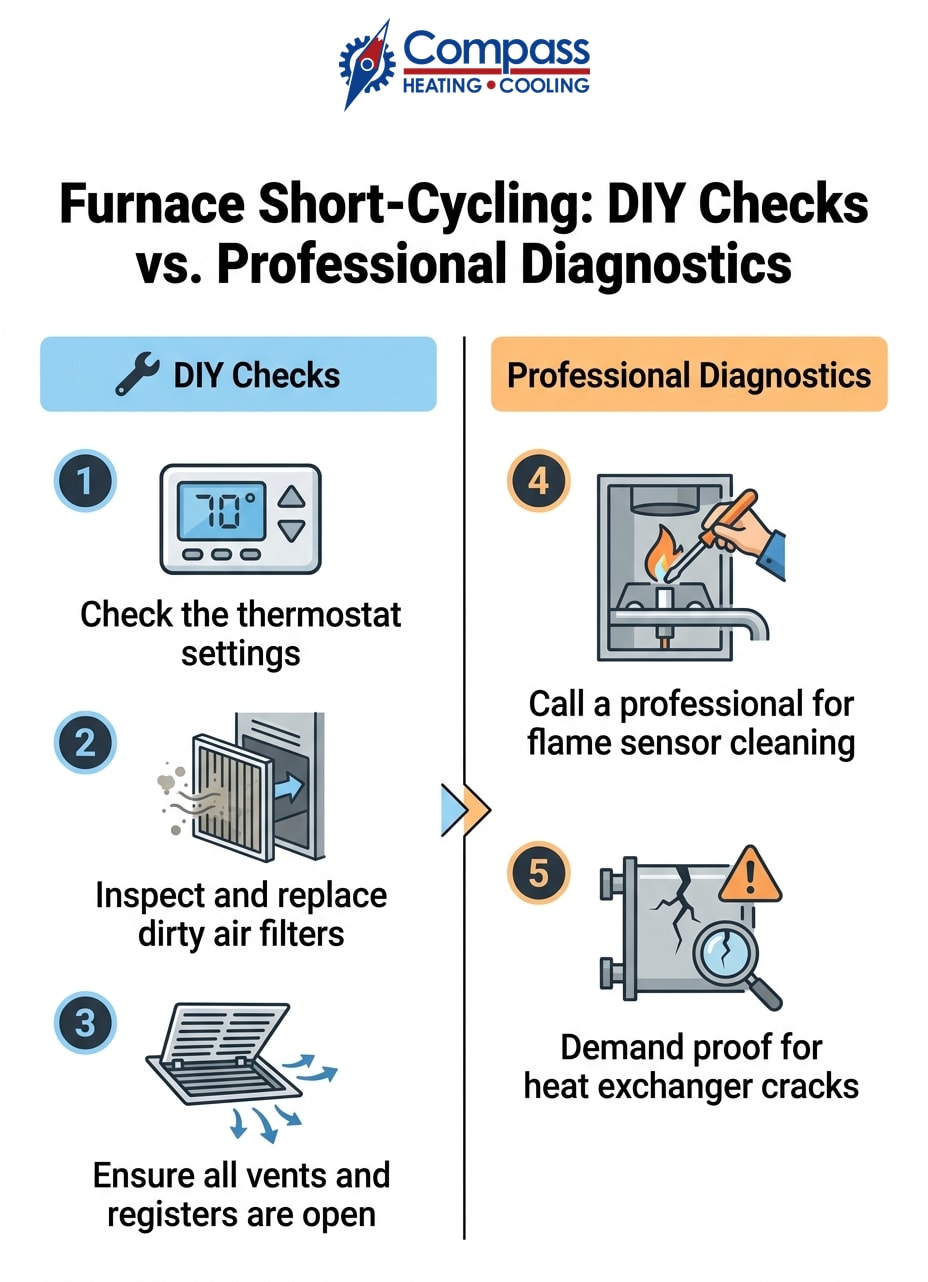
Here are the safe, limited DIY steps we recommend taking before calling in our professionals:
• Check your thermostat settings: Ensure the system is set to "Heat" and the fan is set to "Auto." Sometimes, a thermostat with dead batteries or a loose connection will cause the system to drop the heating signal prematurely.
• Inspect and replace dirty air filters: This is the most critical step. Filters left over from the summer cooling season are often packed with dust, pollen, and pet dander. A clogged filter suffocates your furnace. Pull the filter out and hold it up to a light; if you cannot see light passing through it, replace it immediately.
• Ensure all vents and registers are open: Walk through your home and check every supply and return vent. Closing vents in unused rooms does not save energy—it actually increases static pressure inside your ductwork, forcing the blower motor to work harder and potentially causing the system to overheat and short-cycle.
• Clear the area around the furnace: Make sure boxes, seasonal decorations, or furniture are not crowding the indoor unit. Your furnace needs adequate clearance to draw in the air it needs to function safely.
The critical boundary: These airflow checks are the absolute limit of safe DIY troubleshooting. Once you have verified that the filter is clean and the vents are open, your job is done. As licensed professionals, we must stress that any internal component checks, electrical testing, or gas pressure adjustments require certified training. Opening the furnace cabinet exposes you to high voltage and combustible gases, making it strictly off-limits for anyone without professional training.
Recognizing High-Pressure Replacement Tactics During Cold Snaps
Emergency no-heat calls during the first hard freezes create a highly stressful environment for homeowners. When your house is freezing, your primary goal is to get the heat back on as quickly as possible. Unfortunately, some aggressive contractors use this vulnerability to their advantage, pushing high-pressure sales tactics when you are most desperate for a solution.
It is vital to recognize the red flags of predatory sales tactics so you can pause, take a breath, and seek a second opinion. An honest technician—like the ones on our Compass Heating & Cooling roster—will always empower you with information, while a high-pressure salesperson will try to rush you into a major financial commitment.
• Explains the exact failing component clearly and shows you the part if safely possible. — High-Pressure Sales Red Flags: Uses vague language like "the system is shot" or "it's totally fried" without specifics.
• Provides a written quote for the repair alongside a quote for replacement, allowing you to choose. — High-Pressure Sales Red Flags: Refuses to offer a repair option, insisting that replacement is the only legal or safe path forward.
• Encourages you to take time to think about the decision and welcomes a second opinion. — High-Pressure Sales Red Flags: Creates artificial urgency (e.g., "This deal is only good if you sign right now").
• Uses diagnostic tools like a combustion analyzer or digital manometer to prove a safety hazard. — High-Pressure Sales Red Flags: Relies on fear-mongering about carbon monoxide or fire hazards without showing you actual meter readings.
A reputable technician understands that replacing a heating system is a major decision. We will never fault you for wanting to verify a diagnosis, especially when the recommendation is to condemn the entire unit. If a contractor becomes defensive or pushy when you ask questions or state that you want a second opinion, that is your cue to show them the door.
Commonly Misdiagnosed Furnace Issues That Demand a Second Look
Many homeowners are shocked to learn that the issue causing their furnace to shut down is actually a minor component failure, not a death sentence for the system. When a furnace is prematurely condemned, it is often because a technician misdiagnosed—or intentionally exaggerated—a localized problem. Highlighting these specific components shows exactly why our team believes a second opinion is so valuable.
The Flame Sensor vs. The Heat Exchanger
The most frequent misdiagnosis our technicians encounter involves confusing a dirty flame sensor with a failing heat exchanger. These two issues have vastly different solutions, but both can cause a furnace to short-cycle or fail to heat.
A dirty flame sensor is one of the most common reasons a furnace shuts down immediately after ignition. The sensor is a small metal rod that sits in the path of the burner flame. Its only job is to detect whether a fire is actually present when the gas valve opens. Over time, carbon buildup coats the rod. When the November pre-winter hard freezes hit and the furnace fires up, the coated sensor cannot feel the flame. The system assumes the gas is not igniting and shuts down the gas valve within seconds to prevent a dangerous buildup. The fix? A licensed professional simply removes the sensor, cleans the carbon off with an abrasive pad, and reinstalls it. It is a fast, routine maintenance task that we perform regularly.
On the other hand, a cracked heat exchanger is a legitimate, critical safety failure. The heat exchanger separates the breathable air in your home from the toxic combustion gases (like carbon monoxide) created by the burners. If it cracks, those gases can leak into your ductwork. A cracked heat exchanger often means the furnace must be replaced. However, because it is such a serious diagnosis, it must be proven. A technician should be able to show you the crack with an inspection camera or prove the failure using a digital combustion analyzer. If they claim the heat exchanger is cracked but cannot provide visual or data-driven proof, we strongly advise you to get a second opinion.
The Limit Switch and Blower Issues
Another commonly misdiagnosed part our team frequently replaces is the high-limit switch. As mentioned earlier, this switch shuts the furnace down if it gets too hot. If the switch itself becomes faulty, it may trip prematurely, causing the furnace to short-cycle even when the internal temperature is safe. Replacing a limit switch is a straightforward repair. However, a hurried technician might see the system shutting down on high heat and wrongly conclude that the entire system is failing.
This standard of verification applies year-round. If you know what to expect during an AC second opinion in the summer, you will find that our winter diagnostics follow the same principles of integrity. Verification protects your comfort, your property, and your peace of mind.
The Value of Honest Local Diagnostics for Front Range Homes
When dealing with complex HVAC issues, local knowledge matters immensely. The Loveland CO and Front Range climate is unique. We experience sudden Chinook winds that rapidly warm the area, followed by deep, biting winter freezes that plummet temperatures well below zero. These extreme fluctuations place a very specific type of wear and tear on mechanical equipment.
A technician who understands these regional weather patterns is better equipped to provide accurate diagnostics. In our years of service, we have learned exactly how a sudden freeze impacts a dormant system and can distinguish between a furnace that is genuinely failing and one that is simply struggling to adapt to a 40-degree temperature drop in a matter of hours.
This local expertise stands in sharp contrast to the aggressive, quota-driven tactics often employed by large national chains. Our crew at Compass Heating & Cooling is deeply committed to providing honest, transparent second opinions without relying on high-pressure sales tactics. When you work with our Loveland HVAC experts, you are partnering with professionals who prioritize your safety and the long-term reliability of your system over a quick sale. An honest second opinion is built on community trust, ensuring that you only replace your equipment when it is truly necessary.
Frequently Asked Questions About Furnace Diagnostics and Second Opinions
Is it worth getting a second opinion on HVAC?
In our experience, yes, getting a second opinion is always worth it when a technician recommends a full system replacement or a major, complex repair. Misdiagnoses happen, and unfortunately, some contractors use high-pressure tactics to push unnecessary replacements. A second opinion provides peace of mind, ensures the initial diagnosis was accurate, and can prevent you from making a massive, unneeded financial commitment.
Why does my furnace keep shutting off after 5 minutes?
Our technicians often find that a furnace shutting off after 5 minutes is experiencing short-cycling, which is frequently caused by restricted airflow or a dirty flame sensor. When the air filter is clogged, the furnace overheats, and the high-limit switch shuts the system down to prevent damage. If the filter is clean, the flame sensor may be coated in carbon, causing the system to drop the gas valve because it cannot detect the burner flame.
When should I get a second opinion on furnace replacement?
We recommend seeking a second opinion anytime a technician condemns your furnace without showing you clear, concrete proof of a catastrophic failure, such as a cracked heat exchanger. You should also get another perspective if the technician uses fear-mongering tactics, creates artificial urgency, or refuses to explain exactly which components have failed and why they cannot be repaired.
How do I know if my HVAC contractor is honest?
An honest HVAC contractor will take the time to explain their diagnosis in plain language, show you the failing parts when it is safe to do so, and provide clear options for both repair and replacement. They will not pressure you into signing a contract on the spot, and they will use digital diagnostic tools—like combustion analyzers or manometers—to back up their claims with real data rather than relying on scare tactics.
Should I replace my furnace or fix it?
The decision to replace or fix a furnace depends on the age of the unit, the severity of the breakdown, and the overall condition of the equipment. If the furnace is relatively new and suffering from a minor component failure like a bad limit switch or igniter, repairing it is the smart choice. However, if the system is well past its expected lifespan and requires a major repair like a heat exchanger replacement, investing in a new, efficient unit is usually the better long-term decision.
What is the difference between a dirty flame sensor and a failing heat exchanger?
A dirty flame sensor is a minor, routine maintenance issue where carbon buildup prevents the sensor from detecting the burner flame, causing the furnace to shut off safely. A failing heat exchanger is a critical structural failure where a crack in the metal allows toxic combustion gases to leak into your home's air supply. A sensor is easily cleaned by a pro, while a cracked heat exchanger often requires replacing the furnace.
Secure Your Peace of Mind Before Deep Winter Arrives
Distinguishing between a simple airflow issue and a major component failure is the key to keeping your home comfortable without being taken advantage of. If your furnace begins to short-cycle during the first hard freezes of the season, do not panic. Check your air filters, ensure your vents are open, and if the system still struggles, remember that getting a second opinion is a smart, standard practice for any homeowner.
Do not let a high-pressure sales pitch rush you into condemning a system that might just need a thorough cleaning or a minor part replacement. Secure your peace of mind by scheduling an honest, transparent evaluation with our local professionals. If you need a trustworthy second opinion or are considering a heating system replacement, reach out to our Compass Heating & Cooling team to have your system thoroughly and safely inspected before the deep Colorado winter fully sets in.
hear what our satisfied clients have to say
Our clients consistently praise our exceptional service and attention to detail. They appreciate the personalized approach we take to meet their unique needs, ensuring satisfaction every step of the way.
