


Navigating Fall Startups: When to Get an HVAC Second Opinion on Furnace Replacement
That First Fall Chill: Facing Furnace Startup Anxiety
Before the October first freeze hits the Front Range, homeowners often rely on local service expertise and area tips to ensure their heating systems are ready to handle the sudden temperature drop. The transition from late summer warmth to biting autumn cold rarely happens gradually. Here at Compass Heating & Cooling, we've spent years helping Loveland families navigate these exact transitions. A pattern we see often is a comfortable seventy-degree afternoon followed by a rapid plummet below freezing overnight. This extreme weather whiplash forces heating systems to go from completely dormant to running at maximum capacity in a matter of hours, which naturally creates a significant amount of anxiety for homeowners flipping their thermostats to "heat" for the very first time since spring.
When that furnace roars to life, it often brings a host of unfamiliar sounds and strange odors. The immediate dilemma most homeowners face is deciding whether these initial quirks are harmless seasonal start-up behaviors or the early warning signs of a catastrophic mechanical failure. Smells of burning dust or sudden clicking noises can easily trigger panic, especially when the outside temperature is rapidly dropping. The fear of waking up to a freezing house often pushes people to call the first available technician, leading to rushed decisions under immense pressure.
While prompt professional intervention is absolutely essential for maintaining the safety and efficiency of your home's heating equipment, you should never feel cornered into making a massive financial decision on the spot. Verifying a severe diagnosis through a secondary evaluation is a standard, responsible practice. When evaluating your system's health, relying on trusted professional HVAC services ensures you only proceed with heating repair and replacement when it is genuinely necessary.
Normal Dust Burn-Off vs. Signs of Mechanical Failure
Understanding the basic mechanics of your heating system provides clear, safe parameters for distinguishing between harmless seasonal quirks and actual failures. Over the long spring and summer months, your furnace sits idle. During this period of inactivity, airborne particles—including household dust, pet dander, and microscopic debris—naturally settle on the internal components, particularly the heat exchanger. When the burners ignite for the first time in the fall, these settled particles are instantly incinerated. This process creates the distinct "burning dust" smell that permeates through the ductwork and into your living spaces.
This is a completely normal physical reaction. However, the critical factor is the timeline. Normal dust burn-off typically dissipates within a few hours of the system running continuously. If the smell persists for days, or if the odor changes from dusty to something more acrid, the situation shifts from a normal seasonal occurrence to a potential mechanical issue that requires a professional look. It is vital to emphasize that diagnosing internal furnace components is strictly for licensed professionals. Homeowners should never attempt DIY furnace disassembly, as this can expose you to live electrical voltage, dangerous moving parts, and severe carbon monoxide risks.
When to Wait It Out
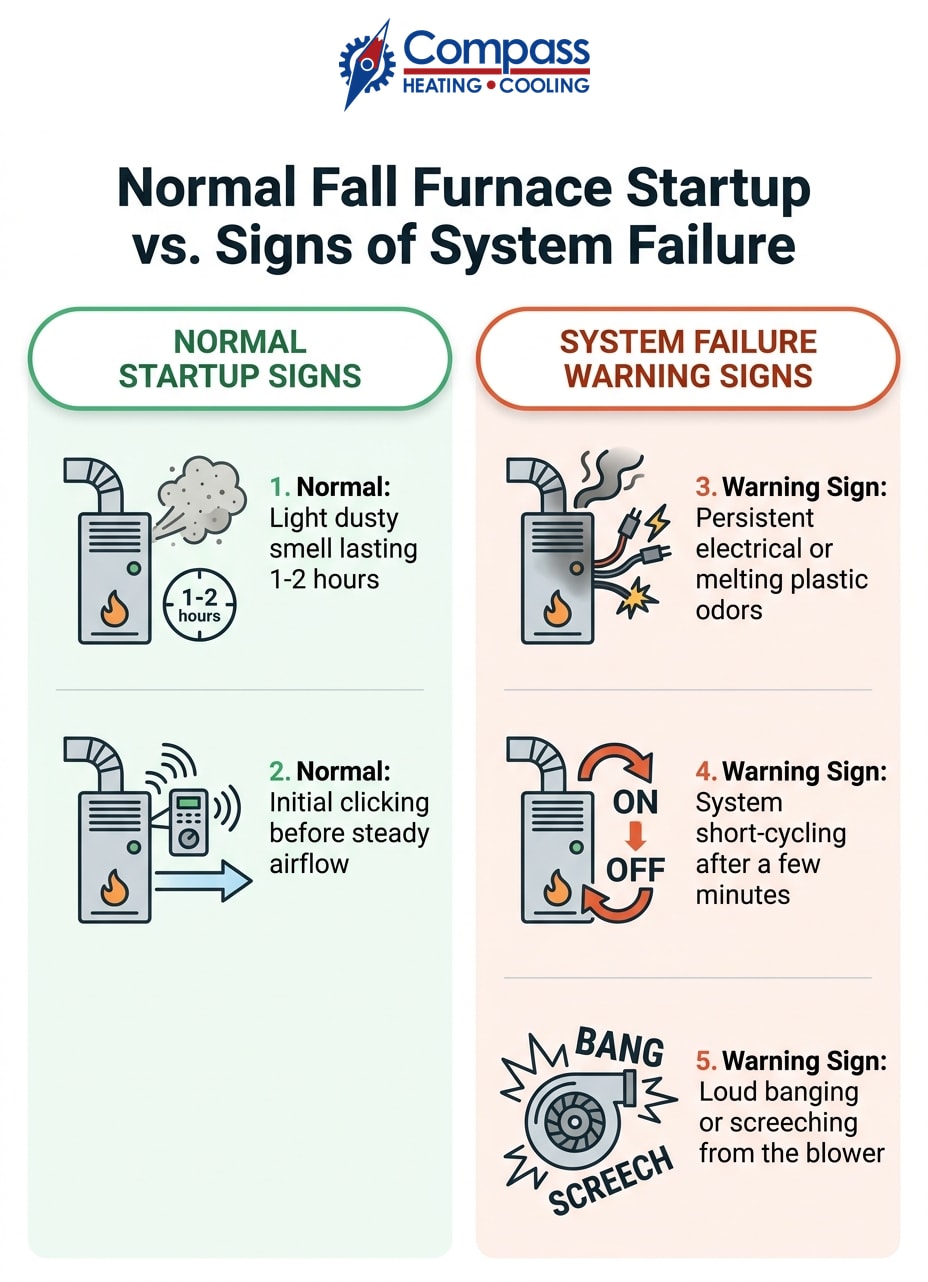
Certain behaviors are entirely expected during that October first freeze start-up. If you notice these symptoms, it is usually safe to monitor the system for a few hours before calling for help:
• Brief, light dusty smells: A faint odor resembling burnt toast that fades after the first heating cycle completes.
• Initial clicking that resolves: The sound of the igniter or relays engaging, which should quickly transition into the steady hum of the blower motor and consistent airflow.
• Minor airflow adjustments: Slight variations in air pressure as the system calibrates and pushes stagnant air out of the ductwork.
When to Call for Diagnostics
Conversely, some symptoms indicate immediate trouble. If you experience any of the following, shut the system down at the thermostat and contact a licensed technician:
• Smells of melting plastic or ozone: These acrid odors strongly suggest electrical shorts, failing blower motor windings, or melting wire insulation.
• Continuous short-cycling: If the furnace ignites, runs for only two or three minutes, and then abruptly shuts down repeatedly, safety switches are likely tripping due to overheating or flame sensor failures.
• Unusual grinding or screeching: Loud, metallic noises emanating from the blower compartment usually point to failing bearings or a deteriorating inducer motor assembly.
• Odors — Normal Start-Up Behavior: Faint burning dust smell lasting 1-3 hours. — Warning Sign Requiring Diagnostics: Persistent electrical, melting plastic, or sulfur smells.
• Sounds — Normal Start-Up Behavior: Initial clicking followed by steady, consistent fan hum. — Warning Sign Requiring Diagnostics: Loud banging, screeching, grinding, or rapid repetitive clicking.
• Operation — Normal Start-Up Behavior: Completes full heating cycles until thermostat is satisfied. — Warning Sign Requiring Diagnostics: System short-cycles, shutting down after only a few minutes.
The 'Cracked Heat Exchanger' Diagnosis: Fact or Fiction?
One of the most alarming diagnoses a homeowner can receive during a fall maintenance visit is that their furnace has a cracked heat exchanger. The heat exchanger is arguably the most critical component of your furnace. It is a series of metal tubes or coils that are heated by the burner flames. The blower motor pushes indoor air over the outside of these hot metal tubes, warming the air before it circulates through your home. Crucially, the heat exchanger keeps the toxic combustion gases inside the tubes completely separate from the breathable air circulating through your ductwork.
If the heat exchanger develops a crack, those harmful combustion gases—including deadly, odorless carbon monoxide—can leak into the household air supply. Because of this severe safety hazard, a verified crack means the furnace must be shut down immediately and either the heat exchanger or the entire furnace must be replaced. Unfortunately, because the safety implications are so dire, this specific diagnosis is frequently exploited as a scare tactic by less reputable contractors to justify immediate, high-pressure furnace replacements.
When told your system is unsafe due to a crack, you must demand concrete proof. A professional technician will follow specific diagnostic protocols to verify the failure:
1. Combustion Analysis Testing: A highly trained technician will use an electronic combustion analyzer to measure the exact levels of oxygen, carbon monoxide, and other gases in the exhaust flue. Abnormal readings strongly indicate a breach in the system.
2. Visual Camera Inspection: Because the heat exchanger is buried deep inside the furnace cabinet, it cannot be fully evaluated with a simple flashlight. A technician should use a flexible, high-definition borescope camera to snake through the internal chambers and locate the exact fissure.
3. Photographic Evidence: A reputable professional will gladly show you the camera screen or provide digital photos of the crack. They understand the gravity of the diagnosis and want to ensure you feel confident in the findings.
If a technician claims your heat exchanger is cracked but only performed a brief visual glance without specialized tools, you should immediately request a second opinion. At Compass Heating & Cooling, we always recommend verifying these claims with concrete, photographic evidence, as we've seen too many homeowners pressured into major replacements based solely on an unverified claim.
Age vs. Condition: Evaluating Premature Replacement Claims
Another common narrative used to push homeowners toward immediate replacement is the argument that the system is simply "too old to fix." While chronological age is certainly a factor in equipment reliability, it is only one piece of a much larger diagnostic puzzle. Using objective data helps homeowners weigh their options when told their equipment has reached the end of the line.
According to data from the Department of Energy (DOE) and ENERGY STAR, a well-maintained modern furnace generally lasts between 15 to 20 years. If a technician recommends a total system replacement on a unit that is under 10 years old, that claim strongly warrants a secondary evaluation. Our team typically sees that a furnace that is only eight or nine years old may simply be suffering from a single failed component—such as a bad draft inducer motor or a faulty control board—that can be replaced, restoring the system to full functionality for many more years.
The role of maintenance history: The actual condition of your heating equipment is heavily dictated by its maintenance history. A 12-year-old furnace that has received annual tune-ups, prompt repairs, and regular filter changes will often be in vastly better mechanical condition than a 6-year-old furnace that has been completely neglected and forced to breathe through severely clogged filters. The internal wear and tear caused by restricted airflow and dirt accumulation accelerates component failure far more rapidly than time alone.
When evaluating a replacement quote, look past the manufacture date. Understanding why getting a second opinion on HVAC work is crucial can prevent you from abandoning a system that only needs a minor repair. A thorough secondary technician will assess the static pressure, the condition of the blower wheel, and the integrity of the electrical connections to give you a true picture of the system's remaining lifespan.
Recognizing High-Pressure Sales Tactics During a Cold Snap
Sudden temperature drops below freezing create a profound psychological vulnerability. When your house is rapidly losing heat and the forecast predicts snow, the instinct to secure a warm environment for your family overrides standard consumer caution. Unfortunately, aggressive sales teams and national chains are well aware of this dynamic and often deploy specific tactics to exploit weather urgency.
The most common strategy is the "buy today or freeze tonight" narrative. This approach is designed to eliminate your ability to research options, compare quotes, or consult with a partner. The salesperson will emphasize the immediate danger of the cold, often pairing it with exaggerated claims about the unavailability of parts for your current system. By creating an artificial sense of scarcity and extreme urgency, they push you toward signing a contract on the spot.
To protect yourself during a cold snap, watch for these specific red flags:
• Exploding offers: Limited-time discounts that "magically" expire the moment the technician pulls out of your driveway. Legitimate pricing does not vanish in sixty minutes.
• Refusal to provide written quotes: Vague verbal estimates without itemized breakdowns of the equipment, labor, and necessary modifications.
• Dismissal of temporary solutions: A reputable company will prioritize restoring safe heat temporarily—perhaps by patching a minor issue or offering safe space heaters—while giving you the breathing room to make an informed, long-term decision.
• Over-focusing on generic rebates: Using the promise of utility incentives or tax credits as a closing tool to distract from an inflated base price.
Whether you need comprehensive heating evaluations or even off-season air conditioning diagnostics, accuracy and transparency should never be compromised for speed. A trustworthy local provider will present the facts, explain the risks clearly, and step back to let you decide.
How to Evaluate Competing Diagnostic Quotes
Once you have secured a second opinion, the next challenge is comparing the competing diagnostic quotes to make your final repair versus replace decision. This process requires looking beyond the bottom line and evaluating the depth, accuracy, and thoroughness of the information provided by each company.
A high-quality diagnostic report should serve as an educational document, not just an invoice. When laying the two quotes side-by-side, consider the following frameworks to determine which company provided the more reliable assessment:
• Itemized vs. Vague Explanations: Look for detailed, itemized explanations of the failure. A quote that simply states "system failure—needs replacement" is a major red flag. The better quote will specify exactly which component failed (e.g., "primary heat exchanger cracked near the third cell") and explain how that failure impacts the rest of the system.
• Diagnostic Methods Utilized: Compare the actual work performed during the visit. Did the first technician spend five minutes looking at the unit before declaring it dead? Did the second technician use digital manometers, multimeters, and combustion analyzers to gather hard data? The quote backed by measurable data is inherently more trustworthy.
• Objective Discussion of Incentives: Check how energy rebates and utility incentives were handled. A reputable provider will mention generally applicable tax credits or local utility programs objectively, advising you to verify current programs with your utility provider or tax professional. They will not use these generic programs as a high-pressure tactic to artificially lower an inflated quote.
• Warranty and Guarantee Clarity: Assess the warranties offered on both the proposed repair and a potential replacement. A company confident in their diagnostic skills will stand behind their repair work with a strong labor warranty. If a company refuses to warranty a repair, they may be trying to steer you toward a replacement.
Why Local Accountability Matters for Winter Reliability
The Colorado Front Range climate requires heating systems to work exceptionally hard. The combination of high altitude, dry air, and rapid temperature fluctuations places immense strain on mechanical components. Because of these unique environmental factors, accurate, pressure-free diagnostics are absolutely critical before deep winter sets in. A misdiagnosis in October can lead to a catastrophic system failure during a sub-zero blizzard in January.
This is where the value of local accountability becomes paramount. When you work with established local professionals, you are partnering with a team that relies heavily on community reputation and word-of-mouth referrals rather than volume-based sales quotas mandated by a corporate headquarters out of state. Local technicians live and work in the same neighborhoods they serve; their business thrives entirely on doing the job right the first time and treating neighbors fairly.
As dedicated Loveland HVAC technicians, our team at Compass Heating & Cooling understands the specific demands of local weather patterns and the unique characteristics of the area's housing stock. We know firsthand how homes in the region are insulated, how the local altitude affects combustion efficiency, and exactly what it takes to keep a family safe during an extended freeze. Taking the time for an objective, localized evaluation ensures a safe, comfortable home all season long, free from the anxiety of wondering if you made the right choice.
Make the Right Choice for Your Heating System
Facing furnace troubles during the first cold snap of the year is stressful, but understanding normal startup behaviors versus real mechanical failures keeps you firmly in control of the situation. By knowing the difference between harmless dust burn-off and dangerous warning signs, you can protect your home without falling victim to unnecessary panic.
Always remember to avoid dangerous DIY inspections; diagnosing complex internal components is a job strictly for licensed professionals. If you are ever told your system is unsafe or too old to fix, take a breath, pause the process, and insist on a verified, transparent evaluation. We encourage you to book a comprehensive, honest diagnostic to ensure your home's winter readiness. A pressure-free path forward is the best way to guarantee reliable warmth when you need it most.
Frequently Asked Questions
Should I get a second opinion if told my heat exchanger is cracked?
Yes, you should always get a second opinion for a cracked heat exchanger diagnosis. Because this is a severe safety hazard that usually requires an expensive furnace replacement, it is occasionally used as a high-pressure sales tactic. A secondary technician can use advanced tools like a combustion analyzer or a borescope camera to provide concrete, visual proof of the crack before you commit to a major purchase.
Is a burning smell normal when turning on the furnace for the first time?
A faint burning dust smell is completely normal when starting your furnace for the first time in the fall. Over the summer, household dust and debris settle on the internal components, which then burn off when the burners ignite. This harmless odor should dissipate within a few hours; however, if the smell resembles melting plastic or electrical burning, shut the system down immediately and call a professional.
Is it worth getting a second opinion on HVAC?
Getting a second opinion on major HVAC work is highly recommended and often saves homeowners from unnecessary expenses. Different technicians have varying levels of experience and may use different diagnostic tools to evaluate the same problem. A secondary evaluation provides peace of mind, ensures the initial diagnosis was accurate, and gives you a point of comparison for repair versus replacement costs.
Do HVAC companies lie about cracked heat exchangers?
While the vast majority of HVAC professionals are honest, some aggressive sales-focused technicians may exaggerate or misdiagnose a cracked heat exchanger to secure a quick replacement sale. Because the homeowner cannot easily see the component, it becomes an easy target for scare tactics. This is exactly why requesting visual evidence, such as a camera inspection, and securing a second opinion is a vital protective step.
How do I know if my furnace really needs to be replaced?
A furnace typically needs replacement when it is over 15 years old, requires frequent repairs, or has suffered a catastrophic failure like a cracked heat exchanger. You should also consider replacement if the cost of a single repair exceeds fifty percent of the value of a new system. A thorough diagnostic from a reputable technician will provide measurable data on the system's efficiency and condition to help guide your decision.
How long does normal furnace dust burn-off last?
Normal furnace dust burn-off usually lasts between one to three hours of continuous operation. The smell is typically most intense during the very first heating cycle of the season and gradually fades as the settled dust is fully incinerated. Opening a few windows during this initial run can help clear the air quickly, but if the smell persists for days, a professional inspection is required.
What should a thorough furnace diagnostic include?
A thorough furnace diagnostic goes far beyond a simple visual inspection. It should include testing the electrical components with a multimeter, checking the gas pressure, inspecting the blower motor and wheel, and evaluating the safety switches. The technician should also analyze the static pressure of the ductwork and use specialized tools to check the heat exchanger for integrity, providing you with a detailed, itemized report of their findings.
hear what our satisfied clients have to say
Our clients consistently praise our exceptional service and attention to detail. They appreciate the personalized approach we take to meet their unique needs, ensuring satisfaction every step of the way.
