



Furnace Startup Smells: When to Wait and When to Get an HVAC Second Opinion

The First October Freeze: Decoding Your Furnace's Startup Quirks
A common misconception among homeowners is that the moment a furnace emits a burning odor, the entire system is damaged beyond repair. If you are searching for reliable home maintenance tips and troubleshooting strategies, understanding exactly what happens during that initial seasonal startup is a great place to start. Every autumn, as temperatures begin to drop, heating systems that have sat dormant for months are suddenly called into action. This transition is rarely odorless, and it is entirely normal to feel a spike of anxiety when your vents start blowing strange smells into your living room.
While some odors are completely harmless byproducts of seasonal transitions, accurately diagnosing them is the key to protecting both your home and your wallet. Knowing the difference between a minor quirk and a major mechanical failure prevents you from panicking unnecessarily—and protects you from prematurely replacing a system that only needs a basic tune-up. Before you assume the worst during the first October freeze, it helps to understand the physical processes happening inside your ductwork and heating cabinet.
For comprehensive support and professional guidance, explore our HVAC services to keep your system running smoothly all season long.
Normal Dust Burn-Off vs. Dangerous Mechanical Smells
To understand why your heater smells like a campfire during its initial run, you have to look at what happens over the summer. While your air conditioning systems are working hard to cool your home, the internal components of your furnace are sitting idle. Over several months, household dust, pet dander, lint, and airborne particulate matter naturally settle on the dormant heat exchanger and burners. When the thermostat finally calls for heat, those internal components rapidly reach extreme temperatures, incinerating the accumulated debris instantly.
This process creates a very distinct, temporary odor. However, it is fundamentally different from the smells produced by failing electrical components, melting wire casings, or gas leaks. Distinguishing between these odors is your first line of defense in diagnosing a heating issue.
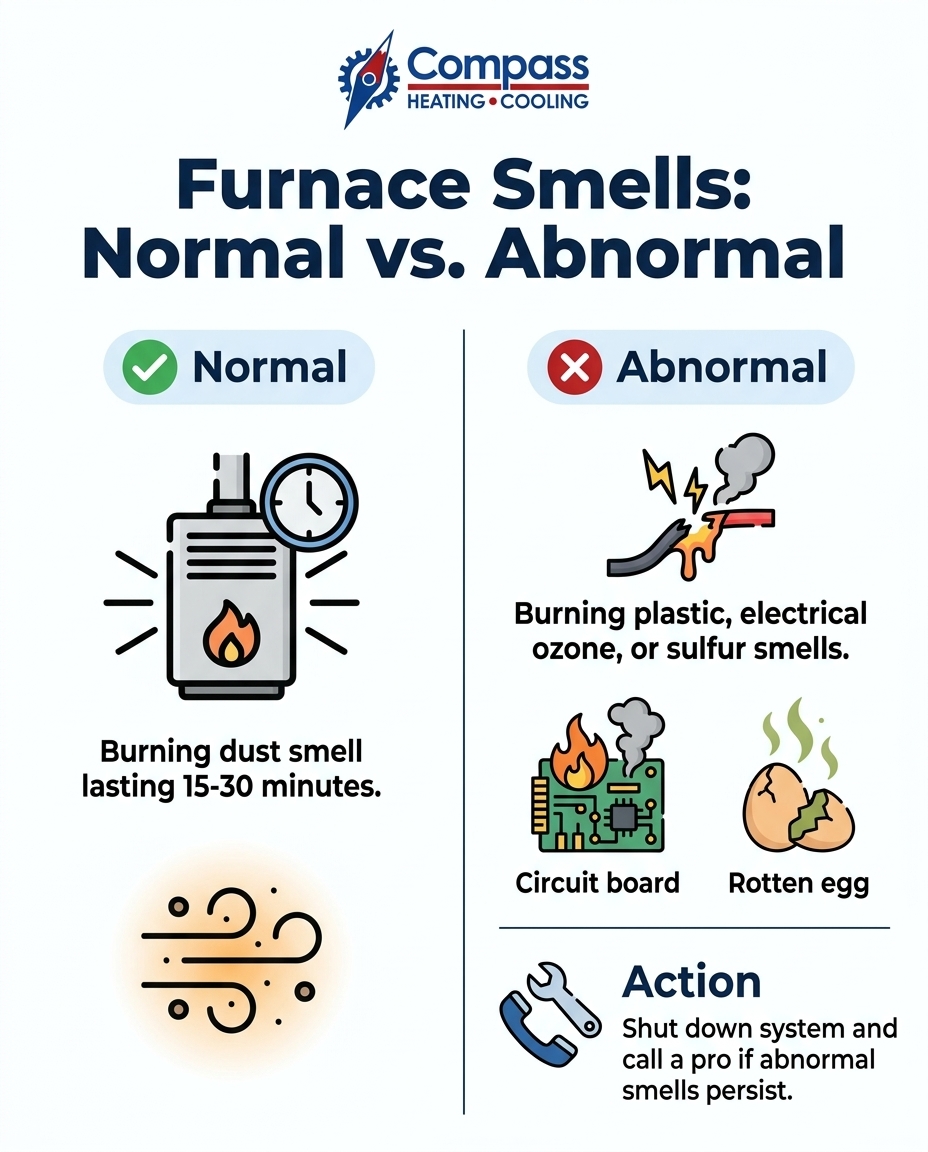
• Burning Dust / Musty Odor — Likely Cause: Incineration of settled summer dust on the heat exchanger. — Required Action: Wait and monitor. Ventilate the home. Should dissipate quickly.
• Electrical Ozone / Hot Wires — Likely Cause: Overheating blower motor, failing capacitor, or frayed wiring. — Required Action: Shut down immediately. Call a professional for electrical diagnostics.
• Melting Plastic / Rubber — Likely Cause: Foreign object in ductwork or melting wire insulation. — Required Action: Shut down immediately. Do not run the system until inspected.
• Sulfur / Rotten Eggs — Likely Cause: Natural gas leak (mercaptan additive). — Required Action: Evacuate the home, leave the door open, and call the gas company.
The 15-to-30 Minute Rule
The golden rule for seasonal startup odors is the 15-to-30 minute window. A harmless dust burn-off smell should peak within the first few minutes of operation and completely dissipate after 15 to 30 minutes of initial dust burn-off smell. During this brief window, it is perfectly acceptable to open a few windows or run ceiling fans to help ventilate the house. If the system continues to produce a burning odor well past the 30-minute mark, or if the smell grows increasingly pungent and chemical in nature, the dust burn-off phase has ended, and a mechanical issue has likely begun. At that point, the safest course of action is to turn the system off at the thermostat and wait for a qualified technician.
Why Is My Furnace Short-Cycling After Months of Inactivity?
Alongside unusual odors, another frequent symptom during the first cold snap is short-cycling. Short-cycling occurs when a heating system turns on, runs for a very brief period, and then abruptly shuts down before the home reaches the target temperature set on the thermostat. The system may repeat this frustrating loop endlessly, wasting energy and putting immense strain on the internal components.
The Problem: Loveland's rapid fall temperature drops place immediate, heavy demand on dormant heating equipment, exacerbating minor airflow issues. When a system goes from zero usage to running at full capacity during the first October freeze, any underlying restriction in the ductwork becomes a glaring performance issue.
The Cause: In the vast majority of cases, early-season short-cycling is triggered by a clogged air filter. The furnace contains a safety device called a high limit switch, which monitors the internal temperature of the heat exchanger. If a dirty filter blocks the airflow, the heat cannot escape into your ductwork. The internal cabinet temperature skyrockets, and the limit switch forcefully shuts down the burners to prevent a fire. Other common causes include thermostats that have lost their calibration during the transition from cooling to heating, or blocked return vents in the home.
The Solution: The first step is always to check and replace the air filter. Ensure all supply and return vents in the home are fully open and unobstructed by furniture or rugs. If the filter is clean and the vents are clear, the short-cycling is likely caused by a malfunctioning flame sensor, a failing blower motor, or a defective limit switch. Because these components involve high voltage and combustible gas, testing and replacing them requires specialized diagnostic tools and should never be attempted as a DIY project.
Red Flags: When to Shut Down the System and Call a Professional
While patience is warranted for minor dust smells, certain symptoms demand immediate action. Providing a safety-first diagnostic framework empowers you to recognize genuine emergencies before they cause catastrophic damage to your equipment or compromise your indoor air quality. If you observe any of the following red flags, it is time to seek professional heating replacement and repair.
• Persistent electrical odors: If the smell resembles an overheating appliance, a hot copy machine, or melting wire casings, a component is actively failing. This often points to a seized blower motor or a melting capacitor.
• Loud screeching or grinding: A healthy system should only produce the sound of rushing air and a soft mechanical hum. High-pitched screeching indicates metal-on-metal friction, usually due to failing bearings in the inducer motor or main blower.
• Delayed ignition bangs: If you hear a loud "boom" or "bang" when the system turns on, gas is pooling in the combustion chamber before the igniter lights it. This miniature explosion damages the equipment over time and requires immediate recalibration.
• Continuous short-cycling: If replacing the air filter does not stop the system from rapidly turning on and off, the internal safety switches are repeatedly tripping, indicating a severe overheating condition.
The Danger of a Cracked Heat Exchanger: One of the most serious red flags is a cracked heat exchanger. This metal shield separates the toxic combustion gases from the breathable air circulating through your home. If it cracks due to age or chronic overheating, carbon monoxide can leak into your ductwork. Because carbon monoxide is odorless and invisible, diagnosing a cracked heat exchanger requires a professional equipped with digital combustion analyzers and specialized inspection cameras. If you suspect an emergency, safely turn off the system at the thermostat, and if necessary, flip the dedicated breaker in your electrical panel to cut all power to the unit.
The 'Condemned' System: Spotting High-Pressure Sales Tactics
Unfortunately, the anxiety surrounding fall furnace startups is occasionally exploited. A typical pattern we see in the industry is a technician using a normal startup quirk—like a brief burning smell or an easily fixable short-cycle—to claim the entire system is completely unsafe and must be replaced immediately. This tactic is known as "condemning" a system, and while it is sometimes entirely legitimate, it is also a common high-pressure sales strategy.
Predatory technicians often manufacture urgency. They might tell you that turning the system back on will result in an immediate fire hazard or a catastrophic carbon monoxide leak, pushing you to sign a replacement contract on the spot. They may use highly technical jargon to confuse the issue or refuse to explain the exact nature of the mechanical failure in plain language.
As Loveland HVAC experts, Compass Heating & Cooling is committed to honest, transparent evaluations without high-pressure sales tactics. You have the right to demand clear evidence before making a major financial decision. If a technician claims your heat exchanger is cracked, ask to see a photograph or video of the crack from their inspection camera. If they claim the system is leaking carbon monoxide, ask to see the live readouts on their combustion analyzer. Unless there is a verified, immediate safety hazard—such as a confirmed gas leak or a visually documented breach in the heat exchanger—you always have time to weigh your options and gather more information.
Protecting Your Investment: Why a Second Opinion Matters
Bridging the gap between recognizing a potential high-pressure sales pitch and taking actionable steps to protect your home is simple: you get another set of eyes on the equipment. A major repair or a full system replacement is a significant investment, and making that decision under duress rarely yields the best outcome.
Here is how to approach the situation if you are told your system is beyond saving:
1. Request a written report: Ask the initial technician to document exactly what has failed, why it failed, and why it cannot be repaired. Vague notes like "system unsafe" are not sufficient.
2. Leave the system off: If there is any doubt about safety, leave the equipment powered down while you arrange for another evaluation.
3. Schedule a comprehensive diagnostic: Contact a reputable company for a second opinion. A trustworthy technician will perform a full system diagnostic, including static pressure tests, electrical multi-meter readings, and a visual inspection of the combustion chamber.
4. Review load calculations: If a replacement is genuinely needed, the second opinion should include a review of the sizing (load calculation) to ensure the new unit is perfectly matched to your home's square footage and insulation levels.
A thorough second evaluation can often reveal cost-effective repair options that the first technician may have ignored or missed entirely. Reputable companies actively encourage homeowners to seek additional information because they stand firmly by their own diagnostics. Understanding why getting a second opinion is important is one of the most effective ways to maintain control over your home's maintenance budget.
Frequently Asked Questions About Fall Furnace Startups
How long should a furnace smell like burning dust?
The harmless smell of burning dust should dissipate within 15 to 30 minutes of the first seasonal use. This odor is simply the system incinerating particles that settled on the internal components over the summer. If the smell persists beyond half an hour or grows stronger, turn the system off and schedule an inspection.
Why is my furnace short cycling during the first cold snap?
Short cycling is most commonly caused by severely restricted airflow, which forces the system to overheat and shut down prematurely. Clogged air filters, blocked return vents, and thermostat calibration issues are primary, non-emergency culprits. Replacing a dirty filter is the first and most effective troubleshooting step you can take.
Is it safe to run a furnace that smells like burning?
It is safe only if the smell is standard dust burn-off and dissipates quickly during the initial startup. The odor should resemble a dusty, musty smell rather than chemicals or melting plastic. If the odor smells like electrical ozone, sulfur, or burning rubber, it is absolutely not safe to run and must be shut down immediately.
When should I get a second opinion on a furnace replacement?
You should seek a second opinion anytime a technician pressures you for an immediate replacement, uses scare tactics, or cannot clearly prove the system is unsafe. If they refuse to provide photographic evidence of a cracked heat exchanger or a detailed written report, bringing in a second, independent professional is highly recommended.
What causes a heater to smell like burning plastic?
A burning plastic odor typically indicates melting wire casings, an overheating blower motor, or a foreign object that has fallen into the ductwork. Unlike normal dust burn-off, this is a serious mechanical or electrical failure. You should cut power to the unit immediately to prevent electrical fires and call for emergency service.
Make Confident Heating Decisions This Fall
Navigating the transition into colder weather doesn't have to be a stressful experience. By keeping these home maintenance tips and troubleshooting guidelines in mind, you can easily distinguish between normal 15-to-30 minute startup quirks and genuine mechanical failures. Remember that you always have the right to transparent, honest diagnostics without the pressure of manufactured urgency. If you are ever unsure about the safety of your system, or if you simply want the peace of having a professional verify that everything is running cleanly and efficiently, scheduling a thorough inspection or seeking a trusted second opinion is the smartest move you can make.
hear what our satisfied clients have to say
Our clients consistently praise our exceptional service and attention to detail. They appreciate the personalized approach we take to meet their unique needs, ensuring satisfaction every step of the way.
