


The Repair vs. Replace Framework: When to Seek an HVAC Second Opinion

Is Your Furnace Ready for the First Fall Cold Snap?
Are you actively researching options comparisons for homeowners because your heating system is struggling, or are you just crossing your fingers every time the thermostat clicks on? At Compass Heating & Cooling, we see this anxiety peak every October. As the pre-winter heating startup approaches, many households face the dread of turning on their furnace for the first time, only to be met with strange noises, lukewarm air, or a system that refuses to ignite. The first significant temperature drop of the fall creates an immediate sense of urgency. When the house is cold and the system is malfunctioning, making a clear-headed decision becomes incredibly difficult.
We know that this early-season stress often forces a common dilemma: should you patch up an aging unit to get through one more winter, or is it time to invest in a completely new system? Rushing into either choice can lead to long-term frustration. Before committing to a major expense, it pays to step back and evaluate the situation objectively. Relying on professional HVAC services ensures you get a thorough, unbiased assessment of your equipment. By establishing a solid framework for comparison, you can navigate this stressful moment with confidence and avoid the pitfalls of a panicked, last-minute decision.
The Core Criteria: Age, Lifespan, and the 50% Rule
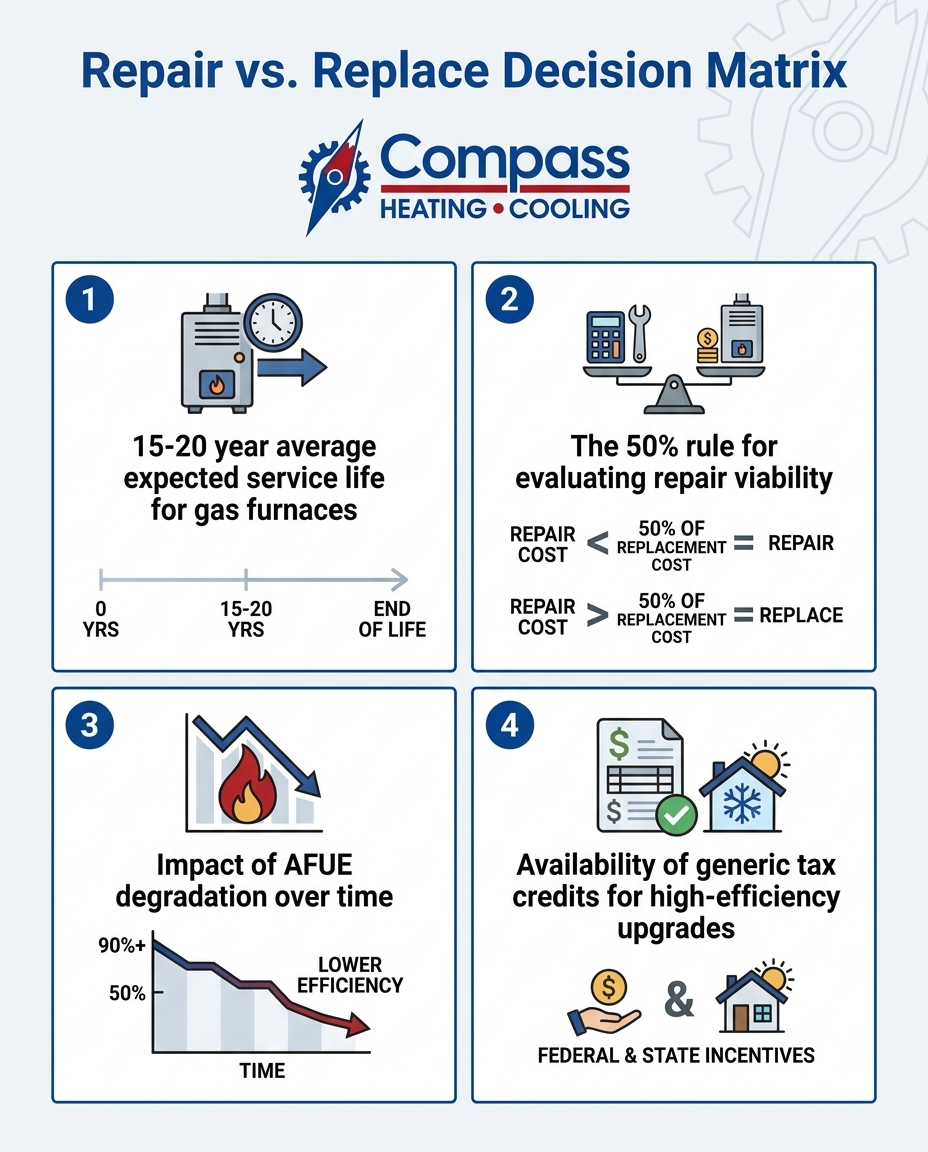
Establishing a baseline framework is the first step in making a logical decision about your equipment. In our years serving Loveland and the Colorado Front Range, our technicians typically see gas furnaces reach an expected service life of 15 to 20 years. While a well-maintained unit can sometimes push past the two-decade mark, the reliability of its internal components begins to degrade significantly after year 15. Parts become harder to source, and the risk of a major mechanical failure increases with every heating cycle.
Understanding the 50% Rule
When evaluating your next steps, our team frequently references the 50% rule to help customers make sense of their options. This guideline states that if the cost of a repair approaches half the value of a new, comparable system, upgrading is generally the wiser choice. Pouring substantial funds into a unit that is already nearing the end of its functional life rarely offers a good return on investment. Instead, those funds are usually better applied toward a modern system with a fresh warranty.
Tracking the Frequency of Breakdowns
Age and repair costs are not the only metrics we watch during service calls. The frequency of breakdowns is a major indicator of system health. Consider these warning signs we regularly encounter:
• Compounding failures: Fixing a blower motor one month and a control board the next suggests systemic degradation.
• Nuisance lockouts: A furnace that frequently shuts itself down for safety reasons is becoming inherently unreliable.
• Rising energy bills: Sudden spikes in utility usage, even when thermostat habits remain the same, point to a system working twice as hard to produce the same amount of heat.
These metrics serve as the starting point for deciding on heating system repair or replacement. By weighing the unit's age against the severity of its recent breakdowns, you build a clear, logical foundation for your next steps.
Evaluating Capacity Against Sudden Temperature Drops
Generic equipment comparisons often miss a critical, climate-specific factor: system load. Having worked through countless Colorado winters, we know the weather here does not slowly transition. The Loveland region is known for rapid weather shifts and strong Chinook winds, where temperatures can plummet dozens of degrees in a single afternoon. When our team responds to no-heat calls during these sudden drops, we often find older, patched-together heating systems pushed past their breaking point.
Baseline Efficiency vs. Severe Cold Capacity
There is a vast difference between a unit's baseline efficiency on a mild day and its actual capacity to handle a deep freeze. An aging furnace might run perfectly fine when the outside temperature is 45 degrees. However, when a sudden cold front drops the temperature to 10 degrees, that same system may lack the capacity to keep up. The heat exchanger has to work longer, the blower motor runs continuously, and the internal components are pushed to their absolute limits.
The Risk of High-Stress Failures
When an older system is pushed beyond its comfortable operating capacity, the risk of a sudden breakdown skyrockets. Short-cycling becomes common as the system desperately tries to meet the thermostat's demand, overheating and shutting down before the house actually warms up. Patching a struggling unit might seem cost-effective in October, but if the system cannot handle the thermal load of a January blizzard, that repair money was essentially wasted.
To truly understand what your system can handle, we highly recommend having our Loveland HVAC professionals assess the unit. A thorough evaluation will determine not just if the furnace turns on, but if it has the sustained capacity to manage abrupt weather shifts safely and reliably throughout the entire winter season.
Uncovering Hidden Inefficiencies in Older Equipment
Beyond sudden breakdowns, older heating equipment suffers from long-term operational degradation. When your furnace was first installed, it was given an Annual Fuel Utilization Efficiency (AFUE) rating. This percentage represents how much fuel the system successfully converts into usable heat. However, as our maintenance crews often remind homeowners, that original rating does not last forever.
The Quiet Cost of AFUE Degradation
As a furnace ages, it quietly loses its efficiency. Soot buildup, worn bearings, and micro-cracks in the combustion chamber all force the system to consume more fuel to produce the same amount of warmth. A furnace that was rated at 90% AFUE fifteen years ago might be operating closer to 75% today. This degradation quietly increases your daily energy consumption, inflating your utility bills month after month without you even realizing it.
Wear, Tear, and Uneven Heating
The physical wear and tear on internal components also severely impacts comfort. You might notice longer run times, where the furnace seems to run continuously but the house never quite reaches the target temperature. You may also experience uneven heating, with certain rooms feeling like a sauna while others remain freezing cold. When we see these symptoms during the October pre-winter heating startup, they are clear indicators that the system is losing its ability to distribute air effectively.
The Importance of Holistic Diagnostics
Evaluating a furnace in isolation only tells half the story. At Compass Heating & Cooling, our truly comprehensive assessment looks at the overall health of the entire HVAC infrastructure. This holistic diagnostic process might also review past air conditioning system evaluations to determine compatibility. If your AC unit is also nearing the end of its lifespan, replacing the indoor coil and the furnace at the same time often results in better airflow, improved efficiency, and a more cohesive, reliable climate control system for the home.
Recognizing High-Stress Breakdowns vs. Objective Diagnostics
Sudden early-season breakdowns create a highly vulnerable situation for homeowners. When the October pre-winter heating startup fails and the house is freezing, panic naturally sets in. Unfortunately, this high-stress environment is exactly when homeowners are most susceptible to rushed decisions and high-pressure sales tactics.
The Danger of the Rushed Recommendation
A pattern we see all too often is the rushed recommendation: a technician arrives, inspects a broken furnace for ten minutes, and immediately declares that the entire system must be replaced by tomorrow. While sometimes a replacement truly is the only safe option, aggressive ultimatums should always raise a red flag. High-pressure tactics often prioritize sales quotas over what is actually best for the home's long-term comfort and safety.
The Value of Pausing to Weigh Options
When faced with a drastic, expensive recommendation, we believe the most powerful tool you have is the ability to pause. Taking a breath to weigh your options prevents costly mistakes. Honest, locally owned expertise focuses on long-term solutions, not immediate panic. A trustworthy technician from our team will clearly explain the exact nature of the failure, show you the damaged components, and present a balanced view of both repair and replacement paths.
This is exactly why it is important to get a second opinion on HVAC work. Seeking an objective diagnostic ensures that the recommendations you receive are based on verifiable system health, not a rushed sales pitch. A second set of eyes protects you from unnecessary replacements and ensures that if you do choose to upgrade, you are doing so based on solid, trustworthy evidence.
Factoring in Generic Tax Credits and Rebates
When we help homeowners build a comparison framework, we always point out that the financial dimension extends beyond just the sticker price of a new unit versus the cost of a repair part. Modernizing your heating equipment often opens the door to various financial incentives that can significantly alter the math of the repair-versus-replace decision.
Federal and Local Incentives
Homeowners in Loveland and the Colorado Front Range should be aware that generic federal tax credits are often available for upgrading to high-efficiency heat pumps or modern, qualifying gas furnaces. These programs are designed to encourage energy conservation by offsetting a portion of the installation costs for highly efficient equipment.
In addition to federal programs, local utility providers frequently offer their own rebates for energy-efficient installations. Because older systems place a heavy burden on the local energy grid during peak winter months, utility companies often provide financial incentives to homeowners who make the switch to modern, low-draw equipment.
Changing the Decision Math
These incentives can dramatically shift the application of the 50% rule. If a major repair costs a significant amount, and a new system qualifies for substantial generic rebates and tax credits, the out-of-pocket gap between patching the old unit and investing in a new one shrinks considerably. Because these programs change frequently based on legislation and utility funding, we always advise our customers to consult a tax professional or their local utility provider to verify exactly which current incentive programs apply to their specific situation.
Side-by-Side: Repair vs. Replace Criteria for Gas Furnaces
To make the best choice during the October pre-winter heating startup, it helps to view the data clearly. Based on our years of field experience, our team has compiled the table below to summarize the core conditions under which repairing or replacing your gas furnace makes the most logical sense.
• Equipment Age — When to Repair: Under 10-12 years old with a valid manufacturer warranty. — When to Replace: Over 15 years old, out of warranty, and showing signs of wear.
• Frequency of Breakdowns — When to Repair: Isolated incident; system has otherwise run reliably for years. — When to Replace: Multiple service calls in the last two seasons; compounding part failures.
• The 50% Rule — When to Repair: Repair costs are minor and well below half the value of a new unit. — When to Replace: Repair costs approach or exceed 50% of a new system's total value.
• Safety Risks — When to Repair: Standard mechanical wear (e.g., a bad capacitor or dirty flame sensor). — When to Replace: Critical safety hazards, such as a cracked heat exchanger or carbon monoxide risks.
• Climate Readiness — When to Repair: System easily maintains target temperatures during sudden cold snaps. — When to Replace: System short-cycles or fails to keep the house warm during rapid temperature drops.
Making a Confident Decision for the Winter Ahead
Navigating the options comparisons for homeowners does not have to be an overwhelming experience. By applying the logical evaluation framework our team uses every day—weighing the age of the equipment, the severity of the breakdowns, and the system's ability to handle the extreme weather of Loveland and the Colorado Front Range—you can prevent rushed, costly mistakes.
Remember that a sudden breakdown does not obligate you to accept the very first recommendation you receive. Objective, second-opinion guidance is essential when evaluating aging equipment, especially if you are facing a major repair bill. As the cold weather approaches, take the time to schedule a thorough, honest diagnostic evaluation with Compass Heating & Cooling. By understanding exactly where your system stands today, you can weigh your options confidently and ensure your home remains safe and comfortable long before the most severe winter weather hits.
Frequently Asked Questions
When should I replace my furnace instead of repairing it?
Our team generally recommends replacing your furnace when it is over 15 years old and facing a repair that costs nearly half the value of a new system. This is widely known as the 50% rule in the HVAC industry. Additionally, if the unit requires frequent service calls or poses a safety risk like a cracked heat exchanger, investing in a new, reliable system is the safest and most cost-effective choice.
Is a second opinion worth it for HVAC replacement?
Yes, we highly recommend getting a second opinion whenever a technician suggests a complete system replacement. A second evaluation protects you from high-pressure sales tactics and ensures the diagnosis is accurate. It provides peace of mind that you are making a major financial decision based on objective, verifiable facts rather than a rushed assessment.
How long do gas furnaces last in Colorado?
In our experience throughout the Colorado Front Range, a well-maintained gas furnace typically lasts between 15 and 20 years. However, the region's rapid temperature drops and heavy winter usage can accelerate wear and tear on internal components. Regular pre-winter maintenance is critical to helping the system reach the upper end of that expected lifespan safely.
Should I get a second opinion on a cracked heat exchanger?
Absolutely. A cracked heat exchanger is a severe safety hazard that can leak carbon monoxide into your home, and it almost always warrants a full system replacement. Because it is such an expensive and critical diagnosis, having a second professional use a combustion analyzer or inspection camera to verify the crack ensures you aren't being sold a system you don't actually need.
How can I tell if my older furnace is losing its efficiency?
The most obvious sign of lost efficiency we see is a steady increase in your winter utility bills, even when your thermostat settings haven't changed. You might also notice the furnace running for much longer cycles to reach the desired temperature. Uneven heating throughout the house and a general lack of strong airflow from the vents are also strong indicators of internal degradation.
hear what our satisfied clients have to say
Our clients consistently praise our exceptional service and attention to detail. They appreciate the personalized approach we take to meet their unique needs, ensuring satisfaction every step of the way.
