


Beyond the Seasonal Home Maintenance Checklist: When to Get an HVAC Second Opinion
The First Freeze: Recognizing When Your Furnace Needs Professional Attention
Is that burning smell coming from your vents a normal part of fall, or a warning sign that your seasonal home maintenance checklist needs immediate professional intervention? When temperatures begin to plummet, knowing how to interpret your heating system's behavior becomes one of the most critical responsibilities of homeownership. It is late fall, the first real freeze is approaching the Loveland CO area, and turning on the thermostat for the first time often brings strange noises, odd odors, or a system that simply refuses to ignite. Before you panic about a major breakdown, it helps to understand exactly what happens inside that metal cabinet after months of sitting idle.
If you need professional help right away, our comprehensive HVAC services cover everything from seasonal tune-ups to complete heating system repair or replacement.
During an October heating startup, it is completely normal to feel a bit of anxiety when the furnace exhibits strange symptoms. The thermostat clicks, the blower fan spins up, but the air coming out of the vents might feel lukewarm, or a harsh, dusty smell might quickly fill the hallway. The immediate decision point for most homeowners is determining whether this is just normal seasonal dust burn-off or a true mechanical issue that poses a safety hazard. Ignoring a genuine mechanical fault can lead to mid-winter breakdowns when you need the heat the most, while overreacting to normal startup behavior can cause unnecessary stress.
Understanding the difference requires a calm, objective look at how modern heating systems operate. By learning to identify the specific sounds and smells of a healthy startup sequence, you can confidently check the heating system off your seasonal to-do list. However, when the signs point to a deeper issue—like persistent short-cycling or sharp electrical odors—securing a professional diagnostic before the deep winter freeze sets in is the only way to ensure your home remains safe and comfortable.
Decoding the Initial Startup: Normal Burn-Off vs. Warning Signs
In the Loveland CO area, our distinctly dry climate combined with rapid fall temperature drops creates a unique challenge for residential heating systems. Over the long, arid summer, fine dust, pet dander, and airborne particulate matter settle heavily on dormant furnace components, particularly the heat exchangers. When the first freezing night hits and the system kicks on, that accumulated debris is instantly subjected to high heat, creating a very distinct set of startup symptoms.
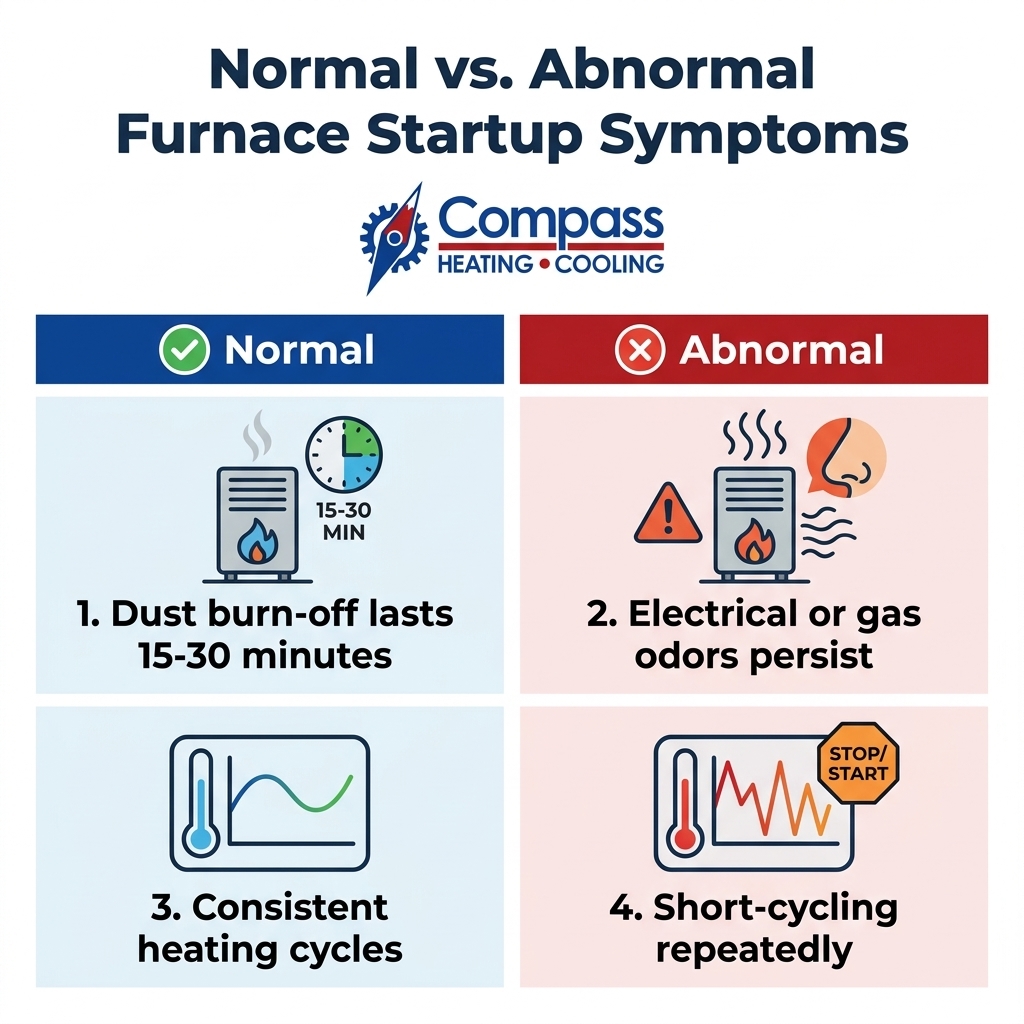
To help you accurately decode what your system is doing, it is essential to compare normal, harmless behaviors against the warning signs that demand a professional inspection. The table below outlines the key differences between a standard startup and a system in distress.
• Odors and Smells — Normal Startup Behavior: A distinct smell of burning dust that dissipates completely within 15 to 30 minutes of the first ignition. — Abnormal Warning Signs: Sharp electrical smells, the odor of melting plastic, or the distinct smell of raw gas or rotten eggs.
• System Noises — Normal Startup Behavior: A soft click from the thermostat, a gentle hum from the inducer motor, and the whoosh of the main burners igniting. — Abnormal Warning Signs: Loud banging upon ignition, continuous metal-on-metal grinding, or high-pitched squealing from the blower.
• Heating Cycles — Normal Startup Behavior: The furnace runs continuously until the thermostat's set temperature is reached, then shuts down smoothly. — Abnormal Warning Signs: The system turns on and off rapidly every few minutes without actually warming the living space.
• Airflow Quality — Normal Startup Behavior: Steady, warm air flowing evenly from all supply registers after a brief initial push of cooler air. — Abnormal Warning Signs: Weak airflow, cold air blowing continuously, or specific rooms remaining completely unheated.
What to Expect During the First 30 Minutes
When you initiate that first October heating startup, the initial 30 minutes are critical for observation. As the burners ignite, the heat exchanger rapidly warms up, incinerating the layer of summer dust. This process produces a smoky, dusty odor that will circulate through your ductwork. This is a harmless process. The best course of action is to open a few windows to ventilate the home and let the system run. Within half an hour, the smell should completely fade as the dust is exhausted. If the smell persists beyond this timeframe, or if it changes from a dusty odor to an acrid, electrical smell, shut the system down at the thermostat immediately and contact a licensed professional for a thorough safety evaluation.
Understanding Your Furnace Ignition Sequence
When a heating system fails to produce warm air, homeowners often assume the entire unit is broken. In reality, modern furnaces rely on a highly specific, sequential safety process to ignite. If any single step in this sequence fails, the system's control board will intentionally lock out the startup to prevent gas leaks or fire hazards. Understanding this sequence takes the mystery out of an October heating startup failure.
1. The Thermostat Call: The sequence begins when the indoor temperature drops below your set point. The thermostat sends a low-voltage signal to the furnace control board, requesting heat.
2. The Draft Inducer Motor Engages: Before any gas is released, a small motor called the draft inducer turns on. You will hear this as a low hum. Its job is to pull air through the heat exchanger and push residual, potentially dangerous gases out through the flue pipe.
3. The Pressure Switch Verification: The control board must verify that the inducer motor is actually moving air. A pressure switch detects the negative pressure created by the draft inducer. If the flue is blocked by a bird's nest or debris, the switch will not close, and the sequence stops here.
4. The Igniter Warms Up: Once airflow is confirmed, the control board sends voltage to the igniter. In most modern systems, this is a hot surface igniter that glows bright orange, similar to a toaster element. In older systems, it may be a spark igniter.
5. The Gas Valve Opens: With the igniter glowing hot, the gas valve opens for a few precise seconds, releasing combustible gas over the burners. The gas meets the glowing igniter, and the burners light with a distinct "whoosh" sound.
6. The Flame Sensor Confirmation: This is the most critical safety step. A metal rod called a flame sensor sits directly in the path of the newly lit flames. The flames conduct a tiny microamp electrical current through the rod back to the control board. If the sensor does not detect this current within roughly three seconds, the board immediately slams the gas valve shut to prevent raw gas from flooding your home.
Because these components handle combustible gas and high voltage, testing, cleaning, and repairing them requires a licensed professional. A technician has the specialized multimeters and manometers required to safely test flame microamps and gas pressures without compromising the safety of the equipment.
Why Short-Cycling Happens During Early Season Operation
One of the most frequent complaints during the early weeks of fall is a phenomenon known as short-cycling. Short-cycling occurs when the furnace turns on, runs for a minute or two, and then shuts down abruptly before the living space has actually reached the temperature set on the thermostat. The system will sit idle for a few minutes, then attempt to start the process all over again. This rapid on-and-off behavior places severe mechanical strain on the blower motor and the ignition components, significantly driving up energy consumption while leaving your home chilly.
In the Loveland CO area, where heating systems work hard throughout the winter, identifying the root cause of short-cycling early is essential. The most common culprit is a dirty flame sensor. Over the summer, microscopic carbon dust and oxidation build up on the sensor rod. When the burners ignite, this buildup insulates the rod, preventing it from reading the flame's electrical current. As we discussed in the ignition sequence, if the control board cannot verify the flame, it shuts the gas valve down immediately for safety, causing a short cycle.
Another frequent cause is restricted airflow due to heavily soiled air filters. If the blower motor cannot pull enough return air through the system, the heat generated by the burners cannot be distributed into the home. This causes the internal temperature of the furnace cabinet to skyrocket. A safety device called the high-limit switch detects this dangerous internal heat and shuts the burners off to prevent a fire hazard. Once the cabinet cools down, the system tries to run again, resulting in an endless loop of short cycles.
While a dirty filter is a simple homeowner fix, diagnosing a failing limit switch or a compromised flame sensor requires exact technical knowledge. Just as precise air conditioning diagnostics are critical during the peak of summer, exact heating evaluations are mandatory in the fall to ensure your system is operating safely and efficiently before the heavy snow arrives.
Navigating Major Repair Quotes: When to Seek a Second Opinion
A typical pattern we see during an October heating startup is a homeowner calling for a routine inspection or a minor short-cycling issue, only to be handed a staggering quote for a complete system replacement. The anxiety of facing a freezing winter without reliable heat can pressure homeowners into making rushed, expensive decisions. However, jumping straight to a replacement based on a single early-season symptom is often unnecessary.
This is exactly why it is important to get a second opinion on HVAC work. Objective, technical diagnostics should always take precedence over high-pressure sales tactics. As a locally owned Loveland company, we believe in honest, transparent evaluations focused on fixing issues rather than forcing premature replacements. There are several specific scenarios where seeking a second opinion is absolutely critical:
• Cracked Heat Exchanger Claims: A cracked heat exchanger is a severe safety hazard that can leak carbon monoxide into your home. If a technician claims your heat exchanger is cracked, they should be able to show you undeniable visual evidence, such as a clear photograph or a video from a combustion analyzer camera. If they cannot provide proof, get a second opinion immediately.
• Obsolete Parts Diagnoses: Sometimes, homeowners are told they must replace their entire system because a specific control board or blower motor is "no longer manufactured." While this is true for very old units, a second professional can often source universal replacement parts or verify if the OEM part is truly obsolete.
• Complete System Failure from a Single Symptom: If your system is short-cycling, and the diagnosis is a "complete system failure" without a detailed explanation of which components have actually failed, pause the process. A dirty flame sensor or a tripped limit switch mimics major failure but requires only a minor repair.
• High-Pressure Deadlines: If a quote comes with a "today only" discount or aggressive warnings that your family is in immediate danger unless you buy a new furnace right now, step back. A reputable professional will make the system safe (by shutting off the gas if necessary) and give you time to review your options.
Factoring in System Upgrades and Energy Efficiency
While getting a second opinion is vital to protect against unnecessary replacements, there are legitimate times when upgrading your heating system is the most prudent financial and practical decision. When evaluating the health of your HVAC setup in the Loveland CO area, you must weigh the cost of ongoing repairs against the benefits of modern technology.
A legitimate system replacement is usually warranted under a few specific conditions. First is severe mechanical failure in an aging system. If your furnace is over 15 years old and requires a major component replacement—such as a cracked heat exchanger or a seized blower motor—the cost of the repair often exceeds the remaining value of the unit. Second, if a system poses a verified safety hazard that cannot be reliably mitigated with a repair, replacement is the only responsible choice.
When a replacement is necessary, it is important to understand the energy efficiency gains available with modern equipment. Today's variable-speed blowers and multi-stage gas valves provide vastly superior temperature control, eliminating the harsh hot and cold spikes common with older, single-stage units. Higher AFUE (Annual Fuel Utilization Efficiency) ratings mean that more of the fuel you pay for is converted directly into usable heat for your home, rather than being wasted as exhaust.
Furthermore, there are often broad financial incentives available to help offset the cost of high-efficiency upgrades. Federal tax credits may apply to qualifying heat pump installations for homeowners considering moving away from traditional gas heating. Always verify current programs, eligibility requirements, and deadlines with your utility provider or a qualified tax professional before making a final decision.
Frequently Asked Questions About Fall Furnace Diagnostics
Why does my furnace smell like burning when I turn it on for the winter?
The short answer is that your furnace is incinerating dust that settled on the heat exchangers over the summer. This normal burn-off process produces a distinct, smoky odor that typically lasts for 15 to 30 minutes during the first October heating startup. If the smell persists longer than half an hour, or if it smells like melting plastic or raw gas, turn the system off and call a professional.
Why is my furnace short-cycling when the temperature drops?
Short-cycling is most commonly caused by restricted airflow or a dirty flame sensor. When air filters become clogged, the internal cabinet temperature rises too high, triggering a safety switch that shuts the burners down prematurely. Alternatively, a dirty flame sensor will fail to detect the burner flames, causing the control board to immediately close the gas valve to prevent a leak.
When should I get a second opinion on a furnace replacement?
You should always seek a second opinion if a technician uses high-pressure sales tactics or quotes a complete replacement based on a vague diagnosis. This is especially true if they claim you have a cracked heat exchanger but cannot provide clear visual proof of the damage. A second, independent diagnostic ensures you aren't paying for a new system when a minor repair would suffice.
How do I know if my furnace is safe for winter operation?
The only way to definitively know your furnace is safe is to have a licensed HVAC technician perform a comprehensive combustion analysis and safety inspection. They will verify that the heat exchanger is intact, test the safety limit switches, ensure the gas pressure is calibrated correctly, and check that carbon monoxide is drafting properly out of the flue.
What is the most important maintenance for a house heating system in fall?
The most important homeowner maintenance task is replacing the air filter before turning the system on for the season. A clean filter ensures proper airflow, which prevents the system from overheating and protects the blower motor from excessive strain. Beyond the filter, scheduling a professional tune-up is the most critical step to ensure safe, efficient operation.
Can a dirty flame sensor be cleaned, or does it require replacement?
In most cases, a dirty flame sensor can be carefully cleaned to restore proper function. The carbon buildup and oxidation can be removed using specialized abrasive materials. However, because this component sits directly in the burner flame and is wired to the main control board, cleaning or replacing it requires the expertise of a licensed professional to ensure the system remains safe.
Make Confident Heating Decisions Before the Winter Freeze
Navigating the transition from summer cooling to winter heating doesn't have to be a source of stress. By understanding the basics of your furnace's ignition sequence and recognizing the difference between normal dust burn-off and genuine mechanical warning signs, you can approach the colder months with confidence. Accurate diagnostics during the fall startup period are the cornerstone of a safe, efficient home.
Whether you are finalizing your seasonal home maintenance checklist, dealing with a system that refuses to stop short-cycling, or looking for an honest evaluation of a major repair quote, professional guidance is invaluable. Don't wait until the first blizzard hits the Loveland CO area to find out if your heating system is up to the task. Schedule a pre-winter professional inspection or seek a reassuring second opinion today. Reach out to our dedicated Loveland HVAC professionals for the transparent, expert service you need to keep your home warm and secure all winter long.
hear what our satisfied clients have to say
Our clients consistently praise our exceptional service and attention to detail. They appreciate the personalized approach we take to meet their unique needs, ensuring satisfaction every step of the way.
