


Home Maintenance Tips and Troubleshooting: When to Get a Second Opinion on Furnace Startup Smells
Is That Burning Smell Normal? Troubleshooting Your Fall Furnace Startup
Are you staring at your thermostat, wondering if that sudden, harsh smell coming from your vents is a normal part of fall or a serious hazard? Mastering basic home maintenance tips and troubleshooting starts with knowing exactly how your heating system should behave during its first run of the season. If you have just turned on your heat for the first time and immediately noticed an alarming burning odor, you are certainly not alone. For many Loveland Front Range homes, our team at Compass Heating & Cooling knows that the initial switch from cooling to heating brings a wave of anxiety as strange smells and unexpected noises fill the house.
To help you navigate this transition safely, our team provides comprehensive HVAC services designed to evaluate your system's health. Deciding whether to keep your furnace running or shut it down immediately is a stressful decision. You want your house to be warm, but you also want to protect your property and your family from potential fire hazards or mechanical failures.
The good news is that not every strange smell means your furnace is failing. Some startup symptoms are completely harmless and expected after months of inactivity. However, other odors are clear warning signs of electrical issues, failing motors, or even gas leaks. Understanding the distinct differences between a normal seasonal startup and a dangerous malfunction empowers you to take the right action, preventing unnecessary panic while ensuring your home remains secure.
How the October First Freeze Stresses Dormant HVAC Systems
To understand why your furnace acts up in the fall, you have to look at what happens to the equipment during the off-season. Months of summer dormancy allow significant amounts of dust, pet dander, and airborne particles to settle directly onto your furnace's internal components, especially the heat exchangers and burners. When the system finally fires up, it has to burn through this accumulated debris.
Beyond the dust, the physical stress placed on your system during the transition into colder weather is immense. Colorado's dry climate and extreme summer-to-fall temperature swings act as a primary catalyst for sudden mechanical strain on dormant components. Moving rapidly from hot, dry summer days to freezing fall nights forces metal parts to expand and contract aggressively.
The Three Stages of Startup Stress
1. The Dormancy Penalty: While your air conditioner worked hard all summer, your furnace burners and heat exchangers sat idle in the dark. Dust acts as an insulator, and when the burners ignite, that dust immediately scorches.
2. Thermal Expansion Shock: When the October first freeze hits, your system goes from resting at room temperature to producing intense heat within seconds. This rapid temperature change causes metal components to expand quickly. If a component is weakened from previous years of use, this sudden expansion can lead to stress fractures.
3. The Demand Spike: During a hard freeze, your system does not just turn on; it runs for extended cycles to overcome the sudden drop in indoor temperature. This prolonged run time tests every motor, belt, and sensor that hasn't moved in six months.
This sudden accumulation of stress is exactly why so many systems experience failures right at the start of the season. If your equipment cannot handle the transition, you may find yourself needing our professional heating system repair and replacement much sooner than anticipated.
Normal Dust Burn-Off vs. Hazardous Odors: A Direct Comparison
The most common question homeowners ask during the fall is how to tell the difference between a harmless smell and a dangerous one. In our experience maintaining Loveland Front Range homes, we find that making the right call early is critical for your safety and comfort, especially since local residents rely heavily on their heating systems for months at a time.
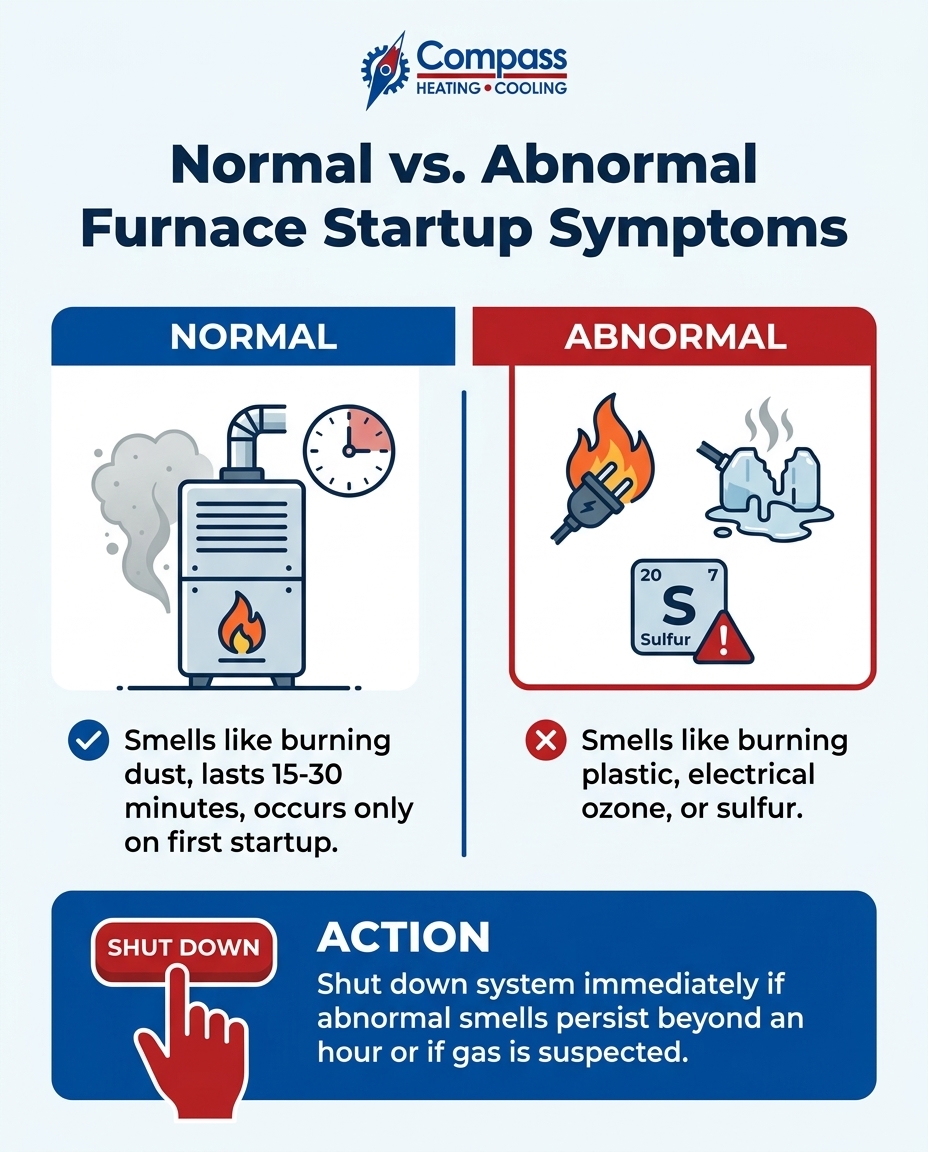
Normal dust burn-off has a very specific profile. It typically smells exactly like burning dust or warm dirt. This odor should only appear the very first time you turn the system on for the season. More importantly, it should dissipate completely within 15 to 30 minutes of continuous operation. If you open a few windows to ventilate the house, the smell should clear out and not return during subsequent heating cycles.
Hazardous odors, on the other hand, indicate that something is physically melting, short-circuiting, or leaking. These smells do not fade away; they often grow stronger the longer the system runs.
Symptom Identification Guide
• Warm, dry, burning dust — Likely Cause: Dust settling on the heat exchanger over the summer — Severity & Duration: Low. Lasts 15-30 minutes on the first startup only. — Immediate Action Required: Monitor the system. Open windows to ventilate. No repair needed if it fades.
• Acrid burning plastic or rubber — Likely Cause: Melting wire casing, failing capacitor, or a foreign object in the ductwork — Severity & Duration: High. Persists and worsens as the furnace runs. — Immediate Action Required: Shut down the system immediately at the thermostat. Call for diagnostics.
• Sharp electrical or "ozone" smell — Likely Cause: Overheating blower motor, seizing bearings, or failing circuit board — Severity & Duration: High. Often accompanied by humming or grinding noises. — Immediate Action Required: Turn off power at the breaker panel. Do not run the system.
• Rotten eggs or sulfur — Likely Cause: Natural gas leak near the furnace or gas lines — Severity & Duration: Critical. Immediate safety hazard. — Immediate Action Required: Evacuate the home immediately. Call your gas provider and emergency services.
The golden rule of furnace smells: Persistent odors after the first hour of operation are never normal. If your home still smells like burning material after a full heating cycle, or if the smell returns on the second or third day of use, you must have the system evaluated by a professional.
Short-Cycling: Common Causes and Safe Home Maintenance Tips
Aside from unusual odors, the second most alarming issue homeowners face during the fall startup is short-cycling. Short-cycling occurs when your furnace turns on, runs for a brief period (often just a few minutes), and then abruptly shuts down before the house reaches the temperature set on the thermostat. The system will then repeatedly try to start again, creating a frustrating loop of starting and stopping.
This rapid cycling places incredible wear and tear on the starting components and the blower motor. Over time, it dramatically shortens the lifespan of your equipment and drives up your monthly energy usage. Fortunately, the most common cause of short-cycling is something you can address safely on your own.
Safe DIY Maintenance Checks
• Inspect the air filter: A clogged, dirty air filter is the leading culprit for short-cycling. When airflow is restricted, the heat generated by the burners cannot escape into your ductwork. The internal temperature of the furnace spikes, tripping the high-limit safety switch, which shuts the system down to prevent a fire. Check your filter monthly and replace it if it looks gray or opaque.
• Verify thermostat settings: Ensure your thermostat is set to "Heat" and that the fan is set to "Auto." Sometimes, a thermostat placed in direct sunlight or near a heat-producing appliance will misread the room temperature, causing the system to shut off prematurely.
• Check all room vents: Walk through your home and confirm that all supply registers and return grilles are fully open and unobstructed. Blocking vents with furniture, rugs, or curtains chokes the system's airflow.
One pattern our Compass Heating & Cooling technicians see often is that airflow problems are not exclusive to winter. If your system struggled with poor airflow or frozen coils during the summer, those underlying ductwork or blower issues will carry over into the heating season. In these cases, scheduling comprehensive air conditioning system diagnostics alongside your heating check can uncover hidden airflow restrictions affecting the entire HVAC setup.
When to Stop Troubleshooting and Call for Professional Diagnostics
While checking filters and clearing vents are safe and necessary tasks, there is a hard line where homeowner troubleshooting must end and professional intervention must begin. Modern heating equipment involves high-voltage electricity, combustible gases, and complex exhaust venting. Attempting to repair internal components without proper training puts your home at severe risk of fire or carbon monoxide exposure.
Recognizing the Red Flags
You should stop troubleshooting and contact a professional immediately if you observe any of the following red flags:
• Repeated short-cycling after a filter change: If you have installed a fresh filter and verified your vents are open, but the system still shuts down after three minutes, the limit switch may be failing, or the blower motor may be overheating.
• Strange metallic noises: Grinding, squealing, or loud banging sounds indicate failing bearings, loose belts, or delayed ignition in the burners.
• Tripped circuit breakers: If your furnace repeatedly trips the breaker at your electrical panel, there is a serious short circuit that requires immediate attention.
The risks of ignoring these signs are steep. Pushing a struggling system through the early fall months often results in a complete, catastrophic failure right in the middle of a harsh winter storm. Worse, ignoring airflow issues or strange noises can lead to a cracked heat exchanger, which allows deadly carbon monoxide to mix with your breathing air.
This is where the value of our experienced Loveland HVAC technicians becomes clear. At Compass Heating & Cooling, we focus on honest, accurate diagnostics over aggressive sales tactics. The goal is to provide a clear picture of what is actually failing, ensuring you only proceed with necessary repairs rather than being pressured into a full replacement over a minor sensor issue.
Why High-Cost Repair Quotes Warrant an HVAC Second Opinion
If you schedule a routine fall startup check and the technician suddenly condemns your system, telling you that it is unsafe to operate and must be replaced immediately, you have the right to pause. High-cost repair quotes, especially those that push for total system replacement on the spot, always warrant verification.
The Reality of Complex Modern Equipment
Modern HVAC systems are highly complex, relying on intricate circuit boards, variable-speed motors, and sensitive safety switches. Because of this complexity, misdiagnoses can and do happen. A technician might mistake a failing, easily replaceable limit sensor for a cracked heat exchanger, or they might misinterpret a system lockout code. In some unfortunate cases, high-pressure sales tactics are used to convince homeowners that a repairable system is completely dead.
What a Trustworthy Second Look Involves
If you feel rushed, pressured, or confused by a severe diagnosis, seeking a second opinion is the smartest move you can make for your peace of mind. A trustworthy second evaluation should include:
• Transparent explanations: The technician should be able to show you exactly what is broken, using a camera or testing equipment, rather than just telling you it is broken.
• A focus on repairability: An honest assessment looks for ways to safely repair the system first, laying out the mechanical realities of repair versus replacement so you can make an informed choice.
• No artificial urgency: While safety is paramount, a reputable professional will respect your need to think over a major investment and will not use fear-mongering to force a signature.
Understanding why it is important to get a second opinion on HVAC work protects your investment and ensures that when you do decide to upgrade your system, you are doing so based on facts, not panic.
Secure Your Winter Comfort with Honest Diagnostics
Knowing the difference between normal seasonal dust burn-off and a serious mechanical issue gives you the confidence to operate your heating system safely. When the temperature drops and the snow begins to fall, you deserve a home that feels warm and secure, without the lingering worry of strange smells or erratic cycling.
If your system is showing signs of struggle, a clear, honest breakdown of its health is just a phone call away. You do not have to guess whether your furnace is safe to run. Schedule a professional inspection with our team or request a thorough second opinion today to ensure your equipment is ready to handle whatever the winter season brings.
hear what our satisfied clients have to say
Our clients consistently praise our exceptional service and attention to detail. They appreciate the personalized approach we take to meet their unique needs, ensuring satisfaction every step of the way.
.png)