


Decoding Fall Furnace Troubleshooting: When to Get an HVAC Second Opinion
Is That Fall Furnace Smell Normal or a Cause for Concern?
When you start looking up home maintenance tips and troubleshooting advice, it is usually because something in your house just made a strange noise or emitted an alarming odor. Are you noticing a distinct burning smell coming from your vents right now? You are certainly not alone. Here at Compass Heating & Cooling, we know that turning on the heating system for the first time after months of dormancy often brings a moment of anxiety for Loveland homeowners. You expect warm air, but instead, you are greeted by an unsettling odor that immediately makes you wonder if something is catching fire inside your ductwork.
During that first fall heating startup in October, it is completely normal to feel a bit on edge. Your heating equipment has been sitting idle all summer, and asking it to suddenly perform requires a shift in how the system operates. The critical challenge for any homeowner is learning how to distinguish between a harmless, temporary dust burn-off and a genuine mechanical failure that requires immediate professional intervention.
Understanding these early warning signs empowers you to make smart, safe decisions about your home comfort. Knowing exactly what to look for—and what to listen for—ensures you know when to simply open a window to ventilate the house, and when it is time to bring in an expert. If you are ever in doubt about your system's safety, reaching out for professional residential HVAC services is always the right call. A thorough heating system diagnosis and repair can pinpoint exactly what is happening behind the metal cabinet, giving you peace of mind as the colder months approach.
What to Expect During the Initial Heating Startup
To understand why your furnace behaves the way it does in the fall, it helps to look at the science of what happens during the off-season. Throughout the spring and summer, microscopic dust particles, pet dander, and airborne debris circulate through your home. Even with a good air filter, a small amount of this particulate matter settles directly onto your furnace's heat exchanger—the metal component that gets incredibly hot to warm your indoor air.
As the first cold snaps hit Northern Colorado, systems are suddenly asked to perform at high capacity after months of dormancy. When the burners ignite for the first time, those settled dust particles are instantly incinerated. This is exactly what creates that dusty, slightly burnt odor. Here is what our technicians tell homeowners a normal, healthy startup sequence should look and feel like during your first fall heating startup in October:
1. The thermostat calls for heat: You will hear a soft click from your thermostat, signaling the control board to begin the heating sequence.
2. The draft inducer motor starts: Before any gas is released, a small motor kicks on to clear residual gases out of the heat exchanger and ensure proper drafting through the exhaust flue. This sounds like a low, steady hum.
3. The igniter activates: Depending on your system's age, you may hear the rapid clicking of a spark igniter or the silent glow of a hot surface igniter warming up.
4. The burners ignite: You will hear a distinct "whoosh" as the gas valve opens and the burners light. The flames should be a steady, bright blue.
5. The blower fan engages: After a brief delay to allow the heat exchanger to warm up, the main blower fan kicks on, pushing warm air through your vents. This is when you will first notice the dust smell.
In a healthy system, this normal burn-off odor should dissipate entirely within 30 to 60 minutes of continuous operation. Proper ventilation during this initial phase is a standard part of seasonal home maintenance. Simply open a few windows to let the smell escape while the system runs its first full cycle. If the system sounds steady, the airflow is strong, and the smell fades, your furnace is operating exactly as designed.
Harmless Burn-Off vs. Dangerous Symptoms: A Side-by-Side Comparison
While a temporary dusty odor is nothing to worry about, other symptoms are clear indicators of a mechanical breakdown or a safety hazard. Knowing the precise thresholds between "monitor this" and "shut the system off immediately" is crucial for protecting your home.
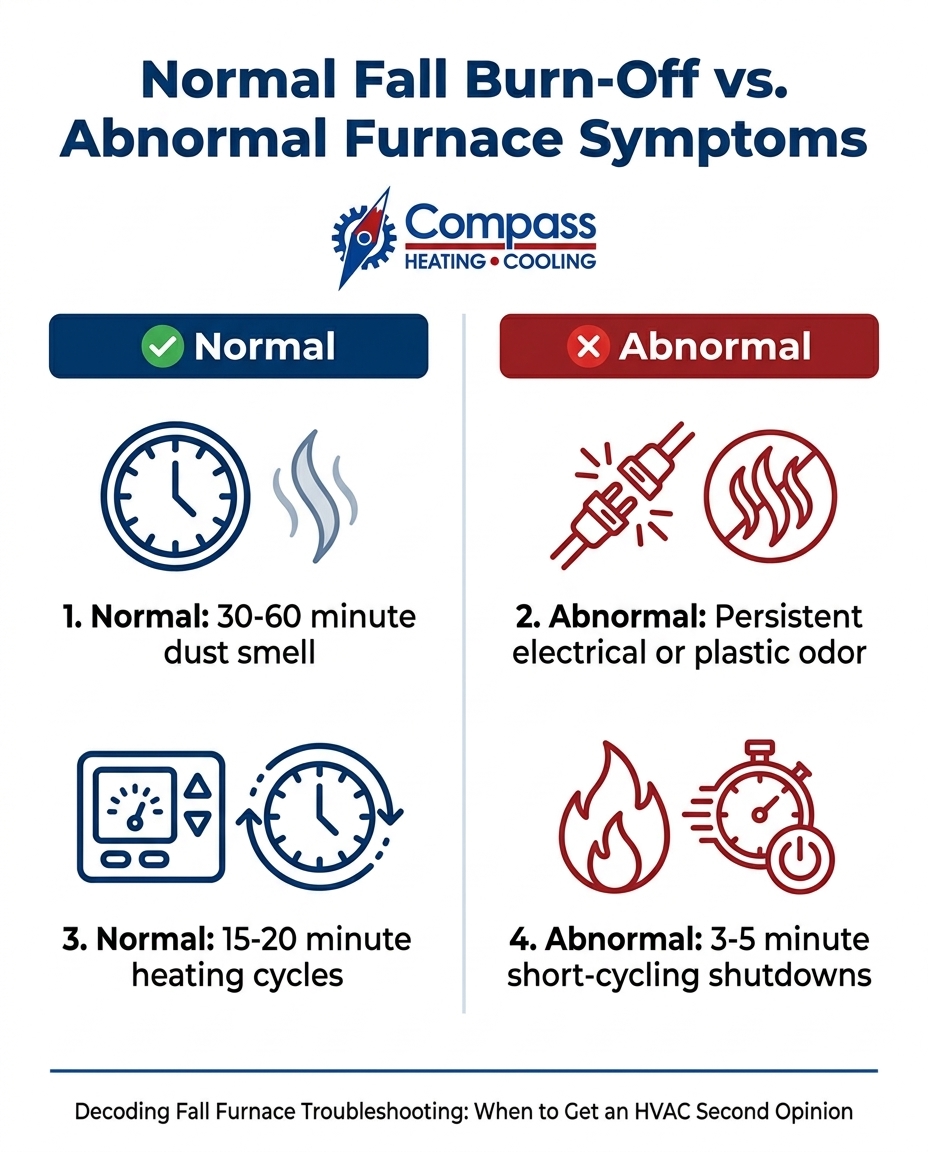
One of the most alarming red flags our team encounters is a system cycling off after 3-5 minutes of operation. A healthy heating cycle should last roughly 15 to 20 minutes to evenly warm your home. Rapid on-and-off behavior indicates the system is failing to complete its primary function. Use the comparison table below to evaluate your system's behavior.
• Odors from Vents — Normal Operation (Monitor): Smells like burning dust or lint; fades within 30 to 60 minutes. — Dangerous Malfunction (Call a Pro): Smells like melting plastic, burning wires, or sulfur (rotten eggs).
• Heating Cycle Length — Normal Operation (Monitor): Runs continuously for 15 to 20 minutes until the target temperature is reached. — Dangerous Malfunction (Call a Pro): Short-cycles, shutting down completely after just 3 to 5 minutes.
• Startup Noises — Normal Operation (Monitor): A soft "whoosh" of ignition, followed by a steady hum of the blower motor. — Dangerous Malfunction (Call a Pro): Loud banging, grinding metal, or a delayed "boom" upon ignition.
• Airflow Quality — Normal Operation (Monitor): Strong, consistent, and warm air blowing from all open supply registers. — Dangerous Malfunction (Call a Pro): Weak, lukewarm, or completely cold air blowing while the system runs.
If you notice any of the symptoms in the "Dangerous Malfunction" column, do not wait to see if the problem resolves itself. Turn your thermostat to the "off" position to prevent further damage to the unit or potential safety hazards in your home.
Safe Homeowner Troubleshooting: What You Can Check Yourself
When your system acts up during that first fall heating startup in October, there are several safe, non-technical steps you can take before picking up the phone. A pattern we see often on our fall service calls is that many common heating issues stem from simple oversights that do not require a technician to fix. However, it is vital to know where a homeowner's responsibilities end and a licensed professional's duties begin.
Here is a safe checklist to run through if your system is underperforming:
• Verify the thermostat settings: It sounds obvious, but ensure the thermostat is actually switched to "Heat" and not left on "Cool" or "Off" from the summer. Verify that the fan setting is on "Auto" rather than "On" so it doesn't blow cold air between heating cycles.
• Check and replace the HVAC air filter: A clogged, dirty air filter is the number one culprit for airflow restriction. If the filter is caked in dust, the blower motor cannot pull enough air through the system, which leads to immediate overheating.
• Ensure all household vents are open: Walk through your home and check every supply and return register. Make sure none of them are blocked by heavy furniture, rugs, or drapes. Closing vents in unused rooms actually increases static pressure inside the ductwork, straining the blower motor.
• Check the circuit breaker: Look at your home's main electrical panel to ensure the breaker dedicated to your furnace has not tripped. If it has, you can reset it once. If it trips again immediately, leave it alone—you have an electrical short.
What you should NEVER do: Do not open the furnace cabinet to attempt internal repairs. Never try to clean the flame sensor, adjust the gas valve, or bypass any safety switches. These components handle combustible gas and high-voltage electricity. Tampering with them is incredibly dangerous and requires a licensed professional. To keep these internal components running safely year after year, we always recommend enrolling in a preventative HVAC maintenance plan so an expert can tune them up before the cold weather arrives.
The Mechanics of Short-Cycling: Why Your System Protects Itself
If your system is firing up, blowing warm air briefly, and then abruptly shutting down, it is experiencing a phenomenon known as short-cycling. In our experience working on Loveland homes, understanding the mechanics behind this behavior is crucial because short-cycling is not just an annoyance—it is a built-in safety mechanism designed to prevent catastrophic overheating or fire hazards.
The Problem: You set the thermostat to 72 degrees. The furnace turns on, but you notice the system cycling off after 3-5 minutes, long before the house actually reaches the target temperature. It waits a few minutes, turns back on, and repeats the rapid cycle.
The Cause: The most common cause of short-cycling is restricted airflow. When a dirty filter or blocked vents prevent cool air from flowing over the heat exchanger, the internal temperature of the furnace spikes rapidly. The system physically cannot get rid of the heat it is generating. Other potential causes include a dirty flame sensor (which fails to detect the burner flame and shuts off the gas as a precaution) or an oversized unit that heats the immediate area too quickly, tricking the thermostat into shutting down prematurely.
The Solution: If changing the air filter and opening all vents does not resolve the rapid cycling, the system requires a professional diagnostic. Ignoring a short-cycling furnace forces the heat exchanger to expand and contract rapidly, leading to metal fatigue and, eventually, a cracked heat exchanger.
The Role of the High-Limit Switch
The unsung hero of your furnace's safety system is the high-limit switch. This small probe extends directly into the heat exchanger chamber to monitor internal temperatures. If the temperature exceeds a safe threshold (usually due to that restricted airflow), the high-limit switch trips. It immediately shuts down the gas burners to stop heat production, while keeping the blower fan running to cool the overheated metal down. Once the chamber cools, the switch resets, and the furnace tries to run again—creating the endless loop of short-cycling.
Navigating High-Stakes Diagnoses: The Value of an HVAC Second Opinion
Sudden heating failures often happen at the worst possible times. When a system breaks down during that first fall heating startup in October, homeowners are left vulnerable. The house is getting cold, the family is uncomfortable, and the pressure to make a fast decision is incredibly high. If a technician inspects your short-cycling system and delivers a major, high-cost diagnosis—such as a cracked heat exchanger or a recommendation for a full system replacement—it is entirely reasonable to pause and seek verification.
Major diagnoses warrant a second look. A cracked heat exchanger, for example, is a severe safety hazard because it can allow carbon monoxide to leak into your home's breathing air. If a technician condemns your system for this reason, they are required to shut it down for your safety. However, because replacing a heat exchanger or installing a whole new furnace is a significant investment, getting a secondary diagnostic protects you from misdiagnoses or high-pressure sales tactics.
A second opinion provides absolute peace of mind. During a secondary diagnostic, a different technician will perform a fresh evaluation. They will use specialized tools, such as combustion analyzers and digital inspection cameras, to verify the exact condition of the internal components. If you are ever unsure about a major repair quote, understanding what to expect during an AC second opinion or heating second opinion can help you prepare for the visit and ensure you are making a fully informed decision.
Choosing a Transparent Professional to Verify Your System's Health
When you need to verify a major diagnosis, the contractor you choose matters just as much as the tools they use. You need a professional who prioritizes education over urgency. Trustworthy professionals actively encourage second opinions because they are confident in their diagnostics and want you to feel comfortable with the proposed solution.
Look for traits of a reputable contractor: transparent communication, a willingness to answer all your questions, and an eagerness to actually show you the problem. If a technician claims your heat exchanger is cracked, they should be able to show you the crack using an inspection camera or explain the specific readings on their combustion analyzer that led to that conclusion.
Local expertise is also critical. Northern Colorado's extreme temperature swings make a reliable, accurate diagnosis critical for long-term comfort and safety. A system that works fine in mild weather might struggle severely when the temperature drops below freezing. As your dedicated Loveland HVAC contractors, our team at Compass Heating & Cooling is committed to honest, transparent local expertise. We believe that reputable companies should always empower homeowners with facts, not fear.
To prepare for a second opinion visit, gather any documentation from the first technician. Have their diagnostic notes, the specific parts they claimed were failing, and their written quotes available. However, you do not necessarily need to share the quoted price with the second technician right away—just the symptoms and the diagnosis. For example, if you tell them you noticed the system cycling off after 3-5 minutes, they can focus their testing on the airflow, the high-limit switch, and the heat exchanger to verify the root cause.
Frequently Asked Questions About Furnace Startups and Second Opinions
Why does my furnace turn off after 5 minutes?
When a furnace turns off after just a few minutes, it is experiencing short-cycling, which is usually a safety shutdown. The system cycling off after 3-5 minutes typically means the internal components are overheating due to restricted airflow. It can also be caused by a dirty flame sensor failing to read the burner flame. You should check your air filter immediately, but if the filter is clean, a professional needs to diagnose the exact cause.
How long does the burning smell last when turning on the heater?
A normal dust burn-off smell should dissipate within 30 to 60 minutes of the system running. This odor is simply the incinerated dust that settled on the heat exchanger over the summer. If the smell persists for several hours, or if it smells like melting plastic or burning wires, turn the system off and call an HVAC technician.
Can a dirty filter cause a furnace to short cycle?
Yes, a dirty filter is the most common cause of short-cycling. Severe airflow restriction prevents the blower motor from moving cool air over the heat exchanger. This causes the internal temperature to spike rapidly, tripping the high-limit safety switch and forcing the burners to shut down to prevent a fire hazard.
Do I need a second opinion for a cracked heat exchanger?
We strongly advise getting a second opinion if you are told your heat exchanger is cracked. This is a high-stakes safety issue that usually requires a very costly repair or a full system replacement. A reputable second contractor will use a digital camera or combustion analyzer to definitively prove the crack exists before asking you to make a major financial decision.
What should I do if my new furnace smells like burning plastic?
Turn off the system immediately at the thermostat. While a dusty smell is normal during startup, odors resembling burning plastic, melting rubber, or electrical wires are never normal. These smells indicate a serious electrical short, a failing motor, or debris melting inside the cabinet, and require immediate professional attention.
Make Confident Heating Decisions This Fall
Navigating the quirks of your heating system does not have to be a stressful experience. By understanding the difference between normal seasonal odors and alarming mechanical symptoms, you are fully equipped to protect your home. Remember that during your first fall heating startup in October, a brief dusty smell is expected, but rapid shutdowns and persistent harsh odors are not.
If you find yourself facing a major repair quote, never hesitate to seek verification. Seeking a second opinion is a smart, standard practice that ensures you receive an honest, accurate assessment of your equipment. If your system is struggling to stay on, or if you simply want the peace of mind that comes with a clean bill of health, schedule a professional inspection today. Your comfort and safety are always worth a closer look.
hear what our satisfied clients have to say
Our clients consistently praise our exceptional service and attention to detail. They appreciate the personalized approach we take to meet their unique needs, ensuring satisfaction every step of the way.
.png)