



Why Your Furnace Won't Turn On After a Power Outage (And What to Check First)
Restoring Heat After a Winter Storm Outage
Before the first major freeze hits, there is one scenario every homeowner dreads: discovering their furnace wont turn on after power outage. The grid electricity finally returns, the lights come back on, but the house remains uncomfortably cold. When you are dealing with the aftermath of November early-winter snowstorm outages, the immediate panic of a silent heating system is completely understandable. You expect the furnace to reboot automatically alongside your refrigerator and living room lamps, but HVAC systems operate under a much stricter set of safety protocols.
If your system is unresponsive, a professional assessment of your HVAC services is often the safest next step. The reality of power restoration is that it rarely happens smoothly. When electricity floods back into the grid, it frequently creates electrical surges that can disrupt sensitive mechanical equipment. In our years serving Loveland and the surrounding Northern Colorado communities, the Compass Heating & Cooling team has seen firsthand how late fall and winter bring rapid, freezing temperature drops, making getting the heat back on quickly an urgent priority to protect both your family and your property.
Fortunately, a silent furnace does not always mean a broken furnace. By taking a safety-first diagnostic approach, you can determine if the system simply needs a basic reset or if it has sustained electrical damage. There are several safe, straightforward checks any homeowner can perform before picking up the phone, helping you rule out minor tripped switches and dead batteries while avoiding dangerous internal components.
Why a Power Restoration Surge Causes Furnace Lockouts
To understand why your heating system is locked out, you have to look at what happens the exact moment the electricity returns. The sudden rush of voltage when the grid comes back online acts as a localized power surge. While your lights might simply flicker, your heating system is absorbing a significant spike in electrical current.
Our technicians often remind homeowners that modern furnaces are highly sophisticated machines. They no longer rely on simple mechanical switches; instead, they are governed by sensitive electronic control boards that monitor every phase of the heating cycle. These boards are designed to detect irregularities in voltage, gas flow, and exhaust ventilation. When a power surge hits, the control board's built-in safety mechanisms will intentionally lock the system out to prevent electrical fires, gas leaks, or further damage to the blower motor.
The Shift to Electronic Diagnostics
This protective behavior is a direct result of how heating technology has evolved. If you are wondering why modern furnaces don't have pilot lights, it is because electronic ignitions and computerized sensors offer vastly superior safety and efficiency. However, this same technology makes them vulnerable to electrical spikes.
• Ignition Source — Older Mechanical Furnaces: Standing pilot light (constant gas flame) — Modern Electronic Furnaces: Electronic hot surface ignitor or spark ignition
• Safety Controls — Older Mechanical Furnaces: Basic mechanical thermocouples — Modern Electronic Furnaces: Microprocessor control boards with fault memory
• Post-Outage Behavior — Older Mechanical Furnaces: Often requires manual relighting of the pilot — Modern Electronic Furnaces: Enters an automatic diagnostic delay or hard lockout
• Surge Vulnerability — Older Mechanical Furnaces: Low (fewer sensitive electronics) — Modern Electronic Furnaces: High (power spikes can fry the control board)
When these modern safety features trigger, the result is often a completely unresponsive system. You might notice blank thermostat screens and flashing diagnostic furnace codes visible through the lower cabinet door. These flashes are the system's way of communicating exactly which safety parameter was breached during the outage.
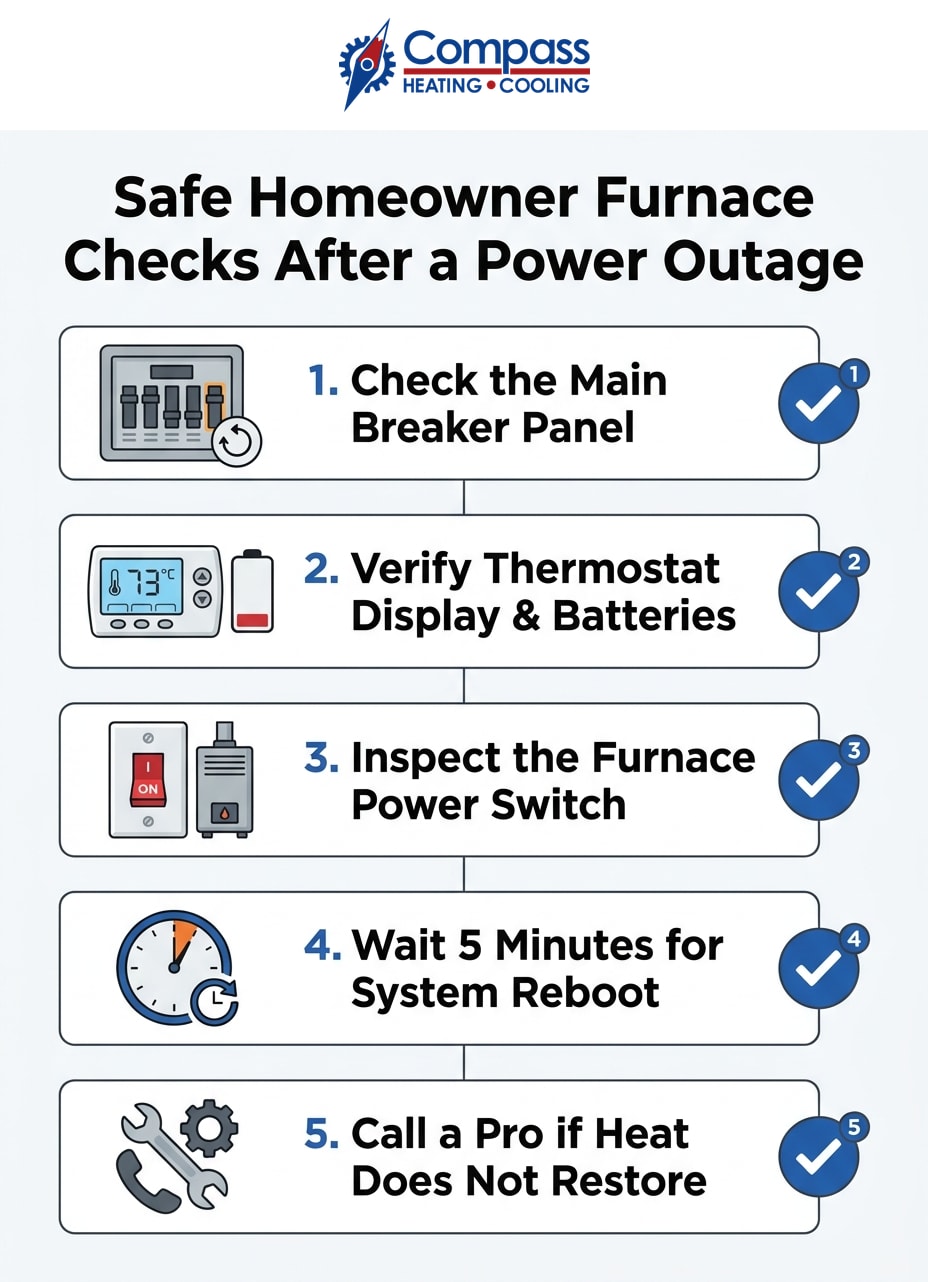
Safe Homeowner Check #1: The Main Electrical Panel
The very first and safest troubleshooting step takes place away from the furnace itself. During November early-winter snowstorm outages, our team frequently responds to calls where power fluctuations have caused circuit breakers to trip as a protective measure. Your furnace may be perfectly fine, but it has been physically disconnected from your home's power supply.
Follow these steps to safely inspect your electrical panel:
1. Locate your main electrical panel: This is usually found in a garage, basement, utility room, or hallway. Ensure your hands are dry and you are standing on a dry surface before touching the panel.
2. Identify the furnace breaker: Look for the label marked "Furnace," "HVAC," or "Air Handler." If the panel is poorly labeled, look for a high-amp breaker (often double-pole) that appears out of alignment with the others.
3. Check for a tripped position: A tripped breaker rarely flips all the way to the "Off" side. Instead, it rests in a spongy, middle position. It will not line up perfectly with the active breakers.
4. Reset the breaker safely: To restore power, you must first push the breaker firmly all the way to the "Off" position until you feel a click. Then, push it firmly back to the "On" position.
5. Observe the result: Return to the thermostat and wait a few minutes. If the breaker immediately trips again with a loud pop, stop immediately. This indicates a severe short circuit or electrical fault, and attempting to reset it again can cause a fire. You must call a professional.
Safe Homeowner Check #2: Thermostat Display and Settings
If the breaker is securely in the "On" position, the next checkpoint is the thermostat. A power interruption can sever the communication between your wall unit and your heating equipment, leaving the system stranded without instructions.
It is a pattern we see often after grid instability: blank thermostat screens and flashing diagnostic furnace codes. A blank screen means the thermostat is not receiving low-voltage power from the furnace control board, or its internal backup has failed. Run through this checklist to verify your controls:
• Inspect the display screen: Is the screen completely dark, or is it showing an error message? A dark screen usually points to a blown low-voltage fuse inside the furnace cabinet, which requires professional replacement.
• Replace the batteries: Many modern thermostats rely on a hardwired connection but use AA or AAA batteries for backup memory. If the power was out for an extended period, these batteries might have drained. Swap them out for a fresh set.
• Verify the system settings: When power is restored, some digital thermostats revert to their factory default settings. Ensure the system mode is explicitly set to "Heat" (not "Off" or "Cool").
• Check the fan setting: The fan switch should be set to "Auto." If it is set to "On," the blower will run continuously, blowing unheated air through your vents even when the burners are inactive, which can make the house feel even colder.
• Adjust the temperature: Turn the target temperature at least five degrees higher than the current room temperature to force a clear call for heat.
Safe Homeowner Check #3: The Furnace Power Switch
If the breaker is fine and the thermostat is calling for heat, the issue might be a localized power disconnect. Every modern heating system is required by code to have a dedicated shut-off switch located within sight of the equipment.
This switch often looks exactly like a standard residential light switch, mounted on the side of the furnace cabinet, on a nearby wall, or on a ceiling joist above the unit. Because of its appearance, we frequently find it is the culprit behind unexplained lockouts.
1. Inspect the switch position: Ensure the toggle is flipped up to the "On" position. During the chaos of a power outage, someone navigating the dark with a flashlight might have bumped it, or a family member might have intentionally turned it off as a precaution and forgotten to turn it back on.
2. Locate the internal reset button (with caution): Many systems have a physical reset button located inside the blower compartment. Warning: You should only press this button once. Repeatedly pressing the reset button can flood the combustion chamber with unburned gas or force a failing electrical component to overheat.
3. Wait for the reboot cycle: After verifying the power switch is on and pressing the reset button a single time, step back and wait. Modern systems have a built-in safety delay that lasts between three and five minutes before they will even attempt to ignite.
If you have waited ten minutes and the system still shows blank thermostat screens and flashing diagnostic furnace codes, you have exhausted the safe homeowner troubleshooting steps.
The Safety Boundary: When to Stop Troubleshooting
There is a distinct line between basic homeowner maintenance and dangerous mechanical interference. When a system remains unresponsive after checking the breaker, thermostat, and power switch, you have reached that boundary. Opening the main furnace cabinet to inspect internal wiring, test voltage, or manipulate gas valves is strictly for licensed professionals.
During November early-winter snowstorm outages, homeowners often feel pressured to attempt DIY repairs to get the heat back on. We strongly advise against this, as it is highly dangerous. Bypassing safety switches or using jumper wires to force a system to ignite removes the very protections designed to prevent carbon monoxide leaks and house fires. If a power surge has damaged your control board, the board cannot properly regulate the sequence of operations. It may open the gas valve without engaging the ignitor, creating an immediate hazard.
The Risk of Surge-Damaged Components
When a control board is fried by a grid surge, it cannot be reset; it must be diagnosed with professional multimeters and replaced with exact manufacturer-specified parts. Our crew at Compass Heating & Cooling brings extensive expertise in responding to Front Range winter storm emergencies safely and reliably, ensuring your equipment is thoroughly tested before any new components are installed. Relying on professional Loveland heating services is the fastest and safest route to restoring your home's comfort without risking your family's safety or voiding your equipment warranty.
Protecting Your Home from Frozen Pipes During a Lockout
While you wait for professional repairs, you face a secondary emergency: the threat of freezing plumbing. In Northern Colorado, harsh freezing temperatures can cause a home's internal temperature to plummet rapidly once the heating system fails. If the power is back on but the furnace is dead, your pipes are on a ticking clock.
To protect your home during the wait for service following November early-winter snowstorm outages, we always advise our Loveland customers to implement these immediate mitigation strategies:
• Leave faucets on a slow drip: Moving water is much harder to freeze. Open both the hot and cold taps slightly on sinks located against exterior walls. Even a slow drip relieves the pressure buildup that actually causes pipes to burst.
• Open under-sink cabinet doors: Plumbers often route pipes through enclosed cabinets in kitchens and bathrooms, which blocks the ambient heat of the room from reaching them. Opening these doors allows whatever residual warmth is left in the house to circulate around the plumbing.
• Seal off unused rooms: Close the doors to guest bedrooms, offices, or storage areas to concentrate the remaining warm air in the central living spaces where the main plumbing lines run.
• Use safe supplemental heat: If you have electric space heaters (since your power is restored), place them safely in rooms with exposed plumbing. Never leave them unattended or plug them into extension cords.
Once the immediate crisis is resolved, the best defense against future lockouts is a proactive approach. Scheduling routine furnace maintenance ensures your system's electrical connections are tight, fuses are fresh, and safety sensors are calibrated to handle the stress of the winter season.
Frequently Asked Questions About Post-Outage Furnace Resets
How do I reset my furnace after a power outage?
Check the breaker, verify the thermostat, and ensure the furnace switch is on. If it has a reset button, press it only once. Start by ensuring the main electrical panel hasn't tripped the HVAC breaker. Next, confirm your thermostat has fresh batteries and is set to "Heat." Finally, check the physical power switch near the furnace unit. If the system has an internal reset limit switch, press it a single time and wait five minutes. If it does not turn on, you must call a licensed professional, like our team at Compass Heating & Cooling, to assess the electrical components.
Why is my thermostat blank after a power outage?
A blank screen usually indicates tripped breakers, dead batteries, or a blown fuse on the furnace control board caused by a power surge. When grid electricity returns with a spike, it frequently blows the small 3-amp or 5-amp automotive-style fuse located on the furnace's internal circuit board to protect the main processor. Because the thermostat relies on this board for low-voltage power, the screen goes completely dark. You may also notice blank thermostat screens and flashing diagnostic furnace codes simultaneously.
Does a gas furnace need electricity to run?
Yes, gas furnaces require electricity to power the blower motor, electronic ignition, and control board. While the actual heat is generated by burning natural gas or propane, the system cannot operate without electrical power. Electricity is required to open the gas valve, ignite the flame, monitor the safety sensors, and spin the large fan that pushes the heated air through your ductwork.
How long does it take for a furnace to turn on after a power outage?
Many modern furnaces have a built-in delay of 3 to 5 minutes before restarting to protect the compressor and electrical components. This delay prevents the system from rapidly turning on and off if the grid power is fluctuating. During this time, the control board is running a self-diagnostic check to ensure all safety parameters are met. Do not repeatedly adjust the thermostat or press the reset button during this waiting period.
Can a power surge permanently damage my furnace control board?
Yes, the sudden spike in voltage when grid power is restored can short out sensitive electronic components, requiring professional replacement. The microprocessors on a modern control board are highly vulnerable to electrical surges. If the board is fried, the furnace will remain in a hard lockout state and cannot be reset manually. A licensed technician must use a multimeter to verify the board has failed and install a replacement.
Get Professional Help for Your Winter Heating Emergency
Dealing with a heating failure after November early-winter snowstorm outages is stressful, but following a safety-first approach protects your home from serious hazards. If you have checked your electrical panel, verified your thermostat settings, and ensured the furnace power switch is active, but the system remains silent, it is time to stop troubleshooting. Continuing to push reset buttons or opening the cabinet exposes you to dangerous high-voltage and gas risks. Restoring your heat quickly is vital for protecting your property from frozen pipes and keeping your family safe during a cold snap. Do not wait for the temperature inside your home to drop further; schedule professional heating repair immediately so our licensed technicians can safely diagnose the surge damage and get your system running again.
hear what our satisfied clients have to say
Our clients consistently praise our exceptional service and attention to detail. They appreciate the personalized approach we take to meet their unique needs, ensuring satisfaction every step of the way.
