


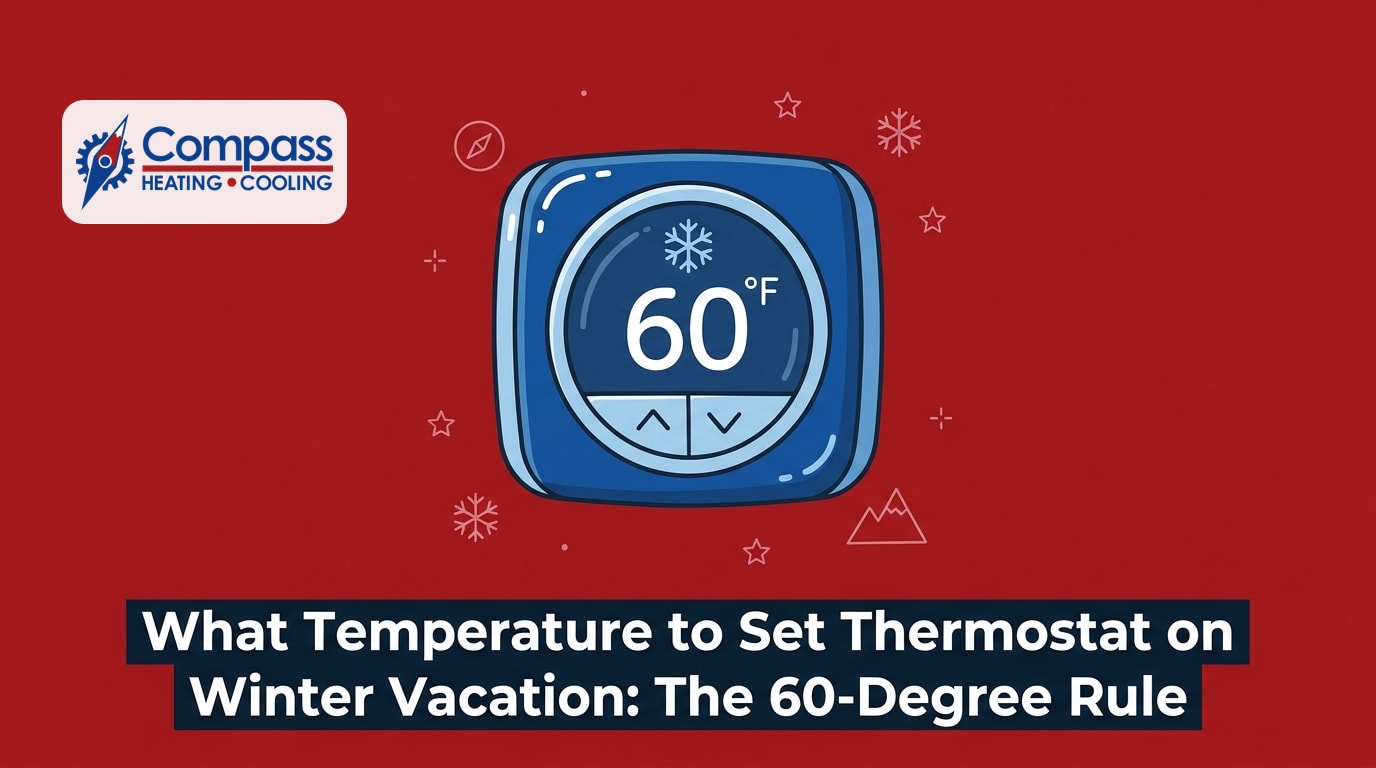
What Temperature to Set Thermostat on Winter Vacation: The 60-Degree Rule
Planning a Winter Getaway? Don't Let Your Thermostat Setting Ruin the Trip
Are you finalizing your packing for upcoming holiday travel and wondering exactly what temperature to set thermostat on winter vacation? At Compass Heating & Cooling, it is a question our team hears from almost every homeowner right before they lock the front door and head to the airport. November marks the beginning of the busy holiday travel season, but it also kicks off the most volatile weather months of the year. In the rush to pack suitcases and coordinate flights, many homeowners make a critical, well-intentioned mistake: drastically dropping their indoor temperature to maximize energy savings while the house is empty.
The logic seems sound at first glance. If nobody is home to enjoy the warmth, why keep the furnace running? However, your central heating system does much more than just keep your family comfortable. During the harsh winter months, it serves as your property's primary defense against catastrophic structural and water damage. The temperature you select right before you leave determines whether your home can withstand a sudden cold snap while you are miles away.
Before you depart, securing a preventative HVAC maintenance plan ensures your equipment will not unexpectedly shut down while you are away. But even a perfectly maintained system can only protect your home if the thermostat is set correctly. The setting you choose is the only thing standing between a peaceful return home and a disastrous, water-logged emergency.
What Temperature to Set Thermostat on Winter Vacation
The short answer is clear: Set your thermostat to no lower than 60 degrees Fahrenheit when leaving for a winter vacation.
This 60-degree minimum safe baseline acts as a critical thermal buffer for your entire house. When you search online for winter energy-saving tips, you will frequently encounter generic advice suggesting you drop your thermostat to 50 or 55 degrees while traveling. While that might work in mild, temperate coastal climates, it is a highly dangerous practice in regions that experience true winter freezes.
Here is why the 60-degree rule is an essential insurance policy for your home:
• Ambient Heat Loss: Heat naturally moves toward the cold. Your furnace needs to generate enough ambient warmth to penetrate through the air in your rooms and reach the structure's perimeter.
• System Reaction Time: If the temperature drops rapidly outside, a house sitting at 60 degrees has a head start. The furnace has enough of a buffer to kick on and maintain warmth before the chill penetrates the walls. A house sitting at 50 degrees has almost zero margin for error.
• Structural Protection: Your home's drywall, flooring, and interior framing all absorb and hold heat (known as thermal mass). Keeping the baseline at 60 degrees ensures the physical structure of your home retains enough warmth to fight off external freezing temperatures.
Ultimately, treating your thermostat setting as a simple energy-saving tool ignores its more important role: protecting your plumbing. The utility savings you might gain by dropping the dial to 50 degrees will instantly be wiped out by the massive repair bills associated with a single frozen pipe.
The Hidden Danger: Central Thermostats vs. Exterior Walls
To understand why a 60-degree minimum safe baseline is necessary, you have to look at the physics of how your home is built and where your thermostat is located. Most thermostats are mounted on an interior wall in a central hallway or living room. This location is heavily insulated from the outdoor elements, surrounded by other conditioned rooms, and represents the warmest, most stable environment in your house.
Your plumbing, however, does not enjoy that same cozy environment. Many critical water lines run through exterior wall cavities, uninsulated crawlspaces, or right along the outer perimeter of your foundation. Water freezes solid at 32 degrees Fahrenheit. The hidden danger lies in the drastic temperature delta between the central hallway where your thermostat takes its reading and the dark, drafty cavities inside your exterior walls.
During a severe winter storm, the temperature inside an exterior wall cavity can easily be 10 to 20 degrees colder than the interior room temperature. If you follow bad internet advice and set your hallway thermostat to 50 degrees, the temperature inside the walls housing your pipes could easily plunge to 30 degrees. At that point, the water inside the copper or PEX tubing begins to freeze and expand.
• 70°F (Normal Occupancy) — Estimated Exterior Wall Temp: 50°F - 60°F — Risk of Frozen Plumbing: Very Low Risk
• 60°F (Vacation Minimum) — Estimated Exterior Wall Temp: 40°F - 50°F — Risk of Frozen Plumbing: Safe Buffer Maintained
• 55°F (Generic Advice) — Estimated Exterior Wall Temp: 35°F - 45°F — Risk of Frozen Plumbing: High Risk During Cold Snaps
• 50°F (Dangerous Setback) — Estimated Exterior Wall Temp: 30°F - 40°F — Risk of Frozen Plumbing: Critical Freezing Danger
The consequences of this miscalculation are severe. A tiny, 1/8-inch crack in a frozen pipe can release up to 250 gallons of water a day. If you are away on a week-long trip, that is thousands of gallons of water flooding your floors, destroying drywall, and ruining personal belongings before anyone even notices.

Why "50 Degrees" is Dangerous Advice for Northern Colorado
Generic internet articles are written for national audiences, meaning they average out the climate data. But weather in the Loveland CO / Front Range area is anything but average. Our local climate is characterized by extreme volatility, and relying on national averages is a surefire way to put your property at risk.
The Threat of Rapid Temperature Plunges:
In Northern Colorado, it is not uncommon to experience a mild, sunny afternoon followed by a brutal, sub-zero freeze overnight. Phenomena like the aftermath of Chinook winds can cause temperatures to plummet 40 degrees or more in a matter of hours. When the outdoor temperature drops that rapidly, a heating system that has been dialed back to 50 degrees simply cannot produce heat fast enough to stop the exterior walls from flash-freezing.
Wind Chill and Heat Stripping:
The Front Range is also notorious for high winter winds. Strong winds strip ambient heat away from the exterior siding of your house at an accelerated rate. Even if the thermometer outside says 20 degrees, a howling wind can pull heat out of your wall cavities as if it were zero degrees. A 60-degree indoor baseline ensures your furnace is actively pushing warmth outward to counteract this rapid heat loss.
Local Expertise Matters:
As local Northern Colorado HVAC experts who understand the unique winter challenges of the Front Range, our team at Compass Heating & Cooling has seen the devastating aftermath of burst pipes caused by homeowners following bad internet advice. In our years of providing heating services to Loveland homes, a pattern we see often is residents assuming their newer, heavily insulated house can handle extreme setbacks. When you need guidance on protecting your home, rely on professional heating services in Loveland rather than generic blogs. The slight utility savings from dropping your thermostat an extra five degrees will never justify the risk of coming home to a destroyed interior.
Monitoring Your Home Remotely While Away
Establishing the 60-degree rule is your primary defense, but modern technology offers an incredible secondary failsafe. If you are traveling during the November holiday travel season, you no longer have to cross your fingers and hope your furnace keeps running while you are gone. Remote monitoring has revolutionized how we manage empty houses during the winter.
Wi-Fi enabled controls allow you to maintain a constant connection to your home's climate system from anywhere in the world. Our technicians frequently recommend upgrading to smart thermostats like Ecobee or Nest—and local utility incentive programs may even offer generic rebates for qualifying smart thermostat installations. These devices give you the ability to check the exact indoor temperature from your smartphone while sitting at your airport gate or relaxing in your hotel room. If a sudden, unexpected deep freeze hits Northern Colorado, you can easily log into the app and bump the temperature up to 65 degrees for extra protection, then lower it back to 60 when the weather breaks.
More importantly, these smart devices provide proactive alerts. You can set a custom temperature threshold—for example, 55 degrees. If your furnace malfunctions and the indoor temperature drops to that threshold, the thermostat will immediately push an emergency notification to your phone. This gives you the critical time needed to call our local HVAC technicians and have them dispatch to your house before the temperature drops to the freezing point and pipes begin to burst.
Combining the physical thermal buffer of the 60-degree rule with the digital oversight of a smart thermostat provides the ultimate peace of mind for winter travelers.
Frequently Asked Questions About Winter Vacation HVAC Settings
Is 50 degrees too cold for a house in winter?
Yes, 50 degrees is dangerously cold for an empty house during winter. Our team typically sees severe freezing issues when homes dip this low because while the center of the house where the thermostat is located may read exactly 50 degrees, the poorly insulated exterior walls will likely drop below freezing during a cold snap. This creates a severe risk of burst pipes, as the water lines hidden inside those walls have no thermal buffer to protect them from the outdoor chill.
Will pipes freeze if the thermostat is set to 55?
Pipes can easily freeze at a 55-degree setting during a severe cold snap or high-wind event. The narrow 5-degree buffer is simply not enough to protect plumbing located in exterior walls, crawlspaces, or basements. To ensure your home is protected against sudden temperature plummets, always maintain a 60°F minimum safe baseline.
Should I turn my heat off when on vacation?
Never turn your heat completely off during winter travel under any circumstances. Doing so guarantees that the indoor temperature will eventually drop to match the freezing outdoor temperature. Once the house dips below 32 degrees, every water line, toilet tank, and appliance connection is at risk of freezing and shattering, resulting in water damage that will cost exponentially more than any utility energy you saved.
What else should I do to prepare my home for winter travel?
Beyond setting your thermostat to 60 degrees, consider turning off the main water supply to the house and draining the lowest faucet to remove pressure from the lines. You should also open all cabinet doors under kitchen and bathroom sinks to allow the warm indoor air to circulate directly near the hidden plumbing. Finally, arrange for a trusted neighbor or family member to walk through the house periodically to ensure the heat is running properly.
Does turning down the thermostat actually save money?
Moderate setbacks, such as dropping your thermostat from 70 degrees down to 60 degrees while you travel, absolutely save energy and reduce utility costs. However, dropping the temperature below 60 degrees creates a false economy. The minimal extra utility savings gained are heavily outweighed by the massive financial risk of catastrophic water damage from frozen pipes.
Enjoy Your Holiday Trip with Complete Peace of Mind
Preparing your home for winter travel does not have to be stressful. By understanding the relationship between your central heating system and your exterior walls, you can protect your property from worst-case scenarios. Keeping the house at a 60°F minimum safe baseline is the smartest, most reliable way to prevent flash-freezing during unpredictable cold snaps.
A small investment in heating your empty home prevents massive disasters. Before you pack your bags, ensure your system is fully travel-ready by scheduling a preventative HVAC maintenance plan checkup. Knowing your equipment is professionally tuned by Compass Heating & Cooling and your thermostat is set correctly allows you to lock the door, head to the airport, and enjoy a safe, worry-free winter vacation.
hear what our satisfied clients have to say
Our clients consistently praise our exceptional service and attention to detail. They appreciate the personalized approach we take to meet their unique needs, ensuring satisfaction every step of the way.