



Ecobee vs Nest: Which Smart Thermostat Actually Saves Money in Northern Colorado
Why Do Multi-Level Homes Struggle With Uneven Temperatures?
Why are your upstairs bedrooms sweltering while the main floor feels like an icebox? If you find yourself researching Ecobee vs Nest: Which Smart Thermostat Actually Saves Money in Northern Colorado, the answer depends heavily on how your house is built and how your air distributes. Most traditional thermostats are installed in a central hallway on the main floor. They read the temperature in that one specific location, completely blind to the conditions in the rest of the house.
To upgrade your home's comfort, you need to look at the brain controlling your HVAC system. A single-point thermostat simply shuts off the heating system or air conditioner the moment the hallway reaches the target temperature. In Northern Colorado multi-level homes, this creates a massive comfort gap.
Common symptoms of a single-sensor blind spot include:
• Freezing main floors: The air conditioner runs constantly to cool the upstairs, turning the main floor into a refrigerator.
• Stifling upper bedrooms: The thermostat satisfies quickly downstairs and shuts off before the cold air can reach the second story.
• Constant manual adjustments: Homeowners find themselves walking to the hallway thermostat multiple times a day to force the system to run.
• Wasted energy: The equipment short-cycles, turning on and off rapidly without ever achieving whole-home balance.
The core decision point for homeowners is choosing between the remote sensor ecosystems of Ecobee and Nest. Both platforms allow you to place wireless sensors throughout the house, giving the thermostat multiple data points. However, they use entirely different philosophies to command the equipment. Upgrading the brain of your heating and cooling equipment is the first step toward whole-home balance, but you have to choose the logic that fits your floor plan.
The Impact of Late-Summer Heat on Second-Story Cooling Loads
To understand why a smart thermostat is necessary, we have to look at the physics of temperature stratification. During late-summer August cooling, solar heat gain becomes a significant hurdle. The sun beats down on the roof and second-story windows, transferring massive amounts of thermal energy into the upper rooms. At the same time, cold air is dense and heavy.
When your air conditioner kicks on, the cold air naturally wants to sink down the stairwell to the lowest point in the house. The hot air rises to the top floors. This creates a severe airflow dynamic that tricks a standard main-floor thermostat into shutting off far too early. The hallway reaches 72 degrees quickly, the system powers down, and the upstairs bedrooms are left baking at 80 degrees.
The Stress of Rapid Weather Shifts
Northern Colorado's rapid late-summer temperature swings stress residential cooling systems, especially in homes with high vaulted ceilings or poorly balanced ductwork. A 90-degree afternoon can quickly turn into a 60-degree evening, requiring a thermostat that can pivot without manual intervention. If you are wondering why your AC runs all day but your house stays at 78 degrees, the culprit is often a thermostat that is misreading the actual cooling load of the home.
Smart remote sensors physically interact with the system to resolve these hot and cold spots. By placing a sensor in the hottest upstairs bedroom, you force the thermostat to acknowledge that the house is not actually cool yet. The system will continue to push conditioned air until that specific remote room reaches the target temperature. However, the Ecobee Smart Thermostat Premium vs Nest Learning Thermostat handle this data in vastly different ways.
Ecobee Smart Thermostat Premium: Occupancy-Driven Balancing
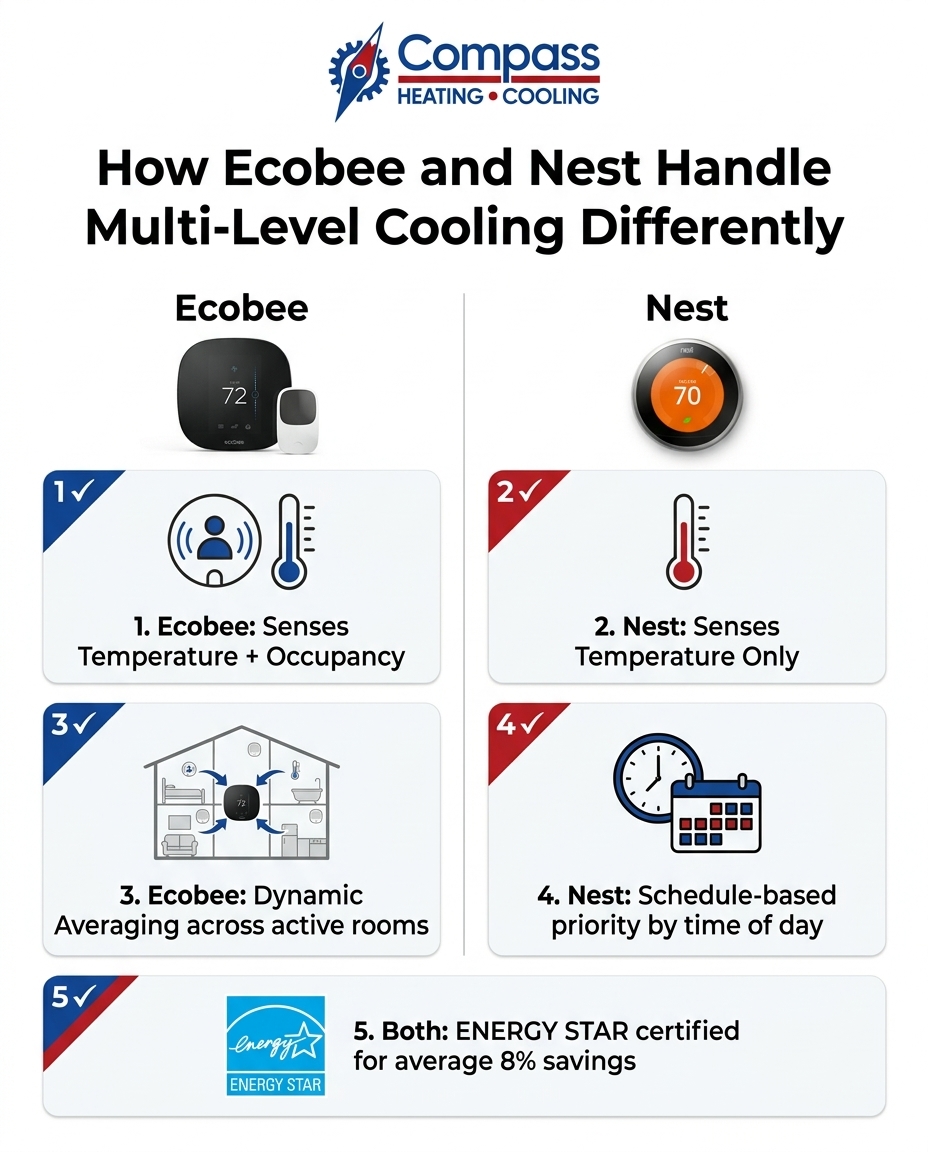
When evaluating the Ecobee Smart Thermostat Premium vs Nest Learning Thermostat, the most significant difference lies in how their remote sensors gather data. Ecobee Smart Sensors are dual-purpose devices. They detect both ambient temperature and human occupancy simultaneously using built-in motion and radar technology.
This creates a dynamic averaging feature that changes how the HVAC system runs in real-time. If you have four sensors spread across a Northern Colorado multi-level home, the Ecobee does not simply average all four numbers together. Instead, it actively ignores empty rooms and prioritizes the temperature of occupied spaces.
How Occupancy Detection Reduces Energy Waste
Ecobee utilizes a feature called "Follow Me." As you move throughout the house, the thermostat shifts its focus to the rooms where it detects motion. If the entire family is downstairs in the living room watching a movie, the Ecobee ignores the hot, empty upstairs bedrooms and only cools the space you are actually using.
The benefits of occupancy-driven sensing include:
• Targeted comfort: The system focuses entirely on where you are, preventing the overcooling of vacant main floors just to cool an empty master bedroom.
• Reduced short-cycling: By focusing on active spaces, the system runs longer, more efficient cycles rather than starting and stopping constantly.
• Energy conservation: Minimizing unnecessary HVAC cycles directly contributes to the ENERGY STAR average 8% savings without sacrificing your actual comfort.
For homes struggling with late-summer August cooling, this dynamic approach means the air conditioner works smarter, not harder. It stops trying to perfectly balance a sprawling multi-level house and instead focuses purely on the rooms that matter at that exact moment.
Nest Learning Thermostat: Schedule-Based Temperature Control
The Nest Learning Thermostat takes a completely different approach to whole-home balancing. While Nest does offer wireless remote devices, the Nest Temperature Sensor lacks occupancy detection. It is a single-purpose device that only reads the ambient temperature of the room it is placed in.
Because the sensors cannot tell if a room is empty or full, Nest relies heavily on time-of-day scheduling. The user must manually program which sensor the main thermostat should listen to during specific blocks of time. For example, you can tell the Nest to prioritize the downstairs living room sensor from 7:00 AM to 10:00 PM, and then shift priority to the upstairs master bedroom sensor from 10:00 PM to 7:00 AM.
When Time-Based Sensing Falls Short
The strength of the Nest ecosystem is its algorithmic routine learning. If your household has highly predictable routines, the Nest learns your habits and builds an incredibly efficient schedule automatically. However, this rigid scheduling can create comfort gaps for households with erratic schedules.
A typical pattern we see in Northern Colorado multi-level homes is a homeowner working from home in an upstairs office outside of their normal pre-set schedule. Because the Nest is programmed to prioritize the downstairs sensor during the day, the upstairs office becomes uncomfortably hot. The thermostat is reading the cooler downstairs hallway and refuses to turn on the air conditioner. To fix this, the user must open the app and manually force the thermostat to shift sensor priority, defeating the purpose of a "smart" system. When comparing the Ecobee Smart Thermostat Premium vs Nest Learning Thermostat, this reliance on strict schedules is the biggest limitation of the Nest ecosystem.
Side-by-Side: Handling Rapid Temperature Swings
Choosing between the Ecobee Smart Thermostat Premium vs Nest Learning Thermostat requires looking at how their technical specifications translate to real-world performance. Optimizing either system properly improves overall air conditioning performance, but they achieve that efficiency through different avenues.
Below is a direct comparison of how both systems manage efficiency, comfort, and temperature stratification across multiple floors.
• Remote Sensor Type — Ecobee Smart Thermostat Premium: Temperature + Occupancy (Motion/Radar) — Nest Learning Thermostat: Temperature Only
• Balancing Method — Ecobee Smart Thermostat Premium: Dynamic Averaging (Focuses on active rooms) — Nest Learning Thermostat: Schedule-Based Priority (Time of day blocks)
• Learning Style — Ecobee Smart Thermostat Premium: Manual/Guided scheduling with dynamic overrides — Nest Learning Thermostat: Algorithmic routine learning based on habits
• Handling Empty Rooms — Ecobee Smart Thermostat Premium: Automatically ignores unoccupied spaces — Nest Learning Thermostat: Continues to heat/cool based on the active schedule
• Best Use Case — Ecobee Smart Thermostat Premium: Erratic schedules, remote workers, varying occupancy — Nest Learning Thermostat: Highly predictable daily routines and set schedules
Understanding these differences is crucial for resolving the heavy cooling loads of late-summer August cooling. If your family moves unpredictably through the house, dynamic averaging is superior. If your family operates like clockwork, algorithmic learning provides seamless background control.
HVAC Compatibility: What Local Installers Look For
Even the smartest thermostat is useless if it cannot communicate properly with your existing equipment. Insights from local HVAC technicians who actively install and troubleshoot these specific units in Loveland and Northern Colorado emphasize that the best thermostat depends on the specific wiring and staging of the home's existing HVAC equipment.
The most critical component of smart thermostat installation is the C-wire, or common wire. Smart thermostats are essentially tiny computers mounted to your wall. They require continuous, stable 24-volt power to run their Wi-Fi chips, vibrant screens, and sensor networks.
The Importance of Dedicated Power
While both Nest and Ecobee claim to have workarounds for homes without a C-wire, local installers strongly advise against relying on them. Without a dedicated C-wire, thermostats utilize "power-stealing," where they pulse the heating or cooling circuits rapidly to siphon small amounts of electricity. In Northern Colorado multi-level homes, this power-stealing often causes the furnace control board to short out or the air conditioning contactor to chatter, leading to premature equipment failure.
Other compatibility factors include:
• Multi-stage heating and cooling: High-efficiency furnaces and air conditioners often have two or more stages of output. Ecobee generally offers more granular, manual control over staging thresholds, while Nest prefers to manage staging via its internal algorithm.
• Accessory control: If you have whole-home humidifiers or dehumidifiers, the thermostat must have the correct terminal relays to command them.
• System health: Pairing a smart thermostat with regular HVAC maintenance ensures the system can actually deliver the efficiency the thermostat promises. A smart thermostat cannot fix a clogged filter or a failing blower motor.
Maximizing Energy Efficiency and Local Rebates
Upgrading to a smart thermostat is one of the most cost-effective ways to reduce energy consumption, especially when battling late-summer August cooling bills. Both the Ecobee and the Nest are ENERGY STAR certified, meaning they have been independently verified to yield average energy savings of 8% annually on heating and cooling costs.
These savings are achieved by preventing the system from running when no one is home, optimizing the recovery times when transitioning from setback temperatures, and providing homeowners with detailed energy usage reports. Seeing exactly how many hours your air conditioner runs on a 95-degree day allows you to make informed decisions about your comfort settings.
Navigating Utility Incentives
Because these devices demonstrably reduce strain on the local power grid, local utility companies frequently offer generic energy rebates for qualifying smart thermostat installations. These incentive programs are designed to encourage homeowners to adopt technology that lowers peak demand during extreme weather events.
We advise homeowners to check with their specific utility provider for current incentive programs before purchasing a unit. Many utility companies maintain a list of pre-approved models, and purchasing an unapproved unit or installing it without a licensed contractor can sometimes void eligibility for these generic energy rebates. Always verify the current requirements with your provider.
Finding the Right Smart Solution for Your Multi-Level Home
Deciding between the Ecobee Smart Thermostat Premium vs Nest Learning Thermostat comes down to how you live in your space. Ecobee excels in dynamic, occupancy-based balancing, making it ideal for families with varying schedules who want the temperature to follow them from room to room. Nest thrives on predictable, schedule-based learning, offering a hands-off approach for households with strict, repeating daily routines.
However, a thermostat is only as good as the system it controls. A clear, technical evaluation of your home's ductwork, staging capabilities, and existing equipment is the best way to choose the right control interface. If your second floor is consistently uncomfortable, swapping a piece of plastic on the wall might only be part of the solution.
We encourage reaching out to local experts to determine the best fit for your specific multi-level layout and comfort goals. A professional assessment ensures that your new smart thermostat is wired correctly, staged properly, and fully capable of delivering the comfort you expect.
Frequently Asked Questions
Is Ecobee or Nest better for a two-story house?
For most two-story homes with unpredictable foot traffic, Ecobee is generally the stronger choice. Its remote sensors detect both temperature and occupancy, allowing the system to dynamically average the temperature based only on the rooms people are actively using. This prevents the system from overcooling an empty main floor just to bring the upstairs down to a comfortable temperature.
Does Nest work with remote room sensors?
Yes, the Nest Learning Thermostat is compatible with Nest Temperature Sensors. However, these sensors only read the ambient temperature of the room and do not have occupancy detection. You must manually schedule which sensor the main thermostat prioritizes during specific blocks of time throughout the day.
Which smart thermostat is best for uneven heating and cooling?
A thermostat that utilizes dynamic averaging, like the Ecobee, is typically best for uneven heating and cooling. By placing sensors in the known hot and cold spots, the thermostat can calculate a more accurate average of the home's overall climate, forcing the HVAC system to run long enough to condition the problem areas.
How do Ecobee smart sensors balance room temperatures?
Ecobee sensors use built-in motion and radar technology to detect if a room is occupied. The main thermostat then uses a "Follow Me" feature to ignore the temperature readings of empty rooms, focusing the HVAC system's efforts entirely on achieving the target temperature in the spaces where people are currently gathered.
Can a smart thermostat fix a hot second floor?
A smart thermostat with remote sensors can force the air conditioner to run longer to cool a hot second floor, but it cannot fix underlying mechanical issues. If the hot second floor is caused by undersized ductwork, poor insulation, or a failing blower motor, the smart thermostat will simply cause the main floor to become freezing cold while trying to compensate.
Do I need a C-wire to install a smart thermostat in Colorado?
Yes, a dedicated C-wire (common wire) is highly recommended for all smart thermostat installations. While some models claim to work without one by "power-stealing" from the heating or cooling circuits, this practice frequently causes control board failures, Wi-Fi dropouts, and erratic system behavior during extreme weather.
hear what our satisfied clients have to say
Our clients consistently praise our exceptional service and attention to detail. They appreciate the personalized approach we take to meet their unique needs, ensuring satisfaction every step of the way.
.png)