



Why Your AC Runs All Day but the House Stays at 78 Degrees
Why Your AC Runs All Day but the House Stays at 78 Degrees
Are you wondering why your AC runs all day but the house stays at 78 degrees, no matter how low you set the thermostat? It is incredibly frustrating to hear your cooling system working tirelessly during the peak of late-summer August heat, only to realize the indoor temperature simply refuses to drop. You might immediately assume the unit is completely broken and requires an expensive replacement. However, a cooling system that runs continuously without lowering the temperature is dealing with one of two distinct problems: either a mechanical failure is preventing it from absorbing heat, or a fundamental mismatch exists between the home's thermal envelope and the system's design capacity. Determining which issue you are facing requires an objective, diagnostic mindset rather than sudden panic. If you need immediate help evaluating your system, you can explore our Air Conditioning Services or schedule an AC Repair today with the Compass Heating & Cooling team.
When you stare at a stubborn 78 degrees indoor thermostat reading, it is easy to assume the worst. Yet, in many cases, the air conditioner is actually performing exactly as it was engineered to perform under extreme environmental stress. The key to solving this cooling deficit is separating expected operational limits from genuine equipment malfunctions. By understanding how heat loads work, you can make informed decisions about your home's comfort and avoid unnecessary part replacements.
The 20-Degree Differential: Understanding Your AC's Design Limits
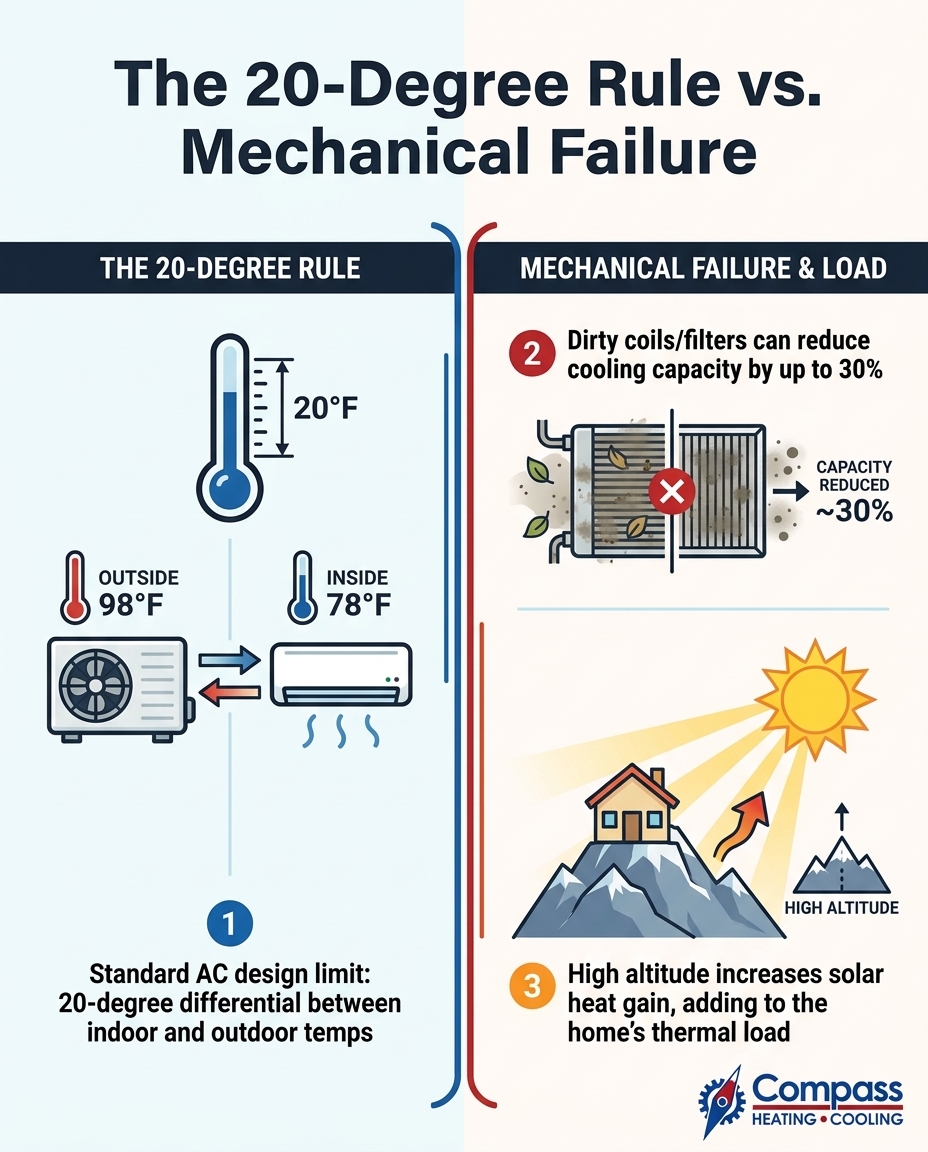
At Compass Heating & Cooling, our technicians frequently explain to Loveland homeowners that residential air conditioning systems are not designed to create a freezing indoor environment regardless of the outdoor weather. Instead, they are engineered around an industry-standard benchmark known as the 20-degree maximum temperature differential. This means a perfectly functioning, properly sized air conditioner can reliably cool your home to about 20 degrees below the ambient outdoor temperature. If it is 98 degrees outside on a sweltering afternoon, a 78 degrees indoor thermostat reading means the system is actually operating at its maximum design capacity. It is not failing; it has simply reached the physical limit of its heat removal capabilities.
Common factors that influence this 20-degree rule include:
• ASHRAE Design Conditions: HVAC systems are sized based on historical weather data for your specific region, optimizing for efficiency during the most common summer temperatures rather than the most extreme, rare heat spikes.
• Ambient Heat Overload: When outdoor temperatures spike far above the regional average, the system lacks the extra capacity to push the indoor temperature down further.
• Humidity Levels: Air conditioners must remove latent heat (humidity) before they can effectively lower sensible heat (temperature), meaning high humidity consumes a significant portion of the system's cooling power.
• Continuous Operation: Running constantly during extreme heat is actually how a properly sized system maintains that 20-degree differential; an oversized system would short-cycle, failing to remove humidity.
Understanding this differential is the first step in diagnosing your cooling issues. If the outdoor temperature is 100 degrees, achieving a 70-degree indoor environment is nearly impossible for standard residential equipment without massive, inefficient oversizing. However, if it is only 85 degrees outside and your house is still stuck at 78 degrees, you are likely dealing with a mechanical restriction or a severe environmental heat gain that requires professional attention.
Mechanical Culprits: What Prevents Your System From Cooling Properly
If the outdoor temperatures are moderate but your system is still struggling, mechanical failures are likely to blame. An air conditioner does not actually "create" cold air; it absorbs heat from inside your home and rejects it outside. When a mechanical component fails or degrades, this heat transfer process is severely restricted. This causes the system to run endlessly as it tries to satisfy the thermostat setting, wasting energy while providing little to no relief from the end-of-season heat as we enter the back-to-school transition.
Airflow Restrictions and Dirty Coils
1. Suffocated Air Handlers: Our team typically sees suffocated air handlers as the most common, yet easily preventable, mechanical issue. Your air conditioner relies on a precise volume of air moving over the indoor evaporator coil. When the air filter becomes clogged with dust, pet dander, and debris, the blower motor has to work twice as hard to pull air through. This lack of airflow prevents the coil from absorbing enough heat from the house.
2. Insulated Condenser Coils: The outdoor unit (condenser) is responsible for releasing the absorbed heat into the outside air. Over the course of the summer, this unit pulls in massive amounts of pollen, dirt, and grass clippings. According to Department of Energy data, dirty condenser coils or severely clogged air filters can reduce a cooling system's efficiency and capacity by up to 30 percent. The dirt acts as an insulating blanket, trapping the heat inside the refrigerant and forcing the compressor to run continuously.
3. The Importance of Upkeep: While changing the air filter is a simple task any homeowner can perform, cleaning delicate aluminum coil fins requires specialized solutions and techniques. Keeping these components clean through routine AC maintenance is the most effective way to protect your system's total cooling capacity.
Refrigerant and Compressor Issues
1. Refrigerant Leaks: Refrigerant is the lifeblood of your cooling system. It undergoes phase changes from liquid to gas to absorb and release heat. Air conditioners do not "consume" refrigerant; it operates in a closed loop. If the system is low on refrigerant, there is a leak. Low refrigerant drastically limits the amount of heat the system can absorb, often leading to a frozen evaporator coil that blocks airflow completely.
2. Compressor Inefficiency: The compressor is the engine that pumps refrigerant through the system. If the compressor's internal valves are wearing out or if it is suffering from electrical issues (like a failing run capacitor), it will not compress the refrigerant to the proper pressure. This results in weak heat transfer.
3. Strict Professional Boundaries: It is critical to note that handling refrigerant, diagnosing compressor valves, and testing high-voltage electrical components are not DIY tasks. Federal regulations require a licensed HVAC professional to handle refrigerant, and attempting electrical repairs without proper training is highly dangerous. If you suspect a refrigerant leak or compressor failure, professional diagnostics are mandatory.
Your Home's Thermal Envelope: Are You Losing the Battle Against Heat?
Sometimes, the air conditioner is working flawlessly, but the house itself is failing to retain the conditioned air. In our years inspecting Loveland homes, we've found that a weak thermal envelope essentially mimics a mechanical AC failure. Your home's "thermal envelope" consists of everything that separates the conditioned indoor air from the unconditioned outdoor air—including insulation, windows, weatherstripping, doors, and ductwork. When this envelope is compromised, heat infiltrates the home faster than the air conditioner can remove it, leaving you with a frustrating 78 degrees indoor thermostat reading despite the unit running continuously.
The system is pumping out cold air, but that cold air is being immediately neutralized by invasive heat. One of the biggest offenders in this category is leaky ductwork located in unconditioned spaces, such as an attic or crawlspace. If your return ducts have cracks or disconnected joints, the system will suck in 130-degree attic air, attempt to cool it, and blow lukewarm air into your living spaces. Conversely, if supply ducts leak, you are paying to air-condition your attic while your living room remains hot.
• Airflow at the vents — Mechanical Failure Indicator: Weak, barely blowing, or completely stopped. — Thermal Envelope Failure Indicator: Blowing strongly, but the room remains hot.
• Air temperature at vents — Mechanical Failure Indicator: Lukewarm or ambient room temperature. — Thermal Envelope Failure Indicator: Very cold, but the room temperature won't drop.
• System runtime — Mechanical Failure Indicator: Runs constantly, often freezing up at the indoor unit. — Thermal Envelope Failure Indicator: Runs constantly during peak sun hours, catches up at night.
• Indoor humidity — Mechanical Failure Indicator: Feels sticky and humid, indicating poor moisture removal. — Thermal Envelope Failure Indicator: Feels dry near vents, but hot near windows or exterior walls.
Beyond ductwork, inadequate attic insulation allows radiant heat to bake the ceilings of your upper floors. Single-pane windows or degraded weatherstripping around exterior doors allow convective heat transfer. If your thermal envelope is heavily compromised, installing a larger air conditioner will not solve the problem; it will only result in higher energy bills as the new system fights a losing battle against the constant influx of outdoor heat.
Colorado Climate Factors: How Altitude and Sun Impact Cooling
Environmental factors play a massive role in how a home heats up, and regional climate nuances can drastically alter an air conditioner's performance. As local Loveland HVAC experts, we know firsthand that the unique combination of high altitude and intense solar radiation in the Colorado Front Range creates a cooling environment that is significantly more challenging than sea-level locations with similar ambient temperatures.
At higher elevations, the Earth's atmosphere is thinner, meaning it filters out less of the sun's ultraviolet and infrared radiation. This intense solar heat gain dramatically increases the thermal load on a home's exterior. The sun beats down on the roof, rapidly heating the attic space to extreme temperatures, which then presses down on the living spaces below. This radiant heat transfer is relentless during the peak afternoon hours.
Furthermore, homes with large, unshaded west-facing windows bear the brunt of this high-altitude solar radiation right as the ambient outdoor temperatures reach their daily peak. The sun blasts directly through the glass, instantly heating the floors, furniture, and indoor air. This sudden, massive influx of heat often overwhelms standard cooling systems. Even if the outdoor air temperature is a moderate 90 degrees, the solar heat gain effectively makes the house "feel" like it is fighting a 105-degree day. When dealing with end-of-season cooling in this region, homeowners must account for this intense solar radiation. Utilizing blackout curtains, planting shade trees, or installing UV-blocking window films can significantly reduce the solar heat load, allowing the air conditioner to finally catch up and lower the indoor temperature.
Cumulative Wear: The Toll of Late-Summer Heat on HVAC Components
Cooling systems do not typically fail on the first warm day of spring. Instead, breakdowns and severe efficiency losses usually occur late in the season, driven by the cumulative wear and tear of continuous operation. By the time late-summer heat arrives and families are prepping for the back-to-school transition, your air conditioner has likely been running for hundreds of hours, accumulating subtle forms of degradation that slowly erode its cooling capacity.
The late-summer toll includes:
• Micro-Dust Accumulation: Even with regular filter changes, microscopic dust particles bypass the filter over months of operation, coating the indoor evaporator coil and reducing its ability to absorb heat.
• Thermal Fatigue on Electrical Parts: Capacitors and contactors endure massive thermal stress every time the system cycles on and off in 95-degree weather. By late summer, these components are often operating at the very edge of failure.
• Vibration and Friction: Blower motors and condenser fan motors experience months of continuous friction. If bearings begin to wear or belts loosen, the system moves less air, reducing overall efficiency.
This cumulative wear means an air conditioner that easily maintained a 72-degree indoor temperature in June might struggle to maintain a 78-degree temperature by late August, even if the outdoor weather is identical. The system has simply lost a percentage of its operational efficiency due to months of hard work. We recommend addressing this cumulative wear to restore lost capacity, which is precisely why end-of-season checkups and timely AC repair in Loveland are crucial to ensuring the system can handle the final heatwaves of the year without suffering a catastrophic, total breakdown.
System Capacity vs. Mechanical Failure: Getting to the Root Cause
When you are staring at a 78 degrees indoor thermostat reading, the most critical step is distinguishing between a system that is fundamentally broken and a system that is simply undersized for the current heat load. A broken system has a mechanical defect—like a failed compressor or a refrigerant leak—that prevents it from reaching its rated capacity. An undersized system, however, is mechanically perfect but physically too small to remove the amount of heat entering the home.
Unfortunately, many homeowners fall into the trap of seeking quick, temporary band-aids. Simply "topping off the refrigerant" without finding the leak, or replacing a capacitor without checking the compressor's amp draw, will not solve a capacity issue. If the real problem is a compromised thermal envelope or an undersized unit, throwing new parts at the system is a waste of time and resources.
This is where working with the Compass Heating & Cooling team makes all the difference. Providing expert local diagnostics that evaluate the whole home envelope and system capacity ensures that you get to the root cause of the problem. A comprehensive diagnostic approach involves calculating the home's actual heat load, inspecting ductwork integrity, and measuring the system's precise output. By evaluating the entire thermal ecosystem of the house, professionals can give you an objective answer: whether you need a mechanical repair, duct sealing, or need to look for signs of an undersized AC unit. This thorough, whole-home approach prevents unnecessary part replacements and provides a clear, actionable path to restoring your indoor comfort.
Frequently Asked Questions About Air Conditioners That Won't Stop Running
Why is my house stuck at 78 degrees with the AC on?
This is often due to the 20-degree design limit during extreme heat, or compromised thermal envelopes allowing heat in faster than the system can remove it. If the outdoor temperature is near 100 degrees, a 78 degrees indoor thermostat reading means the system is operating at its maximum design capacity. However, if it is only 85 degrees outside, this indicates a mechanical issue like restricted airflow, dirty coils, or low refrigerant that is severely limiting the system's cooling power.
How much can an AC cool below the outside temperature?
Standard residential air conditioning systems are designed to maintain a 20-degree differential between the indoor and outdoor temperatures. While a system might occasionally achieve a slightly larger differential under perfect conditions with low humidity, expecting a standard unit to cool a house to 68 degrees when it is 98 degrees outside exceeds its engineered capacity. The system will run continuously without reaching that lower setpoint.
Is it bad if my AC runs constantly in the summer?
Continuous running is expected during peak heat to maintain temperature, but it shouldn't run constantly while the temperature continues to rise. Running constantly is actually how modern, highly efficient systems are designed to operate during extreme weather to maximize humidity removal. However, if the unit runs non-stop and the indoor temperature is climbing, that indicates a failure to keep up with the heat load.
At what temperature does an AC struggle to cool?
Typically, an air conditioner begins to struggle when outdoor temperatures exceed 95 to 98 degrees, depending on the system's specific ASHRAE design conditions. At these extreme temperatures, the system reaches its maximum heat transfer capability. High humidity levels or intense, direct solar heat gain on the home can lower this threshold, causing the system to struggle even at 90 degrees.
Why is my AC running but the temperature is going up?
This indicates a severe mechanical failure or a massive influx of heat that has completely overwhelmed the cooling capacity. Common mechanical culprits include a frozen evaporator coil, a severe refrigerant leak, or a failing compressor. It can also be caused by environmental factors like open windows, severely disconnected ductwork in a hot attic, or a sudden spike in outdoor temperatures.
Is my AC undersized or just broken?
Determining this requires professional diagnostics to calculate the actual heat load of the home versus the current output of the system. If the system is mechanically sound, has proper airflow, and holds the correct refrigerant charge but still cannot cool the home, it is likely undersized or fighting a severe thermal envelope failure. Only a licensed technician with proper diagnostic tools can accurately make this distinction.
Stop Guessing and Start Cooling with Expert Diagnostics
Dealing with an air conditioner that runs non-stop during late-summer August heat without actually cooling your home is a miserable experience. While understanding the 20-degree differential and checking your air filters are great first steps, determining the exact cause of an AC stuck at a 78 degrees indoor thermostat reading ultimately requires professional tools and expertise. You do not have to endure a sweltering house or waste money on endless electricity bills while hoping the system catches up. Stop guessing whether it is a dirty coil, a refrigerant leak, or a capacity issue. Take the next step toward reliable, efficient comfort by scheduling a comprehensive diagnostic evaluation to pinpoint the exact root cause. For a thorough assessment and expert solutions, schedule your AC Repair today.
hear what our satisfied clients have to say
Our clients consistently praise our exceptional service and attention to detail. They appreciate the personalized approach we take to meet their unique needs, ensuring satisfaction every step of the way.
.png)