



Detailed Guide to Undersized AC Unit Signs and Problems
Is Your AC Struggling to Keep Up? Undersized AC Unit Signs and Problems in a Colorado Home
If you've noticed undersized AC unit signs and problems in a Colorado home, you're not alone — and the Front Range's high altitude, intense sun, and wide daily temperature swings make the situation worse than it would be almost anywhere else in the country.
Here's a quick look at the most common warning signs:
• Home never reaches the set temperature — the system runs all day but still can't close the gap
• Constant runtime — your AC rarely or never cycles off, even overnight
• Uneven cooling — upstairs rooms or sun-facing spaces stay noticeably hotter than the rest of the house
• High indoor humidity — the air feels stuffy or clammy even when the AC is running
• Rising energy bills — utility costs climb because the system works overtime without delivering results
• Frequent breakdowns — components wear out faster from continuous, strained operation
• Frozen evaporator coils — ice forms on the indoor coil because the undersized unit can't maintain proper airflow and cooling cycles
These symptoms are easy to misread as a refrigerant problem or a failing unit, but in many cases the root cause is a system that was simply never the right size for the home — a problem that Colorado's climate makes significantly harder to ignore.
Key Undersized AC Unit Signs and Problems in a Colorado Home
When the summer heat rolls off the Rockies and settles into Northern Colorado communities like Fort Collins, Loveland, and Windsor, an air conditioner is your home’s ultimate defense. However, if your system is too small, it will quickly show its limitations.
Homeowners often mistake a system that is running constantly for a minor mechanical glitch. But when an air conditioner lacks the physical capacity (measured in British Thermal Units, or BTUs) to handle your home's volume and heat load, it creates a unique set of headaches.
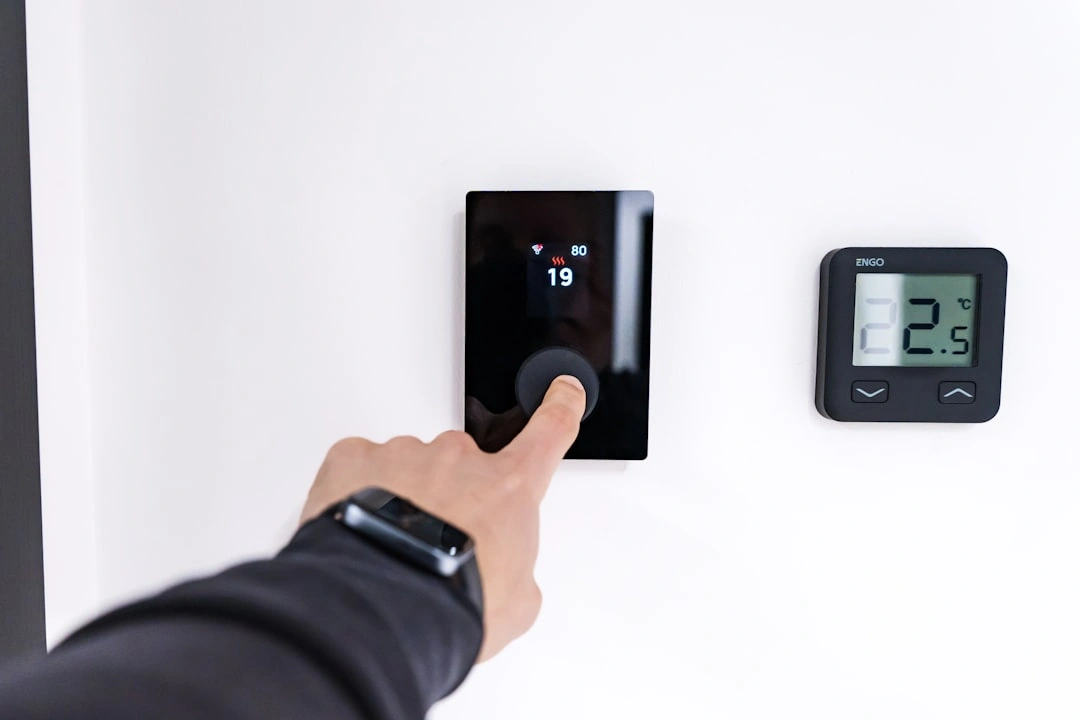
One of the first things people notice is a widening gap between what the thermostat is set to and what the actual indoor temperature is. If you set your thermostat to 71°F, but the indoor display stubbornly reads 77°F all afternoon, your system is suffering from a capacity deficit.
It is also important to distinguish between a system that runs continuously and one that cycles rapidly. If you are experiencing the opposite problem, where your system starts up and shuts down every few minutes, you may want to read about why an AC Keeps Turning On and Off in Colorado Summer Heat What is Wrong. While short-cycling is often a sign of an oversized system or an electrical issue, an undersized system does the exact opposite: it turns on and simply cannot turn off.
Constant Running and the Thermostat Gap as Undersized AC Unit Signs and Problems in a Colorado Home
A properly sized air conditioning system is designed to run in cycles. Under normal conditions, it should run for about 15 to 20 minutes to cool your home to the desired temperature, shut off, and then cycle back on when the indoor temperature rises.
When you have an undersized system, those cycles disappear. Instead, the unit enters a state of continuous runtime. On a typical July afternoon in Greeley or Johnstown, when outdoor temperatures climb into the 90s, an undersized AC will run 24/7.
This continuous operation happens because the system is trying to reach "steady-state cooling," but the rate at which heat enters your home through the roof, walls, and windows is faster than the rate at which the small air conditioner can remove it. The "thermostat gap" is the direct result. During peak design conditions—the hottest hours of the hottest days—the system simply fails to maintain your target temperature.
Uneven Temperatures and Frozen Coils as Undersized AC Unit Signs and Problems in a Colorado Home
Multi-level homes are incredibly popular across Northern Colorado, from modern builds in Timnath to established properties in Loveland. Unfortunately, these layouts are particularly unforgiving to undersized cooling systems.
Because warm air naturally rises and upper levels are closer to hot attic spaces, your second story requires significant cooling power. An undersized unit will dump what little cold air it can produce into the lower level, leaving the upstairs bedrooms feeling like a sauna.
Even worse, running a small system constantly can lead to frozen evaporator coils. When an AC runs without a break, the temperature of the indoor evaporator coil can drop below freezing. If there is even a slight restriction in airflow, or if the system cannot absorb heat fast enough, the moisture that condenses on the coil will turn to ice. Once a layer of ice forms, it blocks all heat transfer, completely stopping the cooling process and potentially causing liquid refrigerant to flood back into the compressor, leading to catastrophic system failure.
How Colorado’s Altitude and Dry Climate Exacerbate Sizing Issues
Sizing an air conditioner in Colorado is vastly different than sizing one in a humid, low-elevation coastal city. If an HVAC technician uses a standard sizing chart designed for Florida or Texas, they will almost certainly install an undersized system in your Colorado home. Our unique geography directly impacts how cooling equipment operates, affecting the Average Lifespan of a Central Air Conditioner in a Hot Dry Front Range Climate.
The Physics of High Elevation and Air Density
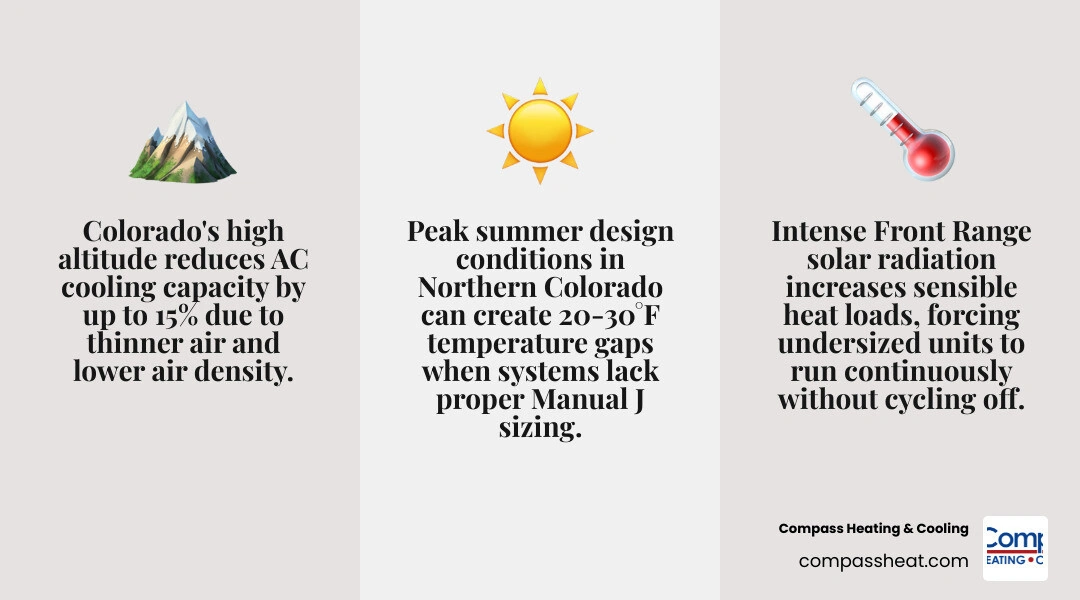
The most overlooked variable in Colorado HVAC design is altitude. In cities like Fort Collins, Loveland, and Wellington, we live at 5,000 feet or higher. At this elevation, the barometric pressure is lower, meaning the air is thinner and less dense.
Because the air is thinner, a blower fan moving a specific volume of air (measured in Cubic Feet per Minute, or CFM) is actually moving fewer air molecules by weight than it would at sea level. Thinner air carries less mass, and because heat transfer relies on air mass, your air conditioner loses cooling capacity.
As a rule of industrial physics, HVAC equipment experiences roughly a 3% capacity reduction for every 1,000 feet of elevation above sea level.
• At 5,000 feet (Fort Collins/Loveland), a system experiences a 15% loss in nominal cooling capacity.
• If you install a standard "3-ton" unit (rated for 36,000 BTUs at sea level), it will only deliver about 30,600 BTUs of actual cooling in your Front Range home.
Without adjusting for this altitude derating, your brand-new system will start its life severely undersized.
Dry Climate and Sensible Cooling Loads
Colorado's dry, semi-arid climate changes the type of work your air conditioner has to do. Air conditioning loads are split into two categories:
1. Latent heat (removing moisture/humidity from the air)
2. Sensible heat (lowering the actual temperature of the air)
In highly humid climates, a large portion of an AC's energy goes toward condensing water vapor out of the air. In Colorado, because our air is already dry, nearly 100% of your system's capacity goes toward sensible cooling.
While this sounds like an advantage, it comes with a major catch: dry air allows solar radiation to pass through the atmosphere with very little filtration. The Colorado sun is incredibly intense. This high solar gain causes rapid heat transfer through your roof, siding, and west-facing windows. Additionally, our region experiences massive day-to-night temperature swings—often dropping 30 degrees or more once the sun goes down. An air conditioner must be sized to handle that sudden, intense daytime heat spike, even if it only lasts for a few hours in the afternoon.
Diagnosing an Undersized AC vs. Other Common HVAC Problems
Before you assume your air conditioner is too small, it is critical to rule out other common issues. A system that runs constantly or fails to cool could simply be suffering from a lack of maintenance, a refrigerant leak, or restricted airflow.
To help you understand the differences, let's look at how these issues compare:
• Airflow Strength — Undersized AC Unit: Strong, consistent airflow from vents — Low Refrigerant Charge: Normal to weak airflow — Restricted Airflow / Dirty Filter: Very weak airflow from registers
• Air Temperature — Undersized AC Unit: Cool air (15–20°F drop) but not enough volume — Low Refrigerant Charge: Warm or barely cool air — Restricted Airflow / Dirty Filter: Very cold air at the vent, but minimal volume
• System Behavior — Undersized AC Unit: Runs constantly during hot afternoons — Low Refrigerant Charge: Runs constantly; may short-cycle if safety switches trip — Restricted Airflow / Dirty Filter: Runs constantly; blower motor may overheat
• Coil Freezing — Undersized AC Unit: Occasional freezing under extreme, continuous use — Low Refrigerant Charge: Frequent freezing, starting at the outdoor line — Restricted Airflow / Dirty Filter: Frequent freezing due to lack of warm air crossing coil
• Diagnostic Solution — Undersized AC Unit: Requires a Manual J calculation — Low Refrigerant Charge: Requires pressure testing by a technician — Restricted Airflow / Dirty Filter: Replace filter; check static pressure
Regular upkeep is the best way to prevent these confusing overlaps. Knowing How Often Should You Service Your Air Conditioner in a Hot Dry Colorado Climate can keep minor issues like dirty coils from mimicking the signs of a major capacity problem.
Low Refrigerant Charge vs. Lack of Capacity
A low refrigerant charge is one of the most common causes of poor cooling performance. Because refrigerant is responsible for absorbing heat from your indoor air, a leak in the coils will cause the system to run indefinitely without cooling the home.
The key difference lies in the temperature drop across the indoor coil (the delta-T). A properly operating, but undersized, AC will still produce a healthy 15-to-20-degree temperature difference between the return air intake and the supply vents—it just cannot produce enough total air volume to cool the entire house. A system with low refrigerant, however, will blow lukewarm air (a temperature drop of less than 10 degrees) because it lacks the chemical agent needed to absorb heat. A licensed technician can easily diagnose this by measuring the system's operating pressures.
Ductwork Restrictions and Airflow Issues
Sometimes, the air conditioner itself is perfectly sized, but the ductwork is restricting its ability to distribute air. If your ducts are too small, leaky, or poorly designed, the system cannot move the required volume of air.
This restriction increases "static pressure" within your system, forcing the blower motor to work harder and reducing the overall efficiency of the air conditioner. Leaky ducts can lose up to 30% of your conditioned air to unconditioned spaces like attics, crawlspaces, or wall cavities. If your AC is running constantly because cold air is escaping before it reaches your living spaces, sealing and balancing your ductwork can resolve the issue without requiring a full equipment replacement.
The Role of Manual J Load Calculations and Sizing Solutions
If you suspect your system is too small, the only way to know for sure is to have a professional perform a Manual J load calculation. This is the industry-standard, scientific method developed by the Air Conditioning Contractors of America (ACCA) to determine the exact heating and cooling needs of a home.
When you schedule a professional AC Installation Fort Collins CO, this calculation should always be the very first step.
Why Square Footage Rules of Thumb Fail
For decades, many builders and old-school technicians relied on simple rules of thumb, such as "one ton of cooling per 500 square feet." In 2026, we know this approach is highly inaccurate and leads to poorly designed systems.
Two homes with the exact same square footage in Severance or Berthoud can have wildly different cooling loads. Factors that drastically alter your home's cooling requirements include:
• Insulation values (older homes with R-11 walls vs. modern builds with R-21+ walls)
• Window specifications (double-pane, low-E glass vs. older single-pane metal frames)
• Solar orientation (homes with massive, west-facing windows receive intense afternoon heat)
• Ceiling heights (vaulted ceilings increase the volume of air that must be cooled)
• Air infiltration rates (how leaky the house is, often measured with a blower door test)
A Manual J calculation takes all of these variables into account, along with local altitude and design temperatures, to specify the exact BTU capacity your home needs.
Repair vs. Replacement Decisions for Colorado Homeowners
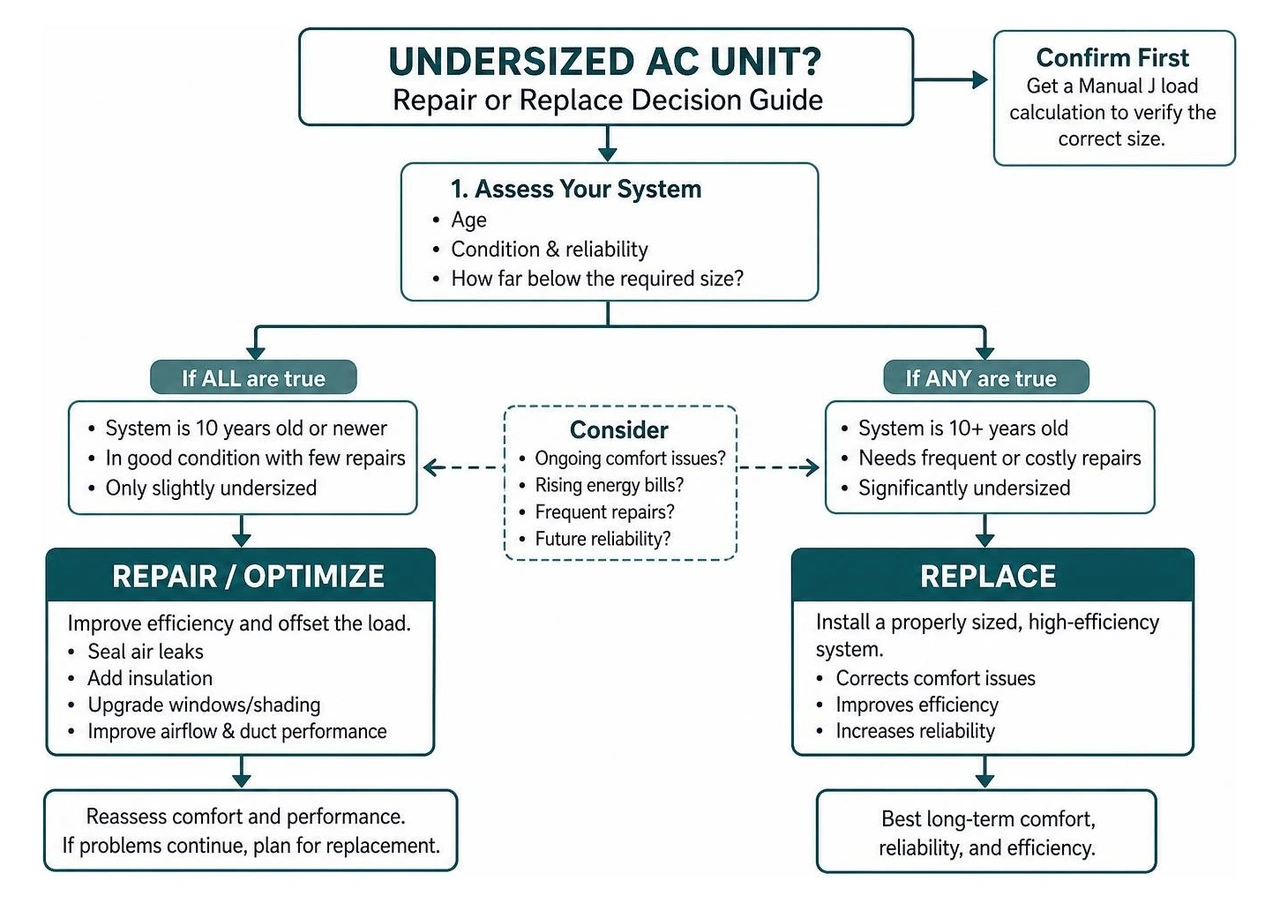
If your air conditioner is undersized, you face a choice: do you try to modify your existing setup, or is it time to replace the system entirely?
To make an informed decision, check out our AC Repair vs Replace Decision Guide for Northern Colorado. Generally, if your system is young and only slightly undersized, you may be able to offset the load through home improvements.
However, if you are asking yourself Is a 12 to 15 Year Old AC Worth Fixing in a Northern Colorado Home, the answer is almost always no—especially if it is undersized. An older system that has spent over a decade running constantly is likely near the end of its life, and upgrading to a properly sized, energy-efficient model can cut your cooling costs by 20% to 40%.
Supplemental Cooling and Zoning Options
For homes where replacing the main central air system isn't immediately practical, there are alternative ways to handle the cooling deficit.
One highly effective solution is installing a ductless mini-split system to assist your main AC. These systems provide targeted, high-efficiency cooling to specific trouble areas, such as a hot master bedroom or a finished attic space.
If you decide that a complete system overhaul is the best path forward, exploring your options for AC Replacement Fort Collins CO will allow you to design a zoned system. Zoning uses motorized dampers within your ductwork to direct cooling exactly where it is needed, ensuring perfect comfort across every level of your home.
Frequently Asked Questions about AC Sizing in Colorado
Can adding insulation fix an undersized AC unit?
In some cases, yes. If your air conditioner is only slightly undersized (by half a ton or less), improving your home's thermal envelope can reduce your overall cooling load. Adding attic insulation to bring it up to R-49 or R-60, sealing air leaks around windows and doors, and installing solar screens or window films on west-facing glass can reduce the amount of heat entering your home by 10% to 15%. This reduction can sometimes bridge the gap, allowing a slightly smaller AC to finally keep up. However, if your system is severely undersized, insulation alone will not solve the problem.
How does an undersized AC affect my energy bills and system lifespan?
An undersized AC is incredibly expensive to run. Because it never reaches the set temperature, it runs continuously at 100% capacity, which can increase your summer utility bills by 15% to 30% compared to a properly sized unit that cycles off periodically. Furthermore, this non-stop operation places immense mechanical strain on the compressor and blower motor. Undersized systems often suffer from premature compressor failure and typically last only 5 to 8 years, compared to the healthy 12-to-15-year lifespan of a properly sized and maintained system.
Does Colorado's elevation really reduce my AC's cooling capacity?
Yes, absolutely. Because the air is thinner at higher elevations, it has less mass to carry heat away from your indoor spaces. At elevations of 5,000 feet or higher (which covers Fort Collins, Loveland, Windsor, and surrounding areas), an air conditioner loses roughly 15% of its rated cooling capacity. This means a system rated for 36,000 BTUs (3 tons) at sea level will only deliver around 30,600 BTUs of cooling in Northern Colorado. Licensed HVAC professionals must always apply altitude derating factors when sizing new equipment.
Conclusion
Living with an undersized air conditioner means dealing with constant noise, high utility bills, and a home that never truly feels comfortable during the peak of summer. Identifying undersized ac unit signs and problems in a colorado home is the first step toward reclaiming your indoor comfort.
At Compass Heating & Cooling, we specialize in helping homeowners across Northern Colorado—including Fort Collins, Loveland, Windsor, Wellington, Severance, Timnath, Johnstown, Greeley, Berthoud, and Evans—find the perfect HVAC solutions for our unique high-altitude climate.
We make upgrading your home’s comfort incredibly accessible by handling utility rebates of up to $8,000+ directly on your behalf. Plus, our comprehensive maintenance plan offers priority service, ongoing discounts, and the peace of mind that your system is running at peak efficiency.
If you are ready to stop sweating through the summer and want a professional, accurate assessment of your home's cooling needs, explore our Air Conditioning services today and let us help you find the perfect fit.
hear what our satisfied clients have to say
Our clients consistently praise our exceptional service and attention to detail. They appreciate the personalized approach we take to meet their unique needs, ensuring satisfaction every step of the way.
.png)