


AC Short Cycling in Colorado Heat: Fast Fixes
Why Your AC Keeps Turning On and Off in the Colorado Heat
When your ac keeps turning on and off in colorado summer heat what is wrong with your cooling system is often a frustrating issue known as short cycling. For homeowners dealing with this issue, finding reliable AC Repair in Denver, CO is critical to keeping comfortable. A short-cycling air conditioner doesn't just leave your home warm and humid; it also wastes energy and puts severe stress on your compressor. Understanding why this happens is the first step to fixing the problem.
If you need fast help, you can learn more about our AC Repair services or Schedule Your AC Service Online today.
Quick Answer: What Causes AC Short Cycling?
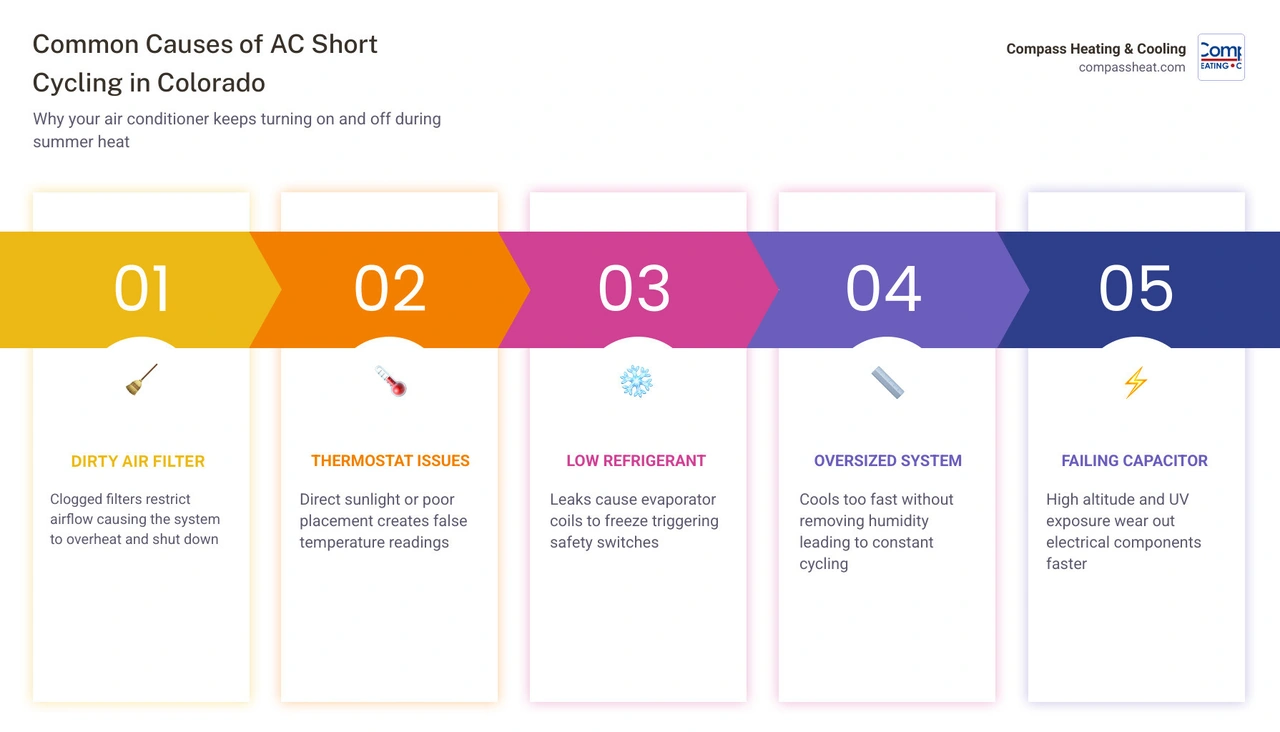
If your air conditioner runs for only a few minutes before shutting off, here are the most common causes:
• Dirty Air Filter: A clogged filter limits airflow, causing the system to overheat and shut down.
• Thermostat Placement: If your thermostat is in direct sunlight or near a register, it gets false temperature readings.
• Low Refrigerant: A leak causes the evaporator coils to freeze, triggering safety switches.
• Oversized System: An oversized AC cools the house too fast without removing humidity, leading to constant cycling.
• Failing Capacitor: Denver’s high altitude and UV exposure wear out electrical capacitors 40% faster than at sea level.
What is Short Cycling and Why Does It Happen in Colorado?
To understand why your air conditioner is acting up, we first need to look at what a healthy cooling cycle actually looks like. In a perfect world, your air conditioner turns on, runs for about 15 to 20 minutes to evenly distribute cool air and pull humidity out of your home, and then shuts down once the thermostat is satisfied. This is a complete cooling cycle.
Short cycling, however, is when your system starts up but shuts down prematurely—often after only 3 to 8 minutes—only to turn back on again a few minutes later. It is the HVAC equivalent of driving a car in stop-and-go bumper-to-bumper traffic on I-25. It wastes fuel (or in this case, electricity) and places immense mechanical strain on the engine (the compressor).
But why does this stop-and-go pattern happen so frequently during Colorado's intense summer months? The answer lies in our unique climate and geography.
First, we have to talk about air density. At our high elevations in Northern Colorado towns like Fort Collins, Loveland, and Windsor, the air is significantly thinner than it is at sea level. In fact, at 5,280 feet, AC systems move roughly 20% less air than they would at sea level. Because there are fewer air molecules passing over your AC's coils, the system has to work much harder to transfer heat out of your home. This altitude factor can lead to an immediate 15% drop in cooling capacity, forcing your system to run longer and hotter. To learn more about how these systems function under normal conditions, check out our guide on How Does an Air Conditioner Work Anyway.
Additionally, Colorado summers present extreme daily temperature swings. It is not uncommon to wake up to a crisp 55-degree morning in Greeley or Johnstown, only to watch the thermometer spike to 95 degrees by 3:00 PM. This rapid swing places thermal stress on the metal and electrical components of your air conditioner. Combine that with our intense high-altitude UV radiation—which is up to 25% stronger than at sea level—and your outdoor condenser unit is essentially taking a daily beating.

AC Keeps Turning On and Off in Colorado Summer Heat: What Is Wrong?
When your system is constantly starting and stopping, you need a systematic approach to diagnostics. It can be hard to tell if your system is just working hard under a heavy afternoon heat load or if it is experiencing a genuine mechanical failure.
To help you diagnose the root cause, we recommend checking out our comprehensive guide on Why Isn't My AC Working. In general, short cycling points to either an airflow restriction, a control/sensor error, or a major mechanical failure.
Here is a quick look at how to distinguish between a normal heavy heat load and a short-cycling malfunction:
• Run Time — Normal Heavy Heat Load: Runs continuously for 30–60+ minutes during peak afternoon heat — Mechanical Short Cycling (Malfunction): Turns on and off every 3 to 8 minutes, regardless of indoor temperature
• Air Temperature — Normal Heavy Heat Load: Consistently blows cold air from the supply vents — Mechanical Short Cycling (Malfunction): May blow warm or lukewarm air, or cold air that cuts out quickly
• Indoor Humidity — Normal Heavy Heat Load: Keeps indoor air dry and comfortable — Mechanical Short Cycling (Malfunction): Home feels sticky, humid, and clammy
• Thermostat Status — Normal Heavy Heat Load: Temperature slowly drops or stays steady at your set point — Mechanical Short Cycling (Malfunction): Temperature never reaches the set point, but the system shuts off anyway
• Outdoor Unit Noise — Normal Heavy Heat Load: Smooth, steady hum from the fan and compressor — Mechanical Short Cycling (Malfunction): Frequent clicking, buzzing, or hard-starting noises every few minutes
Is a Dirty Filter Why Your AC Keeps Turning On and Off in Colorado Summer Heat: What Is Wrong?
You might find it hard to believe, but a simple, inexpensive air filter is the number-one culprit behind AC short cycling. When your air filter becomes clogged with dust, pet dander, and wildland smoke particulates—which are common during Colorado summers—it restricts the volume of air entering your HVAC system.
Your AC needs a steady stream of warm indoor air flowing over the indoor evaporator coil. The refrigerant inside the coil absorbs the heat from this air. If that airflow is restricted:
1. The refrigerant gets too cold.
2. Moisture in the air condenses on the coil and rapidly freezes solid.
3. The ice buildup acts as an insulator, blocking what little airflow you had left.
4. Your system's low-pressure safety switch detects the drop in pressure and shuts the system down to prevent compressor damage.
5. Once the ice melts slightly, the pressure rises, the switch resets, and the system turns back on—only to repeat the entire cycle.
According to the U.S. Department of Energy, a dirty filter can increase your system's energy consumption by up to 15%. Over time, this restricted airflow can destroy your compressor, leading to an incredibly expensive repair. Keeping up with regular AC Maintenance and changing your filter every 30 to 60 days in our dry, dusty climate is the easiest way to prevent this.
Is a Thermostat Issue Why Your AC Keeps Turning On and Off in Colorado Summer Heat: What Is Wrong?
Sometimes, there is absolutely nothing wrong with your air conditioner itself; instead, the "brain" of the system is misbehaving. Your thermostat tells the AC when to start and stop based on the ambient temperature in its immediate vicinity.
If your thermostat is experiencing a sensor failure or calibration issues, it may send erratic on/off signals to your outdoor unit. However, the most common thermostat issue is actually improper placement, which leads to "ghost readings."
If your thermostat is installed:
• In direct sunlight from a west-facing window.
• Directly under or near a supply register blowing cold air.
• Near heat-generating appliances like ovens, televisions, or lamps.
• On an exterior wall that absorbs outdoor heat.
It will experience rapid, localized temperature swings. For example, if direct afternoon sunlight hits the thermostat, it will think the house is 85 degrees and kick the AC on. Within minutes, the cold air from a nearby vent blows directly onto the thermostat, cooling it down to 70 degrees instantly. The thermostat thinks the job is done and shuts the AC off. A few minutes later, the sun warms it right back up, and the cycle repeats.
Low Refrigerant and Electrical Failures
If your filters are clean and your thermostat is placed correctly, the issue may be internal.
First, low refrigerant levels are a major cause of short cycling. Your air conditioner does not "consume" refrigerant; it circulates it in a closed loop. If your system is low on refrigerant, you have a leak. Low refrigerant levels cause a drop in pressure inside the evaporator coil, which leads to ice buildup and triggers the low-pressure safety switch, shutting the system down. Running an AC with low refrigerant will quickly overheat and destroy the compressor. If you suspect a leak, you must call for professional AC Repair immediately, as handling refrigerant requires specialized EPA certification.
Second, let's talk about electrical components—specifically, the run capacitor. Think of the capacitor as a temporary battery that delivers the electrical boost your compressor and fan motor need to start up and run smoothly.
Because of our high altitude (which means thinner air provides less cooling for electrical parts) and intense UV exposure, capacitors fail 40% more often along the Colorado Front Range compared to sea-level locations. When a capacitor begins to fail, it can overheat or lose its ability to hold a charge. This causes the compressor to "hard start" or overheat and shut down via its internal thermal overload switch. Once the compressor cools down, it attempts to start again, causing a rapid on-and-off cycling pattern that will quickly burn out the motor.
The Risks of Ignoring Short Cycling and How to Fix It
Ignoring a short-cycling air conditioner is a recipe for financial and mechanical disaster. Heating and cooling already make up roughly 43% of a typical home's utility bill. Because an air conditioner draws the vast majority of its electricity during the startup phase, a system that turns on and off four times an hour will send your monthly utility bills through the roof.
Beyond high energy bills, short cycling causes rapid wear and tear. The constant starting and stopping places immense physical stress on the compressor—the heart of your AC system. If the compressor fails, you are often looking at a highly expensive repair. At that point, you will have to make a tough decision. We recommend checking out our AC Repair vs Replace Decision Guide for Northern Colorado to weigh your options.
The Oversized System Problem
What if your AC has short-cycled since the very day it was installed? In this case, you likely have an oversized system.
Many builders or inexperienced contractors use "rules of thumb" to size air conditioners based solely on square footage. However, proper system sizing requires an ACCA Manual J load calculation, which takes into account your home's insulation, window orientations, local altitude, and climate.
An oversized AC will blast your home with cold air, satisfy the thermostat in 5 minutes, and shut off. While this might sound like a good thing, it is actually a major comfort problem. Because the system runs for such short bursts, it never runs long enough to perform its second crucial job: dehumidification. You will end up with a home that feels cold, clammy, and sticky, and you will likely notice massive temperature swings between different rooms.
To keep your system running efficiently all year long, be sure to bookmark our Seasonal HVAC Maintenance Tips Calendar. Additionally, as the seasons change, don't forget your heating system! Taking care of your furnace is just as important, so check out our guides on Do I Really Need a Furnace Tune-Up and how to Reduce Repair Costs with Consistent Furnace Maintenance Tips to avoid winter breakdowns.
Frequently Asked Questions About Colorado AC Performance
How long should an AC cycle normally run in Colorado?
On a typical summer day along the Front Range, a properly sized air conditioner should run for 15 to 20 minutes per cycle, about two to three times per hour. However, when afternoon temperatures climb into the 90s or triple digits in places like Greeley and Loveland, it is completely normal for your AC to run for much longer stretches—sometimes continuously for several hours in the afternoon. As long as your home is maintaining your set temperature and the system is blowing cold air, this continuous run time is actually more efficient than cycling on and off.
Can a dirty air filter cause my AC to turn on and off repeatedly?
Yes, absolutely. A dirty air filter blocks the return airflow, preventing the warm air in your home from reaching the cold evaporator coil. This lack of heat transfer causes the coil's temperature to plummet, freezing the condensation on the coil into solid ice. The system's safety sensors will detect the drop in pressure or temperature and shut the unit down. Once the ice melts, the system attempts to start again, creating a continuous cycle of freezing and shutting down. If you are experiencing this in Fort Collins, scheduling an AC Service Fort Collins CO is the best way to clean your system and restore proper airflow.
When should I call a professional for AC short cycling in Centennial or Denver?
While you can safely check your air filter and thermostat settings yourself, you should call a professional technician immediately if you suspect refrigerant leaks, electrical failures, or compressor issues. Handling refrigerant requires EPA certification, and testing live electrical components like capacitors (which store dangerous levels of voltage even when the power is turned off) poses serious safety hazards. If you live in Northern Colorado, booking an AC Tune-Up Fort Collins CO will bring a certified technician to your home to safely diagnose and resolve the issue before it causes permanent damage.
Conclusion
When your ac keeps turning on and off in colorado summer heat what is wrong is a clear warning sign that your system is under extreme stress. Whether it is a simple clogged filter, a misplaced thermostat, or a failing capacitor struggling against Colorado’s high altitude and UV rays, ignoring the problem will only lead to higher utility bills and premature system failure.
At Compass Heating & Cooling, we are proud to serve our neighbors throughout Northern Colorado, including Fort Collins, Loveland, Windsor, Wellington, Severance, Timnath, Johnstown, Greeley, Berthoud, and Evans. We specialize in making your home comfortable again while keeping your budget in mind.
We can help you navigate local utility rebates up to $8,000+ to make system upgrades highly affordable. Plus, our comprehensive maintenance plan offers priority service and discounts to keep your system running smoothly year-round.
Don't let a short-cycling AC burn out in the summer heat. Contact Compass Heating & Cooling today to schedule your professional diagnostic and keep your home cool all summer long!
hear what our satisfied clients have to say
Our clients consistently praise our exceptional service and attention to detail. They appreciate the personalized approach we take to meet their unique needs, ensuring satisfaction every step of the way.
.png)