



The Definitive Guide to Repair vs Replace a 12-15 Year Old AC in Northern Colorado
Is a 12 to 15 Year Old AC Worth Fixing in a Northern Colorado Home?
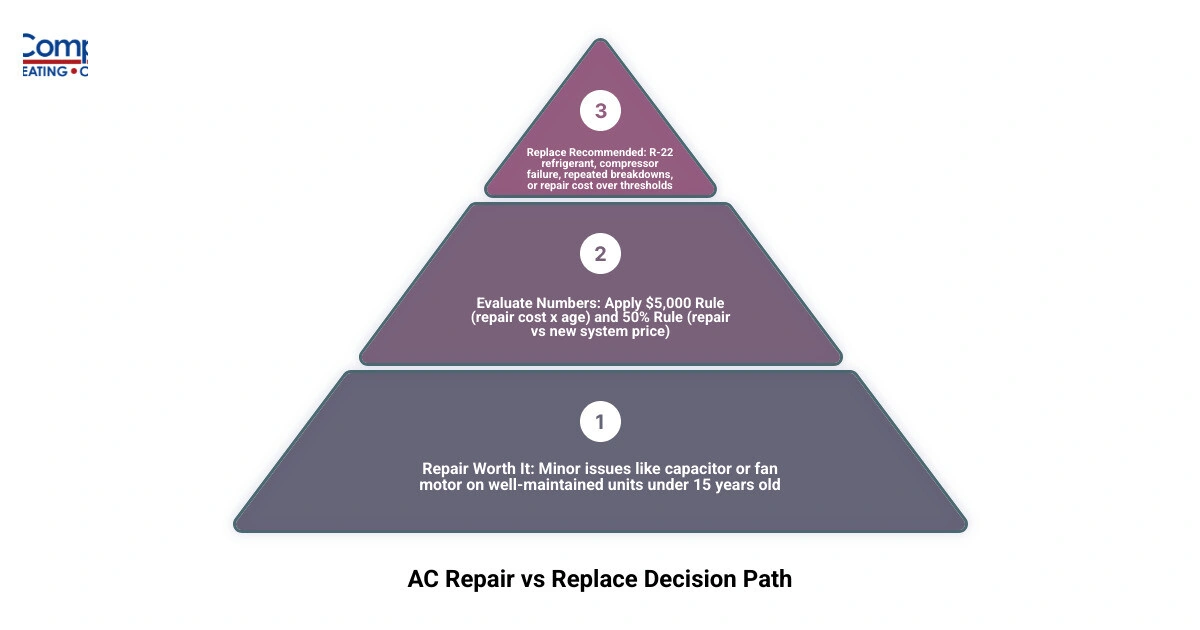
Is a 12 to 15 year old AC worth fixing in a Northern Colorado home? The short answer: it depends on the repair type, the unit's condition, and a few key numbers. Here's a quick breakdown to help you decide right now:
Quick Answer — Repair or Replace?
• Minor repair (capacitor, contactor, fan motor) on a well-maintained unit — Recommendation: Repair is likely worth it
• Repair cost × unit age exceeds $5,000 — Recommendation: Lean toward replacement
• Repair cost is more than 50% of a new system's price — Recommendation: Replace
• Unit uses R-22 refrigerant — Recommendation: Replace
• Compressor or evaporator coil failure — Recommendation: Almost always replace
• Unit is 12–15 years old with repeated breakdowns — Recommendation: Replace
• Unit is 12–15 years old with no major issues — Recommendation: Repair and monitor
When your AC starts acting up in the middle of a Northern Colorado summer — with temperatures climbing and dry heat pressing in — the last thing you want is a confusing repair-or-replace decision hanging over you. And if your system is somewhere between 12 and 15 years old, that decision is rarely simple.
At that age, your AC is sitting right at the edge of its expected lifespan. Northern Colorado's climate makes things even trickier. The combination of intense UV exposure, high altitude, temperature swings between scorching summer afternoons and cool nights, and blowing dust puts extra strain on outdoor AC equipment year after year. Local HVAC professionals note that these conditions can push the effective lifespan of a unit closer to 10 years rather than the national average of 15.
So before you approve a repair quote or start shopping for a new system, it's worth understanding exactly what the numbers say — and what your unit's condition is really telling you.
AC Lifespan and Performance in Northern Colorado's Climate
Living along the Front Range means enjoying beautiful mountain views, but it also means putting our home comfort systems through a unique environmental gauntlet. When we evaluate the lifespan of an air conditioner in cities like Fort Collins, Loveland, and Greeley, we cannot rely on national averages.
At our high altitude, several geographic factors accelerate the wear and tear on an air conditioner:
• Extreme Temperature Swings: It is not uncommon to experience a hot, dry 90°F afternoon followed by a sudden mountain breeze that drops the temperature into the 50s overnight. These rapid thermal contractions and expansions put structural stress on the metal components and electrical connections inside your outdoor condenser unit.
• Intense UV Radiation: The thinner atmosphere in Northern Colorado allows more intense ultraviolet rays to reach the ground. Over 12 to 15 years, this relentless solar exposure degrades plastic fan blades, wire insulation, and protective coatings on your outdoor unit.
• Dust, Wind, and Cottonwood Pollen: Spring and summer winds in places like Wellington and Severance blow heavy dust and agricultural debris directly into the delicate aluminum fins of your AC condenser. Cottonwood seeds act like a thick blanket, choking off airflow and forcing the compressor to run hotter and work harder.
Without consistent AC Maintenance, a system in Windsor or Timnath can easily age prematurely. Keeping your system clean and tuned up is critical to surviving these elements. To stay ahead of these local climate challenges, you can refer to our Seasonal HVAC Maintenance Tips Calendar to keep your system running smoothly year-round.
Why is a 12 to 15 year old ac worth fixing in a northern colorado home under certain conditions?
If your system is in this age bracket, a breakdown does not automatically mean you need to purchase a brand-new system. So, is a 12 to 15 year old ac worth fixing in a northern colorado home? Yes, under the right circumstances.
If the breakdown is caused by a failed minor electrical component, repairing the system is often the most sensible path. Common minor issues include:
• Failed Run Capacitor: This small, cylindrical component acts like a battery to give your compressor and fan motor the electrical boost they need to start up. Capacitors commonly fail during summer heatwaves, but they are quick and simple for a professional to swap out.
• Worn Contactors: The contactor is an electrical switch that controls the flow of power to the compressor and outdoor fan. Over time, the electrical contacts can pit, burn, or stick. Replacing a contactor is a routine service that can buy your system several more years of life.
• Condenser Fan Motor Issues: If the fan motor fails but the compressor is still healthy and the refrigerant circuit is sealed, replacing the motor is a reasonable investment to keep a well-maintained system running.
If you are currently staring at a system that refuses to turn on, you might be wondering, Why Isn't My AC Working? If it points to one of these isolated electrical components, a quick repair is highly defensible.
Signs of End-of-Life in Older AC Units
When an air conditioner reaches the 12-to-15-year mark, it often begins to drop subtle (and sometimes not-so-subtle) hints that its working days are numbered. Recognizing these red flags can save you from a complete system failure during a July heatwave:
1. Weak or Inconsistent Airflow: If some rooms in your Johnstown or Berthoud home feel like an icebox while others remain warm, your system's blower motor or compressor may be struggling to distribute cool air effectively.
2. Frequent Cycling: An AC that constantly turns on and off in rapid succession (short-cycling) is working overtime to maintain your thermostat's target temperature. This places immense strain on the compressor and spikes your energy usage.
3. Unusual Noises: Squealing, banging, clicking, or humming noises from the outdoor unit are clear indicators of mechanical distress. Squealing often points to a failing belt or motor bearing, while banging suggests a loose part inside the compressor.
4. Musty Odors: Foul or stale smells blowing through your vents can indicate mold accumulation on your indoor evaporator coil or standing water in the condensate drain pan.
5. Rising Utility Bills: If your monthly energy bills are steadily climbing even though your household cooling habits haven't changed, your aging system is losing its operational efficiency.
Financial Decision Frameworks: The $5,000 and 50% Rules
When deciding whether to repair or replace, it is best to remove the emotion and rely on objective financial formulas. Two industry-standard guidelines help homeowners navigate this crossroad: the $5,000 Rule and the 50% Rule.
• The $5,000 Rule — How It Works: Multiply the age of the unit (in years) by the repair quote. — When to Repair: If the total is under $5,000. — When to Replace: If the total is over $5,000.
• The 50% Rule — How It Works: Compare the repair quote to the cost of a complete replacement system. — When to Repair: If the repair is less than 50% of replacement cost. — When to Replace: If the repair is more than 50% of replacement cost.
For a deeper dive into choosing between these options, check out our AC Repair vs Replace Decision Guide for Northern Colorado.
Applying the $5,000 Rule to Your System
Let's look at how the math plays out in real life using the $5,000 Rule formula:
$$\text{Age of Unit (Years)} \times \text{Estimated Repair Cost} = \text{Decision Index}$$
Consider a 12-year-old AC unit in an Evans home that needs a moderate repair. If the repair quote is relatively minor, the math looks like this:
$$12 \text{ years} \times \text{minor repair} = \text{Well under } \$5,000 \rightarrow \mathbf{Repair}$$
However, if that same 12-year-old system suffers a major failure, such as a burnt-out compressor or a leaking evaporator coil, the repair quote will be significantly higher:
$$12 \text{ years} \times \text{major repair} = \text{Well over } \$5,000 \rightarrow \mathbf{Replace}$$
At age 12 to 15, the threshold for a sensible repair becomes very low. Any repair that represents a significant percentage of a new system's value will almost always push your calculation past the replacement threshold.
Refrigerant Transitions, Efficiency, and Comfort Risks
The HVAC industry has undergone massive regulatory shifts designed to protect the environment and improve energy efficiency. For homeowners with systems manufactured 12 to 15 years ago, these regulatory changes have a direct impact on your wallet.
To understand why older systems struggle to keep up with modern standards, it helps to understand the basics of How Does an Air Conditioner Work Anyway? Modern systems must meet strict SEER2 (Seasonal Energy Efficiency Ratio 2) standards. In Colorado, the minimum allowable efficiency rating for new installations is SEER2 14.
An older unit built in the early 2010s likely operates at a much lower efficiency rating. Upgrading to a modern, high-efficiency system can reduce your cooling energy consumption by 20% to 40%, directly lowering your monthly utility bills and improving your home's HVAC Energy Efficiency.
Deciding if a 12 to 15 year old ac worth fixing in a northern colorado home based on refrigerant availability
The type of chemical refrigerant flowing through your air conditioner's copper lines is one of the most critical factors in your decision.
• The R-22 Freon Ban: If your system is closer to 15 years old (or older), it may run on R-22 refrigerant (commonly known as Freon). The EPA completely banned the production and import of R-22. If your R-22 system develops a refrigerant leak, recharging it is incredibly expensive, and parts are becoming nearly impossible to source.
• The R-410A Phase-Down: If your system was installed after 2010, it likely uses R-410A. However, under the EPA's AIM Act, R-410A is also undergoing a strict phase-down. As of 2025 and 2026, new residential cooling equipment is transitioning to more eco-friendly refrigerants like R-454B or R-32. While R-410A remains legal to service, the shrinking supply means that repairing a major refrigerant leak on an older R-410A system will become increasingly expensive over the coming years.
If your 12 to 15 year old system has a confirmed refrigerant leak, investing in a leak search and recharge is rarely a smart financial move. The high cost of the disappearing refrigerant, combined with the likelihood of future leaks in an aging coil, makes replacement the clear choice.
Health and Comfort Risks of Aging Systems
An air conditioner does more than just lower the temperature in your home; it plays a vital role in managing your indoor air quality and humidity levels. Aging systems often struggle to maintain these secondary functions, which can lead to noticeable comfort and health issues:
• Excessive Indoor Humidity: As an AC unit loses efficiency, its ability to pull moisture out of the air declines. High humidity levels make the air feel sticky and warm, forcing you to lower the thermostat even further.
• Mold and Bacteria Growth: If your system's condensate drain line becomes clogged or the evaporator coil remains constantly damp due to poor airflow, mold can begin to grow inside your indoor air handler. These spores are then circulated throughout your home, potentially triggering allergies and respiratory issues.
• Poor Air Filtration: Older blower motors may struggle to push air through high-efficiency allergen filters, leading to an accumulation of dust, pet dander, and pollen in your living spaces.
Is a 12 to 15 year old ac worth fixing in a northern colorado home?
When you are weighing your options, scheduling a professional diagnostic evaluation is the best way to get an accurate picture of your system's health. Doing this during the "shoulder seasons" (spring or early autumn) is highly recommended. Planning ahead allows you to make a calm, informed decision without the pressure of an active heatwave.
If your system is currently blowing warm air, you can schedule a professional AC Repair service to pinpoint the exact cause of the failure before making your final decision.
When to Choose AC Replacement Over Repair
While minor fixes are perfectly fine for keeping a healthy system going, there are several scenarios where choosing a complete AC Replacement is the wisest path:
• Compressor Failure: The compressor is the heart of your air conditioner. If it fails on a 12 to 15 year old unit, the cost of replacing this single component is so high that it almost never makes sense to repair it.
• Leaking Evaporator or Condenser Coils: Copper coils degrade over time due to formicary corrosion. Once a coil begins to leak refrigerant, patching it is a temporary fix at best. Replacing the coil is a major expense that still leaves you with an aging compressor and fan.
• A History of Frequent Breakdowns: If you have had to call a technician out multiple times over the last two seasons, those individual repair bills are quickly adding up to the price of a new system.
If you decide that replacement is the right move, you can explore our Top AC Replacement Options: A Comprehensive Brand Comparison to find the perfect fit for your home.
Benefits of Upgrading to a Modern System
Investing in a new air conditioning system brings several immediate and long-term advantages to your home:
• Variable-Speed Technology: Unlike older single-stage units that are either 100% on or completely off, modern variable-speed compressors adjust their output precisely to match your home's cooling needs. This leads to incredibly stable indoor temperatures, superior dehumidification, and whisper-quiet operation.
• Smart Thermostat Integration: New systems pair seamlessly with smart thermostats, allowing you to control your home's climate remotely, set energy-saving schedules, and monitor your system's performance from your phone.
• Boosted Home Resale Value: If you plan to sell your home in Fort Collins or Loveland in the near future, a brand-new, energy-efficient HVAC system is a massive selling point. Buyers love "turn-key" homes and will often negotiate hard or walk away if they see a 15-year-old AC unit that they will have to replace immediately after moving in.
To ensure your new system is sized and installed perfectly for your home's unique layout, trust our professional AC Installation team to handle the job.
Frequently Asked Questions About Aging AC Units
Q: How long do most air conditioning systems last in Northern Colorado?
A: While well-maintained systems can occasionally last up to 15 years, our local climate factors — such as high altitude, intense UV rays, blowing dust, and extreme temperature swings — often reduce the typical useful lifespan closer to 10 to 12 years.
Q: Can I replace just the outdoor AC unit and keep my old indoor furnace and coil?
A: We highly advise against this. Air conditioners and heating systems are designed to work as "matched systems." Mixing a brand-new, high-efficiency outdoor unit with an aging, low-efficiency indoor coil can cause premature system failure, reduced efficiency, and will likely void the manufacturer's warranty.
Q: Should I replace my furnace at the same time as my AC?
A: If your furnace is also over 10 to 12 years old, replacing both units at the same time is highly efficient. Splicing them together at once saves on labor costs, ensures perfect system compatibility, and qualifies you for the maximum possible utility rebates.
Conclusion
Deciding whether to repair or replace a 12 to 15 year old air conditioner can feel overwhelming, but keeping these simple guidelines in mind will help you make the right choice for your home. Minor repairs on a well-maintained system are often worth doing to buy a little more time, while major component failures or refrigerant leaks on an aging unit are strong signals that it's time to upgrade.
At Compass Heating & Cooling, we make the replacement process as smooth and affordable as possible for our neighbors across Northern Colorado. We proudly serve homeowners in Fort Collins, Loveland, Windsor, Wellington, Severance, Timnath, Johnstown, Greeley, Berthoud, and Evans.
To help ease the transition to a high-efficiency system, we handle utility rebates up to $8,000+ on your behalf, saving you the hassle of paperwork. Plus, our exclusive maintenance plan provides you with priority service, ongoing discounts, and peace of mind for years to drive down future repair needs.
Ready to get an honest, professional opinion on your aging air conditioner? Schedule professional AC service with Compass Heating & Cooling today, and let us help you keep your home comfortable all summer long.
hear what our satisfied clients have to say
Our clients consistently praise our exceptional service and attention to detail. They appreciate the personalized approach we take to meet their unique needs, ensuring satisfaction every step of the way.
.png)