



A Practical Guide to AC Repair vs Replace in Northern Colorado
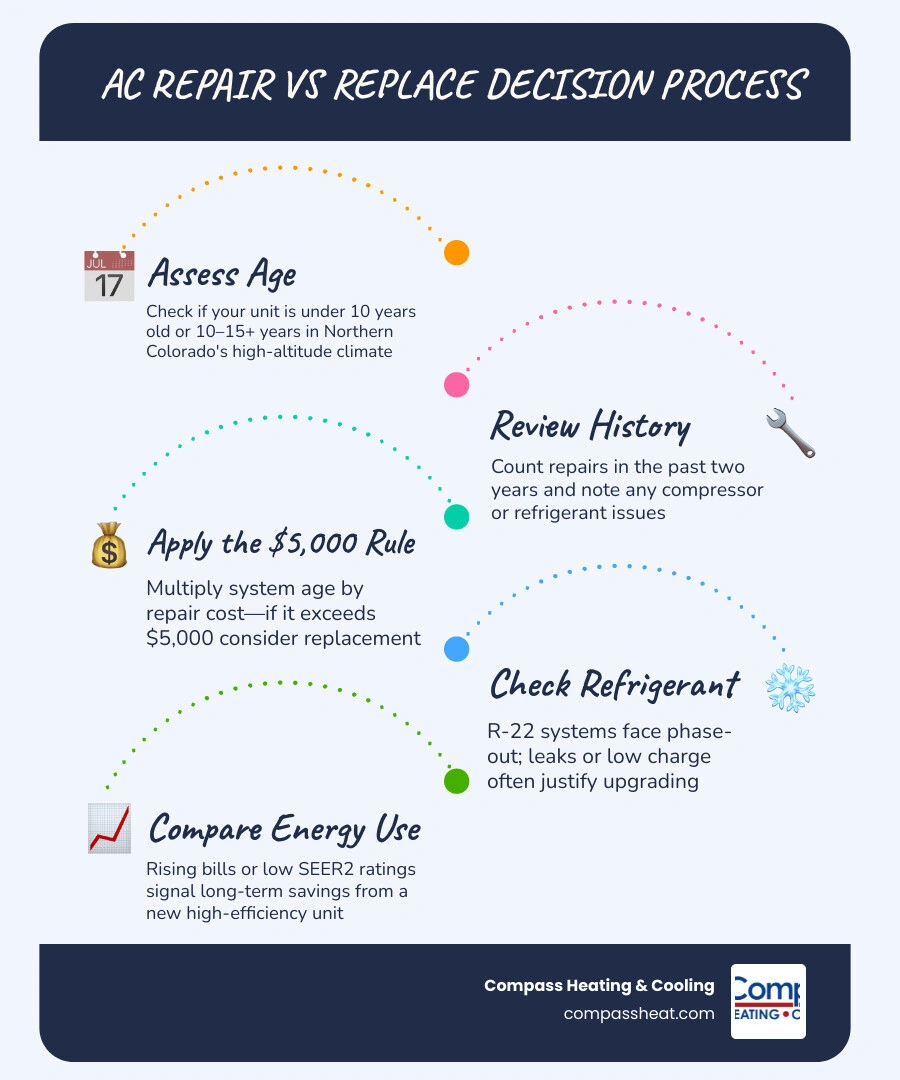
Is It Time to Repair or Replace Your AC in Northern Colorado?
When it comes to the ac repair vs replace — decision guide for northern colorado, here is a quick way to decide:
Repair your AC if:
• The system is under 10 years old
• The repair is minor and isolated
• The repair cost is less than 50% of a new system's cost
• The unit has an active warranty
Replace your AC if:
• The system is 10–15 years or older
• You've had multiple repairs in the past two years
• The repair cost multiplied by the system's age exceeds $5,000 (the $5,000 Rule)
• The unit uses R-22 refrigerant
• Energy bills have been steadily climbing
If your air conditioner has been struggling to keep up this summer — running constantly, cycling on and off, or leaving rooms uncomfortably warm — you're probably wondering whether it makes more sense to fix it or start fresh. For homeowners in Fort Collins, Loveland, Greeley, and the surrounding Northern Colorado area, that question comes with a few extra layers. The high altitude, intense UV exposure, temperature swings, and dusty conditions here put more wear on cooling systems than many other parts of the country, which means the typical national averages don't always apply to your situation.
Most AC systems last between 10 and 15 years nationally, but Northern Colorado's climate can push that closer to the 10-year mark. Add in rising energy bills, outdated refrigerant, or a compressor that keeps failing, and the math on repairs starts to look less and less favorable. At the same time, replacing a system that still has life in it is a waste of money — so the decision really comes down to knowing what to look for and how to run the numbers honestly.
This guide walks you through exactly that.
How Lifespan and Climate Impact Your Cooling System
Living along the Front Range means enjoying beautiful mountain views, but it also means subjecting your home’s outdoor mechanical systems to some of the harshest weather in the country. Our unique climate directly impacts how long your air conditioner will last and how hard it has to work.
While the typical national average lifespan for a central air conditioner is 10 to 15 years, systems in Northern Colorado often experience accelerated wear. Several regional environmental factors are responsible for this shortened lifespan:
• High Altitude and Thin Air: At over 4,500 feet (and even higher in our mountain-adjacent communities), the air is thinner. This means your outdoor condenser unit has to work harder to transfer heat away from your home, increasing the physical workload on the compressor.
• Intense UV Exposure: The Colorado sun is incredibly strong. High UV exposure degrades the plastic and rubber components inside your outdoor unit much faster than in lower-elevation states, leading to premature electrical and structural wear.
• Extreme Temperature Swings: It is not uncommon for Northern Colorado to experience a 40-degree temperature drop in a single afternoon. These rapid shifts cause metal components in your HVAC system to expand and contract quickly, putting extra stress on soldered joints, coils, and electrical connections.
• Dust, Debris, and Cottonwood Seed: Spring and summer winds blow heavy amounts of agricultural dust, wild debris, and fluffy cottonwood seeds directly into condenser coils. When these coils get clogged, the system cannot release heat, causing it to run hot, cycle frequently, and burn out its motor.
Because of these local challenges, staying on top of yearly AC Maintenance is the single most important action you can take to protect your investment. Without regular cleaning and tuning, a system that should easily last 12 years might start failing at year 7 or 8.
AC Repair vs Replace — Decision Guide for Northern Colorado
When your air conditioner stops blowing cold air on a hot July afternoon, the pressure is on to make a quick decision. Should you call for a quick fix, or is it time to invest in a brand-new system?
To make the right choice, we recommend looking at your system through a balanced decision framework. Rather than reacting in a panic, you should evaluate the physical warning signs, run a couple of simple mathematical formulas, and consider the age of your equipment.
If you live in Fort Collins, you might find yourself weighing whether to schedule another AC Repair Fort Collins or start planning for an AC Replacement Fort Collins. Let’s dive into the warning signs and formulas that will help you make that call with confidence.
Warning Signs: AC Repair vs Replace — Decision Guide for Northern Colorado
Before you look at the financial math, pay close attention to how your air conditioner is actually behaving. Your system will usually tell you when it is on its last legs. Here are the most common performance red flags:
• Uneven Cooling: If your downstairs feels like an icebox but your upstairs bedrooms are sweltering, your system is struggling to distribute air effectively. This can point to ductwork issues, but in older units, it often means the compressor is losing its capacity to pump refrigerant efficiently.
• Warm Air from Vents: If your system is running but blowing lukewarm air, you could be dealing with a failed compressor, a refrigerant leak, or a broken capacitor. While a capacitor is a quick fix, refrigerant leaks and compressor failures are major issues.
• Strange Noises: Squealing, grinding, rattling, or loud banging sounds from the outdoor unit are clear indicators of mechanical failure. Squealing often points to a failing blower motor belt, while grinding typically means the bearings in your compressor are shot.
• Frequent Cycling: If your AC turns on, runs for three minutes, turns off, and then repeats the process, it is "short-cycling." This places massive electrical strain on your system, drives up your utility bills, and is often a sign that the unit is either improperly sized or failing.
• Rising Energy Bills: Have you noticed your electric bills climbing month after month, even though your family’s habits haven't changed? As air conditioners age, they lose their efficiency. An older unit has to run much longer to achieve the same cooling results, which shows up directly on your monthly utility statement.
If you are facing a sudden cooling issue and want to rule out simple problems before calling us, we suggest reading through Why Isn't My AC Working or checking our step-by-step troubleshooting guide, 8 Steps to Fix AC Yourself. Sometimes, a dirty air filter or a tripped circuit breaker is the only culprit!
Financial Formulas: AC Repair vs Replace — Decision Guide for Northern Colorado
If you have ruled out simple fixes and are looking at a professional repair recommendation, it is time to do some basic math. Two industry-standard guidelines can help take the emotion out of the decision: The $5,000 Rule and The 50% Rule.
The $5,000 Rule
This is a straightforward mathematical formula used by HVAC professionals nationwide. You multiply the age of your air conditioning equipment by the estimated repair cost. If the resulting number is over $5,000, you should seriously consider replacing the unit. If it is under $5,000, repairing it is usually the more practical financial move.
• Example A (Repair): Your AC is 6 years old and needs a new capacitor that costs a moderate amount. $$\text{6 years} \times \text{Moderate Repair} = \text{Well under \$5,000 threshold} \rightarrow \textbf{Repair}$$
• Example B (Replace): Your AC is 11 years old and needs a major repair, such as a new evaporator coil or compressor.$$\text{11 years} \times \text{Major Repair} = \text{Well over \$5,000 threshold} \rightarrow \textbf{Replace}$$
The 50% Rule
This rule states that if the cost of a single repair is 40% to 50% of the total value of a brand-new system, pouring money into the old unit is no longer a smart investment. It is better to put those funds toward a modern, reliable replacement.
For our neighbors in Loveland, applying these rules can save you from throwing good money after bad. If you are stuck trying to decide between a temporary AC Repair Loveland and a permanent AC Replacement Loveland, we can help you run these calculations based on your specific system's condition.
• Minor Electrical Issue — Age of Unit: 5 Years — Repair Complexity: Low (e.g., Contactor) — Formula Applied: Age $\times$ Low = Under $5,000 — Smartest Recommendation: Repair (System is young and has plenty of life left)
• Moderate Fan Motor Failure — Age of Unit: 8 Years — Repair Complexity: Medium (Blower Motor) — Formula Applied: Age $\times$ Medium = Under $5,000 — Smartest Recommendation: Repair (If the overall system is in good shape)
• Major Coil Leak — Age of Unit: 12 Years — Repair Complexity: High (Evaporator Coil) — Formula Applied: Age $\times$ High = Over $5,000 — Smartest Recommendation: Replace (Avoid investing in a system near the end of its life)
• Failed Compressor — Age of Unit: 14 Years — Repair Complexity: Very High (Compressor) — Formula Applied: Age $\times$ Very High = Over $5,000 — Smartest Recommendation: Replace (The compressor is the "heart" of the system; replace now)
Efficiency, Refrigerant, and System Reliability
Aside from immediate repair costs, you must also look at the long-term operational costs of your cooling system. An older, repaired system might keep your home cool, but it will do so at a much higher monthly cost than a modern unit.
If you are a Greeley homeowner trying to choose between AC Repair Greeley and AC Replacement Greeley, understanding system efficiency is key to calculating your true return on investment. To learn more about how modern standards save you money, read our deep dive into HVAC Energy Efficiency.
The Impact of Outdated R-22 Refrigerant
If your air conditioner was installed before 2010, there is a very high chance it uses R-22 refrigerant (commonly known as Freon). Due to environmental regulations and its ozone-depleting properties, the EPA completely banned the production and import of R-22 in 2020.
Today, the only available R-22 is reclaimed or recycled, making it incredibly scarce and highly expensive. If your older system develops a refrigerant leak, recharging it will cost a fortune. Furthermore, if an R-22 system suffers a major component failure—like a burnt-out compressor—you cannot simply swap the part. Modern compressors are designed for newer, eco-friendly refrigerants like R-410A or R-454B, which operate at different pressures.
Continuing to patch up an R-22 unit is like trying to keep a cassette player running in a streaming world. When an R-22 system springs a leak, the most cost-effective move is to check out the Top AC Replacement Options and upgrade to a modern system.
Upgrading to High-SEER2 Systems
Air conditioner efficiency is measured by the Seasonal Energy Efficiency Ratio 2 (SEER2). The higher the SEER2 rating, the less electricity the system uses to cool your home.
As of recent Colorado regulations, the minimum standard for new air conditioners is 14 SEER2. If your current unit is over 10 years old, it likely operates at a much lower rating—often around 10 to 13 SEER (under the older testing standards). Because older systems lose efficiency over time, your current unit is likely running even lower than its original rating.
By upgrading to a high-efficiency system (ranging from 16 to 22+ SEER2), you can reduce your cooling energy consumption significantly. Because cooling can make up to 70% of your home's summer electric bill, upgrading to a high-efficiency unit can slash your total summer electricity costs by up to one-third.
Modern high-efficiency systems achieve this through advanced variable-speed technology. Instead of turning on at 100% capacity and shutting off repeatedly (which wastes massive amounts of energy), variable-speed compressors run continuously at lower speeds, matching the exact cooling needs of your home. This results in quieter operation, superior humidity control, and much lower utility bills. If you are ready to make the switch, a professional AC Installation will pay dividends in comfort and savings.
Strategic Planning: Shoulder Seasons and Matched Systems
Many homeowners wait until their air conditioner completely breaks down on a 95-degree afternoon in July before they think about replacement. While we are always ready to help in an emergency, waiting for a total system failure puts you at a distinct disadvantage.
Taking a proactive approach allows you to plan your upgrade strategically, saving you time, stress, and money.
Why Spring and Fall are Best for Upgrades
The best time to replace your air conditioner is during our local "shoulder seasons"—specifically late winter to early spring (February through April) or mid-to-late fall.
During these milder months, HVAC companies are not swamped with emergency no-heat or no-cool calls. This seasonal shift works in your favor in several ways:
1. Flexible Scheduling: You can choose an installation date and time that fits your schedule perfectly, rather than waiting days for an emergency opening during a summer heatwave.
2. No Emergency Discomfort: Replacing your cooling system requires turning off your HVAC system for several hours. Doing this when outdoor temperatures are a comfortable 60 degrees is much more pleasant than doing it when it is 95 degrees outside.
3. Better Planning: You have the time to research different systems, compare features, and find the perfect match for your home without the pressure of an active cooling emergency.
Replacing Your Furnace and AC Simultaneously
If you are planning to replace your air conditioner, you should also ask yourself: Is It Time for a New Furnace?
Your heating and cooling systems are not entirely separate; they share critical infrastructure, including the indoor blower motor, the ductwork, and the thermostat. Replacing both systems at the same time offers several major benefits:
• Matched System Efficiency: Modern outdoor AC units are designed to work in tandem with specific indoor furnace blowers. If you pair a brand-new, high-efficiency AC with an old, single-speed furnace blower, you won't get the full efficiency or comfort benefits of your new air conditioner.
• Reduced Installation Labor: Installing both systems at once is far more efficient than installing them years apart. Because our technicians are already at your home, modifying the ductwork and hooking up electrical lines for both units at the same time saves significant labor.
• Aligned Warranties: When you replace your entire heating and Air Conditioning system together, both units start their warranty periods at the exact same time, giving you complete peace of mind for the next decade or more.
Frequently Asked Questions About Air Conditioning Decisions
How long does an air conditioner typically last in Fort Collins and Loveland?
While the national average is 10 to 15 years, our local climate in Fort Collins, Loveland, and surrounding areas often shortens that lifespan closer to 10 to 12 years. High UV rays, rapid temperature swings, agricultural dust, and wind-blown debris all cause outdoor condenser units to age more quickly. Consistent, professional maintenance is key to helping your system reach the 15-year mark.
Is it better to replace an AC before it fails completely?
Yes. Proactive replacement is highly recommended. It allows you to schedule the installation during the mild spring or fall shoulder seasons, gives you time to research your options, and prevents the extreme discomfort of a sudden breakdown during a summer heatwave. It also gives you time to secure financing and maximize local utility rebates.
Does a new air conditioner increase a home's resale value?
Absolutely. Modern, energy-efficient HVAC upgrades are highly attractive to potential home buyers in Northern Colorado. A new cooling system with high-SEER2 ratings improves your home's energy profile and gives buyers peace of mind that they won't face major capital expenses immediately after moving in. It also prevents your cooling system from being flagged as a "red flag" during a standard home inspection.
Conclusion
Deciding whether to repair or replace your air conditioner doesn't have to be a guessing game. By using the $5,000 Rule, paying attention to performance warning signs, and considering the age of your equipment, you can make a smart, financially sound decision for your home.
At Compass Heating & Cooling, we are proud to serve homeowners across Northern Colorado, including Fort Collins, Loveland, Windsor, Wellington, Severance, Timnath, Johnstown, Greeley, Berthoud, and Evans. We are here to help you navigate this decision with honest, professional advice.
When you choose us for your comfort needs, we make the process as easy and affordable as possible. We handle utility rebates up to $8,000+ on your behalf, ensuring you get every dollar of savings you deserve without the paperwork headache. Plus, our comprehensive maintenance plan gives you priority service, year-round peace of mind, and exclusive discounts on repairs.
Whether you need a fast, reliable AC Repair to get through the summer or want to explore your options for a high-efficiency replacement, we’ve got you covered. Contact us today to schedule your system evaluation!
hear what our satisfied clients have to say
Our clients consistently praise our exceptional service and attention to detail. They appreciate the personalized approach we take to meet their unique needs, ensuring satisfaction every step of the way.
.png)