



How Late-July Monsoonal Moisture Impacts Your AC's Cooling Capacity
When the Monsoon Hits: Why Your AC Suddenly Can't Keep Up
Late-July monsoon thunderstorms are an unavoidable part of summer, bringing a drastic and sudden shift to our usually dry afternoons. You know the exact physical sensation: dark storm clouds roll over the foothills, the outdoor temperature drops a few degrees, but the air inside your house suddenly feels heavy, thick, and uncomfortable. If you are wondering exactly how late-July monsoonal moisture impacts your AC's cooling capacity, you are not alone. Here at Compass Heating & Cooling, our dispatch board lights up the moment these storms hit, with homeowners reporting their air conditioner running continuously for hours, yet the thermostat refuses to budge and their living room still feels warm and sticky.
This jarring shift creates a stressful decision point for many homeowners. When the system is running non-stop but failing to lower the temperature, it is easy to assume the compressor has failed or a vital component has broken. You are left wondering whether you need to call for an emergency repair immediately or if you should just wait out the humidity spike. The reality is that your cooling equipment is likely facing a massive, temporary change in the composition of the air it is trying to process. Understanding how your air conditioning systems process this sudden influx of moisture can save you from unnecessary panic and help you make the right call for your home's comfort.
The Hidden Battle: Latent Heat vs. Sensible Heat
To understand why your system struggles during a summer storm, we have to look closely at the physics of indoor cooling. Air conditioners do not simply manufacture cold air and push it into a room; they operate by extracting heat and moisture from your indoor air and moving it outside. This extraction process involves a constant, unseen battle between two different types of heat energy: sensible heat and latent heat.
Defining Sensible and Latent Heat
Sensible heat is the heat you can easily measure and feel. It is the actual temperature of the air, the number you read on your thermostat. When your air conditioner lowers the room temperature from 80°F to 72°F, it is removing sensible heat.
Latent heat, on the other hand, is the thermal energy hidden within the moisture suspended in the air. You cannot read latent heat on a standard thermometer, but you track it by measuring your indoor relative humidity percentage. The higher the humidity, the more latent heat is trapped in your home, making the air feel clammy and oppressive even if the sensible temperature is relatively low.
The Sequence of Cooling
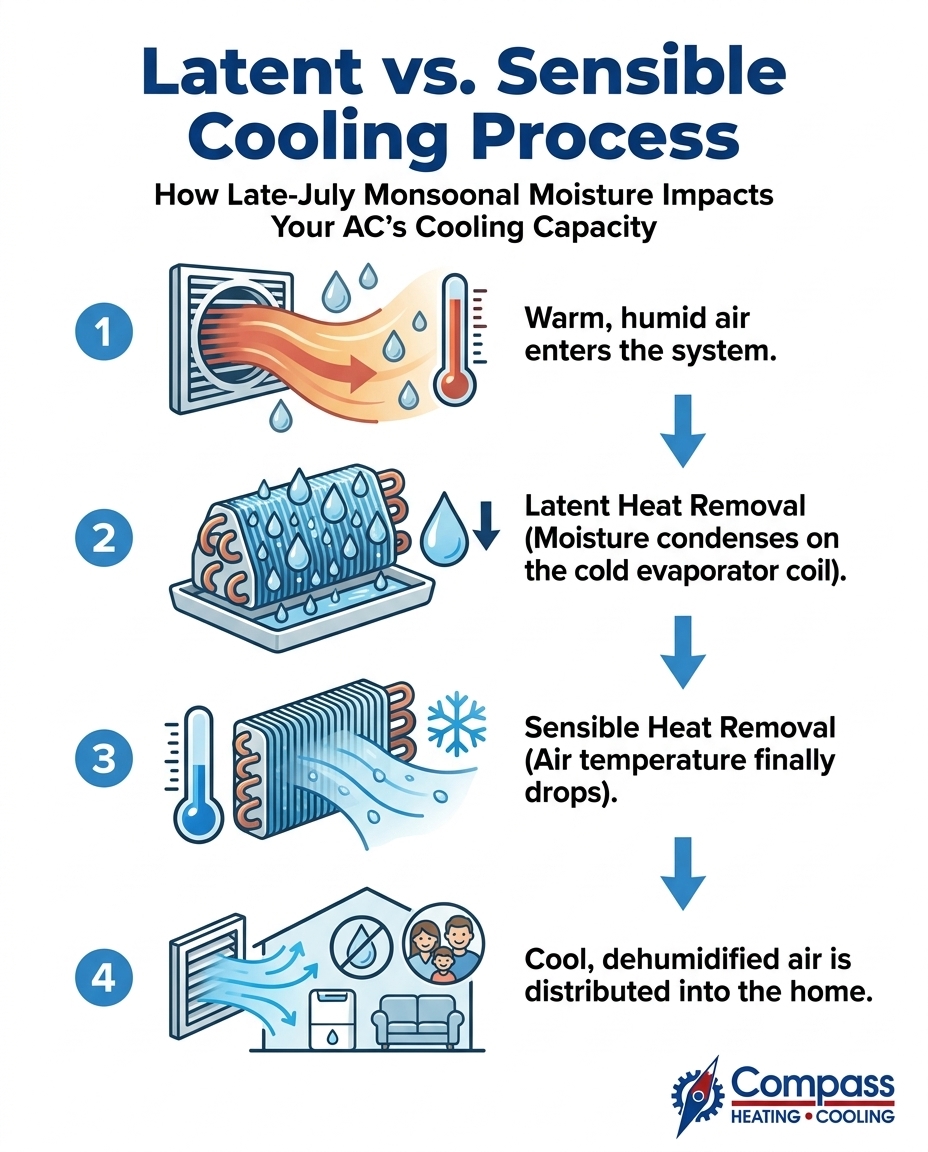
Here is the critical factor our technicians find most homeowners do not realize: an air conditioner must expend significant energy to process and remove latent heat before it can effectively reduce sensible heat. Think of your indoor air like a soaking wet sponge. Before you can cool the sponge down, you have to wring the water out of it.
During high-humidity events, warm, moist air is pulled across your system's freezing cold evaporator coil. Before the air temperature can drop significantly, the moisture in that air must condense into liquid water on the coil and drain away. Your air conditioner essentially becomes a giant dehumidifier first and a temperature-dropper second. This sequence of cooling dictates that during a muggy thunderstorm, the system prioritizes dehumidification. As all of the system's cooling capacity is directed toward wringing water out of the air, the actual temperature drop stalls, leaving you wondering why the thermostat is stuck.
Why Northern Colorado Systems Struggle with Sudden Humidity Spikes
In our years of installing and servicing systems across the Front Range, we've seen firsthand how regional HVAC systems are meticulously sized and calibrated for the specific climate they operate in. In our region, air conditioners are optimized for a predominantly dry climate. A properly sized system for a dry climate is designed with a high sensible cooling capacity because the primary job is to combat dry, 95-degree heat without having to process massive amounts of airborne moisture.
This careful calibration is exactly why the North American Monsoon season causes such a shock to residential cooling systems. When late-July monsoon thunderstorms roll through the Loveland area, thunderstorm downdrafts drastically and instantly alter the HVAC cooling load profile. The outdoor temperature might drop from a dry 95 degrees down to 85 degrees, but the relative humidity spikes rapidly.
A system sized perfectly for dry heat is suddenly forced to deal with a massive latent heat load it was not primarily designed to handle. The equipment has a fixed amount of cooling capacity. When the environment suddenly demands that 70% of that capacity go toward pulling water out of the air, only 30% is left to lower the temperature. This is why an 85-degree day with high humidity often feels much harder on your system—and your comfort levels—than a 95-degree day with zero humidity. The system is simply shocking its capacity to catch up with a weather anomaly.
Signs Your System is Overwhelmed, Not Broken
When we get emergency calls during a storm, our first goal is to help you distinguish between a system that is temporarily dealing with a massive latent heat load and one that actually requires our professional attention. Here are the key indicators our team recommends watching for:
• Continuous running with heavy air: The AC is running non-stop, but the indoor air feels heavy or clammy. This indicates the system is actively working on dehumidification.
• Rapid condensate drainage: If you check outside or at your floor drain and see water pouring rapidly from the condensate line, this is excellent news. It means the system is successfully wringing latent heat out of the air.
• Steady thermostat readings: The thermostat temperature is holding steady or dropping very slowly. As long as the temperature is not climbing rapidly, the system is likely holding its own against the moisture.
• Altered cycling patterns: The system cycles differently than it does on dry days. If it is struggling with airflow while trying to process heavy moisture, you might notice the AC keeps turning on and off in the heat, which can sometimes point to a frozen coil or airflow restriction rather than just a heavy load.
Overwhelmed vs. Broken: What to Look For
• Heavy condensate drainage, steady temperature — Likely Cause: System is processing high latent heat load. — Recommended Action: Wait it out; allow the system to dehumidify.
• Thermostat temperature climbing rapidly — Likely Cause: Compressor failure or severe refrigerant leak. — Recommended Action: Turn system off and call for professional repair.
• Ice forming on refrigerant lines or indoor coil — Likely Cause: Restricted airflow or low refrigerant levels. — Recommended Action: Turn system to FAN ONLY to thaw, then call a pro.
• System short-cycling every 3-5 minutes — Likely Cause: Electrical issue, oversized unit, or clogged filter. — Recommended Action: Check filter; if clean, request a system diagnostic.
Immediate Steps to Reduce Indoor Moisture Load During a Storm
If your system is overwhelmed by a sudden spike in your indoor relative humidity percentage, our team recommends a few actionable, non-technical triage steps you can take to help the equipment catch up. By reducing the amount of moisture generated inside the home, you free up your air conditioner's capacity to focus on cooling the air.
1. Avoid moisture-generating activities: During the height of a humid storm, do not boil water for pasta, run the dishwasher, or take long, steamy showers. These activities pump massive amounts of latent heat directly into your indoor air, forcing your AC to work twice as hard to remove it.
2. Seal the building envelope: Ensure all windows and exterior doors are tightly closed and sealed against the humid outdoor air. Even a slightly cracked window during a thunderstorm can introduce enough moisture to completely overwhelm a residential cooling system.
3. Utilize exhaust fans strategically: Turn on exhaust fans in bathrooms and kitchens—provided they vent directly to the outside—to expel existing indoor humidity. Make sure to turn them off once the moisture is cleared so you do not pull conditioned air out of the house.
4. Set the thermostat fan to AUTO: Check that your thermostat fan setting is on 'AUTO' rather than 'ON'. When set to 'ON', the blower fan runs continuously, even when the outdoor compressor cycles off. This will take the moisture that just condensed on your wet evaporator coil and blow it right back into your living space, completely defeating the dehumidification process.
The Role of Clean Coils and Proper Refrigerant Levels
While patience is required during a sudden weather shift, your system's ability to handle that shift depends entirely on its maintenance condition. A pattern we see often in Loveland is that well-maintained equipment handles this specific weather window beautifully, while neglected systems immediately struggle. When a sudden storm hits, any underlying inefficiencies in your equipment will be instantly magnified.
Consider the role of the indoor evaporator coil. This coil must be freezing cold to pull moisture out of the air effectively. If the coil is covered in a layer of dust, pet hair, or dirt, that debris acts as an insulating blanket. An insulated coil cannot absorb heat or condense moisture efficiently, severely reducing the system's ability to extract humidity from the air. Similarly, slightly low refrigerant levels—which might go completely unnoticed during dry, mild weeks—become glaringly obvious when the system needs absolute maximum capacity for dehumidification. Low refrigerant alters the pressure and temperature of the coil, crippling its latent cooling power.
Proactive care ensures the system is ready for the intense, short-term strain of the monsoon season. As your local Northern Colorado experts, our team at Compass Heating & Cooling intimately understands the unique stress these sudden monsoonal shifts place on local HVAC systems, offering targeted solutions and precise calibrations that national chains might overlook. If your system continues to struggle to dehumidify even after the storm has passed and the outdoor air has dried out, it is a strong indicator that you need routine AC maintenance to restore its full capacity.
Frequently Asked Questions About AC Performance During Thunderstorms
Why is my AC running but my house still feels humid?
The system is processing the latent heat first. It takes significant time and energy to extract suspended moisture from the air before sensible cooling (temperature drop) can occur. During a heavy storm, the system is acting as a dehumidifier, which delays the temperature drop you are waiting for.
Does an AC remove humidity before cooling the air?
Yes, physics dictates that moisture must condense out of the air on the cold evaporator coil before the overall air temperature drops significantly. The energy required to change water vapor into liquid water consumes a large portion of the air conditioner's total capacity.
How can I help my AC dehumidify my house during a storm?
You can help your system by eliminating indoor moisture sources. Keep doors and windows tightly closed, use kitchen and bathroom exhaust fans to remove steam, avoid boiling water on the stove, and ensure your thermostat fan is set to the AUTO position.
Should I set my AC fan to ON or AUTO during high humidity?
We always recommend using the AUTO setting during humid weather. Setting the fan to ON forces air across the indoor coil continuously. When the cooling cycle ends, the fan will blow the moisture sitting on the wet evaporator coil directly back into your home, raising the humidity all over again.
How long does it take for an AC to remove humidity from a house?
It depends heavily on the system's size, the home's insulation, and the severity of the moisture load. However, we typically see it take several hours of continuous running during a heavy storm to normalize indoor humidity levels and begin dropping the sensible temperature.
At what indoor relative humidity percentage should I be concerned?
Ideal indoor humidity during the summer should sit between 30% and 50%. If your indoor relative humidity percentage consistently stays above 60% long after a storm passes and the outdoor air has dried, your system may be improperly sized or in need of our professional assessment.
Keep Your Home Comfortable Through the Monsoon Season
Navigating the sudden climate shifts of late summer requires a mix of patience and proactive care. When late-July monsoon thunderstorms hit, remember that your air conditioner is working incredibly hard to dehumidify the air before it can cool it. Patience is key when a sudden monsoon hits, as the AC is prioritizing latent heat removal to keep your living space safe from excessive moisture.
Taking simple, immediate steps to reduce your indoor moisture load can make a massive difference in how quickly your system catches up. Keep your windows closed, manage your indoor humidity sources, and always keep your fan set to AUTO. However, if you feel your system is consistently underperforming, failing to drain condensation, or blowing warm air long after the weather has stabilized, it may be time to evaluate the health of your equipment. Taking the time to understand your system's performance ensures you are never caught off guard, allowing you to rely on our professional AC repair services only when truly necessary.
hear what our satisfied clients have to say
Our clients consistently praise our exceptional service and attention to detail. They appreciate the personalized approach we take to meet their unique needs, ensuring satisfaction every step of the way.
.png)