



What to Expect When You Ask Us for a Second Opinion on a Condemned AC
Did Your AC Just Get Condemned During a Heatwave?
Is your system truly dead, or do you just need to know exactly what to expect when you ask us for a second opinion on a condemned AC? Being told your compressor has completely failed is incredibly stressful, especially when the diagnosis happens during a July peak-heat event. Your house is rapidly heating up, your family is uncomfortable, and the pressure to make a major replacement decision feels overwhelming. We completely understand that panic. However, pausing for a proper diagnostic verification often prevents an unnecessary and massive overhaul. Drawing on our extensive experience serving Loveland, CO, our team at Compass Heating & Cooling approaches these specific emergency calls with technical precision rather than sales pressure, giving you the objective facts you need to make the right choice for your home.
If you are looking for honest air conditioning services, our verification process is designed to find the real truth behind a sudden system failure.
Why the 'Dead Compressor' Diagnosis Requires Verification
When severe summer weather strikes Northern Colorado, your cooling equipment works overtime just to maintain a basic indoor temperature. In our years of dispatching technicians throughout Loveland, we have seen a recurring pattern: aging AC electrical systems are under extreme stress during these intense heatwaves, leading to sudden, unexpected shutdowns. Because the symptoms of a minor electrical failure often look exactly like a catastrophic compressor failure, misdiagnoses are incredibly common when technicians are rushed or inexperienced.
Many assumed compressor failures are actually caused by minor electrical faults that mimic a dead unit. A blown capacitor, a pitted contactor, or a tripped thermal overload switch will all stop a compressor from turning on. To the untrained eye—or to a technician trying to meet a sales quota—a silent compressor is quickly labeled as "dead." Understanding the importance of a second opinion on HVAC work is critical before committing to a full system overhaul. A second look ensures that your equipment is evaluated based on hard data rather than assumptions.
Instead of just judging the system by its age or the sound it makes, a proper verification requires specialized tools. Below is a breakdown of how the symptoms of a fixable issue overlap with a total failure:
• Buzzing sound, but fan won't spin — Common Rushed Diagnosis: Seized compressor motor — What We Actually Verify: Failed dual run capacitor
• System clicks but nothing turns on — Common Rushed Diagnosis: Dead compressor — What We Actually Verify: Burnt or pitted electrical contactor
• Unit shuts down after running briefly — Common Rushed Diagnosis: Internal mechanical failure — What We Actually Verify: Thermal overload from dirty coils
• Breaker trips immediately at startup — Common Rushed Diagnosis: Shorted compressor windings — What We Actually Verify: Grounded wires or failing breaker
By taking the time to test the individual components during a July peak-heat crisis, we frequently save homeowners from replacing a system that only needed a standard repair.
Step-by-Step: Our Second Opinion Diagnostic Process
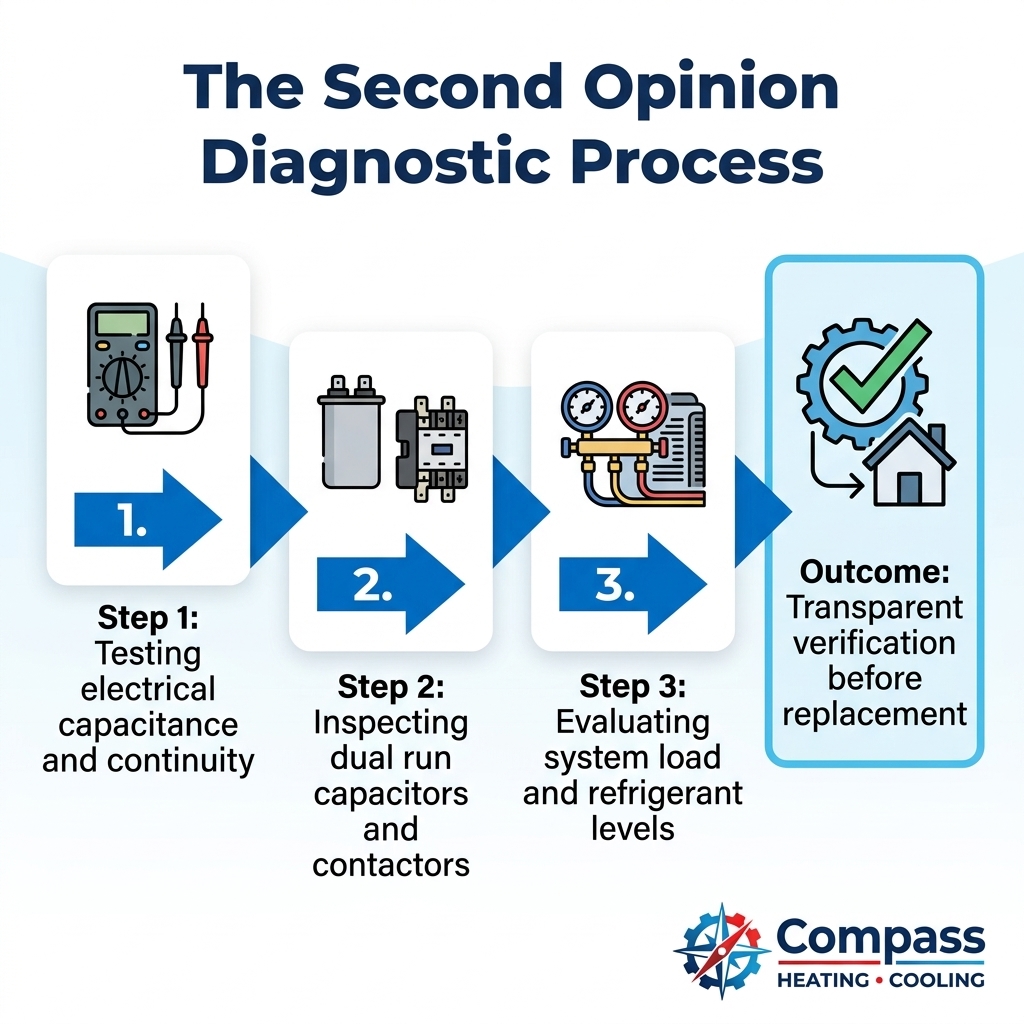
When our Compass Heating & Cooling technicians arrive for a verification call, we do not take the initial diagnosis at face value. We start our testing completely from scratch. By following a strict standard operating procedure we have developed over years in the field, we ensure no detail is missed. This process relies heavily on exact electrical capacitance and continuity readings to confirm or refute the original verdict.
1.
Step 1: Testing Electrical Integrity
First, our technicians disconnect all power to the unit to safely access the internal compressor terminals. Because these components handle high voltage, this step requires specialized training and professional meters. We use a digital multimeter to check for open windings or shorts to ground within the compressor motor itself. If the meter shows continuity through the motor windings and no short to the metal casing, the internal motor is still electrically intact. These specific electrical capacitance and continuity readings are the only true way to know if the heart of the compressor has failed.
2.
Step 2: Inspecting Starting Components
If the internal motor tests fine, we move to the external starting components. The compressor requires a massive jolt of stored energy to start spinning. We check the dual run capacitor for bulging, leaking fluid, or a failure to hold a proper microfarad charge. Next, we inspect the contactor—the mechanical switch that pulls high voltage into the unit. If the contactor has pitted, burnt, or welded contacts, the voltage simply cannot reach the compressor. We also identify if a hard start kit is present and whether it has failed, which can easily prevent a healthy compressor from turning on.
3.
Step 3: Evaluating System Load and Refrigerant
If we identify and bypass a faulty electrical component, and the compressor successfully runs, our job is not done. We monitor the amperage draw upon startup to ensure the motor isn't pulling excessive power, which would indicate internal mechanical wear. Finally, we check the refrigerant levels and system airflow. A system severely low on refrigerant, or one with a completely blocked air filter, will lock out on high or low-pressure safety switches. By evaluating the entire load, we ensure the system is actually safe to continue operating.
Common Fixable Issues Mistaken for a Dead AC
Based on the countless second-opinion calls our team has run across Loveland, it is surprisingly common for a seemingly catastrophic failure to trace back to a single, easily replaceable part. When a technician relies on precise electrical capacitance and continuity readings rather than guesswork, they often uncover minor faults. If you need reliable Loveland AC repair, our team looks for these specific culprits before ever recommending a replacement:
• Blown dual run capacitors: This is the single most common culprit we see for a compressor that refuses to start. When the capacitor fails, the compressor will often sit silently or emit a low hum, mimicking a seized motor.
• Pitted electrical contactors: Over time, the high-voltage electrical arcing inside the contactor causes the metal plates to pit and burn. When this happens, the voltage drops, and the compressor cannot receive the power it needs to run.
• Thermal overload lockouts: Compressors have internal safety switches that shut the motor down if it gets too hot. Dirty condenser coils, failing fan motors, or poor airflow can cause the unit to overheat and lock out. Once it cools down and the airflow issue is resolved, the compressor often runs perfectly.
• Failed hard start kits: Older systems sometimes use a hard start kit to give the compressor an extra boost. If this relay fails, the compressor might struggle to start and eventually trip the circuit breaker, leading to a false "dead" diagnosis.
Identifying these smaller issues through precise measurements is exactly how we save existing systems and protect homeowners from unnecessary expenses.
A Transparent, No-Pressure Assessment Approach
Our philosophy at Compass Heating & Cooling is simple: we prioritize finding smaller, fixable electrical failures before ever agreeing with a total-replacement diagnosis. We know that a July peak-heat emergency makes homeowners feel vulnerable, and high-pressure sales tactics only add to the frustration. A transparent, no-pressure diagnostic process means you get honest answers even during the most stressful breakdowns.
When our technicians perform a second opinion, we don't hide behind technical jargon. We share the actual tool readings with you. If a capacitor is testing below its rated microfarad range, we will show you the meter. If the compressor's internal windings are completely shorted to ground, we will explain exactly what that reading means and why it confirms a failure. This ensures complete transparency from start to finish.
You can rest assured that if the compressor truly is dead, you will see the proof firsthand. We will never rush you into signing a contract. Our commitment is to objective assessments over unnecessary sales, giving you the time and information you need to make a confident decision for your home.
Next Steps After Your Diagnostic Verification
Once the second opinion diagnostic is complete, you will have a clear path forward. If the issue turns out to be a minor electrical fix, our technicians carry fully stocked trucks and can typically restore your cooling that same day. We will explain exactly what part failed and how the new component restores your system's functionality.
After a successful repair, we strongly recommend ongoing upkeep to prevent future emergency misdiagnoses. Regular cleanings and electrical checks keep the system running efficiently. Enrolling in a comprehensive HVAC maintenance plan ensures that your capacitors, contactors, and refrigerant levels are monitored long before they cause a sudden shutdown.
If our electrical capacitance and continuity readings do confirm that the compressor is officially dead, we pivot to an objective process of weighing repair versus replacement. We follow Department of Energy (DOE) guidelines, factoring in the age of your equipment, the type of refrigerant it uses, and its current SEER rating. If replacement is the most logical step, we will provide clear options. Keep in mind that qualifying high-efficiency replacements may be eligible for general energy rebates or federal tax credits, which can help offset the investment. We always recommend verifying current incentive programs with your local utility provider or a tax professional.
Frequently Asked Questions About AC Second Opinions
How do I know if my AC compressor is really dead?
The only way to know for sure is through professional electrical testing. A technician must check the internal motor windings for continuity and ensure there are no shorts to ground. If the unit just hums or clicks, it might simply be a bad capacitor or a pitted contactor. Never assume the compressor is dead based solely on sound or age.
What is checked during an AC diagnostic?
A thorough diagnostic evaluates the entire electrical and mechanical system. We check the voltage arriving at the unit, the health of the dual run capacitor, the integrity of the contactor, and the internal motor windings of the compressor. We also evaluate refrigerant pressures and airflow to ensure safety switches aren't locking the system out.
Can a dead AC compressor be fixed or bypassed?
No, a truly dead compressor cannot be bypassed or repaired internally. Because the motor is hermetically sealed inside a welded steel shell, internal mechanical failures or burnt electrical windings require replacing the entire compressor unit. However, many external parts that mimic a dead compressor can easily be replaced.
Is it worth getting a second opinion on HVAC replacement?
Yes, it is almost always worth getting a second opinion before replacing your entire system. Misdiagnoses are common, especially when technicians are rushed during a July peak-heat event. A second look verifies the failure with hard data, potentially saving you from a massive, unnecessary replacement.
How long does a second opinion diagnostic take?
A proper second opinion diagnostic usually takes between 45 minutes to an hour. This gives the technician enough time to safely disconnect power, test all electrical components, check the internal compressor windings, and evaluate the overall system load. Rushing this process is exactly how misdiagnoses happen in the first place.
What happens if my AC breaks down during a heatwave?
If your system fails during extreme heat, the first step is to turn the thermostat off to prevent further electrical damage. Call for a professional diagnostic and keep your blinds closed to retain as much cool air as possible. A qualified technician will systematically test the unit to determine if the heatwave simply overloaded a small electrical part.
Get the Honest Answers You Deserve Today
You never have to accept a high-pressure diagnosis blindly, especially when your comfort is on the line. Knowing what to expect when you ask us for a second opinion on a condemned AC gives you the power to make informed decisions based on hard facts. By relying on exact electrical capacitance and continuity readings, we remove the guesswork and provide a clear, transparent breakdown of exactly what is happening inside your equipment.
If you have been told your system is beyond saving, let us verify the facts. Reach out today to schedule a professional AC repair assessment. We will check every component thoroughly to verify if the compressor is actually dead or if a smaller, more affordable repair is entirely possible.
hear what our satisfied clients have to say
Our clients consistently praise our exceptional service and attention to detail. They appreciate the personalized approach we take to meet their unique needs, ensuring satisfaction every step of the way.
.png)