



Average Lifespan of Central Air Conditioner in Hot, Dry Climate
My air conditioner is getting old. What is the average lifespan of a central AC on the Front Range, and who can help me with a replacement in Fort Collins?
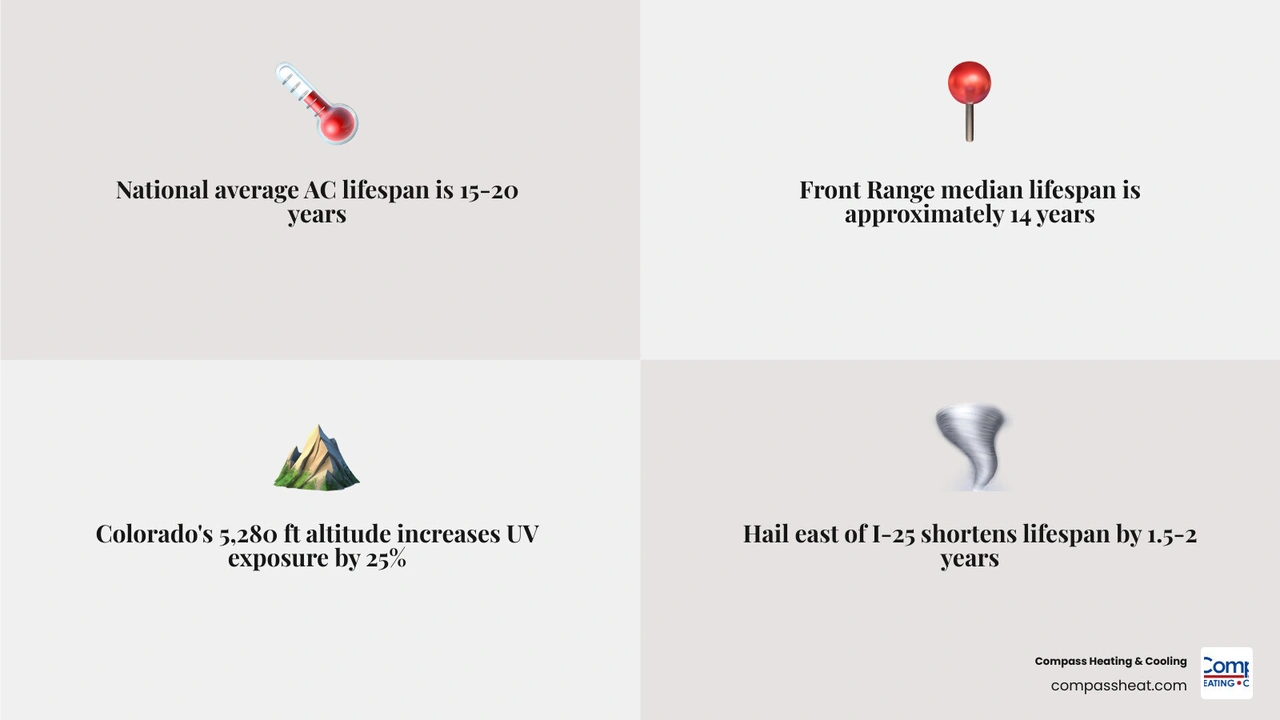
The average lifespan of a central air conditioner in a hot, dry Front Range climate is shorter than most homeowners expect. While national figures suggest 15 to 20 years, Front Range systems typically last 12 to 18 years, with a median of around 14 years — and that number drops further for homes east of I-25 where hail is a recurring problem.
Here's a quick-reference summary:
• National average AC lifespan — Detail: 15-20 years
• Front Range typical range — Detail: 12-18 years
• Front Range median — Detail: ~14 years
• East of I-25 (hail corridor) — Detail: 1.5-2 years shorter than median
• Neglected systems — Detail: Up to 30% shorter lifespan
• Well-maintained systems — Detail: Up to 30% longer lifespan
If you're a homeowner in Northern Colorado, those numbers matter. Hail seasons, intense UV at 5,280 feet, cottonwood seed clogging, and wild daily temperature swings all put unique stress on cooling equipment that manufacturers simply don't account for in their baseline projections. A system that might cruise to 18 years in Minneapolis could be worn out and struggling at 12 years in Fort Collins or Colorado Springs.
In the sections below, we break down exactly why Front Range conditions are so hard on AC equipment, which factors shorten life the most, and what you can do to get every possible year out of your system before replacement becomes unavoidable.
Understanding the Average Lifespan of a Central Air Conditioner in a Hot Dry Front Range Climate
When we evaluate the average lifespan of a central air conditioner in a hot dry front range climate, we have to look past the generic estimates printed in manufacturer brochures. Most major HVAC brands test their systems under controlled, sea-level conditions with moderate relative humidity and stable temperatures.
But if you live along the I-25 corridor in Northern Colorado — whether in Fort Collins, Loveland, Windsor, or Greeley — you know our weather is anything but moderate.
In Northern Colorado, the median lifespan of a central air conditioner is approximately 14 years. While some premium, meticulously maintained systems can push past 18 years, others are ready for retirement by year 12.
Geography within our region also plays a major role. Systems installed in homes east of I-25 (in communities like Severance, Johnstown, and Evans) average 1.5 to 2 years shorter lifespans than those installed west of I-25 (closer to the foothills in Berthoud or West Loveland). This regional discrepancy is almost entirely due to the path of severe summer hailstorms, which sweep across the plains and flatten aluminum condenser fins.
Understanding your system's life expectancy is the first step in planning for your home's long-term comfort. If you are starting to notice your system struggling on hot July afternoons, exploring your options for Air Conditioning service or replacement can save you from a mid-summer breakdown.
Why the Average Lifespan of a Central Air Conditioner in a Hot Dry Front Range Climate is Shorter Than the National Average
Why does a system in Fort Collins or Wellington wear out faster than the exact same model installed in the Pacific Northwest or the Midwest? It all comes down to climate amplitude and operational strain.
To understand this, it helps to ask: How Does an Air Conditioner Work Anyway? An air conditioner doesn't actually "create" cold air; it absorbs heat from inside your home and dumps it outside through the outdoor condenser unit. This process relies heavily on the outdoor air's ability to absorb that heat from the condenser coils.
In our hot, dry Front Range summers, several factors conspire to make this heat transfer process much harder:
• Extreme Diurnal Temperature Swings: The Front Range is famous for daily temperature swings of 40 to 50 degrees Fahrenheit. It is not uncommon to have a chilly 45°F morning followed by a scorching 92°F afternoon. This rapid cycling of temperatures causes intense thermal expansion and contraction in the copper coils and aluminum fins of your outdoor unit, leading to micro-fractures over time.
• Intense Solar Loading: Because our air is dry and thin, the sun beats down on outdoor condenser units with incredible intensity. This direct solar heat increases the effective ambient temperature surrounding the unit by 5 to 15 degrees, forcing the compressor to work significantly harder to dump heat.
• Alkaline Dust and Wind: Our dry climate means there is always dust in the air. Front Range dust is often highly alkaline, containing calcium carbonate and silica. When this dust settles on your condenser coils, it acts as an insulating blanket and chemically corrodes the delicate aluminum fins over time.
How Altitude and UV Exposure Impact the Average Lifespan of a Central Air Conditioner in a Hot Dry Front Range Climate
Altitude is the invisible force that quietly chips away at your AC's longevity. At 5,000 to 5,280+ feet above sea level, the air is significantly thinner than at sea level.
Thinner air contains fewer molecules per cubic foot. Because air is the medium used to carry heat away from your air conditioner's outdoor coils, thin air is a poor heat conductor. Your system has to move a larger volume of air to achieve the same cooling capacity as a system running at sea level. This "altitude derating" means your compressor runs hotter and under higher head pressures, accelerating mechanical wear on internal valves and bearings.
Furthermore, our high elevation means we experience 20% to 25% more intense UV radiation than coastal or low-elevation areas. UV radiation is highly destructive to non-metallic components. Over a decade of exposure, this intense radiation degrades:
• The rubber insulation on electrical wiring.
• The plastic service valve caps.
• The contactor seals.
• The protective coatings on the fan blades.
When these small, inexpensive parts degrade and fail due to UV damage, they often cause cascading electrical failures that can destroy the compressor — the very heart of your air conditioning system.
Key Environmental Factors That Shorten AC Longevity in Northern Colorado
Every region of the country has its own unique HVAC threats. In coastal Florida, it’s salt-air corrosion; in the Pacific Northwest, it’s constant moisture and mold. On the Colorado Front Range, our units face a trifecta of mechanical hazards: hail, cottonwood seeds, and heavy dust loading.
If you are experiencing sudden cooling drops during the peak of summer, it is often due to one of these environmental factors. If you've ever asked yourself, "Why Isn't My AC Working?", the answer is frequently sitting right outside your window, plastered to the side of your condenser unit.
Hail Damage and Cottonwood Clogging
If there is a single "assassin" of air conditioners in Northern Colorado, it is hail. The plains east of I-25 — including Greeley, Evans, Severance, and Johnstown — sit squarely in the nation's premier hail alley.
Even a brief, five-minute hailstorm can pelt your outdoor condenser with golf-ball-sized ice. The aluminum fins that surround your outdoor coils are incredibly delicate (about the thickness of a soda can). Hail easily flattens these fins, completely blocking the airflow required for heat dissipation.
When fins are flattened, the system can lose 15% to 25% of its cooling capacity instantly. The compressor must run longer, hotter, and harder to cool your home, leading to premature mechanical failure within a few seasons of the storm.
The second seasonal hazard is the annual cottonwood bloom. In June, rivers and creeks like the Cache la Poudre send clouds of fluffy cottonwood seeds into the air across Fort Collins, Loveland, and Windsor. Your AC unit acts like a giant vacuum cleaner, pulling these seeds directly into the condenser coils.
Within days, a thick, felt-like blanket of cottonwood and dust restricts your system's airflow. If this debris isn't cleared, the system will short-cycle, overheat, and eventually burn out its compressor or capacitor. We highly recommend giving your outdoor unit a gentle, top-to-bottom rinse with a garden hose weekly during the peak of cottonwood season.
Equipment Tiers and Lifespan Expectations
Not all air conditioners are built to withstand our harsh climate equally. The tier of equipment you choose plays a significant role in how well it handles Front Range conditions.
Here is how different equipment tiers generally hold up in our local environment:
• Builder-Grade (Single-stage, basic cabinet) — Expected Lifespan (Front Range): 10-12 Years — Key Features & Climate Resilience: Thin metal grilles offer minimal hail protection; single-stage compressors undergo frequent on/off cycling, speeding up wear.
• Mid-Tier (Two-stage, upgraded cabinet) — Expected Lifespan (Front Range): 13-15 Years — Key Features & Climate Resilience: Louvered steel side panels protect coils from hail; two-stage operation reduces thermal cycling stress.
• Premium (Variable-capacity, heavy-duty cabinet) — Expected Lifespan (Front Range): 16-18+ Years — Key Features & Climate Resilience: Thick, powder-coated steel hail guards; variable-speed compressors run continuously at lower speeds, minimizing starting stress and capacitor wear.
When planning a system replacement, understanding these differences is crucial. Premium systems with heavy-duty cabinets and louvered panels are far better equipped to survive a Northern Colorado summer than basic builder-grade units. For a detailed breakdown of how different manufacturers and models stack up, check out our Top AC Replacement Options: A Comprehensive Brand Comparison.
When to Repair vs. Replace Your Front Range AC System
As your air conditioner blows past its tenth birthday, you will inevitably face a common homeowner dilemma: do you patch up the old system or invest in a new one?
This decision is more complicated today than it was a decade ago, primarily due to the ongoing phaseout of R-410A refrigerant. Under environmental regulations, older refrigerants are being phased down in favor of newer, low-GWP (Global Warming Potential) alternatives. If your older system develops a refrigerant leak, repairing it will become increasingly impractical and expensive as supplies of R-410A dwindle.
Understanding the difference between your system's physical lifespan (how long it can mechanically run) and its economic lifespan (how long it makes financial sense to keep running it) is key to making the right choice. For an in-depth look at this topic, refer to our AC Repair vs Replace Decision Guide for Northern Colorado.
The Age and Repair Cost Decision Framework
To take the guesswork out of the repair-versus-replace debate, we recommend evaluating the age of your system alongside the frequency and nature of its repairs.
A reliable rule of thumb is to consider the overall value of the equipment. If any single repair bill approaches half the value of a brand-new system, or if the system is past its expected lifespan and requires frequent, consecutive repairs, investing in a replacement is almost always the smarter economic choice.
Additionally, as systems age, the cumulative cost of minor repairs can quickly add up. If you find yourself calling for service multiple times a season, those resources are generally better directed toward a modern, high-efficiency system that comes with a fresh manufacturer warranty.
Warning Signs Your AC is Nearing End of Life
Your air conditioner rarely fails completely without warning. It will usually drop hints that its economic lifespan is drawing to a close. Keep an eye out for these five warning signs:
1. Frequent Compressor Hard-Starts and Capacitor Failures: If your outdoor unit shudders, makes a loud buzzing sound on startup, or keeps blowing capacitors every summer, the compressor is struggling to start under high pressure.
2. Rising Utility Bills: If your summer electric bills are steadily climbing even though your local utility rates have remained relatively stable, your system is losing its operational efficiency.
3. Inconsistent Temperatures: If the upstairs bedrooms in your Timnath home are sweltering while the basement is freezing, your aging system is losing its ability to move air and manage humidity effectively.
4. Frequent Refrigerant Leaks: If your technician has to top off your refrigerant level every spring, you have a microscopic leak in your copper coils. With R-410A becoming scarce, a leaking coil is a clear sign that replacement is near.
5. Loud, Unusual Noises: Squealing, grinding, or clanging sounds coming from the outdoor cabinet indicate failing motor bearings or a damaged compressor rotor.
Best Practices to Maximize Your AC Lifespan in Colorado
While our climate is undeniably harsh, you are not powerless. Regular, proactive maintenance can extend your system's life by 20% to 30%, turning a 12-year system into a reliable 16-year workhorse.
By taking charge of your system's care, you can save significantly on premature replacement costs and keep your home perfectly comfortable.
• Change Filters Every 30 to 60 Days: In our dry, dusty Northern Colorado climate, standard filters clog quickly. A dirty filter restricts airflow, causing the indoor coil to freeze up and putting massive stress on the outdoor compressor. Check your filter monthly, especially if you have pets or live near active construction in growing areas like Severance or Windsor.
• Keep the Outdoor Unit Clear: Maintain at least two feet of clear space around your outdoor condenser. Trim back bushes, keep tall grass mowed, and never stack firewood or outdoor toys against the unit.
• Install a Smart Thermostat: A smart thermostat prevents "system shock" by gradually staging your home's cooling. It also prevents short-cycling by ensuring the system runs for efficient, complete cycles rather than turning on and off rapidly.
• Invest in Annual Professional Maintenance: Having a professional clean your coils, check refrigerant pressures, inspect electrical contactors, and test safety controls every spring is the single most effective way to prevent catastrophic failures. If you want to keep your system in top shape, joining a dedicated AC Maintenance plan is the best way to ensure your system gets the regular care it needs.
Frequently Asked Questions About Front Range AC Lifespan
Does high altitude really shorten an air conditioner's life?
Yes. Because the air at 5,000+ feet is thinner, it is less effective at carrying heat away from your outdoor condenser coils. This forces your compressor to work harder and run at higher internal temperatures and pressures to cool your home, accelerating mechanical wear and compressing its overall lifespan compared to sea-level installations.
How often should I change my AC filters in Colorado's dry climate?
We recommend checking your filter every month and replacing it every 30 to 60 days. Our dry climate, high winds, and local pollen (including cottonwood and pine) mean filters load up with dust much faster here than in humid regions. If you have pets or live in a rapidly developing area with airborne construction dust, you will likely need to change them closer to the 30-day mark.
Is it better to replace my AC and furnace at the same time?
In most cases, yes. Your air conditioner and furnace share the same indoor blower motor and ductwork. Replacing them together ensures you get a "matched system" where the indoor and outdoor components are perfectly synced for maximum efficiency. It also saves you significantly on labor costs, ensures your entire home comfort system is covered under a fresh warranty, and qualifies you for the highest possible utility rebates. If you are considering an upgrade, check out your options for AC Replacement Fort Collins CO to see how a matched system can benefit your home.
Conclusion
The average lifespan of a central air conditioner in a hot, dry Front Range climate is a realistic 12 to 18 years, with a local median of 14 years. While our intense UV, high altitude, and summer hailstorms present real challenges to your system's longevity, consistent maintenance and smart equipment choices can help you beat the averages.
At Compass Heating & Cooling, we are dedicated to helping our neighbors throughout Northern Colorado — from Fort Collins and Loveland to Greeley, Windsor, and Berthoud — maximize their home comfort investments. We make upgrading your system simple and affordable by handling local utility rebates directly for you. Plus, our comprehensive maintenance plan offers priority service, regular tune-ups, and exclusive discounts to keep your system running efficiently for years to come.
Whether you need a quick spring tune-up to protect your system from the upcoming cottonwood season or you are ready to explore your options for a modern, high-efficiency replacement, we are here to help. Reach out to us today to schedule your next Air Conditioning service and keep your home cool and comfortable all summer long.
hear what our satisfied clients have to say
Our clients consistently praise our exceptional service and attention to detail. They appreciate the personalized approach we take to meet their unique needs, ensuring satisfaction every step of the way.
.png)