



Why Setting Your Thermostat to 65 Won't Cool Your House Faster During a Heat Wave
The Temptation to Drop the Thermostat During a Loveland Heat Wave
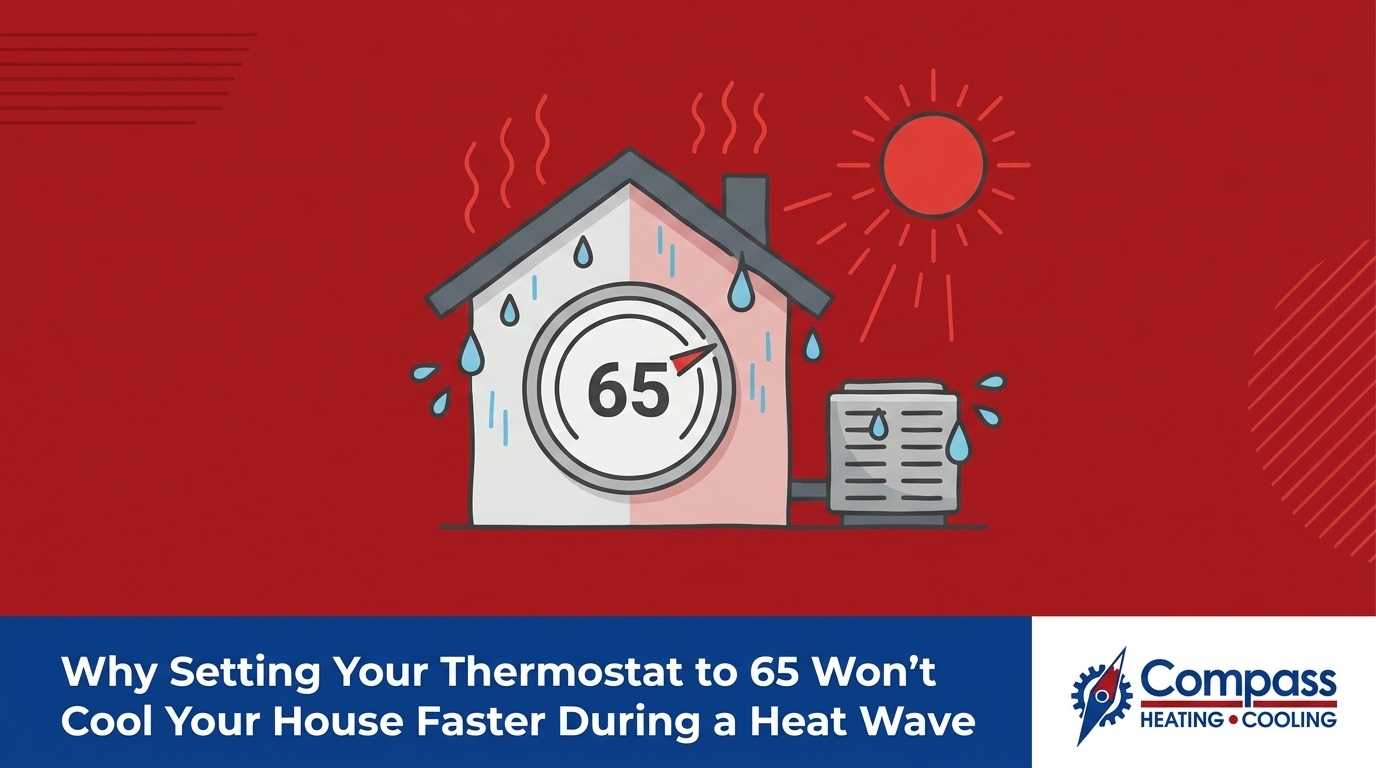
You walk through the front door after a long day, the indoor temperature reads 80 degrees, and you might be wondering why setting your thermostat to 65 won't cool your house faster during a heat wave. When the intense, dry heat of a Loveland, CO summer penetrates your home, the immediate instinct is to seek fast relief. Here at Compass Heating & Cooling, our dispatch team fields calls every July from homeowners who walked over to the wall, pressed the down arrow until the screen read 65°F, and waited for a blast of freezing air to rescue them. It feels like a logical step. If you want a room to cool down quickly, shouldn't you tell the system to work harder?
Need help with your air conditioning system right now? Reach out for professional AC repair to get your home back to a comfortable temperature.
The short answer is that residential cooling systems do not work that way. In our years of servicing HVAC units across Northern Colorado, we constantly remind our customers that dropping the set point drastically does not change the temperature of the air blowing out of your vents. Instead, this common misunderstanding often leads to massive energy waste and severe mechanical stress. During a July peak summer heat wave, your system is already working near its maximum capacity. A pattern we see often is that forcing the system to chase an impossibly low number actually causes the equipment to break down exactly when you need it most.
The Psychology of the Thermostat
Most homeowners treat their climate control systems based on how they operate other household devices. If you want your car to go faster, you push the pedal closer to the floor. If you want the stove to boil water quickly, you turn the dial all the way to "High." It is completely natural to apply this same logic to your home's cooling system. However, understanding the mechanical reality of your equipment is the first step to staying comfortable without risking a costly breakdown.
The 'Light Switch' vs. 'Gas Pedal' Analogy
To understand why a 65°F thermostat setting will not speed up your comfort, you have to look at how the equipment actually operates. In our experience working on homes throughout the Loveland area, we find that the vast majority of residential air conditioning systems utilize single-stage compressors. A single-stage compressor only has one speed: fully on.
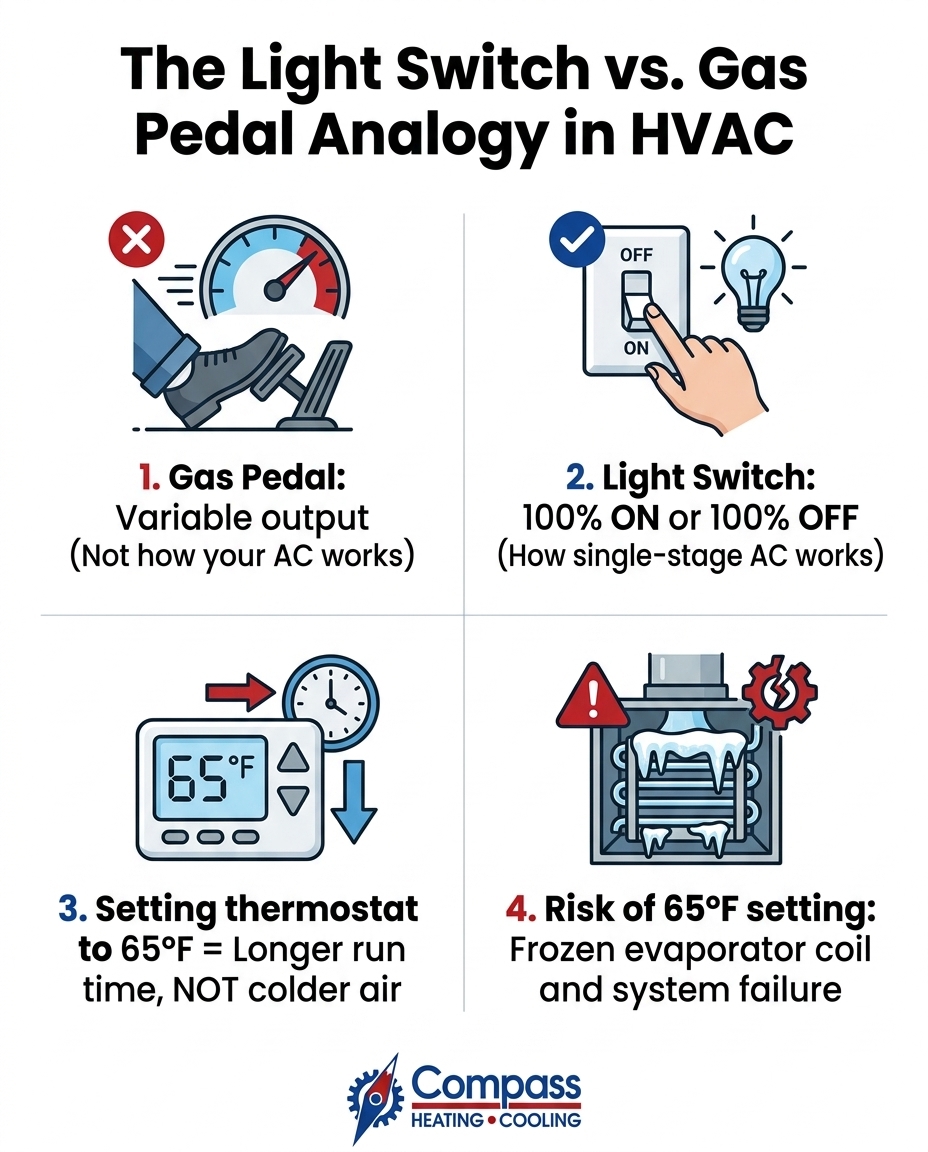
The best way to think about this is to contrast a gas pedal with a simple light switch.
The Gas Pedal Myth
A gas pedal controls a variable flow of fuel and air. If you press it lightly, the engine delivers a little bit of power. If you press it to the floor, the engine roars and delivers maximum power. Many people believe a thermostat acts like a gas pedal for their cooling system. They assume that if they set the temperature to 75°F, the system blows moderately cool air, but if they drop it to 65°F, the system will suddenly blast ice-cold air to reach the goal faster. This is entirely false.
The Light Switch Reality
Your thermostat actually functions exactly like a light switch. A light switch is strictly 100% ON or 100% OFF. You cannot flip a standard light switch "harder" to make the room brighter.
When the temperature in your home rises above your set point, the thermostat sends a simple 24-volt electrical signal to the control board. That signal closes a magnetic switch called a contactor, which turns the system on. The air delivered to your rooms is the exact same temperature whether the thermostat is set to 75°F or 65°F. Usually, this air is about 15 to 20 degrees cooler than the ambient air inside your home.
• Gas Pedal — How It Operates: Variable output based on how hard you press. — HVAC Equivalent: Variable-speed systems (rare in older homes).
• Light Switch — How It Operates: Strictly 100% ON or 100% OFF. — HVAC Equivalent: Single-stage AC (most common residential system).
What Actually Happens When You Set the Thermostat to 65°F?
If the air coming out of the vents does not get any colder, what actually changes when you lower the target temperature so drastically? The only thing that changes is the length of the cooling cycle.
When you input a 65°F thermostat setting during a sweltering afternoon, the system receives a command to run continuously until the indoor temperature reaches that extremely low set point. Because the cooling capacity remains constant, the house cools at the exact same rate it would if set to a moderate, achievable temperature like 75°F.
The Energy Cost of Continuous Operation
Air conditioning units draw a massive amount of electricity. When you command the system to reach an unattainable temperature, it simply never shuts off. This continuous operation drastically increases energy consumption and causes your utility costs to spike without providing any faster relief. You are paying for the system to run endlessly while the indoor temperature slowly creeps down at its natural, fixed pace.
The Mechanical Toll on Your Equipment
Beyond the high energy bills, extended run times place unnecessary wear and tear on vital components. Regular AC maintenance helps mitigate some of this wear, but no system is designed to run without a break for hours on end.
• The Blower Motor: This motor works overtime to push air through your ductwork. Continuous operation can cause it to overheat.
• The Compressor: The heart of your system sits outside in the blistering heat. Running it endlessly without allowing it to cycle off and cool down degrades the internal windings.
• The Capacitors: These electrical components store energy to help start the motors. Constant heat and continuous load significantly shorten their lifespan.
The Hidden Danger: Freezing Your Evaporator Coil
The most immediate and severe mechanical risk of forcing an AC to run continuously without a break during a July peak summer heat wave is freezing the evaporator coil. At Compass Heating & Cooling, this is easily one of the most common—and entirely preventable—summer breakdowns our technicians encounter when responding to emergency calls.
How the Evaporator Coil Works
Located inside your home, usually above the furnace or inside the air handler, the evaporator coil is responsible for removing heat and humidity from your indoor air. Cold liquid refrigerant pumps through the copper tubes of this coil. As warm indoor air blows across the cold tubes, the refrigerant absorbs the heat and turns into a gas. At the same time, humidity in the air condenses on the cold metal, much like water droplets forming on a glass of ice water.
The Anatomy of a Freeze-Up
Under normal conditions, this condensation drips safely into a drain pan. However, when you force the system to run continuously by setting the thermostat too low, the coil's temperature can drop below freezing.
If there is even a slight restriction in airflow—such as a dirty air filter or closed vents—there is not enough warm air passing over the coil to keep it above 32 degrees. The condensation on the metal instantly turns to frost. Because the system never shuts off to let the frost melt, it rapidly builds into a solid block of ice.
Once the coil is encased in ice, airflow is completely blocked. The system will continue to run, but it will only blow warm air, or it may shut down entirely to protect itself. If you are looking to fix common AC problems, preventing this freeze-up by using sensible thermostat settings is the best preventative measure you can take. If your system does freeze, the only safe immediate action is to turn the thermostat off entirely and switch the fan setting to "ON" to help thaw the ice over several hours.
Understanding Thermal Load During a Colorado Heat Wave
To truly understand why a house takes hours to cool down, we have to look at the physics of a home. Setting realistic expectations for your system's performance prevents frustration and protects your equipment.
Air Temperature vs. Surface Temperature
When we talk about cooling a house, most people only think about the air inside the rooms. However, HVAC professionals focus on something called "thermal load." Thermal load is the total amount of heat energy trapped inside the home.
During the hot, dry summer conditions in Loveland, CO, we often have to explain to our customers that the intense solar radiation heats up much more than just the air. The heat energy soaks into the solid objects in your home. Your drywall, your hardwood floors, your heavy furniture, and your kitchen cabinets all absorb and hold massive amounts of heat.
The Uphill Battle of Cooling
When you turn on the cooling system, it begins removing heat from the air. But as soon as the air cools down, the hot walls and furniture begin radiating their stored heat back into the newly cooled air. The system has to constantly remove the heat radiating from these solid objects, not just the ambient air.
This is why rapid temperature drops are physically impossible. Residential systems are sized to maintain comfortable temperatures, not to drop a home by 15 degrees in a single hour. The system has to slowly chip away at the thermal load built up in the physical structure of the house.
Actionable Ways to Stay Cool Without Overworking Your AC
If a 65°F thermostat setting isn't the answer, how do you stay comfortable when the afternoon sun is beating down on your roof? There are several safe, effective alternatives to lowering the thermostat that rely on Department of Energy recommendations and basic physics.
1. Set a Realistic Temperature: The Department of Energy recommends setting your thermostat to 78°F during the summer for the best balance of comfort and energy efficiency. If that is too warm, set it as low as comfortably possible without demanding extreme drops. A setting of 72°F to 74°F is much safer than 65°F.
2. Utilize the Wind-Chill Effect: Turn on your ceiling fans. Fans do not lower the temperature of the room; they cool the people in it. Moving air evaporates moisture from your skin, creating a wind-chill effect that makes the room feel up to 4 degrees cooler than it actually is. Just remember to turn fans off when you leave the room.
3. Block Solar Heat Gain: Close your blinds, shades, and thermal curtains during peak daylight hours. Sunlight beaming through southern and western-facing windows accounts for a massive portion of the thermal load in your home. Stopping the heat before it enters the glass gives your system a massive advantage.
4. Limit Internal Heat Generation: Avoid using heat-generating appliances during the hottest parts of the day. Running the oven, using the clothes dryer, or even taking long, steamy showers adds sensible heat and humidity to the indoor air, forcing the equipment to work harder.
When Slow Cooling Points to a Bigger Problem
It is completely normal for a cooling system to struggle slightly on a 100-degree afternoon. If your thermostat is set to 72°F and the indoor temperature creeps up to 74°F during the hottest part of the day, the system is likely just maxed out against the extreme thermal load. However, there is a clear difference between normal heat wave struggles and actual mechanical failure.
Signs of True Malfunction
If you notice any of the following symptoms, your system is not just struggling with the heat—it requires professional intervention:
• Weak airflow: If you place your hand over a vent and barely feel any air moving, you may have a frozen coil or a failing blower motor.
• Warm air blowing: If the air coming from the vents is room temperature or warmer, the compressor may not be engaging, or you may have a severe refrigerant leak.
• Short-cycling: If the system rapidly turns on and off every few minutes without cooling the house, it is protecting itself from a critical failure.
A system struggling to maintain a moderate temperature may have low refrigerant, a failing start capacitor, or a clogged condensate line. We strongly advise against DIY repairs for sealed refrigerant lines or high-voltage electrical components.
Our team at Compass Heating & Cooling has spent years properly calibrating systems for the unique thermal loads of our local peak summer heat. If your system is showing these red flags, scheduling AC repair in Loveland is the safest way to restore efficiency and prevent catastrophic compressor failure.
Frequently Asked Questions About Summer Thermostat Settings
Does turning the AC down make it cool faster?
No, turning the thermostat down does not make the house cool any faster. Single-stage residential cooling systems operate at one constant speed and output one constant temperature. Lowering the temperature simply makes the system run longer, not harder. It will cool the house at the exact same rate whether set to 75°F or 65°F.
Why is my AC taking hours to cool the house?
Your system is taking hours because it has to overcome the thermal load of the entire house. The equipment must remove heat from the drywall, floors, and heavy furniture, not just the indoor air. High outdoor temperatures and intense sunlight increase this thermal load, naturally slowing the cooling process down.
What happens if I set my AC too low?
If you set the temperature too low, the system receives a command to run continuously without a break. This constant operation wastes a significant amount of electricity, drives up your utility bills, and puts massive wear and tear on the blower motor and compressor. It also dramatically increases the risk of freezing the indoor equipment.
Can an AC freeze if set too low in the summer?
Yes, setting a 65°F thermostat setting can absolutely cause the system to freeze. Continuous operation without adequate warm airflow over the indoor coils causes the normal condensation to freeze into solid ice. This ice completely blocks airflow, causing the system to blow warm air and potentially damaging the outdoor compressor.
What is the best thermostat setting for peak summer heat?
The Department of Energy recommends 78°F for the optimal balance of comfort and energy savings during the summer. While you can adjust this slightly based on your personal comfort preferences, you should avoid drastic drops. Keeping the setting moderate prevents the system from running continuously and protects the components from overheating.
Protect Your System and Stay Comfortable This Summer
Surviving a July peak summer heat wave requires patience and a basic understanding of how your home's climate control operates. By treating your thermostat like a light switch rather than a gas pedal, you protect the vital components of your equipment from unnecessary wear and tear. Remember that cooling a hot house takes time, as the system must remove heat from the physical structure of the home, not just the air.
If you have set a reasonable temperature and your system is still blowing warm air or failing to keep up, it is time to seek professional help. Don't let a minor mechanical issue turn into a major breakdown. Reach out for expert AC repair to ensure your home stays cool, safe, and comfortable all summer long.
hear what our satisfied clients have to say
Our clients consistently praise our exceptional service and attention to detail. They appreciate the personalized approach we take to meet their unique needs, ensuring satisfaction every step of the way.
.png)