



Diagnosing That Loud Buzzing Noise From Your Outdoor AC Unit
Hearing a Loud Buzz Outside? Here is What It Means
Is that loud, aggressive sound from your yard a sign of imminent failure, or just a warning that a single part has worn out? Diagnosing that loud buzzing noise from your outdoor AC unit can feel overwhelming, especially when the house is quickly warming up and you fear the worst for your system. At Compass Heating & Cooling, our team frequently fields frantic late-summer calls from Loveland homeowners who immediately assume the compressor has died, bringing a wave of panic about a total system replacement. The reality we see in the field is usually much less severe. That distinct electrical buzz typically points to a failing electrical component struggling to complete its job, rather than a dead compressor.
When you need professional air conditioning services, securing timely AC repair is the best way to protect your investment. The two most common culprits behind this noise are the contactor and the dual run capacitor. Both are relatively straightforward electrical components that manage the high voltage required to run your outdoor condensing unit. By the time we reach the intense heat of an August late-summer afternoon, these parts have endured months of heavy electrical loads and extreme temperature fluctuations. Recognizing the difference between a humming capacitor and a chattering contactor is the first step in understanding what your system needs, but taking immediate action to protect your equipment is even more critical.
Step One: Shut Off Power at the Breaker Immediately
Before you attempt to listen closely or diagnose the specific type of buzz, you must cut the power to the system. Leaving a buzzing, malfunctioning air conditioner running is the single fastest way to turn a minor electrical repair into a catastrophic compressor failure. If you hear a loud electrical hum or buzz and notice the fan isn't spinning, act immediately.
Follow these exact steps to protect your system:
1. Turn off the thermostat: Switch your indoor thermostat from "Cool" to the "Off" position. This stops the indoor unit from calling for cooling.
2. Flip the main breaker: Go to your home's main electrical panel and locate the breaker labeled for the AC or condensing unit. Flip it completely to the "Off" position.
3. Leave it off: Do not attempt to turn it back on to "test" it. Keep the power disconnected until a professional arrives.
Why is this so urgent? When a component like a capacitor fails, the compressor and fan motors lose their starting jolt. However, the system is still sending high voltage to those motors. Because the motors cannot spin, they enter a state called "locked rotor." In this state, they draw massive amounts of electrical current—often five times their normal operating amperage. This rapid surge of electricity generates extreme heat inside the compressor, leading to thermal overload.
While modern compressors have internal thermal overload switches designed to break the circuit when they get too hot, relying on this safety mechanism is a massive gamble. Repeatedly tripping the thermal overload will eventually melt the internal wiring insulation, permanently destroying the compressor. For homeowners in Loveland, CO, shutting off the power at the first sign of a buzzing noise is the single most important step our technicians recommend to save money and prevent a total system breakdown.
The Humming Capacitor: A Common Victim of High Heat
One of the most frequent reasons you will hear a deep, continuous hum or buzz from your outdoor unit is a failed dual run capacitor. The capacitor acts like a powerful, rechargeable battery. Its primary job is to store electricity and deliver a massive initial jolt of energy to start the compressor and the condenser fan motor. Once the motors are running, the capacitor provides a continuous, steady stream of voltage to keep them spinning efficiently.
When you hear a deep humming sound accompanied by a fan that is either struggling to turn or completely stationary, the capacitor is usually to blame. The motor is receiving power and trying to start, but it lacks the necessary electrical push from the capacitor.
How Heat Destroys Capacitors
Capacitors are incredibly sensitive to heat. Inside the metal cylinder, layers of conductive film are suspended in a dielectric fluid. As the intense August late-summer heat beats down on your outdoor unit, combined with the heat generated by the system constantly cycling on and off, the internal fluid begins to boil and expand. This cumulative heat strain degrades the component's ability to store and release energy. Eventually, the top of the capacitor will physically bulge outward, or it will fail internally and stop delivering the starting jolt.
Signs your buzzing is caused by a capacitor:
• Deep, steady hum: A continuous, low-pitched electrical vibration.
• Stationary fan blades: The fan is not spinning, even though the unit is making noise.
• Hot exterior casing: The top of the outdoor unit feels excessively hot to the touch due to the motor overheating.
Because this is such a frequent issue, replacing a swollen or failed capacitor is a routine fix for experts handling AC repair in Loveland. At Compass Heating & Cooling, our honest diagnostics ensure that we thoroughly test the microfarad readings of your existing parts. We have seen too many systems misdiagnosed, which is why we will only recommend replacing the capacitor if that is the true root of the problem, saving you from unnecessary stress and avoiding high-pressure pitches for a full-system replacement when a simple electrical fix is all that is required.
The Chattering Contactor: When the Electrical Switch Fails
If the sound coming from your outdoor unit is less of a deep hum and more of a harsh, rapid chattering, clicking, or aggressive electrical buzz, the culprit is likely the contactor. The contactor is a high-voltage mechanical relay switch. When your indoor thermostat decides the house needs cooling, it sends a low-voltage (24V) signal outside to the contactor. This signal energizes a magnetic coil, which physically pulls a set of metal contacts closed. Once those contacts touch, high voltage (240V) flows instantly to the compressor and fan.
Why Contactors Chatter and Buzz
Over thousands of cycles, the metal contacts take a beating. Every time they close and open, a small electrical arc occurs. Over time, this arcing causes the smooth metal surfaces to become pitted, burned, and uneven. When the contacts are no longer smooth, they cannot make a solid connection. The magnetic coil struggles to hold them together, resulting in a rapid opening and closing action—this is the loud chattering or buzzing noise you hear.
Additionally, our technicians routinely find that because the outdoor unit sits in the elements in Loveland, CO, it is common for debris, dust, or even small insects (like earwigs or ants) to crawl between the contacts. When the switch closes, the debris is crushed, creating an insulating layer that prevents electricity from flowing cleanly, leading to severe arcing and a harsh buzzing sound.
Understanding AC contactor burned out symptoms can help you distinguish between a failing switch and a bad capacitor.
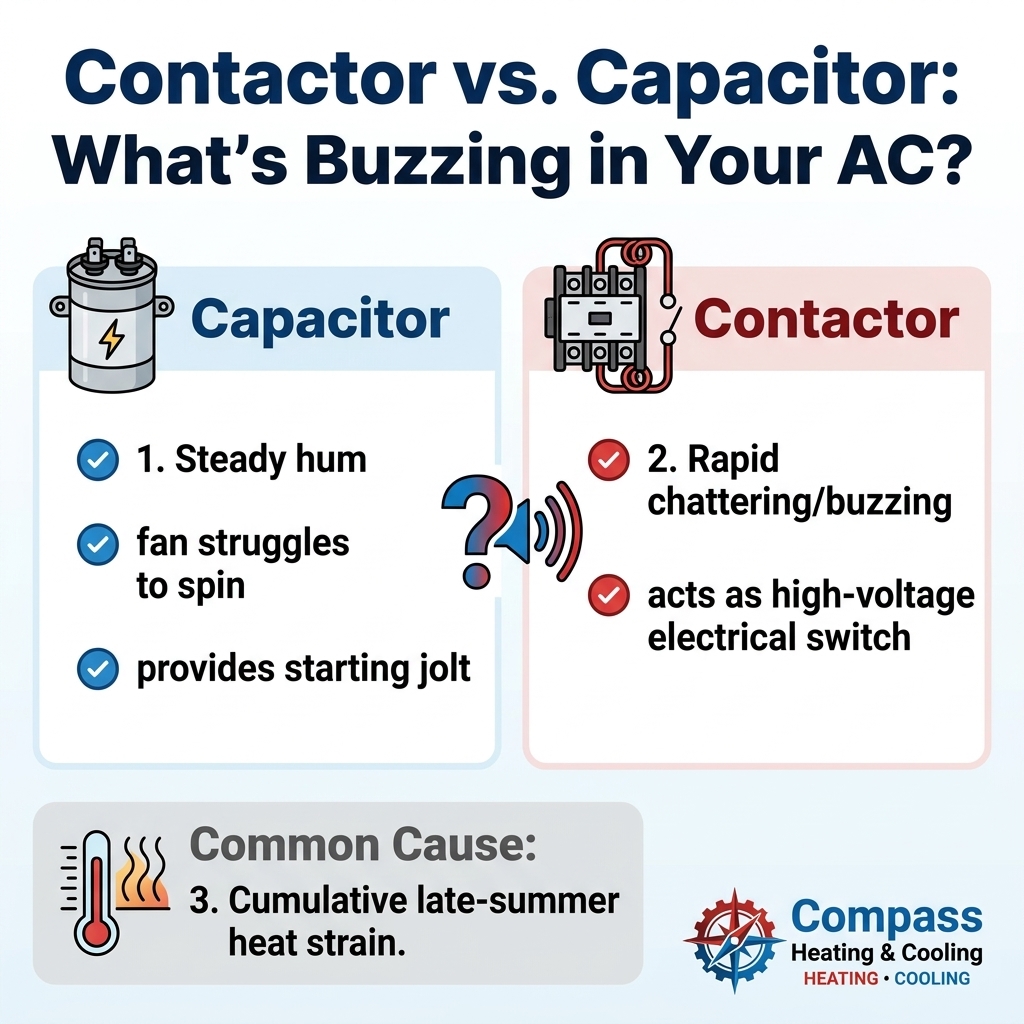
• Dual Run Capacitor — Type of Sound: Deep, steady hum or low buzz — Primary Function: Provides starting jolt and running voltage — Common Failure Symptom: Fan won't spin; top of capacitor bulges
• Electrical Contactor — Type of Sound: Rapid chattering, clicking, harsh buzz — Primary Function: Acts as a high-voltage mechanical switch — Common Failure Symptom: Pitted/burned metal contacts; arcing
Why Electrical Failures Peak at the End of Cooling Season
In our years of servicing air conditioners across the Front Range, we've noticed a distinct pattern: right around the back-to-school transition in August, our phones start ringing off the hook with buzzing AC complaints. It is no coincidence that most homeowners experience these loud noises right as the summer is winding down. Months of continuous operation take a massive toll on the system's electrical limits. By the time an August late-summer heatwave hits, your air conditioner has likely logged hundreds of hours of run time. Every single time the system cycles on, the capacitor releases a massive jolt of energy and the contactor slams shut.
The Cumulative Toll of Heat Cycling
Heat is the natural enemy of electrical components. Components are designed to operate within specific temperature ranges and rely on the surrounding air to dissipate the heat they generate. However, when ambient temperatures remain high for weeks on end, the parts lose their ability to cool down between cycles. They literally bake inside the metal cabinet of the outdoor unit.
Furthermore, the high altitude and intense heat cycling unique to the Front Range compound this wear. Thinner air is less effective at absorbing and carrying away heat from the condenser coils, forcing the fan motor to work harder and run longer. This extended run time keeps electrical components energized and hot for greater durations, rapidly accelerating the breakdown of the dielectric fluids in capacitors and the magnetic coils in contactors.
The most effective way to prevent these end-of-season breakdowns is through routine AC maintenance. During a comprehensive tune-up, a technician uses a multimeter to measure the exact microfarad output of the capacitor and visually inspects the contactor for pitting and burn marks. Catching a weak capacitor or a scarred contactor in the spring ensures these parts are replaced before they fail and leave you sweating to the sound of a buzzing unit in late August.
Why You Must Leave Electrical AC Repairs to Licensed Professionals
When diagnosing a buzzing AC unit, identifying the sound is as far as a homeowner's troubleshooting should go. Replacing capacitors and contactors involves handling dangerous, high-voltage electricity, and these repairs must always be left to a licensed professional. The outdoor unit runs on 240 volts of electricity—more than enough to cause severe injury or worse if mishandled.
Even if you have successfully flipped the breaker and shut off power to the unit at the main panel, the system is still not safe to touch. Capacitors are designed to store massive electrical charges. They can hold a lethal jolt of electricity for hours, or even days, after the power has been completely disconnected. A licensed professional in Loveland, CO knows exactly how to safely discharge the capacitor using a specialized resistor tool before ever touching the terminals—a safety protocol our team follows on every single call.
Furthermore, proper diagnostics require specialized training and equipment. A standard homeowner multimeter is rarely equipped to accurately read capacitance (measured in microfarads). If a replacement capacitor does not match the exact microfarad rating required by your specific compressor and fan motor, it will permanently damage the motors. A licensed technician ensures that the electrical repair is performed safely, the parts match the manufacturer's exact specifications, and the system is thoroughly tested to prevent future thermal overload.
Frequently Asked Questions About Buzzing Air Conditioners
Is it dangerous if my AC is buzzing?
Yes, leaving a buzzing unit on can cause thermal overload and permanent damage. When the system buzzes but fails to start, the motors pull excessive electrical current, which rapidly overheats the internal wiring. This risks severe, irreversible damage to the compressor. You should shut off the breaker immediately to protect the equipment and prevent electrical hazards.
Why is my outside AC unit buzzing but the fan isn't spinning?
This is a classic sign of a failed dual run capacitor. The fan motor is receiving electrical power from the grid, but it lacks the massive starting jolt of energy that the capacitor provides to get the blades moving. Do not try to jump-start the fan with a stick, as this is dangerous and ignores the root electrical failure that requires professional replacement.
What is the difference between a bad contactor and a bad capacitor?
A bad contactor typically makes a rapid chattering, clicking, or harsh electrical buzz as the switch struggles to stay closed. A bad capacitor, on the other hand, makes a steady, deep hum while the motors fail to turn. Both components manage high voltage and require professional electrical replacement to restore the system safely.
Can a buzzing AC cause an electrical fire?
While rare due to built-in safety breakers, overloaded electrical components do pose a fire risk. Pitted contactors can arc, creating excessive heat and melting the surrounding plastic and wire insulation. Cutting power at the main electrical panel eliminates this risk entirely until a technician can resolve the issue.
How long do AC capacitors usually last?
Capacitors typically last 5 to 10 years, depending heavily on usage and environmental factors. Intense heat cycling, especially during an August late-summer heatwave, can shorten their lifespan significantly by degrading the internal fluids. Regular maintenance catches early signs of swelling or capacitance loss before a total failure occurs.
Get Honest Diagnostics for Your Buzzing AC Today
Hearing a loud electrical buzz from your outdoor unit is alarming, but it is often a minor electrical fix rather than a death sentence for your entire cooling system. By immediately shutting off the power at the breaker, you have already taken the most important step in protecting your compressor from thermal overload and permanent damage. The next step is getting a professional out to your home in Loveland, CO to accurately test the components.
At Compass Heating & Cooling, we pride ourselves on delivering honest diagnostics and trustworthy second opinions. We take the time to test your capacitor and contactor thoroughly, ensuring you are never oversold on a full system replacement when a targeted electrical repair is all that is needed. Do not let a buzzing unit leave you without comfort—schedule a comprehensive inspection and AC repair today to restore your cooling safely and efficiently.
hear what our satisfied clients have to say
Our clients consistently praise our exceptional service and attention to detail. They appreciate the personalized approach we take to meet their unique needs, ensuring satisfaction every step of the way.
.png)