


The Decision to Seek an HVAC Second Opinion Before Replacing Your Furnace
Myth vs. Reality: Does a Condemned Furnace Mean Immediate Replacement?
When a technician declares your heating system unsafe, the common myth is that you must replace it immediately—but leveraging local service expertise and area tips can help you determine if a second opinion is actually your best next step. At Compass Heating & Cooling, our team frequently speaks with homeowners who feel incredibly stressed after unexpectedly hearing that their furnace is "condemned." Many homeowners assume that a single contractor's recommendation to replace a system during a cold snap is the final, unquestionable word. However, in our experience across the HVAC industry, a rushed diagnosis can sometimes blur the line between a minor repairable issue and a truly dangerous mechanical failure.
The urgency to restore heat makes it easy to panic. When you are facing a shivering family and a house that is rapidly losing heat during the November first hard freeze, taking a step back feels counterintuitive. Yet, securing a second opinion is a standard, responsible step to protect your home and your investment. A reputable technician will never make you feel trapped into making a massive financial decision on the spot. Instead, they will encourage you to verify their findings, knowing that their diagnostic work holds up to scrutiny.
It is important to understand what the term "condemned" actually means. Legally and professionally, a furnace is only condemned when it poses an immediate safety hazard—most commonly due to a cracked heat exchanger leaking carbon monoxide into the living space. If a system is genuinely unsafe, the gas must be shut off. However, that does not mean you have to buy a new furnace from the first person who inspected it. You always have the right to call for professional HVAC services to perform a secondary evaluation. Taking a deep breath, putting on an extra sweater, and scheduling another diagnostic visit can save you from a costly, unnecessary replacement.
Understanding System Stress During Rapid Temperature Drops
The problem: Heating systems that have sat dormant for months are suddenly forced to operate at maximum capacity when extreme weather arrives. The cause: Regional climate factors create immense thermal and mechanical stress on aging components. The solution: Comprehensive diagnostics that differentiate between temporary environmental overload and permanent mechanical breakdown.
Living in Loveland and the Colorado Front Range means experiencing dramatic weather shifts. In our years of servicing local homes, we regularly see how a mild, sunny afternoon can plummet into freezing temperatures by nightfall. This rapid late-fall temperature swing forces your furnace to wake up from its summer hibernation and immediately run continuously to keep up with the thermostat demand. This sudden transition is incredibly stressful on moving parts, electrical relays, and safety sensors.
When a system struggles under this sudden environmental load, it often displays symptoms that mimic catastrophic failure. A furnace that repeatedly turns on and off after only a few minutes is "short-cycling." While short-cycling can be a symptom of a failing blower motor or a cracked heat exchanger, it is just as frequently caused by simple airflow restrictions. Before committing to a full heating repair and replacement, it is critical to understand how sudden cold weather impacts the physical components of your system.
Airflow Restrictions vs. Mechanical Breakdown
The most common misdiagnosis during early winter involves airflow. When your furnace runs continuously during a hard freeze, it requires a massive volume of air to pass through the filter, over the heat exchanger, and out through your vents. If your filter is even slightly clogged, the system cannot move enough air to keep the internal components cool.
• Tripped high-limit switches: A lack of airflow causes the furnace to overheat. The internal safety switch (high-limit switch) detects this dangerous temperature and shuts the burners down to prevent a fire. The fan may keep running to cool the unit, but the heat stops. To an untrained eye, the furnace looks dead.
• Struggling blower motors: A restricted filter forces the blower motor to work twice as hard. This causes the motor to draw excess electrical current, which can trip a breaker or cause the motor to overheat and shut down temporarily.
• Sensor confusion: Sudden cold drafts and extreme temperature differentials can cause flame sensors to misread the burner status. A dirty flame sensor will shut the entire heating cycle down within seconds of ignition.
In many cases, what appears to be a dead furnace is simply the system's safety mechanisms working exactly as they were designed to—protecting your home from an overheating event caused by poor airflow.
Red Flags of a Rushed or Inaccurate Diagnosis
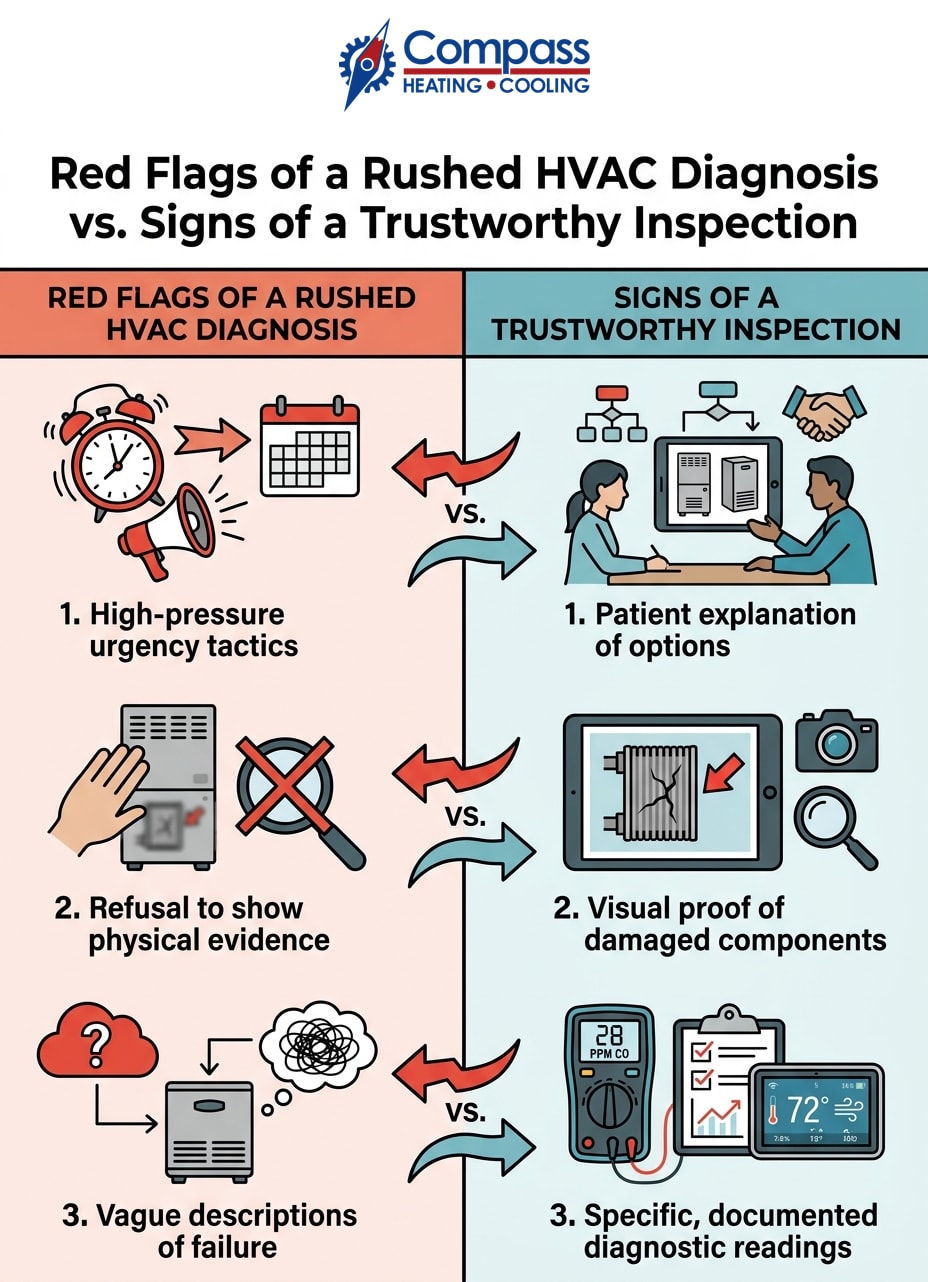
When your heat goes out during the November first hard freeze, you are in a vulnerable position. Unfortunately, some technicians use this vulnerability to push high-pressure sales rather than providing an honest assessment. Knowing the warning signs of a rushed diagnosis can protect you from replacing a system that only needs a minor repair.
Contrast high-pressure sales tactics with our locally owned approach at Compass Heating & Cooling, where we prioritize honest, transparent diagnostics. As a local team, we rely on community reputation and long-term relationships, meaning we have a vested interest in keeping your existing system running safely for as long as possible. Be on the lookout for these specific red flags during any service call:
• Aggressive urgency tactics: The technician insists that if you do not sign a replacement contract today, the price will go up tomorrow, or they use fear-mongering language about your family's immediate safety without showing you proof.
• Refusal to show physical evidence: If a technician claims your heat exchanger is cracked or compromised, they should be able to show you the crack. A professional will use a boroscope inspection camera to let you see the damage on a screen. If they refuse or say it is "too hard to see," get a second opinion.
• Vague explanations: A trustworthy technician will explain exactly which part failed, how it failed, and why it cannot be repaired. If the explanation is simply "the system is old and shot," that is a sales pitch, not a diagnosis.
• No diagnostic tools used: If the technician barely opens the furnace cabinet, doesn't use a multimeter to check electrical draws, or skips measuring static pressure before declaring the unit dead, their diagnosis is incomplete.
• Pushing replacement over a minor part: If a common wear-and-tear component like a capacitor, ignitor, or flame sensor fails, the repair is usually straightforward. A major red flag is when a technician claims a simple, easily replaceable part failure means the whole unit is compromised.
Finding a trustworthy HVAC company in Loveland means looking for a team that treats diagnostics as an investigative process, not a stepping stone to a sales presentation.
What a Legitimate Diagnostic Inspection Should Include
A proper inspection sets a high standard for your second opinion. When a trustworthy professional arrives at your home in Loveland and the Colorado Front Range, they follow a strict, methodical process to evaluate your heating system. This thorough approach ensures that no minor issue is overlooked and no major hazard is ignored. Just as you would expect a mechanic to run computer diagnostics on a modern car, an HVAC technician must measure the vital signs of your furnace.
This level of detail is not exclusive to winter heating. You can draw direct parallels to other thorough system checks—like comprehensive air conditioning diagnostics in the summer—to see that meticulous, step-by-step evaluations are a year-round standard for true professionals. Here is what a legitimate, professional diagnostic process looks like:
1. Thermostat Communication Verification: The technician will first confirm that the thermostat is sending the correct low-voltage signals to the furnace control board. A frayed wire or failing thermostat can completely disable a healthy furnace.
2. Airflow and Static Pressure Testing: Using a manometer, the professional will measure the air pressure inside your ductwork. This confirms whether the blower motor is moving the correct volume of air or if there is a severe restriction causing the system to overheat and short-cycle.
3. Electrical Component Testing: The technician will use a multimeter to test the capacitor, ignitor, flame sensor, and blower motor. They are looking for specific voltage and amperage readings that match the manufacturer's specifications.
4. Combustion Analysis: For gas furnaces, a professional will analyze the exhaust gases to ensure the fuel is burning cleanly and efficiently. High levels of carbon monoxide in the exhaust can indicate poor combustion or venting issues.
5. Visual Heat Exchanger Inspection: This is the most critical safety check. The technician will use a flexible boroscope camera to inspect the internal metal chambers (the heat exchanger) for hairline cracks, rust, or metal fatigue. If a crack is found, they will show you the visual proof on their screen.
6. Comprehensive Findings Report: Finally, the technician will present their findings clearly, explaining which components are failing, why they are failing, and providing a written record of their diagnostic readings.
Weighing Your Options: Repairing vs. Replacing Your System
Once you have secured a second opinion, you will likely have two differing diagnostic reports to compare. Making the final choice between repairing your current unit or investing in a replacement requires objective analysis. It is about balancing your immediate need for reliable heat during the November first hard freeze against the long-term investment value of your home.
When comparing your options, you must factor in the age of the unit, the frequency of past breakdowns, and general Department of Energy (DOE) efficiency guidelines. Reading up on what to expect when getting a second opinion on a condemned AC can also provide a helpful framework, as the decision matrix for replacing heating and cooling equipment shares many of the same core principles.
• System Age — Lean Toward Repair When...: The furnace is less than 10-12 years old and has been well-maintained. — Lean Toward Replacement When...: The furnace is over 15 years old and nearing the end of its expected lifespan.
• Safety Status — Lean Toward Repair When...: The issue is related to a sensor, limit switch, or blower motor (no carbon monoxide risk). — Lean Toward Replacement When...: A cracked heat exchanger is verified, posing an immediate carbon monoxide hazard.
• Efficiency — Lean Toward Repair When...: Your current energy bills are stable and the unit meets basic DOE efficiency guidelines. — Lean Toward Replacement When...: The system is severely outdated, causing steadily rising monthly energy costs.
• Repair Frequency — Lean Toward Repair When...: This is the first major repair the system has needed in several years. — Lean Toward Replacement When...: You are calling for repairs multiple times per season to keep the unit running.
When Repair is the Logical Choice
Repairing makes the most sense when dealing with minor sensor failures, electrical relay issues, or basic airflow restrictions. If your system is relatively young and the core components (like the heat exchanger and primary control board) are in excellent condition, replacing a single worn-out part is the smartest financial move. A good technician will help you preserve a young system rather than pushing a premature upgrade.
When Replacement is Truly Necessary
Replacement becomes unavoidable when verified safety hazards are present. If a second opinion confirms a compromised heat exchanger, the furnace cannot legally or safely be operated. Additionally, if your system is well past its expected lifespan according to Energy Star guidelines, sinking money into a major repair is often a poor investment, as another expensive component is likely to fail shortly after.
Safe Homeowner Checks Before Calling the Professionals
Before you pay for a diagnostic visit—or a second opinion—there are a few basic troubleshooting steps you can safely perform yourself. However, it is vital to establish clear boundaries on what a homeowner can safely verify versus what requires a licensed professional. The heating systems in Loveland and the Colorado Front Range operate using high-voltage electricity and combustible gases; crossing the line into DIY repairs is dangerous.
The golden rule: If a check requires opening the furnace's internal metal cabinet or handling tools, it is a job for a professional.
• Verify the thermostat is set to "Heat" and the temperature is set higher than the current room temp. — Professional-Only Work (Never Attempt): Opening the furnace cabinet to inspect the control board or internal wiring.
• Replace the thermostat batteries with fresh ones to rule out a communication failure. — Professional-Only Work (Never Attempt): Handling, testing, or attempting to clean electrical capacitors or ignitors.
• Check the furnace air filter and replace it immediately if it is dirty, gray, or clogged. — Professional-Only Work (Never Attempt): Inspecting, adjusting, or testing the gas valve and gas manifold.
• Ensure all supply and return air vents in the home are fully open and unblocked by furniture. — Professional-Only Work (Never Attempt): Attempting to visually inspect the heat exchanger for cracks without proper training.
• Check the main electrical panel to see if the furnace circuit breaker has tripped. — Professional-Only Work (Never Attempt): Bypassing safety switches to force the furnace to run.
Frequently Asked Questions About Furnace Diagnostics
Is it worth getting a second opinion on HVAC?
Yes, getting a second opinion is almost always worth the time and minor diagnostic fee, especially when facing a major repair or replacement. A second set of eyes can catch simple airflow issues or sensor miscalibrations that the first technician missed. It provides peace of mind and protects you from unnecessary, high-pressure sales.
Should I get a second opinion on a condemned furnace?
Absolutely. A condemned furnace means the system has been deemed unsafe to operate, usually due to a cracked heat exchanger. Because this diagnosis forces a complete system replacement, you should always have a second licensed professional verify the crack with a visual inspection camera before making a final decision.
What are the signs of a bad HVAC diagnosis?
The most common signs of a bad diagnosis include aggressive urgency tactics, a refusal to explain the specific mechanical failure, and an unwillingness to show you physical evidence of the damage. If a technician relies on fear-mongering rather than diagnostic data like static pressure or multimeter readings, you should be highly suspicious of their findings.
When should I get a second opinion on my furnace?
You should seek a second opinion anytime a technician recommends a full system replacement on a unit less than 12 years old, or when a quoted repair seems unusually extensive for the symptoms you are experiencing. It is also wise to call another company if the first technician makes you feel pressured or uncomfortable.
Can a short-cycling furnace be fixed without replacement?
In many cases, yes. Short-cycling—where the furnace turns on and off rapidly—is frequently caused by minor issues like a clogged air filter, a dirty flame sensor, or a malfunctioning thermostat. A thorough diagnostic check can isolate these easily repairable problems without requiring a full system replacement.
How do rapid temperature drops affect my heating system's performance?
Rapid temperature drops force dormant systems to suddenly run continuously, placing immense thermal stress on metal components and electrical relays. This sudden heavy workload can expose weak points in aging parts, causing them to fail abruptly or triggering safety switches that shut the system down to prevent overheating.
Secure Peace of Mind with an Honest Assessment
Navigating a sudden heating failure in Loveland and the Colorado Front Range doesn't have to end in panic. In our experience, clear, accurate diagnostics satisfy the need for winter readiness and absolute safety without forcing you into a corner. Remember that a condemned diagnosis is not an immediate mandate to buy a new system from the first person who looks at it. Do not rush a major financial decision out of fear of the cold. Instead, respect the clear boundaries of what you can check yourself—like fresh filters and thermostat settings—and rely on our licensed local experts for the definitive warning signs. Schedule a thorough inspection with a professional who prioritizes long-term relationships over quick sales, ensuring your home stays warm and your investment stays protected.
hear what our satisfied clients have to say
Our clients consistently praise our exceptional service and attention to detail. They appreciate the personalized approach we take to meet their unique needs, ensuring satisfaction every step of the way.
