


Home Maintenance Tips and Troubleshooting: When to Seek an HVAC Second Opinion
Is Your Furnace Blowing Cold Air? Deciding Between a Quick Fix and an Emergency Call
Are you searching for reliable home maintenance tips and troubleshooting because your furnace is suddenly blowing cold air right when you need heat the most? Is your heating system running continuously, yet the rooms in your house still feel like an icebox? You are not alone. Here at Compass Heating & Cooling, we see this exact scenario play out every year. When the mild days of autumn abruptly end and those sudden November sub-freezing temperature drops arrive, dormant heating systems are forced into overdrive. This sudden transition puts immense, immediate stress on equipment that has been sitting idle for months.
Waking up to a freezing house is stressful, and your first instinct is likely to panic and assume the entire heating system has failed. The dilemma becomes clear: how do you know whether you are dealing with a simple airflow restriction that you can safely resolve yourself, or a catastrophic mechanical failure that requires immediate professional intervention? Before you assume the worst and pay for an emergency dispatch, it helps to understand how your system operates. Our team's approach to HVAC services always prioritizes accurate, cost-effective repairs over immediate, unnecessary replacements. Empowering yourself with a little basic knowledge is the first step in protecting your comfort and your home.
Many homeowners do not realize that modern heating systems are incredibly sensitive. They are built with an array of safety switches designed to shut the system down at the first sign of trouble. In our experience, what appears to be a dead furnace is often just a system that is actively protecting itself from overheating. Before you make a panicked phone call, taking a few minutes to evaluate the situation can save you from a stressful and unnecessary emergency service visit.
The Myth of the Broken System: Why Airflow Lockouts Mimic Major Failures
Here is a surprising truth about early-winter heating problems that we frequently share with our Loveland customers: many of the systems that refuse to turn on are not actually broken. Instead, they are trapped in a safety lockout. Modern furnaces are engineered with high-limit switches and flame roll-out sensors. If the internal temperature of the heat exchanger gets too hot, the system intentionally shuts down the gas burners to prevent a fire hazard or cracked heat exchanger. However, the blower fan will often continue to run in an attempt to cool the internal components down. This is exactly why your vents might be blowing stubbornly cold air.
What causes this dangerous overheating in the first place? More often than not, our technicians find that the root cause is leftover dirt and dust from the summer cooling season. The dry air and high elevation of the Colorado Front Range / Loveland area contribute to rapid indoor dust accumulation. Throughout the summer, your system pulls this dust-laden air through the ductwork. If the air filter is not changed frequently, it becomes a solid wall of debris. When you finally switch your thermostat to heat, the furnace simply cannot pull enough air through that clogged filter to keep itself cool.
Because the symptoms of an airflow lockout—blowing cold air, short-cycling, or refusing to ignite—look exactly like a dead mechanical component, it is easy to assume the worst. A system that refuses to turn on does not automatically mean the expensive internal parts have failed. We believe it is absolutely critical to verify the root cause of the shutdown before agreeing to any major heating system repair and replacement. Understanding the physics of a safety lockout empowers you to ask the right questions and prevents you from being sold a new system when a simple filter change might be all that is required.
Safe Home Maintenance Tips and Troubleshooting Before You Call
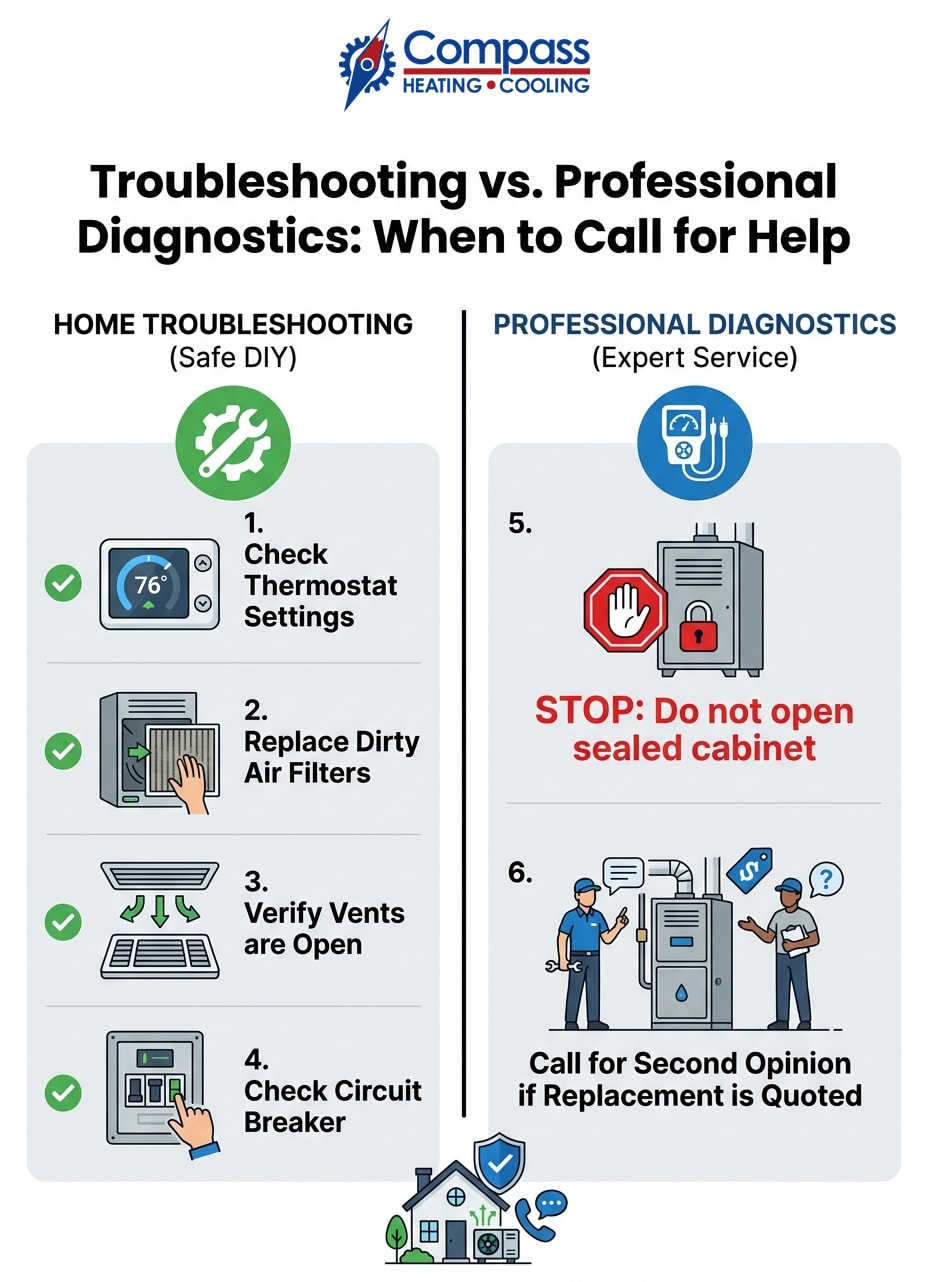
Before you reach for the phone to schedule a service visit with our team, there are several safe, homeowner-level checks you can perform. We frequently walk our customers through these simple steps over the phone, as they resolve a surprising number of early-winter furnace lockouts and can restore your heat without the need for a professional dispatch.
• Check the thermostat settings carefully: Verify that the system is actually set to "heat" and not just "on" or "cool." If the fan is set to "on," it will blow air constantly, even when the burners are resting, which feels like cold air. If the screen is blank or unresponsive, replace the batteries immediately.
• Inspect and replace dirty air filters: This is the number one cause of restricted airflow and safety switch lockouts. Pull the filter out and hold it up to a light. If you cannot see light shining through the material, it is too clogged for your furnace to breathe. Replace it with a fresh, clean filter.
• Ensure all vents and registers are fully open: Walk through every room in your house and verify that the supply and return vents are open and unobstructed. Moving a heavy rug, a couch, or a bookshelf that is blocking a vent can instantly improve system airflow and relieve pressure on the blower motor.
• Verify the circuit breaker status: The initial heating surge during those bitter November sub-freezing temperature drops can sometimes trip a breaker. Check your electrical panel for any switches that have moved to the middle or "off" position. Reset it once, but if it trips again, stop and call a professional.
• Check the furnace power switch: Most furnaces have a standard light switch mounted on or near the side of the unit. Ensure this switch was not accidentally bumped into the "off" position while moving boxes or retrieving winter gear from storage.
When DIY Maintenance Crosses the Line
While checking filters and thermostats is perfectly safe, there is a hard line where DIY troubleshooting must stop. You should never open the sealed furnace cabinet to attempt internal repairs. Modern heating systems deal with high-voltage electricity, combustible natural gas, and deadly carbon monoxide. Trying to clean a flame sensor, splice internal wiring, or adjust a gas valve without proper training and licensing is extremely dangerous. As licensed professionals, we must stress that basic maintenance is strictly about managing external airflow and thermostat communication—never internal mechanical tampering.
Comparing Simple Lockouts to True Mechanical Failures
Understanding the subtle differences in your system's symptoms can help you evaluate the situation calmly. Over years of diagnosing Loveland furnaces, our team has noticed that lingering issues from the summer cooling season often mask themselves until the heavy heating load begins. Knowing what to look and listen for provides a clear threshold for when your troubleshooting ends and professional diagnostics must begin.
• Furnace runs briefly, then shuts off (Short-cycling) — Likely Simple Cause (Try DIY First): Severely clogged air filter or blocked return vents causing the system to overheat and trip the high-limit switch. — Likely Mechanical Failure (Call a Pro): A failing flame sensor, a malfunctioning control board, or a weak blower motor that cannot move enough air.
• Blowing cold air constantly — Likely Simple Cause (Try DIY First): Thermostat fan setting is switched to "On" instead of "Auto," or the pilot light/ignition sequence failed due to a draft. — Likely Mechanical Failure (Call a Pro): The gas valve is failing to open, the igniter is cracked, or the heat exchanger has a severe structural issue.
• System is completely unresponsive — Likely Simple Cause (Try DIY First): Dead thermostat batteries, a tripped circuit breaker, or the external furnace power switch was turned off. — Likely Mechanical Failure (Call a Pro): A blown internal transformer, a burnt-out control board, or severed electrical wiring inside the cabinet.
• Strange noises during operation — Likely Simple Cause (Try DIY First): A loose access panel vibrating against the frame, or a whistling sound from a highly restrictive, overly dense air filter. — Likely Mechanical Failure (Call a Pro): Grinding or squealing from failing blower motor bearings, or a loud boom indicating delayed gas ignition.
• Unusual smells when the heat kicks on — Likely Simple Cause (Try DIY First): The normal smell of settling dust burning off the heat exchanger during the very first run of the season (usually fades quickly). — Likely Mechanical Failure (Call a Pro): Persistent burning plastic smells, electrical ozone odors, or the smell of raw gas (evacuate and call immediately).
If you have addressed the simple causes—like swapping out that filthy filter and checking the breaker—and the system still refuses to operate properly, you have crossed the threshold into professional territory. Just as you would rely on expert air conditioning diagnostics during a summer heatwave, you need a qualified technician from a trusted company like Compass Heating & Cooling to safely assess the internal components of your furnace during the winter.
The Danger of Hasty Diagnoses During the First Major Freeze
When the temperature plummets and your house is losing heat by the minute, you are in a highly vulnerable position. Emergency dispatch boards light up during the first major freeze of the year, creating a chaotic environment for many service companies. Technicians are rushed, working long hours, and bouncing from one freezing house to the next. Unfortunately, our team has observed that this high-stress environment is exactly when hasty diagnoses are most likely to occur.
Some technicians may use the urgency of the November sub-freezing temperature drops to push for a full system replacement rather than taking the time to perform a simple, thorough repair. When a technician tells you that your system is condemned and unsafe to operate, the natural reaction is to authorize whatever work is necessary to protect your home and restore warmth. However, accepting a condemned system diagnosis without verifying the underlying cause carries immense financial and comfort risks.
A rushed technician might see a tripped high-limit switch and immediately declare the furnace too old to save, completely ignoring the fact that an inexpensive clogged air filter caused the overheat in the first place. This is why we tell our customers it is absolutely vital to remain calm, even when the house is cold. Ask the technician for a detailed, written explanation of the failure. Ask them to show you the specific part that failed and explain exactly how it impacts the rest of the system. If the explanation feels rushed, vague, or heavily focused on high-pressure sales tactics, it is time to step back and evaluate your options.
When and Why to Seek an HVAC Second Opinion
An HVAC second opinion is exactly what it sounds like: bringing in a different, independent professional to evaluate your system after another company has recommended a major repair or full replacement. It is a standard, protective practice in the industry, and any reputable technician—including our crew at Compass Heating & Cooling—will actively encourage you to seek one if you feel unsure about a diagnosis.
There are several clear triggers that should immediately prompt you to seek a second opinion. First, if you receive a quote for a full system replacement, especially if your equipment is less than ten years old, you should always get another set of eyes on the unit. Second, if you experience high-pressure sales tactics—such as a technician claiming a "special discount" that expires the moment they leave your driveway—you should respectfully decline and call someone else. Finally, if the explanation of the problem is vague, confusing, or lacks physical evidence, a second opinion is warranted.
A fresh set of eyes can often uncover a minor electrical fault, a loose wire, or a simple airflow issue that was completely overlooked by a rushed technician. The importance of getting a second opinion on HVAC work cannot be overstated. It provides the ultimate peace of mind. Whether the second technician confirms the original diagnosis—giving you the confidence to proceed with a replacement (and potentially taking advantage of generic federal tax credits or utility rebates for qualifying energy-efficient systems)—or finds a much cheaper repair, you win by making an informed, verified decision rather than a panicked one.
What to Expect from Honest, Transparent Diagnostics
When you invite a professional into your home, you deserve complete transparency and respect. A trustworthy diagnostic visit looks very different from a rushed sales call. An honest technician will arrive with the right tools and take the time to test the system thoroughly. They will check the static pressure to evaluate airflow, inspect the heat exchanger visually and with specialized cameras, and test the electrical components using precise multimeters.
More importantly, a reputable technician will actively involve you in the process. They will show you the failed part, explain the mechanics behind the failure in plain language, and discuss all available options. Working with our local Compass Heating & Cooling team dedicated to honesty means you are partnering with professionals who will actively teach you about your system and prioritize repair over replacement whenever it is safely possible. We want to build a long-term relationship, not just make a quick sale.
Trustworthy Loveland HVAC professionals are happy to answer your questions, explain their testing methods, and fully support your right to a second opinion. We stand by our diagnostics because our findings are based on hard data and thorough testing, not guesswork or sales quotas. When you experience this level of transparency, you can move forward with confidence, knowing your home is in capable hands.
Frequently Asked Questions About Furnace Troubleshooting
Why is my furnace blowing cold air?
In our experience, this is often caused by a dirty air filter restricting airflow, which causes the internal heat exchanger to overheat and trip the high-limit safety switch. Once tripped, the burners shut off, but the fan continues to run to cool the system down, resulting in cold air coming from your vents. Another common culprit is a thermostat fan setting that has been accidentally switched to "On" instead of "Auto."
What causes a furnace to short cycle?
Our technicians frequently find that short cycling—where the furnace turns on for a minute or two and then abruptly shuts off—is a self-preservation mechanism. It is usually triggered by overheating due to severely clogged filters, blocked return vents, or a failing flame sensor that cannot detect whether the gas has safely ignited. If changing the filter does not resolve the short cycling, professional diagnostics are required to prevent permanent damage.
How do I reset my furnace?
You can safely reset your furnace by turning the power off at the thermostat, waiting a few moments, and then switching the dedicated furnace circuit breaker off and back on. You can also use the external power switch located near the furnace cabinet. However, repeated resets without fixing the root cause will eventually damage the system; a reset is a temporary test, not a permanent solution.
How do I know if my furnace needs replacing or just repair?
The decision to replace rather than repair depends heavily on the age of the system, the frequency of recent breakdowns, and the exact nature of the failure. Minor electrical faults and airflow issues should always be repaired, while a cracked heat exchanger or a failed compressor on an older unit often justifies replacement. Our team always recommends getting a verified second opinion as the absolute best way to be sure you are making the right choice.
Can a dirty air filter really cause my heating system to shut down completely?
Yes, absolutely. We see this all the time. Modern heating systems are equipped with highly sensitive safety switches that monitor internal temperatures and airflow. If a clogged filter causes the airflow to drop too low, the system will cut power to the burners to prevent a catastrophic fire hazard or a cracked heat exchanger. A clean filter is your first line of defense against unexpected winter breakdowns.
Take Control of Your Home's Winter Comfort
Understanding basic troubleshooting empowers you to take control of your home's comfort and resolve minor airflow issues safely and quickly. By knowing how to check your thermostat, swap out a dirty filter, and verify your breaker panel, you can often restore your heat without the stress of an emergency service call. When the November sub-freezing temperature drops arrive in the Colorado Front Range / Loveland area, our team at Compass Heating & Cooling knows that being proactive makes all the difference.
However, if your troubleshooting steps do not restore your heat, or if a technician unexpectedly condemns your system during a high-stress weather event, remember that verifying the diagnosis is the smartest financial move you can make. Never let the urgency of a cold house push you into a rushed decision. If you are facing a major repair quote and need clarity, reach out to our local experts who prioritize accurate, honest repairs. A transparent diagnostic assessment from Compass Heating & Cooling will give you the reassurance and peace of mind you need to keep your home warm and safe all winter long.
hear what our satisfied clients have to say
Our clients consistently praise our exceptional service and attention to detail. They appreciate the personalized approach we take to meet their unique needs, ensuring satisfaction every step of the way.
