



At What Temperature Do Heat Pumps Lose Efficiency? (And Why Yours Runs Constantly Below 20 Degrees)
Is It Normal for Your Heat Pump to Run Non-Stop During a Cold Snap?
Are you wondering why your heating system will not turn off now that the freezing weather has arrived? When the first late November pre-winter cold snaps hit the Front Range, many homeowners experience a sudden wave of anxiety as they listen to their outdoor unit run for hours on end. You are likely asking yourself exactly at what temperature do heat pumps lose efficiency, and trying to make a quick decision: should you manually switch to emergency heat, call for immediate repairs, or simply trust that your system is operating exactly as it was designed to?
The short answer is that continuous operation during a severe temperature drop is usually completely normal. Unlike traditional gas furnaces that blast hot air and then shut off, modern heat pump systems are engineered to run for longer, sustained cycles. They maintain your indoor comfort by providing a steady, lower-intensity stream of warmth. When the outside air gets colder, the system simply has to work longer to extract the same amount of thermal energy.
Hearing your system run non-stop does not automatically mean it is broken, nor does it mean your energy bills are about to skyrocket out of control. However, understanding how your equipment responds to freezing temperatures is the key to knowing when to relax and when to actually call a professional. Let us break down the technical thresholds of your system, what happens when the temperature plummets, and how to spot the real warning signs of a winter breakdown.
The Science of the Balance Point: At What Temperature Do Heat Pumps Lose Efficiency?
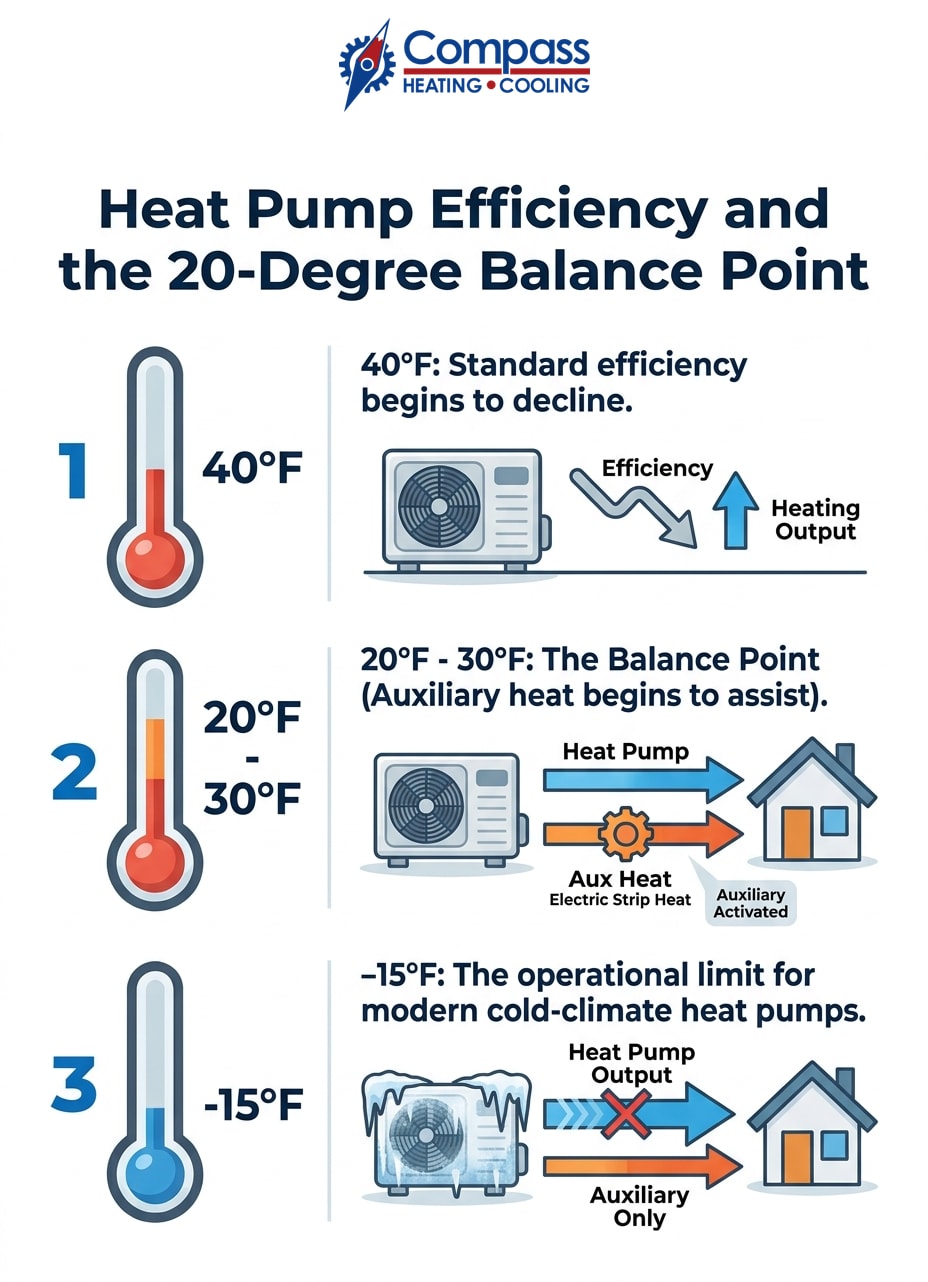
The quick answer: Standard air-source systems typically begin to see a gradual decline in efficiency around 40 degrees Fahrenheit, but they usually hit their true thermal balance point—where they require backup assistance—around 20 degrees Fahrenheit.
To fully understand at what temperature do heat pumps lose efficiency, you have to look at how these systems actually generate heat. Heat pumps do not burn fuel to create warmth; they use refrigerant to absorb existing thermal energy from the outside air and move it indoors. Even when it feels bitterly cold to you, there is still heat energy in the air. However, as the thermometer drops, that heat becomes much harder to capture.
This brings us to the concept of the Coefficient of Performance, or COP. In mild weather, a standard system might operate with a COP of 3.0, meaning it produces three units of heat for every one unit of electricity it consumes. As temperatures fall below 40 degrees, this ratio starts to slowly decline. The system is still working, but it has to run its compressor longer to gather the necessary heat, which is why "losing efficiency" simply means the system is working harder, not that it has stopped functioning.
The most critical threshold is the 20°F balance point. The balance point is the exact outdoor temperature where the heat pump's maximum heating output perfectly matches your home's heat loss. Below this specific temperature, the heat pump alone can no longer keep up with the cold air seeping into your house, and it must rely on a secondary heat source to bridge the gap.
Understanding Heat Extraction in Freezing Weather
It can be difficult to wrap your mind around extracting heat from freezing air. The secret lies in the chemical properties of the refrigerant running through your outdoor coil. This specialized fluid has an extremely low boiling point. Even when the outside air is 15 degrees Fahrenheit, it is still warmer than the ultra-cold liquid refrigerant, allowing the refrigerant to absorb that ambient heat, turn into a gas, and carry the warmth inside.
Because there is simply less heat available in 15-degree air than in 45-degree air, the compressor must run continuously to process a larger volume of outside air. This constant humming is the sound of your system doing exactly what it was built to do: maximizing heat extraction in challenging conditions.
Efficiency Loss vs. Heating Capacity: What Actually Happens as Temperatures Drop?
A common misconception: Many homeowners believe that an efficiency drop means the system will start blowing cold air into the house. This is not true. There is a distinct difference between a system that is costing slightly more to run (efficiency loss) and a system that can no longer keep the house warm (capacity loss).
When you ask at what temperature do heat pumps lose efficiency, you are really asking about the cost of operation. But capacity is about comfort. As the outside temperature approaches the 20°F balance point, the air coming out of your vents might feel slightly cooler than the blast of a traditional furnace. It is still warmer than the air inside your room—usually around 85 to 90 degrees Fahrenheit—but because it is lower than your body temperature, it can create a perceived "cool draft" effect. The system is still heating your home; it is just doing so gradually.
This distinction becomes incredibly important in our specific region. A mild afternoon in Loveland and the Colorado Front Range can easily sit in the comfortable 50s, only to plummet well below freezing by nightfall. These rapid, unexpected temperature drops cause a sudden shift in how your system sounds and feels. The sudden continuous operation of the compressor is just the system adapting to the rapid loss of ambient heat.
For homes that struggle with capacity during these extreme freezes, dual-fuel setups offer a powerful solution. A dual-fuel system pairs a high-efficiency electric heat pump with a traditional gas furnace. The system uses an intelligent thermostat to automatically switch between the two based on the outside temperature. Our local expertise in optimizing dual-fuel systems for the specific extreme temperature swings of Northern Colorado ensures you get the electric efficiency during mild days and the heavy-duty gas heating power during severe blizzards. If you find your current system struggles to keep up, it might be time to learn when to switch from a heat pump to a gas furnace for optimal winter comfort.
Auxiliary Heat vs. Emergency Heat: How Your System Adapts to the Cold
When your system reaches its 20°F balance point and can no longer heat the home on its own, it calls for backup. This is where the confusion between Auxiliary (Aux) Heat and Emergency (Em) Heat typically begins. Understanding the difference between these two modes is critical for keeping your home comfortable without wasting energy.
A very common mistake homeowners make during a cold snap is manually switching their thermostat to Emergency Heat simply because it feels freezing outside. Doing this bypasses the heat pump entirely and relies 100% on your backup heat source, which is usually electric resistance heat strips. Electric resistance heat is highly reliable but notoriously expensive to run as a primary heat source.
Trusting the automated Aux heat is almost always the most efficient choice unless your outdoor unit is physically damaged or covered in a solid block of ice.
• How it Activates — Auxiliary (Aux) Heat: Automatic. The thermostat turns it on when the heat pump falls behind. — Emergency (Em) Heat: Manual. You must physically select this setting on your thermostat.
• How it Works — Auxiliary (Aux) Heat: Runs alongside the heat pump to provide a supplemental boost of warmth. — Emergency (Em) Heat: Shuts down the outdoor heat pump entirely and runs only the backup heat.
• Energy Efficiency — Auxiliary (Aux) Heat: Moderate. Uses the efficient heat pump as much as possible before using backup. — Emergency (Em) Heat: Low. Relies entirely on the expensive backup heating source.
• Best Use Case — Auxiliary (Aux) Heat: Normal winter operation during extreme cold snaps below the balance point. — Emergency (Em) Heat: Only when the outdoor unit is broken, crushed by a falling branch, or completely frozen solid.
Standard vs. Cold-Climate Heat Pumps: Upgrading Your Winter Defense
The technology gap: If you are frustrated by your system constantly relying on auxiliary heat, it is important to know that not all systems share the exact same balance point. The heating industry has made massive technological leaps in the past decade, creating a distinct divide between standard models and advanced cold-climate systems.
Standard heat pumps are fantastic for moderate climates, but they begin to struggle significantly as temperatures drop into the teens. However, modern cold-climate heat pumps are engineered with advanced variable-speed inverter compressors. Instead of just running at one speed (on or off), an inverter compressor can ramp its speed up and down like the gas pedal on a car. This allows it to extract heat much more aggressively in freezing weather.
These advanced systems are designed to operate efficiently in temperatures as low as -15 degrees Fahrenheit. This means that even during the harshest nights in Loveland and the Colorado Front Range, a cold-climate model can often heat your home without ever triggering the expensive auxiliary heat strips.
You will frequently find this advanced cold-climate inverter technology featured in a ductless mini-split system, making them an excellent choice for targeted heating in problem rooms or as a whole-home retrofit. Additionally, because these systems are so highly efficient, qualifying cold-climate heat pumps may be eligible for significant federal tax credits or local utility rebates, making the upgrade more accessible for homeowners looking to improve their winter defense.
4 Signs Your Heat Pump Needs Professional Attention During a Freeze
While we have established that a heat pump running constantly below its balance point is usually normal, there are specific symptoms that indicate the constant running is actually a malfunction. If you notice any of the following signs during late November pre-winter cold snaps, it is time to call a professional.
1. The system is blowing completely cold air: While heat pump air might feel slightly cooler than furnace air, it should never feel like an open window. If your vents are blowing genuinely cold air while the thermostat is set to heating mode, you likely have a refrigerant leak or a failed reversing valve.
2. The outdoor unit is encased in a solid block of ice: A light layer of frost on the outdoor coils is perfectly normal in winter. However, if the entire unit looks like a glacier and the fan blades cannot spin, your automated defrost cycle has failed. Turn the system to Emergency Heat immediately to prevent compressor damage and call for service.
3. The thermostat never reaches the set temperature: If your system has been running continuously for 12 hours, the Aux heat indicator is on, and the indoor temperature is still dropping, the equipment has lost its heating capacity entirely. This points to a failure in the backup heat strips or a blower motor issue.
4. Unusual grinding or screeching noises: A steady hum is normal. Metal-on-metal grinding, loud rattling, or high-pitched screeching from the outdoor compressor indicates a serious mechanical failure, often related to failing bearings or ice impacting the fan blade.
The best way to prevent these mid-winter breakdowns is to stay proactive. We highly recommend enrolling in a routine maintenance plan. A thorough fall tune-up ensures your refrigerant levels are correct, your defrost board is functioning, and your backup heat strips are ready to engage before the first freeze hits.
Frequently Asked Questions About Heat Pump Cold Weather Operation
Do heat pumps work below 20 degrees?
Yes, heat pumps absolutely work below 20 degrees. While standard models begin to lose efficiency and hit their 20°F balance point, they do not simply shut down. They will continue to extract whatever ambient heat is available, while automatically engaging your system's auxiliary heat (usually electric heat strips) to make up the difference and keep your home at the set temperature.
Why is my heat pump running constantly in cold weather?
Your heat pump is designed to run constantly in cold weather to maintain efficiency. Unlike a gas furnace that blasts high heat in short bursts, a heat pump provides a steady, continuous stream of lower-temperature air. When the outside air drops below freezing, the compressor must run longer cycles to extract enough thermal energy to match your home's heat loss. This constant humming is normal operation, not a sign of failure.
At what temperature should I switch from heat pump to emergency heat?
You should never switch to emergency heat based purely on the outside temperature. Your thermostat is designed to automatically engage auxiliary heat when the heat pump needs help. You should only switch to manual emergency heat if the outdoor heat pump is physically broken, encased in a solid block of ice, or if a technician advises you to turn it off to prevent mechanical damage.
Is it cheaper to run a heat pump or furnace below freezing?
This depends heavily on your local utility rates and the specific efficiency of your equipment. Generally, natural gas furnaces are cheaper to run in extreme sub-freezing temperatures, while heat pumps are far cheaper to run in mild winter weather (above 35 degrees). This is exactly why dual-fuel systems are so popular; they automatically switch between the electric heat pump and the gas furnace to ensure you are always using the most cost-effective fuel source for the current weather.
How do I know if my heat pump defrost cycle is working correctly?
You can tell your defrost cycle is working if you occasionally see steam rising from the outdoor unit during cold weather. The system will temporarily reverse its operation to melt frost off the outdoor coils. During this brief 5-to-15-minute cycle, the outdoor fan will stop spinning, and you might feel slightly cooler air coming from your indoor vents. Once the ice is melted, the system will automatically return to normal heating mode.
Keep Your Home Warm and Efficient Through the Winter
Understanding exactly at what temperature do heat pumps lose efficiency brings immense peace of mind when the extreme cold weather arrives. Knowing that your system has a natural 20-degree balance point helps you realize that a continuously running compressor is usually just your equipment working hard to keep you comfortable. Constant operation is not an immediate cause for alarm, but actual performance issues—like blowing cold air or freezing solid—should never be ignored.
If you are tired of your current system struggling during the bitter nights in Loveland and the Colorado Front Range, or if you simply want to ensure your backup heat is ready for the next blizzard, it is time to consult a local expert. Do not wait for a complete breakdown in the middle of a freeze. Reach out today to schedule an inspection or discuss upgrading your system with professional heating services, and enjoy a warm, worry-free winter.
hear what our satisfied clients have to say
Our clients consistently praise our exceptional service and attention to detail. They appreciate the personalized approach we take to meet their unique needs, ensuring satisfaction every step of the way.
