



Why Modern Furnaces Don't Have Pilot Lights (And What Fails Instead)
The First Cold Snap Surprise: Searching for a Pilot Light That Isn't There
As a sudden chill settles over the house signaling an early September cold snap, many Loveland homeowners find themselves wondering why modern furnaces don't have pilot lights (and what fails instead) when they go to turn on the heat. You head down to the basement to fire up the heater for the first time this season, but when you open the metal panel to relight the flame, you are met with unfamiliar wires and circuit boards. This is a very common transition for today's homeowners.
For decades, starting the heating system meant locating a small gas valve, striking a match, and holding down a button until a tiny blue flame stabilized. Today, you open that same panel and find that the familiar gas valve and standing flame are completely missing. Instead, modern heating equipment relies entirely on electronic ignition. Our team at Compass Heating & Cooling frequently receives calls from homeowners caught off guard by this sudden realization when a system refuses to fire up on a chilly fall evening. Because modern ignition failure requires a completely different diagnostic approach than older models, simply guessing or poking around inside the cabinet can lead to serious safety hazards or expensive component damage.
Need help navigating your home's comfort system? Learn more about our comprehensive heating systems and how we keep them running safely.
The End of the Standing Pilot: Why Modern Furnaces Made the Switch
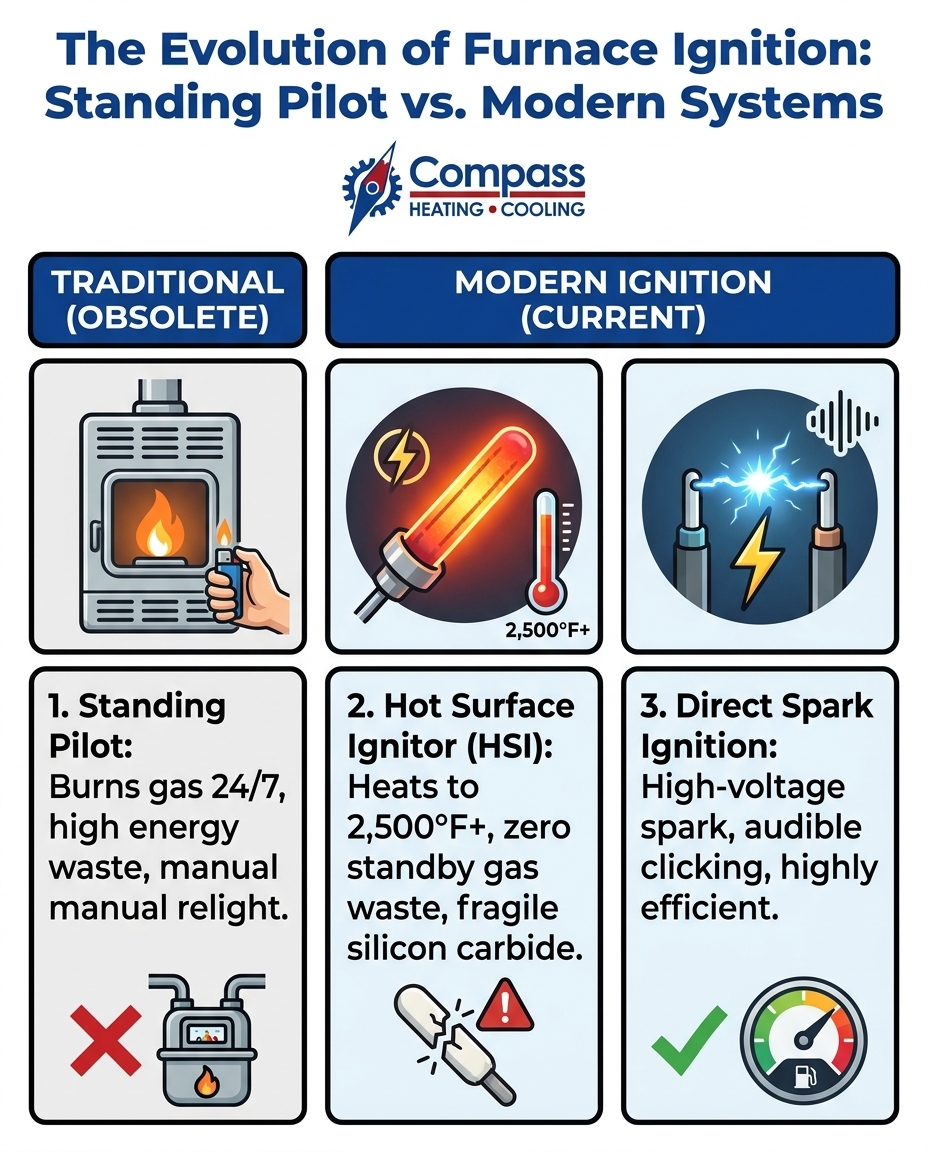
If you grew up with an older heater, the standing pilot was simply a fact of life. This small, continuous flame burned gas twenty-four hours a day, seven days a week, waiting for the thermostat to call for heat. While the design was relatively simple, it came with a massive downside: extreme energy waste.
The true cost of the standing flame: Throughout the spring, summer, and early fall, that tiny pilot light continued to consume gas. Over the course of a single year, a standing pilot could waste a significant amount of fuel just by sitting idle. As energy costs rose and environmental awareness grew, the HVAC industry recognized that burning gas when a home didn't actually need heat was an inefficient practice that had to change.
Eventually, Department of Energy (DOE) efficiency guidelines drove the industry to phase out standing pilots in residential heating equipment. Manufacturers transitioned to electronic ignition systems that only consume energy at the exact moment your thermostat actively calls for heat. Aside from the obvious efficiency benefits, electronic systems also provide much more reliable combustion. In higher altitude areas like ours, older standing pilots were notoriously draft-sensitive and prone to blowing out on windy days. Modern electronic ignitions eliminate this nuisance entirely, ensuring your system fires up consistently. If you are upgrading your home's comfort, exploring professional HVAC services is the best way to ensure your new electronic system is installed for maximum efficiency. (Note: Federal tax credits may also apply to qualifying high-efficiency upgrades, so be sure to check with your tax professional).
Understanding Hot Surface Ignitors (And Why They Eventually Fail)
When the industry moved away from continuous flames, modern furnaces with hot surface ignitors (HSI) became the standard replacement. A hot surface ignitor is a small electronic component that uses electrical resistance to create intense heat, functioning very much like the filament inside an old-fashioned incandescent lightbulb—but on a much more extreme scale.
When your thermostat signals that the house is too cold, the furnace control board sends an electrical current to the ignitor. Within seconds, the component glows bright orange or white-hot, reaching upwards of 2,500 degrees Fahrenheit. Once the ignitor is hot enough, the gas valve opens, the raw gas hits the glowing element, and the burners ignite safely.
Because these components must withstand such extreme temperatures, they are typically manufactured from fragile materials like silicon carbide or silicon nitride. While highly effective, this material is not invincible. Over years of normal wear and tear, the constant, rapid extreme heating and cooling cycles take a toll. The material slowly degrades, becoming increasingly brittle until it eventually cracks and fails to conduct electricity.
Signs Your Hot Surface Ignitor Has Failed
Because an ignitor operates entirely behind the scenes, you likely won't know it has failed until the house starts getting cold. Here are the most common symptoms to watch for:
• The blower runs, but there is no heat: You feel air coming out of your vents, but it is completely cold because the burners never ignited.
• A visible crack or blister: If you look closely at the ignitor element (when the system is powered off), you might see a hairline fracture or a white, blistered spot on the dark gray material.
• Short cycling: The furnace attempts to start, you hear the draft inducer motor spin up, but the system shuts down completely after a few seconds without ever producing a flame.
Direct Spark Ignition: The Source of That Clicking Sound
While the hot surface ignitor is incredibly common, it isn't the only electronic system on the market. Many modern units utilize direct spark ignition systems instead. Rather than relying on a glowing piece of silicon carbide to heat the gas, a direct spark system uses a high-voltage electrical spark to ignite the gas directly.
If you have ever started a gas barbecue grill by pushing a button and hearing a rapid snapping noise, you are already familiar with the basic concept of direct spark ignition. In your heating system, this is the component responsible for the rapid, repeating clicking sound you hear right before the burners roar to life.
The sequence of a spark ignition:
1. The thermostat calls for heat, and the draft inducer fan clears the heat exchanger of any lingering gases.
2. The gas valve opens to release a precisely measured amount of fuel into the burner assembly.
3. The direct spark ignitor fires, sending a high-voltage arc across a small gap.
4. The gas catches the spark and ignites the burners.
When this specific system fails, it usually results in one of two scenarios: you have a spark but no gas, or you have gas but no spark. In either case, the furnace's internal computer will immediately trigger a safety lockout to prevent raw gas from flooding your basement. Troubleshooting this issue is entirely different from dealing with a hot surface ignitor, which is why accurately diagnosing a furnace clicks but refuses to ignite scenario is so critical to restoring your home's warmth.
The Dangers of DIY: Why Modern Ignitors Require Professional Handling
It is incredibly tempting to look up a quick video online, buy a replacement part, and try to fix the ignition failure yourself. However, modern electronic ignitions are highly sensitive, and DIY attempts frequently end in ruined parts, voided warranties, or dangerous safety hazards.
One of the most common and costly mistakes homeowners make is mishandling a new hot surface ignitor. If you simply touch the silicon carbide element with your bare hands, the natural oils from your skin transfer to the fragile material. When the ignitor receives power and rapidly heats to 2,500 degrees, those microscopic oil deposits create uneven hot spots. This thermal shock causes the brand-new component to shatter or fail almost immediately upon heating.
Furthermore, bypassing safety lockouts or mishandling high-voltage direct spark components puts your entire home at risk. A safety lockout happens for a reason—usually to prevent a catastrophic buildup of raw, unburned gas in your home. Working with a trusted professional for Loveland heating repair ensures that you are protected from dangerous, costly DIY mistakes. When responding to no-heat calls, our technicians don't just swap a part; they use specialized tools to diagnose the root cause, checking for underlying voltage issues or cracked heat exchangers that caused the ignition failure in the first place.
Flame Sensors vs. Ignitors: Decoding the Safety Lockout
One of the biggest points of confusion for homeowners is telling the difference between an ignition failure and a flame sensor failure. Both issues result in a cold house, and both trigger the system's safety lockout mechanism, but they happen at different stages of the startup process.
The flame sensor is a thin metal rod positioned directly in the path of the burner. Its sole job is to prove that a flame actually exists after the ignitor does its job. If the gas valve opens but the flame sensor doesn't detect a fire within a few seconds, it immediately shuts the entire system down to protect your home from gas buildup.
If your flame sensor is coated in dust, carbon buildup, or light rust, it loses its ability to sense the microamps of electricity that pass through the flame. The burners will ignite successfully for about three to five seconds, and then abruptly shut off. By contrast, if your ignitor has failed, the burners will never light at all.
• Hot Surface / Spark Ignitor — Primary Function: Creates the initial heat or spark to light the raw gas. — Symptom of Failure: Burners never ignite. Blower may run cold, or system clicks repeatedly. — System Response: System shuts down before any flame is ever produced.
• Flame Sensor — Primary Function: Detects the presence of a flame to confirm safe combustion. — Symptom of Failure: Burners ignite successfully, but shut off abruptly after 3-5 seconds. — System Response: System locks out after multiple failed attempts to sustain the flame.
Frequently Asked Questions About Modern Furnace Ignition Systems
What replaced the pilot light on a furnace?
Modern furnaces use electronic ignition systems, specifically hot surface ignitors (HSI) or direct spark ignitions, to light the burners only when heat is required. These components replaced older standing pilots to eliminate the massive energy waste of burning gas continuously, twenty-four hours a day.
How do you know if your furnace ignitor is bad?
Look for a furnace that blows cold air, clicks repeatedly without lighting, or repeatedly attempts to start but shuts down. If you have a hot surface ignitor, you might also see a visible crack or a white blistered spot on the dark gray glowing element when the system is completely powered off.
Why is my electronic ignition furnace not lighting?
Common causes include a cracked hot surface ignitor, a dirty flame sensor, a faulty control board, or tripped safety limit switches. Because modern furnaces have strict safety protocols, any failure in the ignition sequence will cause the computer to lock the system down to prevent raw gas from accumulating.
Do all new furnaces have pilot lights?
No. Due to strict energy efficiency regulations set by the Department of Energy, nearly all modern residential furnaces manufactured in recent decades utilize electronic ignition rather than standing pilot lights. It is exceptionally rare to find a standing pilot on any newly installed residential heating equipment.
How do I light a furnace without a pilot light?
You cannot manually light a modern furnace with a match or lighter. These systems are electronically sealed and sequenced by a computer control board. If the electronic ignition fails, the component must be professionally diagnosed and replaced by a qualified technician.
Secure Your Home's Comfort Before the Deep Freeze Hits
While discovering that your system lacks a traditional pilot light might be a surprise during an early September cold snap, the shift to electronic ignition is a massive upgrade for your home. Modern furnace ignitions are significantly safer, far more energy-efficient, and less prone to drafts than their predecessors. However, when they do fail, they require specialized professional care to diagnose and resolve safely.
Don't wait until the dead of winter to address ignition issues or strange clicking noises discovered during your fall start-up. If you are still wondering why modern furnaces don't have pilot lights (and what fails instead) because your system is blowing cold air, it is time to bring in an expert. Secure your home's reliability by scheduling a professional furnace maintenance visit today, ensuring you stay warm and safe all season long.
hear what our satisfied clients have to say
Our clients consistently praise our exceptional service and attention to detail. They appreciate the personalized approach we take to meet their unique needs, ensuring satisfaction every step of the way.
.png)