



Why Your Furnace Clicks But Refuses to Ignite
When the Autumn Chill Arrives, But the Heat Doesn't
As the first October freeze rapidly approaches, mastering essential home maintenance tips and troubleshooting is critical when you are relying on your heating system to keep your home comfortable through the dropping temperatures. You walk to the thermostat, switch it to the heating mode, and wait for that familiar rush of warm air to fill the room. Instead, you hear a faint whirring sound from the basement or utility closet, followed by a distinct, repetitive click-click-click—and then, nothing but silence. Understanding why your furnace refuses to ignite is one of the most important places to start.
If your HVAC system is struggling to keep up with the changing seasons, getting to the root of the problem early saves you from freezing nights later.
That clicking noise is not just a random rattle or a loose panel. It is a highly specific mechanical symptom indicating that your heating equipment is attempting to start its normal operation but failing at a crucial step. During Northern Colorado's rapid autumn temperature swings, a sudden need for heat can quickly turn a minor ignition failure into an urgent comfort issue for your household. The challenge for most homeowners is determining whether this early-season hiccup requires a simple, safe check you can perform yourself, or if it demands the specialized tools of a licensed professional. Because your entire heating infrastructure relies on this initial spark to function properly, ignoring the sound will not make it go away—it will simply leave you in the cold.
Decoding the Clicking Sound: The Spark Igniter at Work
To understand why your system is failing to produce heat, it helps to know exactly what is happening inside the cabinet when you hear that repetitive noise. The clicking sound you hear is the electronic spark igniter attempting to create a high-voltage spark to light the gas flowing into the burners. If you have ever pushed the ignition button on a standard outdoor gas grill and heard that rapid snapping sound right before the flames catch, you have heard the exact same mechanical principle at work.
The Evolution of Furnace Ignition
Older heating systems used a standing pilot light—a small, continuously burning blue flame that waited for the gas valve to open. While simple, standing pilots wasted a significant amount of fuel because they burned gas 24 hours a day, 365 days a year. Modern heating equipment eliminated this waste by introducing electronic ignition systems. Today, your system either uses a hot surface igniter (which glows bright orange like a toaster element) or a direct spark igniter (which creates the clicking sound you are currently hearing).
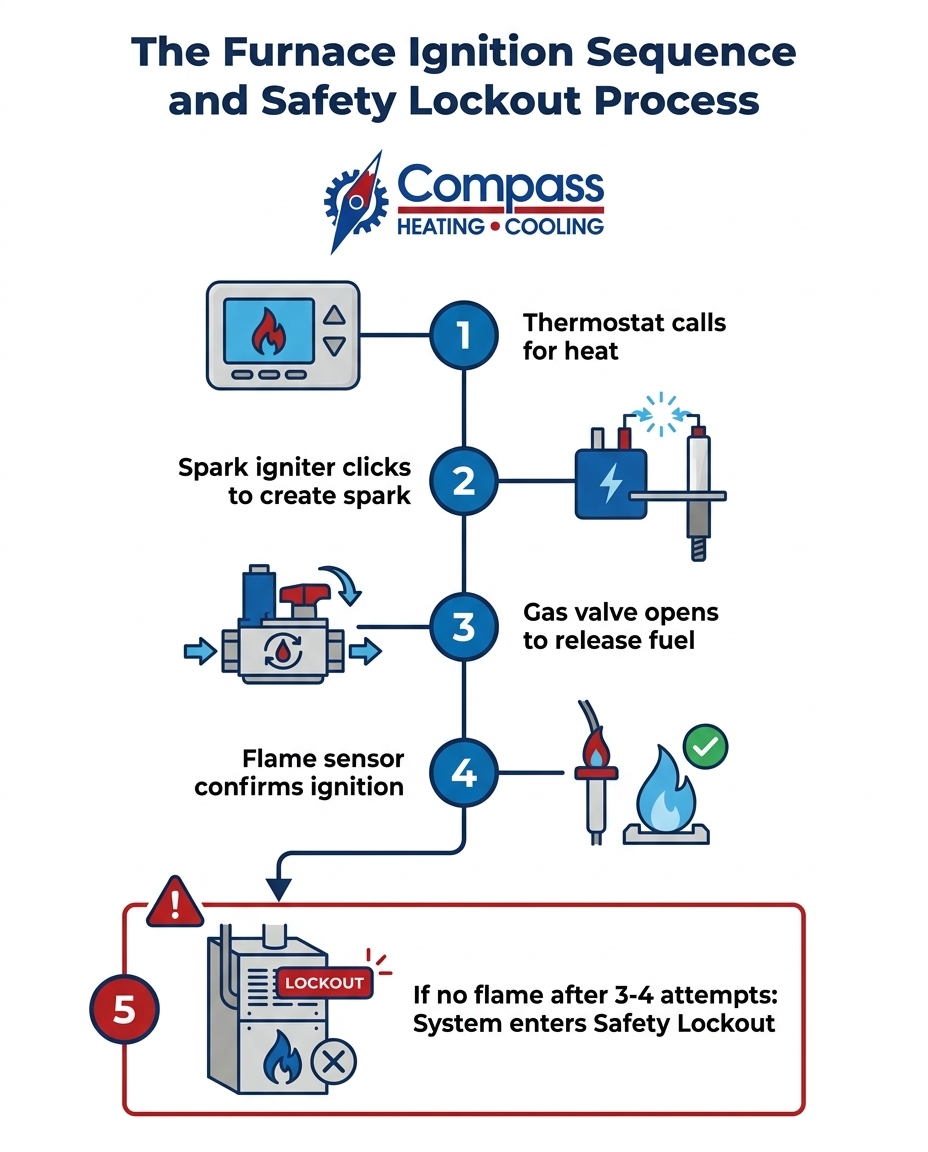
When the thermostat calls for heat, the system initiates a precise sequence of events. First, a small draft motor turns on to clear residual gases out of the heat exchanger. Once the system confirms the exhaust pathway is clear, it sends power to the spark igniter. You hear the clicking. A fraction of a second later, the gas valve opens. If everything works perfectly, the spark ignites the gas, resulting in a gentle "whoosh" of flames. If the gas fails to light after a few clicks, the system will deliberately shut the gas valve down to prevent a dangerous buildup of unburned fuel in your home. When this sequence fails repeatedly, it is time to look into professional heating services to restore safe operation.
The Built-In Safety Feature: Understanding Furnace Lockouts
It is incredibly frustrating when your heating equipment shuts down just as the weather turns cold, but this shutdown is actually a sign that your system is protecting you. Modern gas appliances are designed with strict safety parameters. When the spark igniter clicks but the burners fail to light, the internal control board recognizes the failure and takes immediate protective action.
The 3-to-4 Attempt Cycle
Your system will not simply click forever. Typically, the control board is programmed to allow three to four distinct ignition attempts. It will spark, open the gas valve for a few seconds, and check for a flame. If no flame is detected, it closes the valve, waits a short period to let the unburned gas dissipate out the exhaust flue, and tries again. You might hear the clicking cycle repeat several times over the course of five to ten minutes.
If all three or four attempts fail, the control board triggers an ignition sequence lockout. This is a hard safety shutdown. During an ignition sequence lockout, the system completely disables the gas valve and the igniter, refusing to attempt another start cycle until a specific amount of time has passed (usually one to three hours) or until the system is manually reset by cutting the electrical power. This deliberate lockout ensures that your home is never exposed to a continuous flow of unburned natural gas or propane.
• Initial Call — Normal Ignition Sequence: Thermostat requests heat; draft motor starts. — Ignition Sequence Lockout: Thermostat requests heat; draft motor starts.
• Ignition Attempt — Normal Ignition Sequence: Igniter clicks, gas valve opens, flame ignites. — Ignition Sequence Lockout: Igniter clicks, gas valve opens, flame fails to ignite.
• Verification — Normal Ignition Sequence: Flame sensor detects fire; blower fan engages. — Ignition Sequence Lockout: Flame sensor detects nothing; gas valve slams shut.
• System Response — Normal Ignition Sequence: Warm air is distributed throughout the home. — Ignition Sequence Lockout: System retries 3 times, then shuts down completely.
Common Culprits Behind Ignition Failure After Months of Inactivity
When you experience an ignition failure during the first October freeze, the root cause is often tied directly to the fact that the equipment has been sitting dormant for months. In our years of serving Loveland and the surrounding Northern Colorado communities, our team at Compass Heating & Cooling typically sees that spring and summer inactivity allows dust, moisture, and settling to affect sensitive electronic components. While the symptom is always a clicking sound followed by silence, the underlying mechanical failures can vary significantly.
1. Dust and Debris on the Flame Sensor
The flame sensor is a thin metal rod that sits directly in the path of the burners. Its entire job is to detect whether a fire is actually burning. It does this by passing a tiny electrical current (measured in microamps) through the plasma of the flame itself. Over the spring and summer, airborne dust, pet dander, and humidity can bake a microscopic layer of silica onto this rod. When the igniter clicks and the gas lights, this dust layer insulates the rod. The control board cannot feel the electrical current, assumes the fire failed to light, and shuts the gas valve off within three seconds. This is one of the most frequent causes of early-season lockouts.
2. A Malfunctioning or Closed Gas Valve
If the igniter is sparking brightly but there is no fuel to burn, the system will never light. Sometimes, a gas valve may have been manually closed during summer maintenance or nearby plumbing work and simply forgotten. In other cases, the electronic solenoid inside the gas valve can stick after months of inactivity, preventing it from opening when the control board sends the command.
3. Thermostat Communication Errors
Occasionally, the issue originates on your living room wall rather than in the basement. If the thermostat has weak batteries, frayed wiring, or internal dust buildup, it may send an incomplete signal to the heating equipment. The system might start the draft sequence, but the communication drops out right as the igniter begins to click, aborting the process entirely.
4. Severe Airflow Restrictions
Your heating equipment is incredibly sensitive to airflow. If the system cannot pull enough return air through the ductwork, the internal heat exchanger will overheat rapidly. To prevent a fire hazard, high-limit safety switches are wired directly into the ignition circuit. If these switches detect a lack of airflow or excessive internal heat from a previous short-cycle, they will physically block the ignition sequence from proceeding. This is a pattern we see often, which is why getting a second opinion on HVAC work is so valuable; a transparent diagnostic approach focuses on finding the actual root cause—like a simple dirty flame sensor or a clogged filter—rather than using a clicking noise as a pretext to push for a full system replacement.
Safe Troubleshooting Steps Before Calling a Technician
While the internal mechanics of gas ignition are complex, not every ignition sequence lockout requires an immediate service call. There are several safe, basic checks you can perform as a homeowner without risking your safety or violating the warranty on your equipment. Before you pick up the phone, walk through this simple checklist to rule out the most common external factors.
• Verify the thermostat settings: Ensure the thermostat is explicitly set to the "Heat" position. It sounds obvious, but a bumped switch can leave the system in "Fan Only" or "Off." Additionally, verify that the set temperature is at least three to five degrees higher than the current room temperature to force a strong call for heat.
• Inspect and replace the air filter: A severely clogged air filter starves the system of necessary airflow, which can trip the high-limit safety switches and halt the ignition process. If the filter looks dark, gray, or is coated in a thick layer of dust, replace it with a fresh one immediately.
• Check the furnace power switch: Most heating systems have a dedicated electrical switch mounted on the side of the cabinet or on a nearby wall or ceiling joist. It looks exactly like a standard light switch. If this was bumped to the "Off" position during summer storage or basement cleaning, the system will not complete its startup sequence. Ensure it is firmly flipped up to the "On" position.
• Inspect the electrical panel: Locate your home's main electrical panel and look for the breaker dedicated to the heating system. Even gas-powered equipment requires electricity to run the igniter, circuit boards, and blower fan. If the breaker is tripped (sitting in the middle position), firmly push it all the way to "Off" before snapping it back to "On."
The Dangers of Bypassing Safety Controls
If you have run through the safe troubleshooting checklist and the system still refuses to produce heat, you have reached the limit of safe homeowner intervention. It is absolutely vital to understand the dangers of attempting to bypass safety controls or perform unauthorized DIY repairs on gas appliances. The internet is full of generic advice suggesting homeowners should open burner compartments to clean sensors or manually adjust gas valves, but these actions carry severe risks.
You should never attempt to manually light a modern electronic ignition system with a match or a lighter. Unlike old standing pilot systems, modern equipment releases a large volume of gas very quickly. Inserting a flame into the burner compartment manually can result in a dangerous flash fire or small explosion. Furthermore, repeatedly resetting the electrical breaker to force the system out of an ignition sequence lockout is highly discouraged. The lockout exists for a reason. Forcing the system to cycle over and over can lead to unburned gas accumulation in the exhaust flue or cause permanent electrical damage to the expensive internal control board. Internal component repairs, sensor calibrations, and gas pressure adjustments strictly require a licensed professional for safety and compliance.
When to Schedule a Professional Diagnostic
If your basic checks—verifying the filter, adjusting the thermostat, and confirming the power supply—do not resolve the clicking and the failure to ignite, it is time to call in a professional. Prompt attention prevents a minor, easily fixable ignition issue from leaving your home freezing during a sudden autumn temperature drop.
A qualified technician brings specialized diagnostic tools that take the guesswork out of the repair. They will use a digital multimeter to test the microamp draw on the flame sensor, verify the exact voltage reaching the spark igniter, and use a manometer to measure the precise gas pressure flowing through the manifold. If you live in Loveland, CO, working with our locally-owned team at Compass Heating & Cooling ensures you receive a thorough, honest assessment. A transparent approach means we will show you exactly what failed—whether it is a worn igniter bracket or a stuck gas valve solenoid—ensuring you get exactly the repair you need without being pressured into a rushed, unnecessary replacement.
Frequently Asked Questions About Furnace Ignition Issues
Why is my furnace clicking but not turning on?
The clicking sound you hear is the electronic spark igniter attempting to create a spark to light the natural gas or propane. If the system does not turn on, it means the gas is either not reaching the burners, the spark is too weak to ignite it, or the flame sensor is failing to detect the fire once it lights. The system then shuts down to prevent unburned gas from filling your home.
How do you fix a furnace that clicks but won't ignite?
Homeowners can safely fix this issue if the root cause is external, such as replacing a heavily clogged air filter, replacing thermostat batteries, or ensuring the equipment's power switch is turned on. However, if the issue involves internal components—like cleaning a dirty flame sensor, replacing a cracked igniter, or unsticking a gas valve—professionals must handle the repair to ensure safe operation.
What does a bad furnace ignitor sound like?
A bad direct spark ignitor may click rapidly and repeatedly without the subsequent "whoosh" sound of gas igniting. Alternatively, if the ignitor has completely burned out, cracked, or suffered an electrical short, it may make no sound at all when the thermostat calls for heat, leaving the system entirely silent during the startup phase.
How do I reset my furnace after a lockout?
Most modern systems can be reset by turning the dedicated power switch next to the equipment off for about 60 seconds, then flipping it back on. You can also achieve this by turning the thermostat completely off and back to heat. However, if the system immediately enters a lockout state again after resetting, a professional must diagnose the root cause, as the safety sensors are detecting a persistent hazard.
Can a dirty air filter stop a furnace from igniting?
Yes, a severely dirty air filter restricts the flow of return air into the system, causing the internal heat exchanger to rapidly overheat. This excessive heat trips the high-limit safety switches. Once these switches are tripped, the control board will intentionally block the ignition sequence from starting to prevent a potential fire hazard.
Ensure Reliable Warmth Before the Cold Settles In
A clicking heating system is a clear sign that your equipment is trying its best to work but needs specialized attention to cross the finish line. Understanding the mechanics behind the ignition sequence lockout empowers you to make smart, safe diagnostic decisions when the weather turns cold. By performing safe basic checks and knowing when to call for help, you protect both your home and your equipment. For the best home maintenance tips and troubleshooting results, scheduling routine furnace maintenance before the deep winter freeze ensures your system runs smoothly, safely, and reliably all season long.
hear what our satisfied clients have to say
Our clients consistently praise our exceptional service and attention to detail. They appreciate the personalized approach we take to meet their unique needs, ensuring satisfaction every step of the way.
.png)