



How Poor Attic Insulation Makes AC Run Constantly
Why Your AC Never Shuts Off — and Why Your Attic Is Likely to Blame
How poor attic insulation makes AC run constantly in a Northern Colorado home comes down to one basic physics problem: heat flows from hot spaces into cool ones, and without enough insulation overhead, your attic becomes a furnace that never stops pushing heat into your living space.
Here is a quick summary of what is happening:
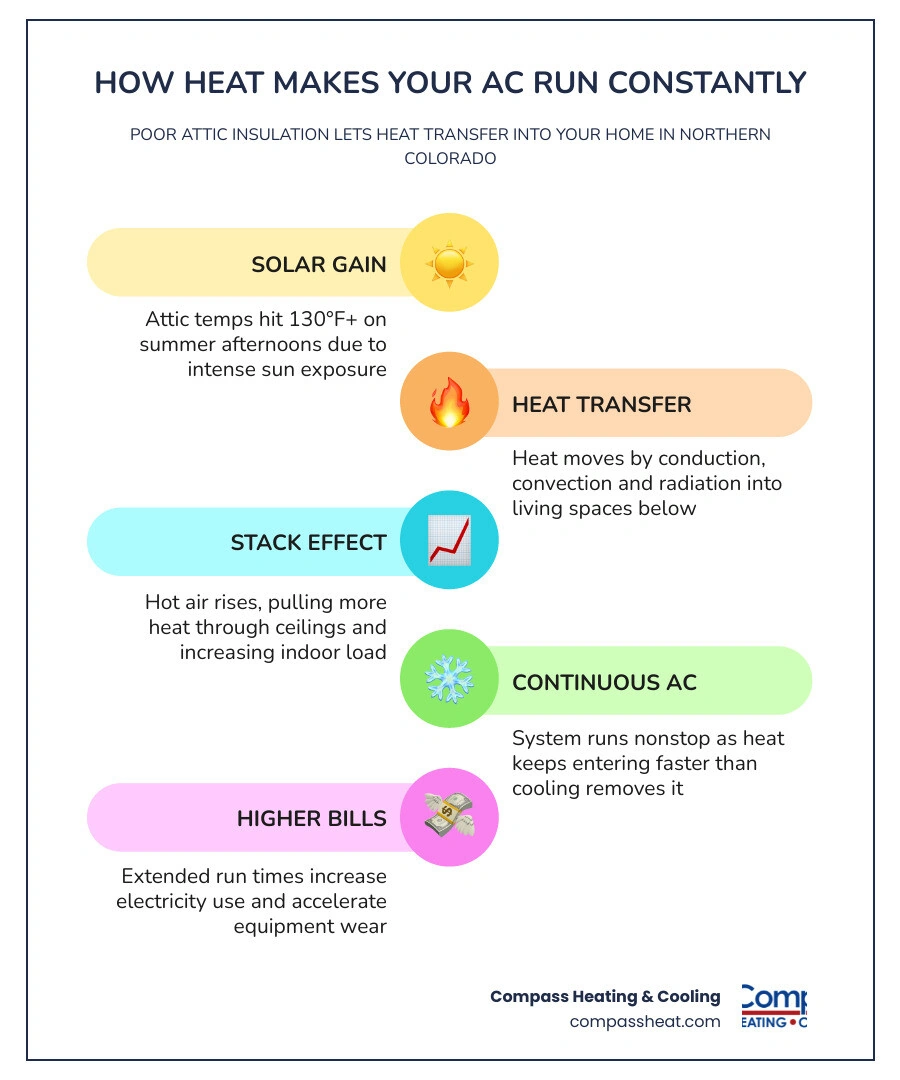
• Heat pours in from above. On a summer afternoon in Fort Collins or Loveland, your attic can reach 130°F or higher — even when outdoor temps are in the 90s. Without adequate insulation, that heat radiates straight down through your ceiling.
• Your AC can never catch up. The system cools the air, but heat keeps flooding back in. So it runs again. And again. And again.
• Energy bills climb. Longer run times mean more electricity consumed — often hundreds of dollars more per summer.
• Your system wears out faster. Continuous operation puts stress on the compressor and other components, shortening the life of your equipment.
• Northern Colorado makes it worse. The region's intense solar gain, high altitude, and dramatic daily temperature swings put extra pressure on homes with inadequate attic insulation compared to lower-elevation climates.
The good news: this is a diagnosable, fixable problem — and understanding it is the first step toward a cooler home and lower bills.
How Poor Attic Insulation Makes AC Run Constantly in a Northern Colorado Home
To understand why your Air Conditioning system won't stop running, we have to look at how our local climate interacts with your home's thermal envelope. Northern Colorado homes in cities like Fort Collins, Loveland, Windsor, and Greeley sit at elevations ranging from 4,500 to over 5,000 feet. At this altitude, the air is thinner, the sunshine is incredibly intense, and the solar heat gain on your roof is significantly higher than it would be at sea level.
During a typical summer afternoon, the sun beats down on your asphalt shingles, heating them up to 150°F or more. That heat is absorbed directly into your attic space. If your home has poor attic insulation, this massive reservoir of heat has an open invitation into your living areas.
To grasp how this cycle operates, it helps to understand How Does an Air Conditioner Work Anyway. Your air conditioner doesn't actually "create" cold air; instead, it removes heat from inside your home and transfers it outdoors. When your attic is poorly insulated, heat is entering your home faster than your AC can extract it. The thermostat senses that the indoor temperature is still above your target setting, so it signals the AC to keep running.
Because the heat source overhead is constant and intense, your AC is forced to run continuously just to prevent the indoor temperature from climbing, let alone cooling it down.
Why Poor Attic Insulation Makes AC Run Constantly in a Northern Colorado Home
The movement of heat through your attic and into your home occurs via three primary mechanisms:
• Conduction: This is heat transfer through direct contact. When your roof gets hot, it warms the rafters, joists, and drywall of your ceiling. Without a thick barrier of insulation to provide thermal resistance (measured as R-value), that heat conducts directly through the drywall and into your ceiling, warming the air in your bedrooms.
• Convection: This involves the movement of air. Hot air in your attic naturally wants to expand and find its way into cooler spaces. If your attic floor isn't properly air-sealed, hot attic air will seep through tiny gaps around recessed lights, electrical boxes, and plumbing stacks directly into your living space.
• Radiation: The hot underside of your roof deck radiates electromagnetic heat waves downward. This radiant heat warms up the joists, the attic floor, and any ductwork running through the attic space.
When these three forces combine in an under-insulated attic, the ceiling of your home essentially turns into a giant radiant heater. This forces your cooling system into a state of perpetual overdrive, which severely impacts the Average Lifespan of a Central Air Conditioner in a Hot Dry Front Range Climate. Instead of cycling on and off as designed, the compressor and fan motor run for hours on end, accelerating wear and tear and leading to premature system breakdown.
Signs Your Attic Insulation is Forcing Your AC to Work Overtime
Many homeowners assume that a constantly running AC unit simply means the cooling system is getting old or needs repair. While mechanical issues do happen, the root cause is frequently the building envelope itself. Here are the classic warning signs that your attic insulation is failing to protect your home from summer heat:
• The "Desert Lizard" Second Floor: If your home has a second story, is it noticeably hotter than the main floor? When attic insulation is thin, the rooms directly beneath the attic become incredibly warm, often feeling like a desert habitat by mid-afternoon.
• The AC Never Shuts Off During Peak Hours: If your air conditioner starts running at 11:00 AM and doesn't cycle off until 9:00 PM, your home is losing the battle against attic heat gain.
• Inconsistent Room Temperatures: You might find that rooms directly under a poorly insulated section of the attic are hot and sticky, while other areas of the house feel perfectly fine.
• Skyrocketing Energy Bills: If your utility bills in Fort Collins, Loveland, or Greeley spike dramatically in July and August compared to June, your AC is consuming excessive electricity due to long run times.
• Hot Ceilings to the Touch: If you can touch your second-story ceiling on a hot afternoon and it feels warm, heat is actively conducting into your home.
If you notice these signs, it is wise to consult our AC Repair vs Replace Decision Guide for Northern Colorado to evaluate whether your cooling system is struggling due to age or if your home's insulation is the real culprit. Additionally, scheduling a professional inspection or AC Service Fort Collins CO can help determine if a system tune-up or building envelope improvements are the most cost-effective path forward.
Diagnosing How Poor Attic Insulation Makes AC Run Constantly in a Northern Colorado Home
If you suspect your attic is the source of your cooling struggles, you can perform a preliminary DIY inspection before calling in the professionals. Here is a simple step-by-step guide to assessing your attic's current state:
1. Check the Insulation Depth: Grab a tape measure and safely peek into your attic hatch. If you can see the wooden floor joists, your insulation is definitely too thin. In Colorado, insulation should completely bury the joists.
2. Look for Settling and Compression: Over time, older loose-fill fiberglass or cellulose insulation can settle, pack down, or get displaced by wind blowing through soffit vents. Compressed insulation loses its thermal resistance.
3. Inspect for Air Leaks: Look around the attic hatch, recessed "can" lights, and plumbing pipes. If you see dark, dirty spots in fiberglass insulation near these areas, it means air is filtering through from the living space below, carrying heat and moisture with it.
4. Note the Insulation Type: Is it old, dusty fiberglass batts laid unevenly between joists? Or is it a thin layer of grey cellulose? Knowing what you have helps determine the best upgrade path.
5. Use a Simple Thermal Test: On a 90°F day, use an inexpensive infrared laser thermometer to measure the temperature of your second-floor ceiling. If the ceiling temperature is significantly higher than the room's air temperature, heat is radiating directly through your insulation.
Recommended Attic Insulation Standards for Northern Colorado
Northern Colorado falls into Climate Zone 5 according to the International Energy Conservation Code (IECC). Because of our cold winters and hot, high-altitude summers, the insulation standards here are strict.
The Department of Energy and local building codes recommend an attic insulation level of R-49 to R-60 for homes in our area.
To put that into perspective:
• R-49 requires approximately 14 to 18 inches of blown-in insulation, depending on the material.
• R-60 requires up to 20 inches of insulation.
Unfortunately, many homes built before 2005 in Windsor, Johnstown, and Loveland were insulated to older standards, often having only R-19 to R-30 (about 6 to 9 inches). Over the decades, this insulation settles and degrades, leaving homeowners with a fraction of the thermal protection they actually need.
• Blown-In Cellulose — R-Value per Inch: 3.2 – 3.8 — Pros: Excellent coverage, fills gaps around joists, great flow resistance — Cons: Can settle over time, heavy — Best Use Case: Existing attic retrofits in Colorado
• Blown-In Fiberglass — R-Value per Inch: 2.2 – 2.7 — Pros: Lightweight, won't settle, naturally fire-resistant — Cons: Requires a thicker layer to achieve R-60 — Best Use Case: Standard attics with irregular framing
• Fiberglass Batts — R-Value per Inch: 2.9 – 3.8 — Pros: Easy to install in open joists — Cons: Hard to fit around wiring/pipes, prone to gaps — Best Use Case: New construction with open, uniform cavities
• Spray Foam — R-Value per Inch: 3.5 – 6.5 — Pros: Seals air leaks and insulates in one step — Cons: High initial cost — Best Use Case: Conditioned attics or vaulted ceilings
Upgrading your attic insulation directly improves your HVAC Energy Efficiency. By slowing down the transfer of heat, your home stays cooler naturally, allowing your AC to cycle off regularly. If your current cooling system is old, undersized, or worn out from years of fighting an uninsulated attic, pairing an insulation upgrade with professional AC Replacement Fort Collins CO can slash your summer cooling costs by up to 40% while ensuring perfect comfort.
Frequently Asked Questions About Attic Insulation and AC Performance
How does attic ventilation prevent my AC from running constantly?
Attic ventilation is the partner of high-quality insulation. While insulation blocks heat from entering your living space, proper ventilation (using a balanced system of soffit intake vents and ridge exhaust vents) allows natural passive airflow to sweep hot, trapped air out of the attic.
Without proper ventilation, your attic becomes a pressurized heat box, reaching temperatures upwards of 140°F. This extreme heat eventually bypasses even good insulation. A well-ventilated attic stays within 10 to 20 degrees of the outdoor temperature, drastically reducing the thermal load on your insulation and your air conditioner.
Can poor attic insulation cause ice dams in the winter?
Yes, absolutely. The same poor insulation that makes your AC run constantly in July will cause ice dams in January.
In the winter, heat escapes from your living space through thin insulation and air leaks, warming the roof deck. This melts the snow on your roof. The meltwater runs down to the colder, uninsulated eaves, where it refreezes. This ice buildup creates a dam that traps water behind it, which can back up under your shingles, causing severe water damage to your ceilings, drywall, and structural framing.
Should I air seal my attic before adding new insulation?
Yes, air sealing is the single most important step in any attic insulation project. Adding new insulation over unsealed gaps is like putting a thick wool sweater on over a screen door—air will still blow right through it.
Air sealing involves using expanding foam and caulk to seal the invisible gaps around top plates, electrical wires, recessed light fixtures, chimney chases, and plumbing bypasses. This stops the "stack effect" (where conditioned air escapes into the attic) and prevents hot attic air and dust from being pulled down into your home during the summer.
Conclusion
When your air conditioner runs constantly without keeping your Northern Colorado home comfortable, the real problem is often hiding right above your head. Upgrading your attic insulation and sealing air leaks is one of the most effective ways to lower your energy bills, restore home comfort, and extend the lifespan of your cooling system.
At Compass Heating & Cooling, we specialize in whole-home comfort solutions for families in Fort Collins, Loveland, Windsor, Wellington, Severance, Timnath, Johnstown, Greeley, Berthoud, and Evans. We can help you diagnose whether your AC issues are due to mechanical wear or building envelope failures.
To keep your system running beautifully all year long, check out our Seasonal HVAC Maintenance Tips Calendar or learn more about our comprehensive AC Maintenance services. If your system is due for a professional checkup before the peak of summer, schedule an AC Tune Up Fort Collins CO with our friendly team.
Best of all, we handle utility rebates up to $8,000+ directly for our customers, and our exclusive maintenance plan offers priority service and generous discounts to keep your home comfortable and efficient. Schedule professional cooling services with Compass Heating & Cooling today to get your home's comfort back on track!
hear what our satisfied clients have to say
Our clients consistently praise our exceptional service and attention to detail. They appreciate the personalized approach we take to meet their unique needs, ensuring satisfaction every step of the way.
.png)