


The Complete Guide to Mini Splits vs Central AC Efficiency
Are Mini Splits More Efficient Than Central AC in a Hot Dry Front Range Climate?
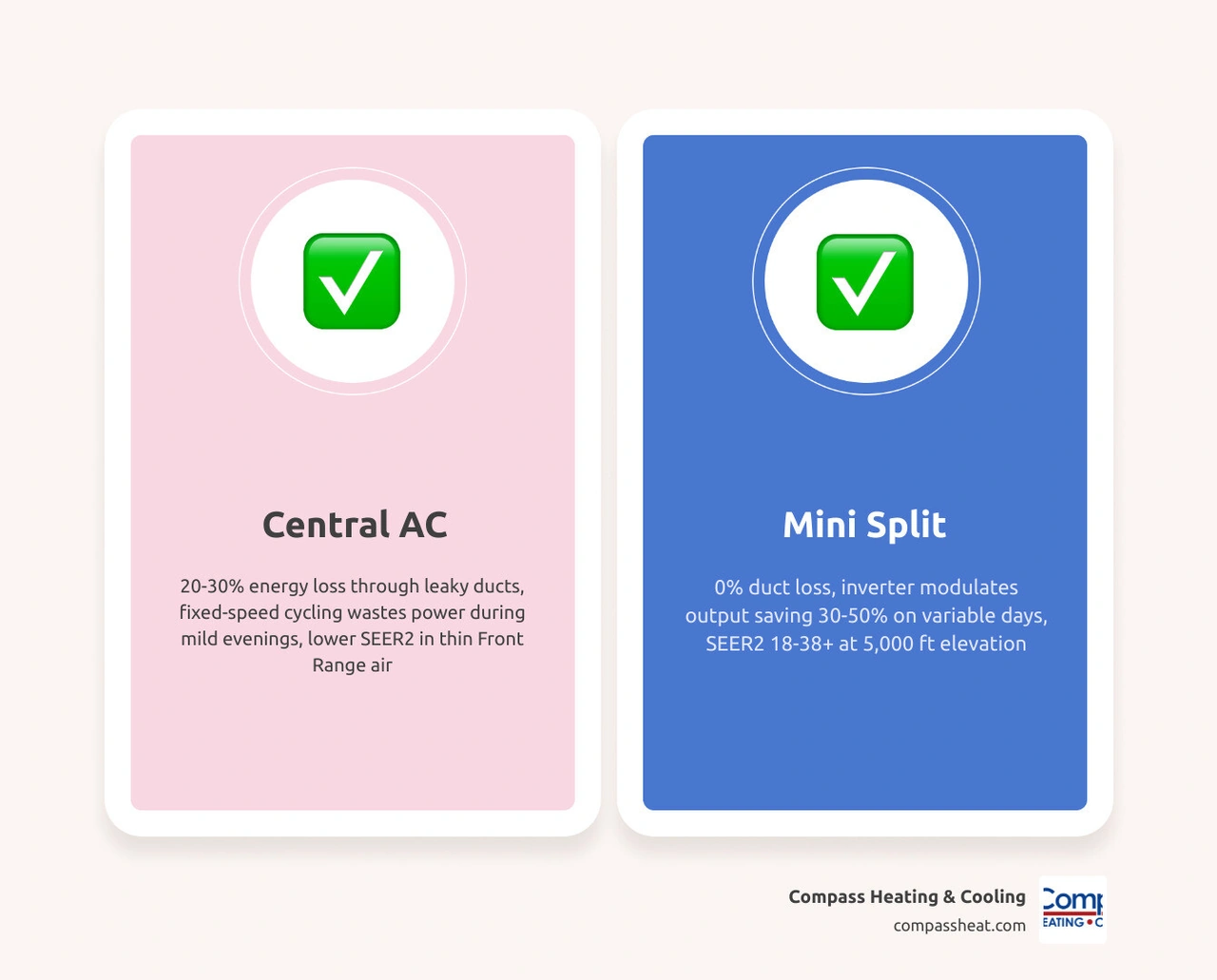
Are mini splits more efficient than central AC in a hot dry Front Range climate? Yes — in most cases, significantly so. Thanks to duct-free design and inverter-driven compressors, mini splits avoid the two biggest efficiency killers in traditional central AC: duct energy loss and constant on/off cycling.
Here's a quick breakdown:
• Duct losses eliminated: Central AC systems lose 20–30% of cooled air through leaky or poorly insulated ducts before it ever reaches a room. Mini splits deliver conditioned air directly.
• Higher efficiency ratings: Mini splits commonly achieve SEER2 ratings of 18–38+, while high-end central AC systems typically top out around 21–26 SEER2.
• Inverter technology advantage: Mini splits modulate their output continuously rather than cycling on and off, which matters especially during Colorado's wide daily temperature swings.
• Zoning benefit: You only cool the rooms you're actually using, reducing wasted energy throughout the day.
• Altitude consideration: At Front Range elevations, inverter-driven systems handle thinner air and variable load demands more efficiently than fixed-speed central units.
That said, if your existing ductwork is well-sealed and in good condition, a high-efficiency central system can still be a competitive option — particularly for whole-home cooling in newer builds.
The sections below go deeper on efficiency ratings, real-world energy costs, winter heating performance, and what actually makes the most sense for your specific home.

When evaluating HVAC Energy Efficiency along the Front Range, we have to look past standard manufacturer spec sheets and look at how these systems actually perform in our unique backyard. Northern Colorado sits at over 4,500 to 5,000 feet of elevation. Our summers are characterized by intense solar radiation, exceptionally low relative humidity, and rapid temperature swings where a 95°F July afternoon can plummet to a crisp 55°F by late evening.
Under these specific conditions, the question of whether are mini splits more efficient than central ac in a hot dry front range climate comes down to how each system handles heat transfer and air density.
In our thin, dry mountain air, standard air conditioners have to work harder. Because dry air holds less heat energy than humid air, and because low-density air at high elevations carries less mass per cubic foot, a cooling system must move a higher volume of air to achieve the same cooling effect. Traditional single-stage central AC units are notoriously bad at adapting to these subtle atmospheric shifts. They are either running at 100% capacity or they are completely off.
Mini splits, on the other hand, utilize advanced inverter-driven variable-speed compressors. Rather than operating on a binary "on/off" cycle, these systems constantly monitor outdoor and indoor conditions, adjusting their refrigerant flow and compressor speed in tiny increments. This continuous, precise modulation allows them to maintain incredibly high efficiency even when our dry climate demands rapid adjustments.
How Inverter Technology Answers: Are Mini Splits More Efficient Than Central AC in a Hot Dry Front Range Climate?
To understand why variable-speed operation is such a game-changer for Northern Colorado homes, it helps to look at how we use energy during a typical summer day. If you have ever wondered, How Does an Air Conditioner Work Anyway, the short answer is that it does not actually "create" cold; it removes heat from your indoor air and dumps it outside.
A traditional central AC compressor operates like a car in stop-and-go traffic. It guns the engine to maximum speed to cool the house down a couple of degrees, shuts off completely, waits for the house to warm back up, and then guns the engine again. This constant starting and stopping draws massive amounts of "inrush" electricity every time the system turns on.
An inverter-driven mini split operates more like a car cruising smoothly on Interstate 25. Once it brings your living room to your desired temperature, it ramps down its compressor speed to a low, steady hum—sometimes running at as little as 17% of its maximum capacity. It stays there, sipping just enough electricity to offset the heat entering through your windows.
In our hot, dry climate, this part-load efficiency is incredibly valuable. Because our evenings cool down so rapidly, a mini split can run at an ultra-low, highly efficient speed for most of the night, whereas a central AC would continue its inefficient cycle of hard starts and stops. This technology can lead to a 30% to 40% reduction in operational electricity consumption compared to older, fixed-speed units.
Eliminating Duct Loss: Why Are Mini Splits More Efficient Than Central AC in a Hot Dry Front Range Climate?
Even if you pair a central air conditioner with a highly efficient variable-speed blower, it still has to contend with the absolute biggest energy thief in residential HVAC: the duct system.
According to the U.S. Department of Energy and the EPA’s Energy Star program, typical home duct systems lose 20% to 30% of their conditioned air through leaks, poor insulation, or thermal bypass. When you route cold air through unconditioned, baking-hot spaces like an attic in Loveland or a crawlspace in Greeley, you are paying to cool spaces where nobody lives.
A Ductless Mini Split completely bypasses this issue. By delivering cold air directly from the indoor handler straight into your living space, mini splits start with a massive head start in efficiency. There are no leaky joints, no uninsulated sheet metal runs, and no opportunities for dust and dry mountain soil to infiltrate your ductwork. When you eliminate a 20% to 30% built-in energy penalty, your monthly utility bills reflect almost every single watt of electricity you pay for.
Real-World Energy Savings and Operating Costs in Colorado
When we talk to homeowners in Wellington, Severance, and Johnstown, the conversation always shifts from abstract efficiency ratings to real-world operating costs. How do these theoretical SEER2 differences translate to your monthly utility bill?
For homes currently relying on window AC units or baseboard electric resistance heat, upgrading to a multi-zone mini split is like trading a gas-guzzling heavy truck for a hybrid sedan. Window units are incredibly inefficient, noisy, and create drafty pathways for hot, dusty summer air to leak into your home. Replacing them with a whisper-quiet mini split not only dramatically lowers your summer electric bills but also restores your view and secures your windows.
The real magic of mini-split operating costs, however, lies in zoning control. With a traditional central system, if you want your upstairs master bedroom to be a comfortable 68°F for sleeping, you have to cool the entire house—including the unoccupied kitchen, basement, and guest rooms—to that same temperature. In multi-level homes common to Northern Colorado, this leads to massive energy waste as cold air naturally sinks to the basement while the upper floors bake under the summer sun.
Mini splits allow for true occupancy-based cooling. You can keep your home office cool during your remote work hours in Timnath, turn down the kitchen unit while you are cooking, and keep the unoccupied guest bedrooms completely switched off. By only conditioning the spaces you are actively using, you can achieve substantial monthly savings. To learn more about how these configurations look in practice, check out Why Mini Split Systems Are a Great Choice for Your Home.
Year-Round Performance: Heating Front Range Homes in Winter
While we often focus on summer cooling, mini splits are actually two-in-one heat pumps. This means they can reverse their refrigerant cycle in the winter to pull ambient heat from the outdoor air and pump it into your home. But can they handle a biting, sub-zero winter storm in Windsor or Berthoud?
Historically, early-generation heat pumps struggled when temperatures dropped below freezing, requiring expensive electric resistance backup heat to kick in. However, modern cold-climate mini splits are engineered specifically for harsh winter environments. Many advanced models maintain 100% of their heating capacity down to 5°F and continue to operate efficiently at outdoor temperatures as low as -15°F or even -22°F.
Because heat pumps transfer heat rather than creating it through combustion, they are incredibly efficient. A high-quality mini split can heat your home up to three times more efficiently than electric baseboards or wall heaters.
For many Northern Colorado homeowners, the ideal setup is a dual-fuel or hybrid system. If you already have a reliable natural gas furnace, you can keep it as a backup heat source for those rare, record-breaking sub-zero winter nights, while letting your highly efficient mini split handle the heating during our typical, sunny winter days. If you are wondering, Should Your Home Have a Heat Pump, the answer is almost always a resounding yes for both comfort and energy savings.
Thermal Comfort and Climate Challenges at High Altitude
Living along the Front Range means dealing with unique environmental factors that directly impact indoor comfort. Our dry air, high elevation, and heavy solar gain (especially on south- and west-facing windows) require a cooling system that can adapt quickly.
Here is how ductless mini splits and central air conditioning compare across key comfort metrics:
• Temperature Consistency — Central Air Conditioning: Can result in hot and cold spots, especially between different floors of tri-level or multi-story homes. — Ductless Mini Split Heat Pumps: Excellent. Each zone has its own thermostat to maintain precise, localized comfort.
• Noise Levels — Central Air Conditioning: Typically ranges from 50 to 75 decibels indoors near return vents and registers. — Ductless Mini Split Heat Pumps: Undisputed champions of quiet; indoor units operate at a whisper-soft 20 to 35 decibels.
• Humidity Control — Central Air Conditioning: Removes humidity during long cooling cycles, but can over-dry the air in already arid climates. — Ductless Mini Split Heat Pumps: Modulates fan speed and compressor output to maintain comfortable, balanced humidity levels.
• Air Distribution — Central Air Conditioning: Moves massive volumes of air through a single central point, which can stir up dust and allergens. — Ductless Mini Split Heat Pumps: Gentle, localized air movement with dedicated filtration in each room to catch fine dust.
• Aesthetics & Space — Central Air Conditioning: Invisible indoor footprint using hidden registers, but requires dedicated closet and duct space. — Ductless Mini Split Heat Pumps: Sleek wall-mounted, floor-mounted, or ceiling-recessed units visible in each zone.
Because our local climate is so dry, static electricity and airborne dust are constant battles. Central AC systems pull air from across the entire house into a single return, which can circulate allergens and dust throughout your living spaces.
Mini splits filter the air locally within each room. This localized filtration, combined with the whisper-quiet operation of modern Air Conditioning technology, creates a serene, clean, and incredibly consistent indoor environment.
Installation, Incentives, and Long-Term Value
Choosing between a mini split and a central AC system often comes down to your home's existing infrastructure. If your home in Evans or historic Fort Collins was built without ductwork (common in older homes with boiler-fed radiator heat), installing central air can be a massive undertaking. Retrofitting ducts requires cutting into plaster, lowering ceilings, and building dry-walled chases, which adds substantial labor time and disruption to your life. In these scenarios, a mini-split installation is the clear winner, requiring only a small, three-inch hole through an exterior wall to connect the indoor and outdoor units.
If you already have high-quality, well-sealed ductwork connected to a forced-air furnace, upgrading to a high-efficiency central AC or a ducted heat pump is often the most straightforward path. You can explore our AC Repair vs Replace Decision Guide for Northern Colorado to help weigh your options if your current system is on its last legs.
No matter which path you choose, 2026 brings some of the most generous financial incentives we have ever seen to help offset the transition to energy-efficient technology:
• Federal Tax Credits: Under the Inflation Reduction Act, qualifying cold-climate heat pump mini splits can qualify for federal tax credits up to $2,000, while traditional central AC systems are typically capped lower.
• Utility Rebates: Local municipal utilities like Fort Collins Utilities, Loveland Water and Power, and regional providers like Xcel Energy offer substantial rebates for installing certified high-efficiency heat pump systems.
• Resale Value: Homebuyers in Northern Colorado are increasingly eco-conscious. A professionally installed, multi-zone mini split system is viewed as a premium, green upgrade that can boost your home's market appeal and appraisal value.
At Compass Heating & Cooling, we don't believe in a one-size-fits-all approach. We custom-design every system to match the exact layout, solar exposure, and insulation levels of your home, ensuring you maximize every available rebate and tax credit.
Frequently Asked Questions about Front Range Cooling
Do mini splits work well in Colorado's dry climate?
Absolutely. In fact, they thrive here. Because our air is so dry, we don't have the heavy latent heat loads (humidity) found in the Midwest or South. This allows mini splits to focus almost 100% of their energy on sensible cooling (lowering the actual air temperature). Additionally, because mini splits run continuously at lower speeds, they provide steady, gentle air filtration that helps capture the fine dust and pollen common to our arid Front Range winds.
Can a mini split fully replace a central AC and furnace system?
Yes, modern cold-climate mini splits are fully capable of serving as your primary, whole-home heating and cooling source down to sub-zero temperatures. However, many Northern Colorado homeowners choose a hybrid approach: keeping their existing gas furnace for emergency backup heat during extreme winter cold snaps, while relying on the highly efficient mini split for all of their cooling and the vast majority of their seasonal heating.
How often do mini splits require maintenance compared to central air?
The primary difference is homeowner filter care. Because mini splits filter air locally, their smaller filters should be slid out and rinsed under a tap every 4 to 6 weeks to maintain optimal airflow and efficiency. Beyond that, both systems require an annual professional tune-up. Our priority maintenance plan is designed to make this worry-free, offering regular safety checks, coil cleanings, and exclusive discounts to keep your system running at peak efficiency for 15 to 20 years.
Conclusion
When it comes to keeping your home comfortable through our hot, dry summers and unpredictable winters, choosing the right system is all about matching technology to your lifestyle. Ductless mini splits offer unparalleled zoning flexibility, whisper-quiet operation, and industry-leading efficiency by completely eliminating duct losses. On the other hand, if your home already has a robust duct network, a high-efficiency central air system remains a reliable and cost-effective choice.
At Compass Heating & Cooling, we are proud to serve our neighbors across Fort Collins, Loveland, Windsor, Wellington, Severance, Timnath, Johnstown, Greeley, Berthoud, and Evans. We make upgrading your home comfort simple by handling all of your utility rebates—helping you secure up to $8,000+ in savings—and backing our work with a premium maintenance plan that gives you priority service when you need it most.
Ready to see how a high-efficiency system can transform your home's comfort and slash your utility bills? Schedule your consultation with Compass Heat today and let our friendly, local experts design the perfect cooling solution for your Northern Colorado home.
hear what our satisfied clients have to say
Our clients consistently praise our exceptional service and attention to detail. They appreciate the personalized approach we take to meet their unique needs, ensuring satisfaction every step of the way.
.png)