



Why AC Capacitors Fail Most Often in August and How to Spot the Warning Signs
The Late-Summer Breakdown: Why August is Peak Season for AC Component Failure
Late summer has officially arrived, and after running flawlessly through June and July, your cooling system might suddenly start struggling to keep up with the afternoon heat. Understanding why AC capacitors fail most often in August and how to spot the warning signs can mean the difference between a quick, minor fix and spending a week in a sweltering house waiting for major repairs. End-of-season breakdowns are rarely a matter of sudden bad luck. Instead, they are the predictable result of cumulative heat and electrical stress that builds up over months of continuous operation. The capacitor is simply the most vulnerable component to this prolonged wear and tear.
If you need immediate help restoring your home's comfort, you can rely on our comprehensive air conditioning services or schedule a professional AC repair today.
The Cumulative Effect of Continuous Operation
When the August / late-summer peak cooling season hits, your air conditioner has already logged hundreds of hours of heavy runtime. Every time your thermostat signals the system to turn on, a massive surge of electricity flows through the outdoor unit. Over the course of the early summer months, this constant cycling generates significant internal heat. While the system is designed to handle this, the microscopic wear on electrical components compounds day after day.
By the time late summer arrives, parts that were slightly worn in May have been pushed to their absolute limits. The capacitor, which acts as the electrical heart of the startup sequence, bears the brunt of this strain. Recognizing the early symptoms of electrical fatigue allows you to address the problem before the component gives out entirely, saving the rest of your cooling system from catastrophic damage.
Understanding the AC Capacitor: The Battery That Jumpstarts Your Cooling
To understand why a late-summer breakdown happens, you first need to understand what this small but critical component actually does. You can think of an AC capacitor as a high-powered, rechargeable battery that delivers a massive, instantaneous jolt of electricity to jumpstart your system. Your air conditioner relies on heavy mechanical parts—specifically the compressor and the outdoor fan motor—which require an enormous amount of torque to overcome inertia and begin spinning.
Your home's standard electrical grid cannot provide this sudden burst of power all at once. The capacitor stores energy during the off-cycle and releases it in a fraction of a second when the thermostat calls for cooling. It provides three to five times the standard running amps required to get those heavy mechanical parts moving. Without this initial kick, the motors simply cannot start the cooling cycle.
The Anatomy of Stored Energy
Inside the metal casing of a capacitor, you will find layers of metallic foil separated by a specialized dielectric fluid and heavy insulation. This internal structure is what allows the component to store and discharge energy so rapidly and efficiently. In a place like Loveland CO, where cooling systems cycle on and off frequently throughout the day, the capacitor must perform this high-voltage discharge perfectly every single time.
• System Startup — Power Requirement: Very High (3x to 5x normal amps) — The Capacitor's Role: Discharges stored energy instantly to overcome motor inertia.
• Continuous Running — Power Requirement: Moderate (Standard running amps) — The Capacitor's Role: Maintains a smooth, even flow of electrical current to the motors.
• System Off-Cycle — Power Requirement: Zero — The Capacitor's Role: Draws power from the grid to recharge for the next cycle.
Because the internal anatomy relies on liquid and thin insulation to hold a charge, it is highly sensitive to external conditions. When the internal environment degrades, the component loses its ability to store that crucial startup energy, leaving your heavy mechanical parts stranded without the power they need to move.
How Cumulative Thermal Stress Bakes Internal Electrical Components
Heat is the natural enemy of all electrical components, and your outdoor condenser unit sits right in the middle of a brutal environment. The capacitor endures a punishing combination of ambient outdoor heat from the sun and internal operational heat generated by the electrical current flowing through it. When you combine these two heat sources, the internal temperature of the component can skyrocket.
Loveland's intense, dry summer heat forces longer, harder cooling cycles. Because the air is hot and dry, the system has to run for extended periods to bring the indoor temperature down. This extended runtime compounds the internal operational heat that actively degrades the capacitor. Over the course of the summer, this continuous baking effect breaks down the internal dielectric fluid and dries out the insulation.
The Drop in Microfarads
As the internal fluid breaks down, the capacitor loses its ability to hold a full electrical charge. The measurement of this storage capacity is called a "microfarad." When a capacitor is healthy, it outputs a very specific microfarad rating designed precisely for your compressor motor. As thermal stress bakes the component during the August / late-summer peak cooling season, that microfarad rating begins to drop.
When the output drops below the acceptable tolerance range, the capacitor can no longer deliver the massive jolt of electricity required for startup. This leads to irregular cooling cycles, severe system strain, and situations where your AC keeps turning on and off without properly cooling the home. The degradation is a slow process that accelerates rapidly once the late-summer heatwaves hit, which is why breakdowns seem to happen all at once.
How to Spot the Warning Signs of a Failing Capacitor
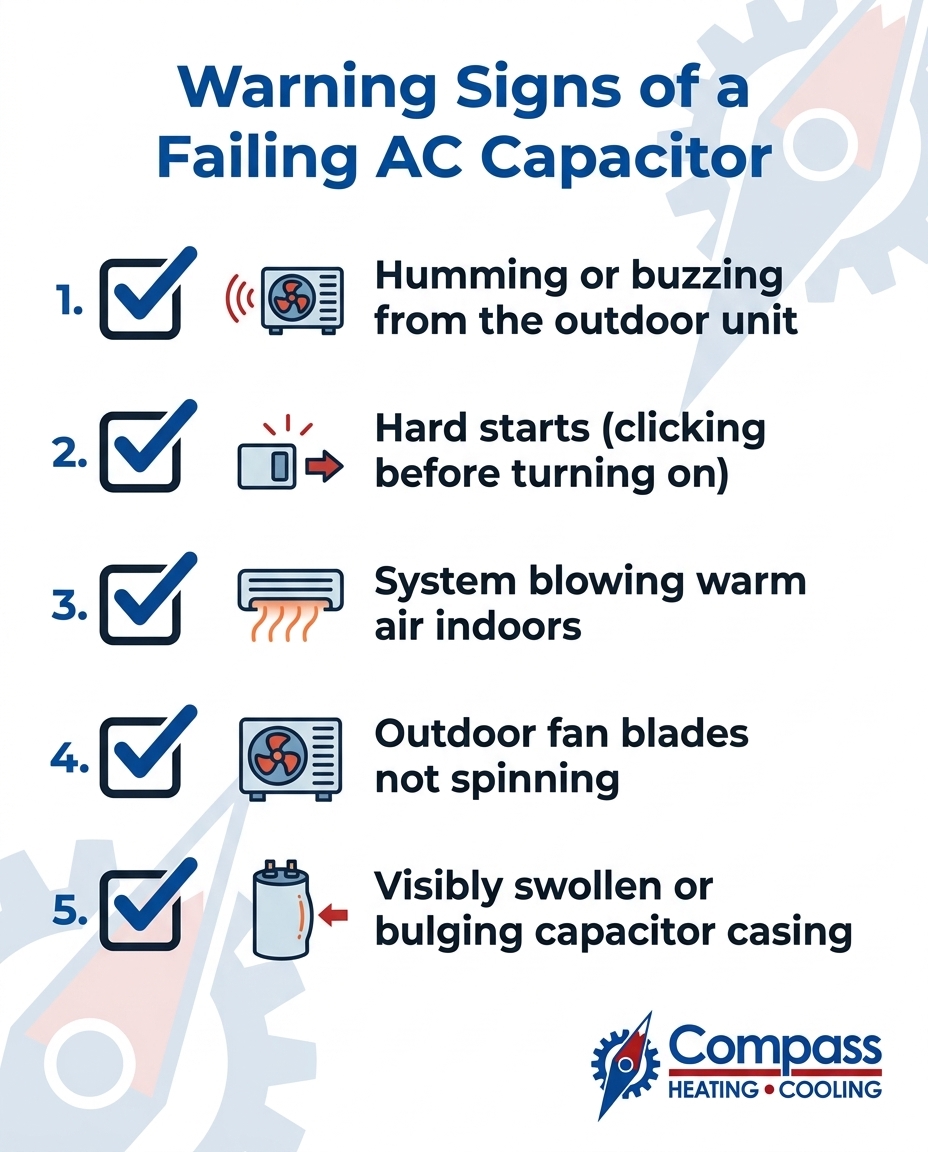
Because a capacitor degrades gradually before it fails completely, it usually gives off several warning signs. Catching these symptoms early can save you from a total system breakdown during the hottest days of the year. If you live in Loveland CO and notice any of the following behaviors from your outdoor unit, your capacitor is likely struggling to hold a charge:
• Humming from the condenser unit: If you hear a loud humming or buzzing sound coming from the outdoor unit, the motor is trying to start but isn't getting the necessary electrical jolt. It is receiving power from the grid, but without the capacitor's boost, it is physically stuck.
• Hard starts or clicking noises: You may notice that the system struggles noticeably, stutters, or makes a clicking sound before the fan finally spins. This hesitation means the capacitor is weak and barely has enough stored energy to overcome the motor's inertia.
• AC blowing warm air indoors: The indoor blower fan operates on a separate electrical circuit. If the indoor fan is running and circulating air, but that air is warm, it often means the outdoor compressor hasn't engaged because the capacitor failed to start it.
• Outdoor fan not spinning: You might hear the compressor running, but the outdoor fan blades remain completely stationary. Some capacitors are "dual-run," meaning they start both the compressor and the fan; if the fan side fails, the blades won't move.
• Swollen top on the casing: If you can see the silver, cylindrical capacitor through the grilles of your outdoor unit, look at the top where the wires connect. A healthy casing is perfectly flat. If the top looks mushroomed, domed, or bulging, internal pressure from heat has physically ruptured the component.
Why Ignoring a Weak Capacitor Leads to Catastrophic Compressor Failure
It can be tempting to ignore a hard start or a slight humming noise if your home is still eventually cooling down. However, ignoring a weakened capacitor is one of the most expensive mistakes a homeowner can make. The capacitor and the compressor are intimately linked; when one struggles, the other suffers immediately.
A weakened capacitor forces the compressor to pull harder on the incoming electrical current to compensate for the lack of startup energy. Because it isn't getting the clean, powerful jolt it expects, the compressor motor has to run hotter and work significantly harder just to turn on. This excessive strain causes the compressor to overheat rapidly during the August / late-summer peak cooling season.
The Domino Effect of Electrical Strain
As the compressor overheats, the protective insulation around its internal copper windings begins to melt and degrade. If the compressor pulls too much current for too long, it will eventually burn out its own windings, resulting in a dead short. At this point, the compressor is completely ruined and must be replaced—a repair that is vastly more complex and disruptive than a simple electrical component swap.
This is the classic domino effect of HVAC failure: a relatively simple, easily addressed electrical component failure quickly cascades into a total system death if left unchecked. Catching the problem early and scheduling professional AC repair in Loveland saves the core mechanics of your cooling system. Addressing a weak microfarad reading today protects the heavy, expensive mechanical parts that keep your home comfortable.
The Hidden High-Voltage Dangers: Why Capacitor Replacement is Not a DIY Project
With so many tutorials available online, some homeowners are tempted to open their outdoor condensing unit and attempt to replace a bulging capacitor themselves. This is an incredibly dangerous idea. Capacitors are specifically designed to store massive amounts of electricity. This means they can deliver a lethal electrical shock even long after the main power has been completely shut off at the breaker panel.
Turning off the disconnect switch does not empty the energy stored inside the metal cylinder. Discharging that stored energy safely requires specialized, insulated tools, a thorough understanding of high-voltage grounding, and professional training. Without the right equipment, a simple slip of a screwdriver can result in severe injury.
The Risk to Your Equipment
Beyond the severe personal safety risks, attempting a DIY replacement puts your entire cooling system in jeopardy. Capacitors are not one-size-fits-all components. Every compressor requires a specific microfarad rating and voltage tolerance to operate safely.
• Installing a lower microfarad rating — The Consequence to Your System: The compressor won't have enough power to start, causing it to stall, overheat, and quickly burn out its internal windings.
• Installing a higher microfarad rating — The Consequence to Your System: The motor receives too much current, causing it to run too fast and too hot, drastically shortening the lifespan of the equipment.
• Incorrect wiring connections — The Consequence to Your System: Reversing the hermetic and fan terminals will instantly short out the motors, requiring a total system replacement.
In Loveland CO, where reliable cooling is a necessity during the late summer, risking your compressor to save a few minutes on a DIY fix is never worth it. Always rely on a licensed professional for any internal electrical diagnostics, testing, or replacements to ensure your system remains safe and functional.
Catching the Drop in Microfarads Before Total System Failure
The best way to handle a blown capacitor is to never let it blow in the first place. Because capacitors rarely fail instantly, their microfarad output drops gradually over the course of the season. This gradual decline leaves a measurable trail of evidence that a trained expert can easily track before the component completely fails.
Professional technicians use specialized, high-precision multimeters to measure this exact output during routine check-ups. By tracking these readings, experts can identify a capacitor that is operating outside of its safe tolerance range long before it causes a hard start or a humming condenser. This is where Compass Heating & Cooling's thorough diagnostic approach makes all the difference. Our technicians meticulously check microfarad levels during every visit, ensuring we catch weakened components before a late-summer heatwave causes a total breakdown.
Replacing a weakened electrical component proactively ensures uninterrupted comfort through the hottest weeks of the year. You don't have to wait for your system to fail during the August / late-summer peak cooling season. By scheduling routine AC maintenance, you gain the peace of mind that comes from knowing every wire, motor, and electrical charge has been verified by a licensed professional, keeping your home consistently cool when you need it most.
Frequently Asked Questions
Why do AC capacitors fail in hot weather?
AC capacitors fail in hot weather because they are subjected to a compounding mix of high ambient temperatures and intense operational heat. As the system runs longer to combat the summer heat, the internal dielectric fluid inside the capacitor begins to bake and break down. Over time, this thermal stress reduces the component's ability to store the electrical charge needed to start the compressor.
What happens when an AC capacitor goes bad?
When an AC capacitor goes bad, it can no longer deliver the massive jolt of electricity required to jumpstart the heavy compressor and fan motors. The system will attempt to turn on, but without that initial power boost, the motors will stall, hum, and quickly overheat. If left running in this state, the lack of startup power can cause the compressor to burn out completely.
How do I know if my AC capacitor is blown?
You can often tell if an AC capacitor is blown by listening for a loud humming or clicking noise coming from the outdoor unit while the fan blades remain completely still. Additionally, you might notice the indoor vents blowing warm air because the outdoor compressor hasn't engaged. In some cases, you can physically see that the top of the silver capacitor casing has become swollen, domed, or mushroomed from internal heat pressure.
Can an AC run with a bad capacitor?
No, an air conditioner cannot properly run with a bad capacitor. While the indoor blower fan might still circulate air through your vents, the outdoor condenser unit will fail to start the cooling cycle. Attempting to force the system to run with a failed capacitor will put immense electrical strain on the compressor, leading to severe and permanent mechanical damage.
Why is it dangerous to replace an AC capacitor yourself?
It is incredibly dangerous to replace an AC capacitor yourself because the component is designed to store massive amounts of high-voltage electricity. Even after you have completely shut off the power at the main breaker panel, a capacitor can still hold a lethal electrical charge. Discharging this energy safely requires specialized insulated tools and professional training that only licensed HVAC technicians possess.
hear what our satisfied clients have to say
Our clients consistently praise our exceptional service and attention to detail. They appreciate the personalized approach we take to meet their unique needs, ensuring satisfaction every step of the way.
.png)