


Why Variable-Speed ACs Outperform Single-Stage Units During Late Summer Humidity
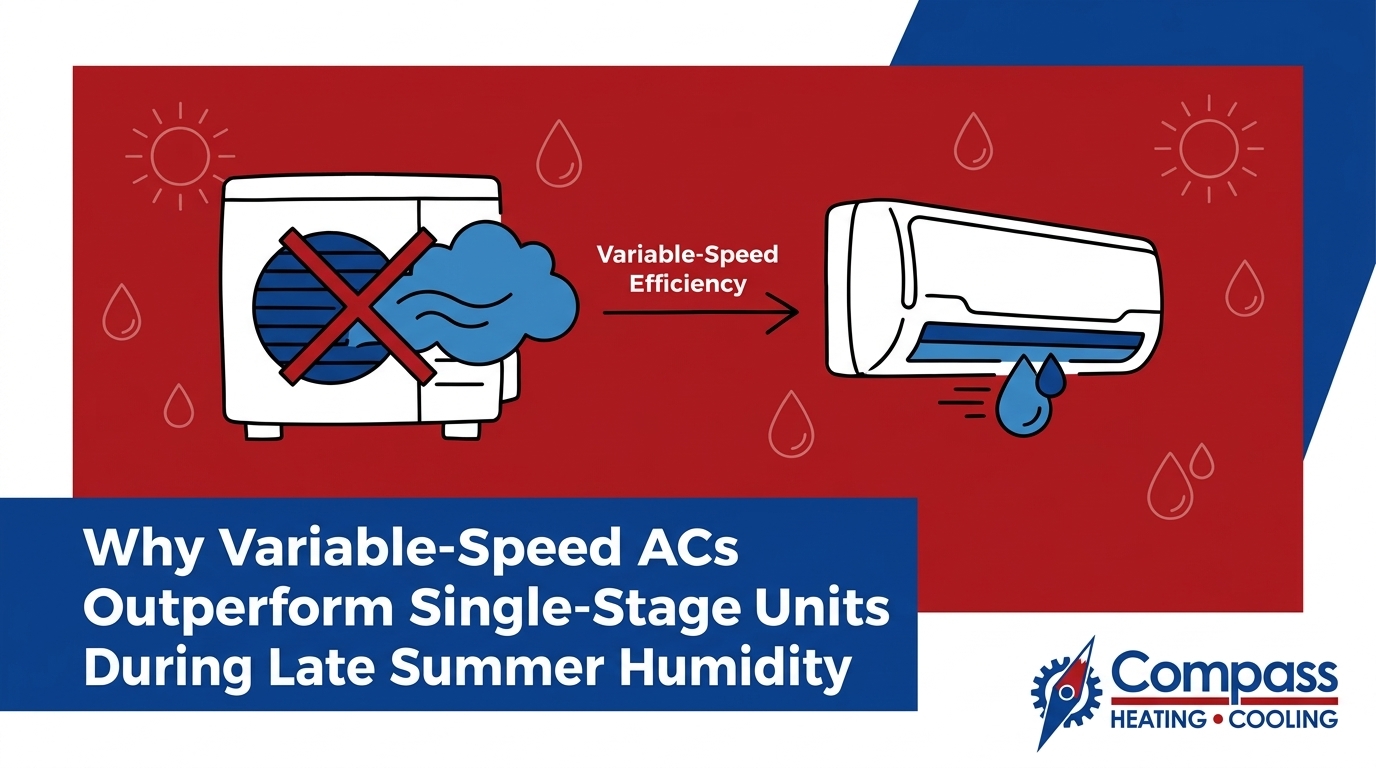
The Myth of "Colder is Better" When Humidity Strikes
As the back-to-school transition begins and we face heavy end-of-season cooling demands, our technicians at Compass Heating & Cooling frequently hear the same complaint. If you want to know exactly why variable-speed ACs outperform single-stage units during late summer humidity, the answer begins by busting a very common myth: dropping the thermostat temperature does not automatically make a muggy room feel more comfortable. Cranking your air conditioner down to 68 degrees when the air is thick with moisture usually just leaves you shivering in a cold, damp environment. This happens because true indoor comfort requires two distinct actions from your HVAC equipment: lowering the air temperature and extracting airborne moisture. When your system fails to do the latter, your home ends up feeling like a cold swamp.
You have likely experienced this physical sensation during the heavy August late-summer humidity. Your skin feels sticky, your floors might feel slightly slick, and the air feels heavy in your lungs, even though the thermostat insists the room is perfectly cool. This clammy feeling is a direct result of excess moisture remaining trapped inside your living space. When you reach the point of deciding how to fix this recurring comfort issue, you face a critical decision. In our experience helping Loveland homeowners, we always recommend evaluating whether upgrading to advanced variable-speed technology is the right solution for your home, rather than simply replacing your current equipment with another basic single-stage unit.
To help you navigate this choice, our team has put together a detailed breakdown of how different compressor types handle moisture. For a broader look at upgrading your home's central cooling, explore our comprehensive guide to air conditioning systems.
How Single-Stage Air Conditioners Mishandle Moisture
To understand why your house feels so clammy, you have to look at the mechanical limitations of a traditional single-stage compressor. A single-stage air conditioner is the most common type of cooling system our team encounters in older Loveland area homes. The term "single-stage" means the compressor only has one speed setting: 100 percent capacity. When your thermostat detects that the room has grown too warm, it sends a signal to the air conditioner to turn on. The system instantly kicks into high gear, blasting maximum cold air into your ductwork until the target temperature is reached. Once the thermostat is satisfied, the system abruptly shuts completely off.
The Problem of Short-Cycling
This all-or-nothing approach creates a significant problem during muggy weather, a phenomenon known as short-cycling. Because the system is blowing air at full blast, it often cools the physical air in the room very rapidly. The thermostat registers the temperature drop and shuts the system down after just ten or fifteen minutes. However, it takes significantly longer than fifteen minutes for an air conditioner to extract humidity from the air.
The extraction process: Inside your indoor unit, there is a component called the evaporator coil. This coil gets extremely cold when the system runs. As warm, moist indoor air blows across this cold coil, condensation forms on the metal fins—exactly like water droplets forming on the outside of a cold glass of ice water on a hot day. That condensation drips into a pan and drains outside, effectively removing humidity from your home.
When a single-stage system cools the room too quickly and shuts off, the air simply does not spend enough time passing over the evaporator coil. The moisture never gets a chance to condense. The result is a room that is technically cold, but still loaded with humidity. While excessive short-cycling can sometimes point to a mechanical failure requiring professional AC repair, our service calls during sticky weather often reveal it is just a frustrating limitation of single-stage technology.
The Mechanics of Variable-Speed Dehumidification
Variable-speed technology takes a completely different mechanical approach to cooling your home. Instead of operating on a simple "on" or "off" binary, a variable-speed compressor features an advanced inverter-driven motor. This allows the system to adjust its cooling output in tiny increments, matching the exact demands of your home at any given moment. Rather than always blasting at 100 percent capacity, a variable-speed unit can ramp down and operate at 30, 40, or 50 percent capacity.
This ability to run at lower speeds introduces a concept called "coasting." When the August late-summer humidity spikes just as the kids head back to school, your variable-speed system recognizes the need for moisture removal. It lowers its compressor speed and slows down the indoor blower fan. This creates a long, gentle, and continuous cooling cycle.
The Four Steps of Continuous Moisture Extraction
By running longer cycles at lower speeds, variable-speed systems excel at wringing out indoor moisture. Here is exactly how that process unfolds inside your ductwork:
1. Extended Coil Contact: Because the blower fan is moving air more slowly, the humid indoor air spends much more time in direct physical contact with the freezing cold evaporator coil.
2. Continuous Condensation: The longer the system runs, the more time condensation has to form on the coil. Instead of a quick ten-minute blast, the system might run gently for forty-five minutes, pulling moisture out of the air the entire time.
3. Steady Drainage: The extracted water constantly drips into the condensate pan and flows out of your house, steadily dropping the indoor relative humidity.
4. Temperature Precision: Because the system is only delivering a small amount of cooling capacity, it avoids dropping the room temperature too far, keeping you comfortable without freezing you out.
This continuous, low-and-slow operation is the secret to true indoor comfort. It treats the air conditioning system as a dedicated dehumidifier that also happens to cool the air, rather than just a cold air delivery machine.
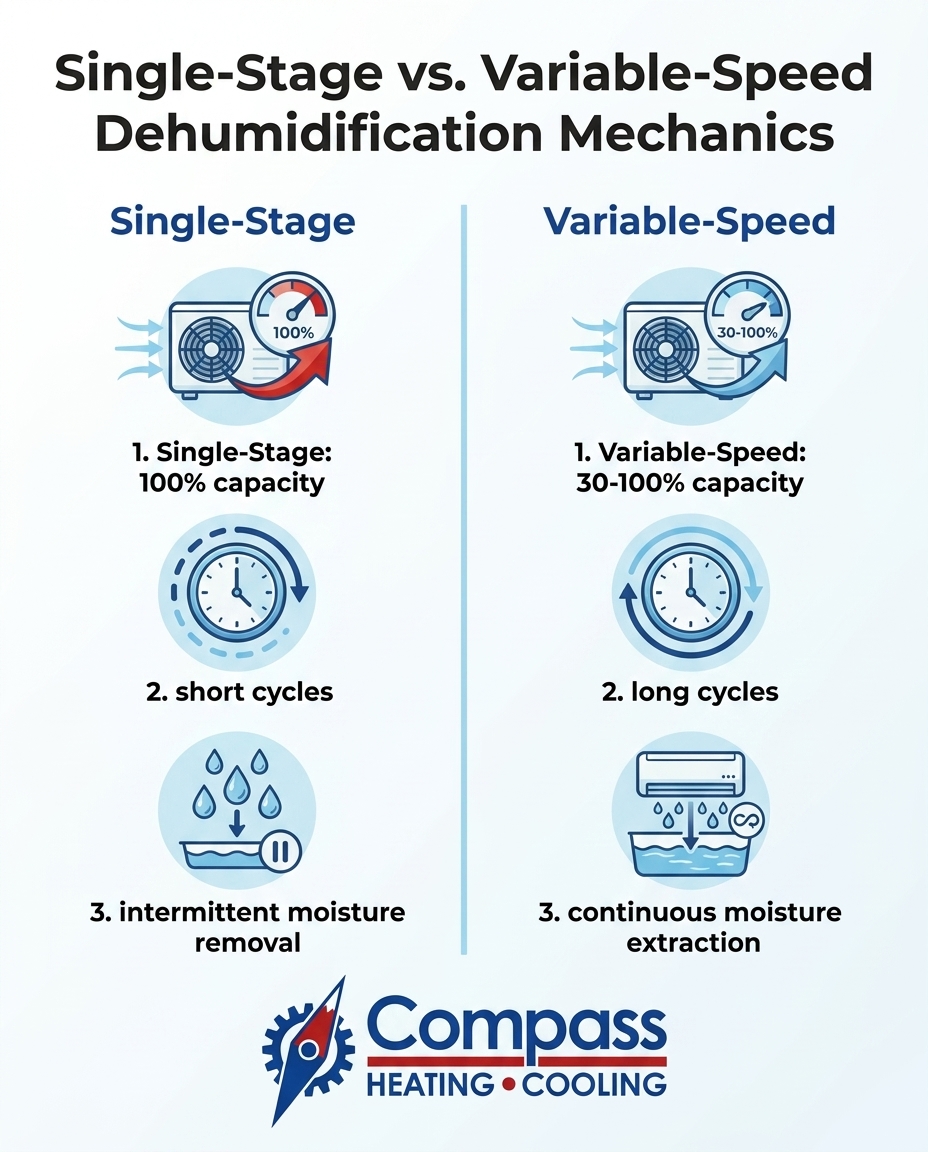
Side-by-Side: Single-Stage vs. Variable-Speed Performance
When you are evaluating your options for a home upgrade, seeing the differences laid out clearly can help you make an informed decision. While both systems will ultimately lower the temperature on your thermostat, the way they get there—and the resulting comfort in your living room—varies wildly. Many Loveland area homes still rely on single-stage units, but our installers are seeing homeowners increasingly recognize the vast comfort gap between the two technologies.
If you are currently comparing top AC replacement options, you need to look beyond just the brand name and focus heavily on the compressor type. The table below breaks down exactly how these two systems perform across the three most critical categories for homeowner comfort: moisture removal, temperature consistency, and energy usage.
• Moisture Removal — Single-Stage Compressor: Intermittent. Short cycles prevent the coil from extracting enough water, leaving the air feeling clammy and heavy. — Variable-Speed Compressor: Continuous. Long, slow cycles maximize condensation time, constantly wringing humidity out of the indoor air.
• Temperature Consistency — Single-Stage Compressor: Noticeable swings. The house gets very cold while running, then noticeably warm before the system kicks back on. — Variable-Speed Compressor: Precise and even. The system constantly supplies just enough cooling to hold the exact temperature you set on the thermostat.
• Energy Usage Profile — Single-Stage Compressor: High-draw spikes. Requires a massive surge of electricity every time the system starts up from a dead stop. — Variable-Speed Compressor: Low-draw continuous. Uses very little electricity to maintain a slow, steady coast, avoiding heavy startup surges.
Pros and Cons of the Upgrade
Every equipment decision involves weighing benefits against upfront considerations. Here is a straightforward look at the pros and cons of moving to variable-speed technology.
• Pro: Superior Comfort. You eliminate hot and cold spots throughout the house and finally get rid of that sticky, damp feeling in late summer.
• Pro: Quieter Operation. Because the system rarely runs at 100 percent capacity, you avoid the loud "clunk" and roaring fan noise associated with traditional AC startups.
• Pro: Better Air Filtration. Since the fan runs almost continuously at a low speed, your indoor air is constantly being pulled through your HVAC filter, capturing more dust and allergens.
• Con: Initial Investment. Variable-speed units feature highly advanced inverter technology, meaning they require a larger upfront investment compared to basic single-stage models.
• Con: Complex Repairs. The advanced electronics and sensors require highly trained technicians for diagnostics and servicing, making proper professional installation critical.
Why Front Range Weather Demands Adaptable Cooling
Understanding the mechanical differences is only half the equation; you also have to factor in the environment where the equipment operates. The climate along the Front Range is highly unique and constantly shifting. In early June, the weather is typically characterized by dry, intense heat. A standard air conditioner sized for these dry conditions might perform adequately because humidity simply is not a factor yet.
However, as the summer progresses, the weather pattern changes drastically. By the time we reach the August late-summer humidity, Northern Colorado frequently experiences monsoonal moisture spikes. Afternoon thunderstorms roll over the foothills, dumping rain and leaving behind heavy, muggy, stagnant air. Suddenly, that standard "dry-climate" single-stage air conditioner struggles. It cools the house down rapidly, shuts off, and leaves all that new monsoonal moisture trapped inside your living room.
This drastic swing in weather conditions is exactly why adaptable capacity is so important. You need a cooling system that can ramp up to 100 percent to fight off a 95-degree dry heatwave in July, but can also throttle down to 40 percent to gently pull moisture out of the air during a damp, 80-degree afternoon in late August. As a locally owned Northern Colorado HVAC expert, Compass Heating & Cooling understands exactly how to match advanced AC technology to these unique temperature and humidity swings of the Front Range. We know from daily field experience that standard, out-of-the-box sizing calculations often fail to account for these late-season moisture spikes, which is why we prioritize adaptable, variable-speed solutions for true local comfort.
Efficiency Gains and Long-Term Energy Management
Beyond the immediate physical comfort of breathing drier air, upgrading your cooling technology has significant implications for how your home consumes energy over the next fifteen years. It is a common misconception that an air conditioner running continuously will drive your utility bills through the roof. With variable-speed technology, the exact opposite is true.
Think about driving a vehicle on the highway. If you constantly slam on the gas to reach 70 miles per hour, then slam on the brakes to a dead stop, you will burn through gas incredibly fast. If you gently accelerate to 55 miles per hour and set the cruise control, you use a fraction of the fuel. Single-stage compressors are the stop-and-go drivers of the HVAC world. Every time they start up, they require a massive surge of electricity to get the heavy compressor motor turning. A variable-speed unit, however, acts like cruise control. It uses a very small amount of electricity to maintain a slow, steady coast, completely avoiding those massive, expensive power spikes.
Incentives and Upkeep
Because these systems are so highly efficient at managing electricity, they are heavily favored by energy programs. Our installation teams often remind customers that qualifying high-efficiency variable-speed installations may be eligible for federal tax credits or local utility incentives, which can help offset the initial investment of the equipment. We always recommend checking with your utility provider or a tax professional to see what generic efficiency programs are currently active in your area.
Of course, protecting this advanced technology requires consistent upkeep. The sensors, inverter boards, and evaporator coils in a variable-speed unit must be kept incredibly clean to maintain peak dehumidification performance. A dirty coil cannot extract moisture effectively, no matter how advanced the compressor is. Keeping your system enrolled in a routine maintenance plan ensures that your high-efficiency equipment continues to pull moisture and save energy in Loveland area homes for years to come.
Frequently Asked Questions About AC Upgrades and Humidity
Why does my house feel cold but humid with the AC on?
Your house feels cold but humid because your air conditioner is cooling the physical air much faster than it can extract the airborne moisture. Single-stage units blast cold air at maximum capacity, satisfying the thermostat and shutting down before the evaporator coil has time to pull condensation out of the air. This leaves the relative humidity high, making your skin feel clammy even at lower temperatures.
Does a variable speed AC remove more humidity?
Yes, a variable-speed AC removes significantly more humidity than a standard unit. By running longer, gentler cooling cycles at lower speeds, it allows the indoor air to spend much more time passing over the cold evaporator coil. This continuous contact ensures a steady stream of condensation, constantly pulling moisture out of your home's air.
How do I fix a clammy house in the summer?
To fix a clammy house, you need to address the moisture removal capabilities of your HVAC system. Our technicians find the most effective long-term solution is upgrading to variable-speed equipment that can continuously dehumidify without overcooling the space. Alternatively, if your current AC is relatively new, you might consider having a professional install a whole-home dehumidifier directly into your ductwork.
Is a variable speed air conditioner worth the upgrade?
For homeowners struggling with muggy indoor air, a variable-speed air conditioner is absolutely worth the upgrade. It provides a perfect balance of improved indoor comfort, precise temperature control, and exceptional moisture management. Additionally, the long-term energy efficiency gained from avoiding heavy electrical startup spikes adds lasting value to the investment.
Can a single-stage unit be modified to run longer?
No, a single-stage unit cannot be modified or rewired to operate like a variable-speed system. Single-stage compressors are mechanically limited to running strictly at 100 percent capacity and cannot be converted to run at lower speeds. While a technician can ensure it is running as efficiently as possible, the fundamental short-cycling nature of the technology cannot be changed.
Secure True Indoor Comfort With the Right Technology
When you understand why variable-speed ACs outperform single-stage units during late summer humidity, it becomes clear that true indoor comfort is about much more than just a number on a thermostat. You need a system that actively manages both the temperature and the moisture levels in your home simultaneously. Continuing to battle clammy air with outdated, single-stage equipment will only lead to further frustration as the late-summer monsoons roll through Loveland area homes.
Do not spend another season shivering in a cold, sticky living room. If you are ready to experience the quiet, continuous, and perfectly balanced comfort that advanced cooling technology provides, it is time to take action. Reach out to book a professional assessment and schedule your AC installation today. Our team at Compass Heating & Cooling will help you find the exact variable-speed solution needed to secure total comfort for your home.
hear what our satisfied clients have to say
Our clients consistently praise our exceptional service and attention to detail. They appreciate the personalized approach we take to meet their unique needs, ensuring satisfaction every step of the way.
.png)