



Window Units vs Emergency Central AC Repair: Stop-Gap Measures for Late Summer
Facing a Late Summer AC Breakdown: The Friday Afternoon Dilemma
What do you do when your cooling system fails right as the weekend begins, leaving you staring at a blank thermostat while the house heats up? When faced with a sudden breakdown, weighing Window Units vs Emergency Central AC Repair: Stop-Gap Measures for Late Summer becomes a critical decision for homeowners trying to maintain comfort. It is late August, the back-to-school transition is in full swing, and a Friday afternoon air conditioning failure is the last disruption your household needs. The immediate reaction is often panic, followed by a rush to figure out how to survive the weekend heat.
The central dilemma usually boils down to two options: rushing to a big-box hardware store to purchase a temporary window unit, or picking up the phone to book an immediate after-hours repair call. Both paths have their merits, but the right choice depends heavily on the lifecycle of your cooling equipment and the logistical realities of weekend service, rather than just the immediate urge to cool down the living room. Making a strategic choice requires stepping back and evaluating the actual severity of the breakdown.
If you need immediate professional guidance on restoring your home's comfort, you can rely on our comprehensive central air conditioning services to find the right path forward.
The Reality of Weekend Parts Availability for Older Systems
Most homeowners do not realize that the HVAC industry operates on a specialized supply chain that largely shuts down over the weekend. When your system fails on a Saturday afternoon during late August end-of-season cooling, the technician arriving at your door is working with the inventory currently stocked on their service truck. While many common components like capacitors, contactors, and standard fuses are always kept on hand, more complex or proprietary parts require a trip to a local supply house.
Because those commercial supply houses close on Friday evening and do not reopen until Monday morning, an after-hours service call can sometimes result in a temporary holding pattern. Here is how the weekend repair process typically unfolds:
1. The Initial Dispatch: A technician arrives at your home to evaluate the malfunctioning equipment and identify the root cause of the cooling failure.
2. The Diagnostic Phase: The technician tests electrical components, checks refrigerant levels, and inspects the mechanical operation to pinpoint the exact failed part.
3. The Inventory Check: If the required component is a universal part stocked on the truck, the repair is completed immediately.
4. The Monday Resolution: If the part is proprietary—especially common with older, aging systems—the technician must order it from the supply house, meaning the final repair cannot take place until Monday or Tuesday.
This logistical hurdle is why working with a trustworthy team is so important. At Compass Heating & Cooling, our technicians pride themselves on providing honest assessments. An honest technician will tell you upfront if an after-hours weekend call will only yield a diagnosis while you wait on Monday parts, rather than pushing a temporary band-aid fix.
Diagnosis vs. Immediate Resolution
There is a distinct difference between identifying the problem and having the physical materials required to fix it on a Saturday evening. Setting realistic expectations for weekend service outcomes helps reduce frustration. If your system is older and running on outdated technology, the likelihood of needing a non-stocked component increases significantly. Understanding this reality helps you decide whether it is worth paying for an after-hours dispatch or if you should seek a temporary cooling bridge. When you are ready to have a professional evaluate the situation, scheduling emergency AC repair ensures you get a clear, accurate picture of what it will take to restore your system.
When a Temporary Window Unit Makes Sense for the Weekend
When you discover that a full system restoration might have to wait until Monday, a temporary window unit can serve as a highly effective weekend bridge. However, relying on a localized cooling unit requires adjusting your expectations regarding whole-home comfort. A window unit is not a replacement for central air; it is a strategic stop-gap measure designed to make a specific zone of your home bearable while you wait for professional repairs.
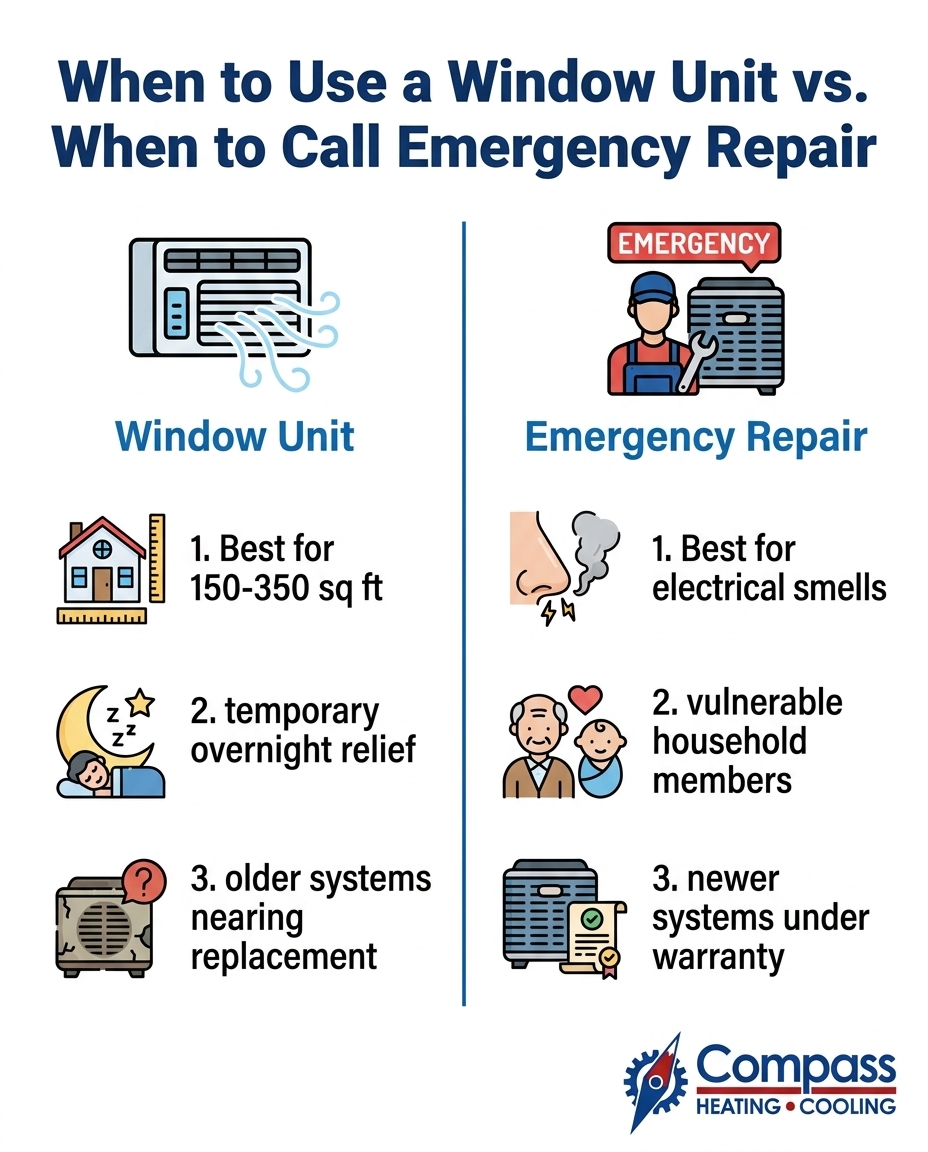
The primary limitation of a window unit is its cooling capacity, measured in British Thermal Units (BTUs). A standard 5,000 to 8,000 BTU unit is only designed to effectively cool a space of about 150 to 350 square feet. If you place a small unit in a massive, open-concept living room, it will run constantly without making a noticeable dent in the temperature. Instead, the smartest logistical move is to target a specific, enclosed room—like a primary bedroom—to ensure your family can sleep comfortably through the weekend.
Here is a breakdown of the pros and cons of using a window unit as a weekend stop-gap:
• Pro: Immediate Targeted Relief: You can purchase and install a unit within a few hours, securing at least one comfortable room for sleeping.
• Pro: Buys Decision Time: A temporary cooling source removes the pressure of making a rushed, high-stakes decision about a major system replacement over the weekend.
• Con: Limited Coverage: It will not cool the rest of the house, which can disrupt whole-home back-to-school routines and daily living.
• Con: Installation Hassle: Window units are heavy, require secure mounting, and must be properly sealed to prevent warm air from seeping back inside.
Living in Loveland, CO provides a unique advantage when utilizing temporary cooling. Loveland's dry climate and significant diurnal temperature swings mean that while afternoon highs can be intense, the evenings often cool down considerably. Hot afternoon highs absolutely require mechanical cooling, but cooler nights can sometimes be managed by opening windows to flush the house with fresh air, using the window unit strictly as a targeted supplement to get through the hottest parts of the day.
Signs You Need 24 Hour Emergency AC Repair Immediately
While a window unit is a great strategy for a standard mechanical breakdown waiting on parts, there are specific scenarios where a stop-gap measure is entirely insufficient. Certain symptoms indicate a dangerous malfunction that requires immediate professional intervention, regardless of the day of the week or the time of night. Ignoring these warning signs over the weekend can lead to catastrophic equipment failure or even pose a safety hazard to your home.
If you are searching for '24 hour emergency ac repair' or '24 hour ac repair near me', you need to know how to distinguish between an uncomfortable inconvenience and a true HVAC emergency. If you notice any of the following signs, do not rely on a temporary window unit—call for professional help immediately:
• Electrical burning smells: An odor resembling burning plastic or ozone strongly suggests melting wire insulation or a failing motor, which is a serious fire hazard.
• Sparking or smoking at the unit: Any visible electrical malfunction at the indoor air handler or the outdoor condenser requires you to shut off power at the breaker and call a professional right away.
• Unusual screeching or grinding noises: Metal-on-metal sounds usually indicate a failing compressor or blower motor bearing. Continuing to run the system can destroy the components completely.
• Vulnerable household members: If you have elderly family members, infants, or individuals with respiratory conditions in the home, extreme indoor heat is a health hazard, elevating a standard breakdown to a true emergency.
• Frequent breaker tripping: If your air conditioner repeatedly trips the circuit breaker, it is pulling too much electrical current, indicating a severe internal short or a locked-up compressor.
Attempting to tough it out through late August end-of-season cooling when electrical or severe mechanical issues are present is never worth the risk. Understanding when to call for 24-hour AC repair vs waiting until morning is crucial for protecting both your property and your family's safety.
Factoring System Age Into Your End-of-Season Decision
When a breakdown occurs in late summer, the immediate reaction is often focused entirely on restoring comfort as quickly as possible. However, shifting your perspective from immediate panic to long-term system lifecycle planning is essential. The age and overall health of your current equipment should be the primary driving factor in how you handle a weekend failure.
Central air conditioning systems typically have an average lifespan of 10 to 15 years. If your unit is approaching or has exceeded this timeframe, sinking significant resources into an aging unit at the end of the cooling season might not be a viable long-term investment. Late August end-of-season cooling means you only have a few weeks of heavy usage left before the weather turns. Paying a premium for an after-hours emergency repair on a failing, inefficient system is often a poor allocation of funds, especially if that system is likely to break down again next summer.
This is where a temporary window unit proves its strategic value. By spending a modest amount on localized cooling, you buy your family enough time to thoughtfully plan a full system replacement rather than rushing a weekend repair just to survive the heat. It provides the breathing room necessary to evaluate your options, research modern, high-efficiency equipment, and schedule a consultation during standard business hours.
The Repair vs. Replace Dilemma in Late Summer
Evaluating the long-term value of patching an old system requires a careful look at its recent performance history. Has the system required frequent top-offs of refrigerant? Have your utility bills been steadily climbing despite regular usage patterns? If the answer is yes, a major component failure is likely just the final symptom of a system at the end of its life. Temporary cooling allows you to step back and make a strategic choice. When you are ready to explore your options for upgrading your home's comfort, learning about professional AC installation and replacement can help you make an informed, pressure-free decision.
Comparing Your Options: Window Unit vs. Emergency Central AC Repair
To help you finalize your decision on a Friday afternoon, it is helpful to look at a definitive, side-by-side framework. Contrasting the immediate, localized relief of a window unit against the potential whole-home restoration of a central repair clarifies the path forward based on your specific household needs and the age of your equipment.
The logistical effort of purchasing, transporting, and properly installing a heavy window unit must be weighed against the effort of coordinating an after-hours service call and potentially waiting for Monday parts. Use the comparison table below to guide your late-summer cooling strategy.
• Cooling Coverage — Temporary Window Unit: Localized spot-cooling (150-350 sq ft). Best for a single primary bedroom. — Emergency Central AC Repair: Potential for whole-home restoration, returning all rooms to the set temperature.
• Logistical Effort — Temporary Window Unit: Requires a trip to the store, heavy lifting, and secure window installation. — Emergency Central AC Repair: Requires coordinating with an after-hours dispatcher and being home for the technician.
• Timeline to Relief — Temporary Window Unit: Immediate, once installed. Provides guaranteed relief for one room. — Emergency Central AC Repair: Variable. Immediate if parts are stocked; delayed until Monday if parts must be ordered.
• Best Suited For... — Temporary Window Unit: Older systems nearing replacement, standard mechanical failures, healthy adults. — Emergency Central AC Repair: Newer systems under warranty, electrical hazards, vulnerable household members.
The ultimate "If this, then that" summary is simple: If your system is old, the failure seems mechanical, and you only need to cool one room for healthy adults, a window unit is a smart bridge. If your system is relatively new, you smell burning, or you have infants in the house, you need an expert immediately. For those requiring professional intervention, securing reliable AC repair in Loveland is the safest route to restoring your home's safety and comfort.
Make the Right Call for Your Late Summer Cooling Needs
Navigating a late August end-of-season cooling failure does not have to be an overwhelming experience. By stepping back and evaluating the situation through a clear, non-financial framework, you can make a confident weekend decision. Remember that the best choice depends entirely on your system's age, the realities of weekend parts availability, and the specific health and comfort needs of your household.
Whether you decide to bridge the gap with a temporary window unit to buy time for a thoughtful system replacement, or you recognize the signs of a true emergency that requires immediate intervention, you do not have to figure it out alone. Reaching out for an honest assessment can provide the clarity and reassurance you need to move forward. Do not let a Friday afternoon breakdown ruin your weekend. If you are ready for professional assistance, contact us today to schedule your emergency AC repair and let our team help you restore your home's comfort safely and efficiently.
Frequently Asked Questions
What qualifies as an AC emergency?
An AC emergency is any situation that poses a safety hazard to your home or a health risk to your family. This includes electrical burning smells, visible sparking, screeching metal noises, or a complete loss of cooling in a home with elderly residents or infants. If you notice any of these signs, you should shut off the system and call a professional immediately.
Should I buy a window unit while waiting for AC repair?
Purchasing a window unit is a highly effective strategy if you are waiting for parts to arrive after the weekend. It provides targeted, localized cooling so you can sleep comfortably without rushing into a major repair decision. However, it is only a temporary stop-gap and should not be viewed as a long-term replacement for central air conditioning.
Can one window unit cool an entire house?
No, a single window unit cannot effectively cool an entire house. A standard 5,000 to 8,000 BTU unit is only designed to cool an enclosed space of roughly 150 to 350 square feet. Attempting to cool a large, open-concept home with one unit will simply overwork the machine without significantly lowering the indoor temperature.
How long does emergency AC repair take?
The timeline for an emergency repair depends entirely on the nature of the breakdown and parts availability. If the technician has the required universal part on their truck, the repair can often be completed in a few hours. If the system requires a proprietary part from a supply house that is closed for the weekend, the final resolution may take until Monday or Tuesday.
Is it safe to run a malfunctioning central AC during the weekend?
Running a malfunctioning system is generally unsafe and can lead to far more extensive damage. If the system is making grinding noises, tripping breakers, or failing to produce cold air, continuing to run it can destroy the compressor or create an electrical fire hazard. It is always safer to turn the system off at the thermostat and wait for a professional diagnosis.
How does Loveland's dry climate affect my temporary cooling options?
Loveland's dry climate and low humidity mean that shade and targeted spot-cooling can feel more effective than they would in a highly humid environment. Additionally, the region's significant diurnal temperature swings often result in cooler evening temperatures. This allows homeowners to manage nighttime comfort by opening windows for fresh air, using a window unit only during the peak heat of the afternoon.
hear what our satisfied clients have to say
Our clients consistently praise our exceptional service and attention to detail. They appreciate the personalized approach we take to meet their unique needs, ensuring satisfaction every step of the way.
.png)