



Navigating Fort Collins Noise Ordinances When Relocating Your AC Condenser
The Hidden Regulatory Risks of Moving Your Outdoor AC Unit
As the late-summer heat lingers and families transition into the back-to-school routine, your current air conditioner might be struggling to keep the house cool. At Compass Heating & Cooling, we know that navigating Fort Collins noise ordinances when relocating your AC condenser is probably the last thing on your mind. You simply want a reliable system that operates efficiently. However, planning an end-of-season AC condenser replacement or relocation carries a hidden risk that many homeowners overlook: strict municipal code violations. Choosing the exact installation location for a new outdoor unit requires carefully balancing system airflow requirements with stringent local noise regulations.
If you are upgrading your system during the late-summer cooling season, the placement of your new outdoor equipment is just as critical as the brand you select. A lack of proactive planning can quickly lead to formal neighbor disputes, failed municipal inspections, and forced relocations after the equipment is already permanently wired and piped. Understanding local acoustic regulations is the required first step before any physical work begins on your property.
To ensure your home stays comfortable without regulatory friction, establishing a foundation of professional air conditioning services is highly recommended. Whether you are replacing a failing unit or planning a comprehensive AC installation in Fort Collins, partnering with experts who understand the legal landscape protects your investment.
Understanding Fort Collins Municipal Code Chapter 20
Before you pour a new concrete pad or set a bracket for your outdoor unit, you need to understand how the city regulates residential sound. In our years of serving Northern Colorado, we've seen many homeowners caught off guard by the city's strict regulations on residential sound. Fort Collins Municipal Code Chapter 20 specifically governs residential noise restrictions, and it treats mechanical equipment like air conditioners with strict scrutiny. The most common misconception homeowners have is that noise is measured right next to the unit itself. In reality, municipal compliance is determined by measuring the acoustic impact at the property line.
The Mechanics of Property Line Measurement
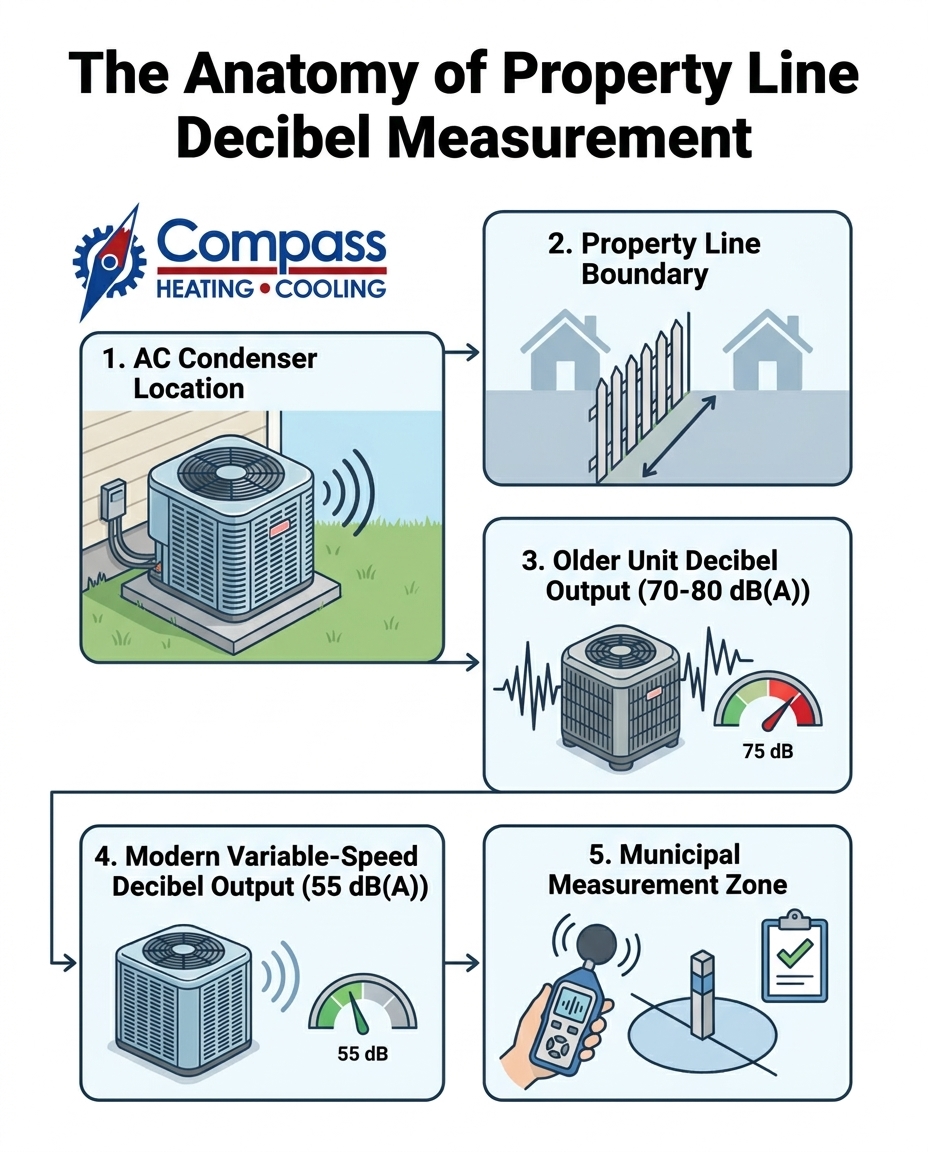
When an inspector evaluates a noise complaint, they do not stand in your yard. They stand at the legal boundary separating your lot from your neighbor's lot. This means that the decibel (dB(A)) limits at the property line dictate whether your installation is legal. The acoustic energy generated by your condenser must dissipate enough over the distance between the unit and the property boundary to fall below the city's mandated thresholds.
Furthermore, these regulations are not static. Different zoning classifications within the city have varying acceptable daytime and nighttime thresholds. Nighttime limits are significantly stricter because ambient neighborhood noise drops, making mechanical humming much more prominent. Failing to account for these legal boundaries and time-of-day restrictions during the planning phase guarantees regulatory friction. If your unit runs loudly at 2:00 AM and exceeds the nighttime decibel limit at your neighbor's fence, you are technically in violation of municipal code, regardless of how hot it is outside.
How Dense Lot Lines Complicate Condenser Placement
The physical layout of your neighborhood plays a massive role in how sound travels. Many local neighborhoods feature dense residential zoning, which means homes are built close together with tight property line setbacks. When you have narrow side yards, the acoustic energy from mechanical equipment has significantly less physical space to dissipate before reaching the legal measurement boundary.
This geographic reality collides with our weather patterns. Constant late-summer AC operation in Fort Collins heat exacerbates neighborhood noise complaints on dense lots. During a severe end-of-season heat wave, your air conditioner may run for hours at a time. Our technicians at Compass Heating & Cooling frequently respond to calls in dense neighborhoods where continuous operation becomes highly noticeable, especially if a unit is located just a few feet from a neighbor's bedroom window.
The Physics of Acoustic Reflection
Strategic placement requires evaluating more than just distance; you must also account for acoustic reflection. Sound waves behave like water—they bounce off hard surfaces. If you place a condenser in a narrow alleyway between two brick houses, the sound waves will ricochet between the exterior walls, amplifying the noise rather than allowing it to dissipate.
• Exterior Walls: Brick, stucco, and vinyl siding all reflect sound waves toward the property line.
• Privacy Fences: While a solid wood fence might block some noise, it can also channel sound laterally if not positioned correctly.
• Overhangs and Eaves: Low rooflines can trap acoustic energy, pushing it outward toward adjacent lots.
Because of these complex acoustic dynamics, selecting the right location requires professional insight. Engaging with experienced Fort Collins HVAC services ensures that your new system is placed in a location that minimizes reflective amplification and respects dense neighborhood lot lines.
The Costly Reality of Forced Post-Installation Relocations
We've witnessed the unfortunate aftermath when homeowners try to bypass these rules. Ignoring municipal codes during a system replacement is a gamble that rarely pays off. Violating local noise ordinances often triggers formal neighbor complaints, which in turn prompt official municipal inspections. Once a complaint is filed, the city is obligated to investigate, bringing certified sound meters to the edge of your property.
If your newly installed unit is found to exceed the allowable decibel (dB(A)) limits at the property line, the municipality has the authority to mandate corrective action. The city does not care about the equipment's brand; they only care about compliance. Corrective action frequently requires a complete tear-down and physical relocation of the condenser. This is not a simple matter of sliding the unit over a few feet.
The logistical nightmare of a forced relocation includes:
• Refrigerant Line Extensions: The copper lines carrying chemical refrigerant must be cut, extended, brazed, and re-tested for leaks.
• Electrical Rerouting: High-voltage whips and disconnect boxes must be moved to meet electrical code at the new location.
• Pad Reconstruction: A new level surface must be poured or leveled to support the heavy equipment.
• Landscape Disruption: Moving the unit often means tearing up gardens, pathways, or turf to bury new lines.
Proactive acoustic planning prevents this costly reality. By verifying local ordinances and calculating sound dissipation before the first piece of copper is cut, you protect yourself from the administrative burden of moving a brand-new cooling system.
Leveraging Modern AC Technology for Acoustic Compliance
The bridge between strict regulatory problems and successful home cooling lies in modern equipment specifications. If you are restricted by tight property lines, the technology inside the condenser matters just as much as where you place it. Older, single-stage AC units often operate at high acoustic levels—frequently between 70 and 80 dB(A). When a unit starts at 80 decibels, our team knows it is exceptionally difficult to place it legally in a tight side yard without exceeding the decibel (dB(A)) limits at the property line.
Fortunately, HVAC manufacturing has evolved. Modern variable-speed technology operates at significantly lower acoustic levels, sometimes as low as 55 dB(A). Because these units can adjust their compressor speed to exactly match the cooling demand of the house, they rarely run at full capacity. This lower operational speed translates directly to a quieter outdoor unit. Additionally, upgrading to high-efficiency systems like these may qualify you for federal tax credits or local utility incentive programs (we always advise readers to verify current programs with their utility provider or a tax professional).
Comparing Acoustic Profiles
Selecting equipment with a lower base decibel rating provides much more flexibility in choosing a relocation spot. Here is a breakdown of how different technologies interact with municipal compliance:
• Older Single-Stage — Typical Acoustic Output: 70 - 80 dB(A) — Compliance Difficulty in Tight Lots: Very High (Requires large setbacks) — Operational Behavior: Turns on at full blast, creating a loud startup noise.
• Modern Two-Stage — Typical Acoustic Output: 65 - 72 dB(A) — Compliance Difficulty in Tight Lots: Moderate (Manageable with planning) — Operational Behavior: Runs at a lower, quieter capacity for most of the day.
• Variable-Speed Inverter — Typical Acoustic Output: 55 - 65 dB(A) — Compliance Difficulty in Tight Lots: Low (Highly flexible placement) — Operational Behavior: Ramps up slowly, maintaining a quiet, consistent hum.
Matching the right technology to the specific acoustic constraints of your property ensures long-term compliance. If your only viable installation location is five feet from a neighbor's property line, our experts recommend investing in a variable-speed system as it is often the only way to legally meet code requirements.
Navigating the Permitting Process for HVAC Relocations
Moving an AC condenser is not a simple swap that can be done under the radar. It requires pulling the appropriate municipal building permits and undergoing official inspections. The permitting process is the city's mechanism for ensuring that all mechanical work is safe, efficient, and compliant with local ordinances.
Permit applications for a relocation often require detailing the new location on a site plan. You must prove on paper that the proposed location meets municipal setback requirements and will not violate the decibel (dB(A)) limits at the property line. This documentation must be accurate, as inspectors will verify the physical installation against the approved plans.
This is where professional oversight becomes invaluable. At Compass Heating & Cooling, our deep expertise in proactively navigating Fort Collins municipal codes ensures that your compliant placement prevents regulatory headaches. We handle the complex paperwork, ensuring that all submitted documentation accurately reflects the equipment's specific acoustic profile and your property's legal boundaries. Working with experts prevents administrative delays and ensures the installation is legally recognized by the city. If you are unsure about the administrative steps involved, reviewing the permit requirements for replacing your AC is a great place to start your planning process.
Frequently Asked Questions About Local HVAC Compliance
What is the noise ordinance for AC units in residential areas?
The noise ordinance for residential areas dictates the maximum allowable sound levels that mechanical equipment can emit, typically measured at the property line. In most municipalities, these regulations are split between daytime and nighttime limits, with nighttime rules being significantly stricter. Compliance ensures that your cooling system does not create a public nuisance or disturb your neighbors' peace.
How loud can an AC unit be at the property line?
While exact decibel limits vary by specific zoning classifications, residential property line limits often hover around 50 to 55 dB(A) during the day and can drop to 45 dB(A) or lower at night. It is critical to verify the current decibel (dB(A)) limits at the property line for your exact address before installing new equipment. Exceeding these limits can result in citations and forced equipment relocation.
How close to the property line can I put my AC unit?
The required physical setback from the property line is determined by both local zoning codes and the acoustic rating of your specific condenser. Even if the building code allows a unit to be placed three feet from the boundary, the noise ordinance might functionally require a five-foot setback to allow the sound to dissipate. Always evaluate both physical setback rules and acoustic regulations simultaneously.
Do I need a permit to relocate my AC condenser in Fort Collins?
Yes, relocating an AC condenser requires a mechanical permit from the city. Moving the unit involves altering high-voltage electrical wiring and pressurized refrigerant lines, both of which require municipal oversight for safety. The permit application will also typically require a review of the new location to ensure it meets all setback and noise compliance standards.
What happens if my AC violates local noise ordinances?
If your system violates local ordinances and a neighbor files a complaint, the city will conduct an acoustic measurement at the property boundary. If you are found to be over the limit, you will be issued a notice of violation and mandated to take corrective action. This usually means you must pay to have the entire system uninstalled, moved to a compliant location, and reinstalled.
How do municipal inspectors measure residential HVAC noise?
Inspectors use calibrated sound level meters to measure the A-weighted decibels (dB(A)) generated by your equipment. They do not measure the sound directly next to the condenser; instead, they stand at the legal property line separating your lot from the adjacent public or private property. The reading is taken while the unit is operating at full capacity to determine peak acoustic impact.
Ensuring a Fully Compliant Cooling Upgrade
As we wrap up the late-summer cooling season, navigating Fort Collins noise ordinances when relocating your AC condenser requires more than just picking a spot that looks visually appealing. It demands a clear, expert breakdown of how municipal codes impact equipment placement. From understanding decibel dissipation to selecting the right variable-speed technology, proactive planning is the only way to avoid costly regulatory disputes.
Professional installers ensure strict adherence to local codes, preventing future neighbor disputes and municipal violations. By evaluating your property lines, accounting for acoustic reflection, and pulling the proper permits, our licensed contractors take the burden of compliance off your shoulders. When you are ready to upgrade your home comfort legally and safely, consult with the local experts at Compass Heating & Cooling to evaluate your lot and plan a seamless AC installation in Fort Collins. Doing the job right the first time ensures years of quiet, compliant, and efficient cooling.
hear what our satisfied clients have to say
Our clients consistently praise our exceptional service and attention to detail. They appreciate the personalized approach we take to meet their unique needs, ensuring satisfaction every step of the way.
.png)