



Preparing Your Home's Air Quality for Flu Season with UV Purifiers
The Shift in Season: Why Fall Demands a New Approach to Indoor Air
The September/Early Fall transition is just around the corner, and before the first hard freeze hits, there is one critical system our team at Compass Heating & Cooling reminds every homeowner to check. Preparing Your Home's Air Quality for Flu Season with UV Purifiers is the most effective way to protect your family as temperatures drop. As the crisp weather arrives, we instinctively shut our windows and doors to keep the cold out. While this keeps your living space warm, it also traps stale air inside, setting the stage for a steep decline in indoor air quality just as cold and flu season ramps up.
According to the EPA, indoor air can be two to five times more polluted than outdoor air. When homes are sealed tight for the winter, that trapped air continuously recirculates through your vents. This creates a concrete problem for families: airborne pathogens, allergens, and viruses become concentrated in the very air you breathe every day. You are faced with a clear decision point. You can continue relying on passive, standard air filters that merely catch dust, or you can take a proactive approach by upgrading your system to actively neutralize microscopic threats.
If you are exploring ways to improve your home's defenses this year, learning about comprehensive HVAC services and professional UV light installation is the smartest place to start.
Standard Filters vs. Microscopic Pathogens: Understanding the Gap
In our years of servicing Loveland CO area homes, our technicians often see homeowners operating under a false sense of security when it comes to their standard furnace filters. It is easy to assume that if you regularly swap out your pleated fiberglass filter, your air is clean and safe from viruses. However, traditional HVAC filters are primarily designed to protect the internal components of your heating and cooling equipment—not to sanitize the air your family breathes.
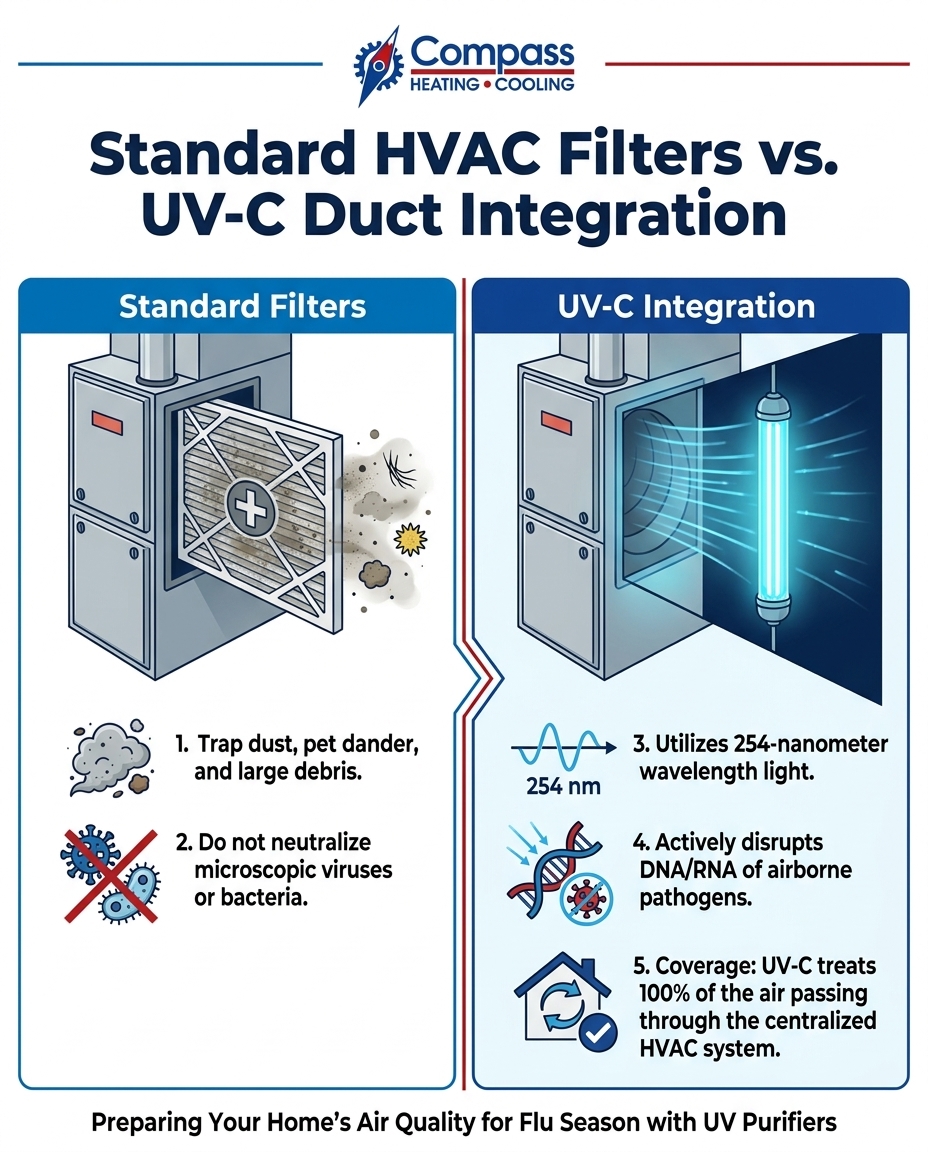
Standard filters act like a chain-link fence. They are fantastic at stopping large, physical debris like pet hair, heavy dust, and lint from coating your blower motor. But when it comes to microscopic viral particles, that chain-link fence is entirely ineffective. The influenza virus, for example, is incredibly small—often measuring around 0.1 microns in diameter. These tiny pathogens easily slip right through the woven media of standard 1-inch or even 4-inch pleated filters, continuing their journey through your ductwork and back into your living room.
What your standard filter catches:
• Heavy dust and dirt: Protects the blower motor from physical buildup.
• Pet dander and hair: Keeps the air physically clearer and reduces strain on the system.
• Large pollen spores: Helps with seasonal allergies during the spring and summer.
What your standard filter misses:
• Viral pathogens: Microscopic viruses, including the flu and common cold, pass through easily.
• Airborne bacteria: Many bacterial strains are too small for standard mechanical filtration.
• Microscopic smoke particles: Similar to the impact of poor air quality and smoke on your HVAC, standard filters struggle to block fine particulate matter.
Relying solely on mechanical filtration leaves a significant gap in your home's defense system. To truly prepare your indoor environment for the winter months, we highly recommend a solution that addresses the microscopic threats that filters leave behind.
The Science of UV-C: How Ultraviolet Germicidal Irradiation Works
To understand how to bridge the gap left by standard filters, we have to look at the science of Ultraviolet Germicidal Irradiation (UVGI). While it sounds incredibly complex, the core mechanism is straightforward and highly effective. During the September/Early Fall transition, as you prepare your home for winter, integrating this technology means shifting from a passive defense to an active offense against airborne illnesses.
UVGI utilizes a specific wavelength of ultraviolet light—exactly 254 nanometers. At this precise wavelength, UV-C light becomes germicidal. When airborne pathogens like the flu virus, bacteria, or mold spores pass through the light zone inside your ductwork, the high-energy UV rays penetrate their cellular walls. The light actively scrambles and disrupts the DNA and RNA of the microorganisms. Once their genetic code is damaged, the viruses are completely neutralized. They can no longer replicate, infect your family, or survive in your home's air supply.
Trapping vs. Neutralizing
The most important distinction in indoor air quality is the difference between trapping a particle and neutralizing a threat. Mechanical filters trap particles. If a virus happens to get caught in a high-efficiency filter, it is merely held there. It remains alive and potentially active on the filter media. UV-C technology alters pathogens biologically. Even if the neutralized virus remains in the airstream and floats into your living room, it is entirely harmless. It has been rendered inert and cannot cause illness.
ASHRAE Recommendations for Home Health
You do not have to take our word for the effectiveness of this technology. The American Society of Heating, Refrigerating and Air-Conditioning Engineers (ASHRAE) officially recognizes UVGI as a proven, effective method for inactivating airborne pathogens. Industry standards heavily support the use of UV light for epidemic and seasonal flu preparedness. Because the UV-C lamps are safely mounted deep inside your ductwork or directly over your evaporator coil, the intense light stays completely contained. This ensures maximum air purification while keeping the human occupants of the house perfectly safe from UV exposure.
Whole-Home Defense: Duct-Mounted UV vs. Portable Room Purifiers
When flu season approaches, our technicians frequently talk to homeowners in Loveland CO area homes who are rushing out to buy portable HEPA room purifiers. While these standalone units certainly have their place, we always explain that they are not the most efficient way to protect an entire house. To truly safeguard your family, you need to compare the localized approach of a portable unit with the comprehensive coverage of a whole-home integration.
Portable purifiers are limited by their size and location. A high-quality portable unit might do an excellent job cleaning the air in a single bedroom, but it does absolutely nothing for the kitchen, the living room, or the hallways. As your family moves around the house, they constantly transition between treated and untreated air zones.
Limitations of Room-by-Room Solutions
Relying on portable units creates a logistical headache. To achieve true whole-home coverage, you would need to purchase a separate unit for nearly every room. This leads to inconsistent air quality, high upfront costs, and a significant cumulative maintenance burden. You end up constantly tracking which filter needs replacing, listening to multiple noisy fans running in your living spaces, and sacrificing valuable floor space in every room.
The Efficiency of Centralized Purification
By contrast, integrating a UV-C light directly into your heating systems provides a seamless, invisible layer of protection. A duct-mounted UV system leverages the powerful blower motor that already exists in your HVAC equipment. Every time your furnace kicks on to warm the house, 100% of the conditioned air circulating through your ductwork passes directly through the UV-C sanitization zone.
• Coverage Area — Portable Room Purifiers: Single room or limited open space — Duct-Mounted UV Systems: Every square foot connected to ductwork
• Aesthetic Impact — Portable Room Purifiers: Takes up floor space, visible cords — Duct-Mounted UV Systems: Completely invisible, hidden in ductwork
• Noise Level — Portable Room Purifiers: Audible fan noise in living areas — Duct-Mounted UV Systems: Silent operation within the HVAC system
• Pathogen Action — Portable Room Purifiers: Traps particles mechanically — Duct-Mounted UV Systems: Actively neutralizes DNA/RNA
This centralized approach ensures comprehensive coverage for every single room connected to your vents, providing true peace of mind without the clutter of standalone machines.
Professional Ductwork Integration: Why UV Installation is Not a DIY Project
With the rise of online tutorials, it is tempting to view home upgrades as weekend DIY projects. However, installing a whole-home UV-C air purifier is strictly a job for licensed professionals. Proper installation requires working with high-voltage electrical connections and making precise modifications to your HVAC plenum and ductwork.
The risks of improper installation:
• Component Damage: UV-C light is incredibly powerful. If positioned incorrectly, the intense light can degrade synthetic materials inside your HVAC system, prematurely destroying drain pans, wire casings, and flexible ductwork.
• Reduced Efficacy: The light must be placed at the exact right angle and distance from the evaporator coil or in the main return duct to ensure the air is exposed to the UV rays for the correct amount of time. Poor placement means pathogens fly right by without being neutralized.
• Health Hazards: Direct exposure to UV-C light is extremely dangerous to human skin and eyes. Professionals use specialized viewports and safety shutoff switches to ensure the light only operates when the system is sealed.
Furthermore, every house is built differently. Working with a local expert means you benefit from our team at Compass Heating & Cooling's specialized knowledge of Northern Colorado's climate. We've spent years working on local ductwork, which means we can recommend and install custom indoor air quality integrations tailored exactly to how Loveland CO area homes are built, sealed, and heated rather than pushing generic, one-size-fits-all portable units.
The September Window: Timing Your HVAC Upgrades for Maximum Protection
Timing is everything when it comes to seasonal home maintenance. While you can upgrade your indoor air quality at any point in the year, the September/Early Fall transition represents the absolute best window of opportunity. Flu season activity typically begins to increase in October, making early fall the critical deadline for proactive home air quality upgrades.
In our region, the timing is even more urgent. As local HVAC professionals, we know firsthand how Loveland's rapid early-fall temperature drops force homeowners to seal windows early, completely cutting off fresh air ventilation and trapping recirculated pathogens indoors much sooner than in warmer regions. If you wait until November to think about your indoor air quality, your family will have already spent weeks breathing stale, poorly filtered air during the start of cold and flu season.
The ideal timeline for fall preparation:
1. Evaluate in early September: Assess your current filtration setup and research UV-C options before the weather turns freezing.
2. Schedule a comprehensive tune-up: Bundle your UV light upgrade with a standard HVAC maintenance plan visit. This ensures your blower motor is clean, your system is efficient, and your new purifier is integrated seamlessly.
3. Lock in protection by October: Have the system fully operational before holiday gatherings begin and flu season peaks.
We always advise homeowners to schedule these upgrades before the winter rush hits. Once the first major freeze arrives, local technicians become heavily booked with emergency furnace repairs, making it harder to schedule proactive enhancements.
Frequently Asked Questions About UV-C and Flu Season Air Quality
As homeowners in Loveland CO area homes look for ways to protect their families, our technicians hear many of the same excellent questions during our service calls. Here is what you need to know about integrating this technology into your home.
Do HVAC UV lights really work?
Yes, they are highly effective when installed correctly. UV-C technology has been used for decades in hospitals, laboratories, and water treatment facilities to maintain sterile environments. In a residential HVAC system, they work by continuously irradiating the air that passes through your ductwork, significantly reducing the overall concentration of viable airborne microorganisms in your home.
Do UV air purifiers kill the flu virus?
UV-C light actively neutralizes the influenza virus by destroying its genetic material. Because the flu virus is highly susceptible to the 254-nanometer wavelength, the light scrambles its RNA, rendering it completely inert. While it is technically "inactivating" the virus rather than "killing" a living organism, the result is the same: the virus can no longer infect your family.
How does UV-C light work in ductwork?
The UV lamp is permanently mounted inside your main supply or return duct, or directly over the indoor evaporator coil. As your blower motor pushes air through the system, all of the conditioned air must pass through this concentrated zone of ultraviolet light. This ensures that the air is continuously treated and sanitized multiple times an hour while your system runs.
Is UV light safe for home air purification?
It is completely safe for your family because the light is entirely contained within the metal enclosures of your ductwork. You will never see the actual UV light in your living spaces. Furthermore, professional installations include safety interlock switches that automatically cut the power to the UV lamp if the HVAC access panel is ever opened, preventing accidental exposure.
What is the difference between HEPA filters and UV-C lights?
HEPA filters are incredibly dense mechanical barriers designed to physically trap very small particles, but they can severely restrict airflow in standard residential HVAC systems. UV-C lights do not restrict airflow at all because they use light rays, not physical media, to treat the air. While HEPA traps particles, UV-C biologically neutralizes pathogens.
When is the best time of year to install a whole-home air purifier?
Early fall is unequivocally the best time for installation. Getting the system in place during September ensures your home is fully protected before you seal your windows for the winter and before the peak flu season begins in late fall and winter.
Take Proactive Steps for Your Family's Health This Winter
As we move through the September/Early Fall transition, preparing your home's air quality for flu season with UV purifiers is the most proactive step you can take. Standard fiberglass filters simply are not enough to stop microscopic viruses from circulating through your tightly sealed home. Active pathogen neutralization provides a whole-home defense that passive filters cannot match.
Do not wait until the winter rush begins and indoor air quality plummets. Talk to our experts about your specific ductwork and heating setup today, and schedule your professional UV light installation before the peak heating season begins. Upgrading your system now ensures your family breathes cleaner, safer air all winter long.
hear what our satisfied clients have to say
Our clients consistently praise our exceptional service and attention to detail. They appreciate the personalized approach we take to meet their unique needs, ensuring satisfaction every step of the way.
.png)