



MERV 8 vs MERV 11: Choosing the Right Filter for Late Summer Allergies
Battling August Allergens: Is a Higher Filter Rating Worth the Risk to Your AC?
Are you constantly sneezing inside your own home, wondering if a thicker air filter is the secret to finally finding some relief? When it comes to MERV 8 vs MERV 11: Choosing the Right Filter for Late Summer Allergies, the decision is rarely as simple as grabbing the highest number off the hardware store shelf. Right now, as kids head back to school and the August late-summer allergy peak hits hard, our team at Compass Heating & Cooling sees how incredibly tempting it is to buy the tightest, most restrictive filter available to block out the pollen and dust infiltrating your living space. However, doing so without understanding your equipment can put your entire cooling system at risk.
As local HVAC professionals, we always remind homeowners that upgrading your air filter is not just an indoor air quality decision. It is a major mechanical decision that directly impacts how hard your blower motor has to work. You want better filtration to stop the sneezing, but you also cannot afford to choke your blower motor right at the end of the cooling season. Finding the safest, most effective option for your home means evaluating your specific air conditioning systems and understanding what they can actually handle. Let's look at how these two popular filter ratings compare, so you can breathe easier without causing an unexpected breakdown.
Understanding the MERV Scale and Particle Capture Capabilities
Before you can make an informed choice for your home, you need to understand what those numbers on the filter packaging actually mean. MERV stands for Minimum Efficiency Reporting Value. This rating scale, developed by the American Society of Heating, Refrigerating and Air-Conditioning Engineers (ASHRAE), measures how effectively a filter traps airborne particles. The scale typically runs from 1 to 16 for residential homes. As a general rule, the higher the MERV rating, the tighter the weave of the filter material.
How Micron Sizing Works
Filters capture particles based on their size, which is measured in microns. To give you an idea of scale, a single strand of human hair is about 70 microns thick. During the August late-summer allergy peak, you are dealing with particles that are microscopic. Some pollen grains and dust mites are relatively large, while smoke and pet dander are incredibly fine. A higher MERV rating means the filter is capable of trapping smaller and smaller microns.
The Hidden Cost of Tight Weaves
Most homeowners assume that a higher MERV rating is automatically better for every HVAC system. Unfortunately, that is a costly misconception. Tighter weaves catch more debris, but they also create a physical barrier that air struggles to pass through. This resistance is known as "pressure drop." When you force your HVAC system to pull air through a highly restrictive barrier, you sacrifice airflow. Understanding this trade-off is the key to choosing a filter that cleans your air without destroying your equipment.
MERV 8 Filters: Reliable Airflow and Essential Dust Control
For the vast majority of residential HVAC systems our technicians service across Loveland CO and the Front Range, we recommend MERV 8 as the gold standard for everyday use. These filters strike an excellent balance between protecting the mechanical components of your furnace or air handler and keeping your indoor air reasonably clean.
What a MERV 8 Filter Catches
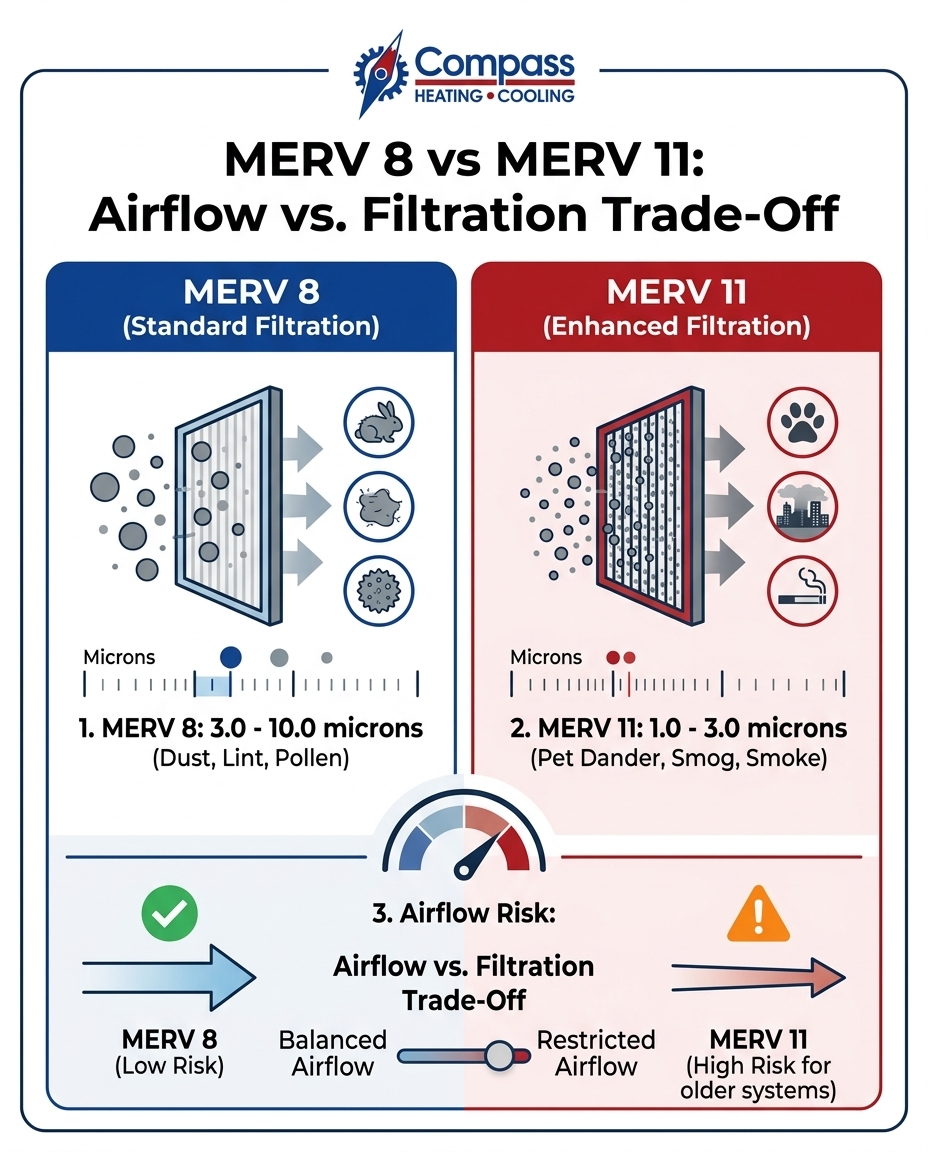
A MERV 8 filter is designed to capture particles that fall between 3.0 and 10.0 microns in size. This range covers the most common household nuisances. If your primary goal is to keep your home clean and protect your equipment from dirt buildup, this rating does the job effectively.
Pros of MERV 8 Filters:
• Excellent airflow: The slightly looser weave allows air to flow freely, preventing your blower motor from overworking and overheating.
• Effective dust control: Easily traps household dust, lint, and textile fibers before they can settle on your furniture or inside your ductwork.
• Pollen protection: Captures most large pollen particles, offering baseline relief for seasonal allergies.
• System longevity: By maintaining proper static pressure, these filters help older or single-stage HVAC systems run efficiently for years.
Cons of MERV 8 Filters:
• Misses fine particulates: They are not dense enough to catch microscopic pet dander or fine smoke particles.
• Limited severe allergy relief: If someone in your home suffers from severe respiratory issues, a MERV 8 might not remove enough triggers from the air.
MERV 11 Filters: Superior Filtration for Allergens and Wildfire Smoke
When the August late-summer allergy peak hits hard, or when regional wildfires send haze into the valley, many homeowners we work with look to upgrade. MERV 11 filters step up the filtration power significantly, utilizing a denser pleated material to trap much finer airborne contaminants.
When You Need Finer Filtration
MERV 11 filters are engineered to capture smaller particles, specifically those falling between 1.0 and 3.0 microns. Because they trap a higher percentage of microscopic irritants, this level of filtration is highly sought after during heavy allergy seasons or active smoke events. If you are focused on managing late summer dust and pollen with upgraded HVAC filtration, a MERV 11 offers a noticeable improvement in indoor air quality.
Pros of MERV 11 Filters:
• Advanced allergen capture: Highly effective at trapping pet dander, mold spores, and severe allergy triggers that slip through standard filters.
• Smoke mitigation: Capable of catching fine smoke particles and smog, making them valuable during local wildfire events.
• Cleaner ductwork: Keeps the internal components of your HVAC system nearly spotless by blocking fine grit.
Cons of MERV 11 Filters:
• Significant airflow resistance: The dense material creates a substantial pressure drop, forcing the HVAC blower to work much harder to pull air through.
• Faster clogging: Because they catch so much fine debris, they become dirty and restrictive much faster than lower-rated filters.
• Risk to older systems: Systems not designed for high static pressure can suffer mechanical failures when forced to pull air through a MERV 11.
The Airflow Trade-Off: Why Restrictive Filters Cause Frozen Evaporator Coils
Understanding the difference between these filters requires looking at what happens inside your air conditioner. Your HVAC system relies on a very specific, calculated volume of air passing over the indoor evaporator coil to function correctly. When you disrupt that airflow, you disrupt the entire cooling process.
The Problem: Starving the System of Air
Air conditioners do not actually "create" cold air; they remove heat from the air inside your home. Warm indoor air is pulled through the return ducts, passes through the filter, and blows over the chilled evaporator coil. The refrigerant inside the coil absorbs the heat, and the newly cooled air is pushed back into your rooms. This process requires a steady, unobstructed flow of warm air to keep the coil at the right temperature.
The Cause: A Chain Reaction of Freezing
A pattern we see often on late-summer emergency calls is homeowners unintentionally starving the blower of air. When you install a dense, restrictive filter in a system that cannot handle it, the fan spins, but it cannot pull enough warm air through the tight filter material. As a result, the evaporator coil does not receive enough heat. The temperature of the coil drops rapidly. The natural condensation that forms on the coil during the cooling process begins to freeze. Within hours, a solid block of ice can encase the coil, blocking airflow entirely and potentially damaging your compressor.
The Solution: Professional Tuning and Assessment
Older systems, or those equipped with single-stage blower motors, are especially vulnerable to this pressure drop. They simply do not have the variable-speed capabilities needed to ramp up and overcome the resistance of a thick filter. This is why routine AC maintenance is so critical. A professional technician can measure your system's static pressure and ensure your equipment is properly tuned to handle the filter you want to use, preventing freeze-ups before they happen across Loveland CO and the Front Range.
The High Altitude Factor: How Local Climate Impacts Your Blower Motor
In our years of maintaining air conditioners across Loveland CO and the Front Range, we've seen firsthand how our specific climate conditions create a unique set of challenges for HVAC equipment, especially as the cooling season winds down.
Thin Air and Hardworking Motors
Living at a high altitude means the air is less dense. Because the air is thinner, your blower motor already has to work harder and spin faster to move the same mass of air over the cooling coils compared to a system at sea level. The system is already operating under a slight disadvantage just by existing in this region.
The Threat of Hot, Dry, and Dusty Conditions
August in this area brings notoriously hot, dry, and dusty conditions. The lack of humidity allows dust to kick up easily, and late-summer winds carry pollen and agricultural debris right to your intake vents. This means your filters clog significantly faster than they would in a milder climate.
When you combine high altitude, end-of-season heat, and a dense MERV 11 filter that is rapidly filling with local dust, you create a perfect storm of static pressure. This combination can easily push an aging, fatigued blower motor past its breaking point. If you choose to run a higher-rated filter during this time of year, our team advises monitoring its condition frequently. Checking it every two weeks—rather than waiting for a monthly schedule—can save your motor from burning out.
Side-by-Side Comparison: Which Filter Belongs in Your System?
Synthesizing all this technical information into a clear decision comes down to evaluating your specific household needs against your equipment's capabilities. During the August late-summer allergy peak, you need a safe rule of thumb to follow.
• Particle Capture Size — MERV 8 Filter: 3.0 to 10.0 microns — MERV 11 Filter: 1.0 to 3.0 microns
• Best For Trapping — MERV 8 Filter: Household dust, lint, large pollen — MERV 11 Filter: Pet dander, fine smoke, smog, severe allergens
• Airflow Risk — MERV 8 Filter: Low (Excellent airflow) — MERV 11 Filter: High (Significant resistance)
• Ideal System Type — MERV 8 Filter: Older units, single-stage motors — MERV 11 Filter: Newer units, variable-speed motors
• Primary Use Case — MERV 8 Filter: Basic dust control, preventing freeze-ups — MERV 11 Filter: Homes with severe allergies or local wildfire smoke
Our Team's Quick Rule of Thumb: If you upgrade to a MERV 11 filter and notice that your air conditioner is running longer cycles, the airflow from your vents feels noticeably weaker, or you hear a whistling sound from the return vent, step back down to a MERV 8 immediately. Your system is telling you it cannot breathe.
You never have to guess which rating is safe. A professional assessment can determine the maximum safe MERV rating for your specific equipment. By enrolling in the Compass Club maintenance plan, you get localized expertise dedicated to protecting your equipment from our unique Front Range climate stress, ensuring your system remains clean, efficient, and capable of handling your preferred filtration level.
Protect Your Air Quality and Your Equipment Before Summer Ends
Balancing allergy relief with the mechanical health of your system is crucial as the cooling season winds down across Loveland CO and the Front Range. While it is tempting to block out every microscopic particle, sacrificing your blower motor or freezing your evaporator coil will leave you far more uncomfortable than a little extra dust.
You do not have to guess which filter is safe for your specific unit. If you are struggling with poor indoor air quality but are worried about straining your air conditioner, reach out to Compass Heating & Cooling for a professional system evaluation and tune-up today. We can help you find the perfect balance, giving you the clear explanation and safe rule of thumb you need to keep your home comfortable and your equipment running strong.
Frequently Asked Questions
Will a MERV 11 filter restrict airflow too much?
It depends entirely on your specific HVAC system's design and age. Older systems or those with single-stage blower motors often struggle to pull air through the dense material of a MERV 11, leading to severe airflow restriction. However, newer systems with variable-speed motors are typically designed to overcome this resistance and can run MERV 11 filters safely. A professional static pressure test is the only way to know for sure.
Which is better for allergies MERV 8 or 11?
A MERV 11 is significantly better for severe allergies because it captures much smaller particles. While a MERV 8 catches large pollen grains and general household dust, a MERV 11 traps microscopic pet dander, mold spores, and fine smoke that trigger severe respiratory reactions. If your system can handle the airflow requirements, MERV 11 provides superior relief.
Why does my AC coil freeze with a high MERV filter?
Your AC coil freezes because a highly restrictive filter starves the system of warm return air. The air conditioning process requires a constant flow of warm air over the indoor evaporator coil to keep the refrigerant from getting too cold. When a dense filter blocks that airflow, the coil temperature drops rapidly, causing natural condensation to freeze into a solid block of ice.
How often should I change a MERV 11 filter?
You should check a MERV 11 filter every two to three weeks and expect to change it every 30 to 60 days. Because these filters have such a tight weave and capture so many microscopic particles, they clog much faster than standard filters. During heavy allergy seasons, periods of wildfire smoke, or hot, dusty months, they may need replacing even sooner to prevent system strain.
Is MERV 8 good enough for late summer allergies?
For many households, yes, a MERV 8 is perfectly adequate for late summer allergies. It successfully traps the majority of large weed pollens, lint, and heavy dust that circulate through the home. If your family only suffers from mild seasonal sneezing and you want to ensure your older HVAC system runs without overheating, MERV 8 is the safest and most reliable choice.
Can my older HVAC system handle a MERV 11 filter?
Most older HVAC systems are not designed to handle the static pressure created by a MERV 11 filter. Forcing an aging, single-stage blower motor to pull air through that level of resistance often leads to overheating, frozen coils, or complete motor failure. If your system is older, our technicians highly recommend sticking with a MERV 8 filter unless a professional has explicitly verified your ductwork and motor can handle the upgrade.
hear what our satisfied clients have to say
Our clients consistently praise our exceptional service and attention to detail. They appreciate the personalized approach we take to meet their unique needs, ensuring satisfaction every step of the way.
.png)