


What to Look for When Vetting HVAC Companies in the Greeley Area
Facing Late-Summer AC Failures Without the Sales Pressure
If your system stops blowing cold during the peak of summer heat, knowing exactly what to look for when vetting HVAC companies in the Greeley area becomes your most urgent priority. That strange noise from your outdoor unit isn't going away on its own, and rising indoor temperatures can quickly turn your living space into an uncomfortable trap. A common pattern our Compass Heating & Cooling team sees during the August end-of-season cooling stretch is homeowners rushing to hire the first available technician just to restore airflow. Unfortunately, prioritizing speed over credentials often opens the door to aggressive sales tactics rather than genuine, cost-effective repairs.
For comprehensive HVAC services across the Greeley HVAC service area, establishing a reliable baseline for what makes a trustworthy contractor is the best way to protect your home and your peace of mind.
The Vulnerability of a Rushed Decision
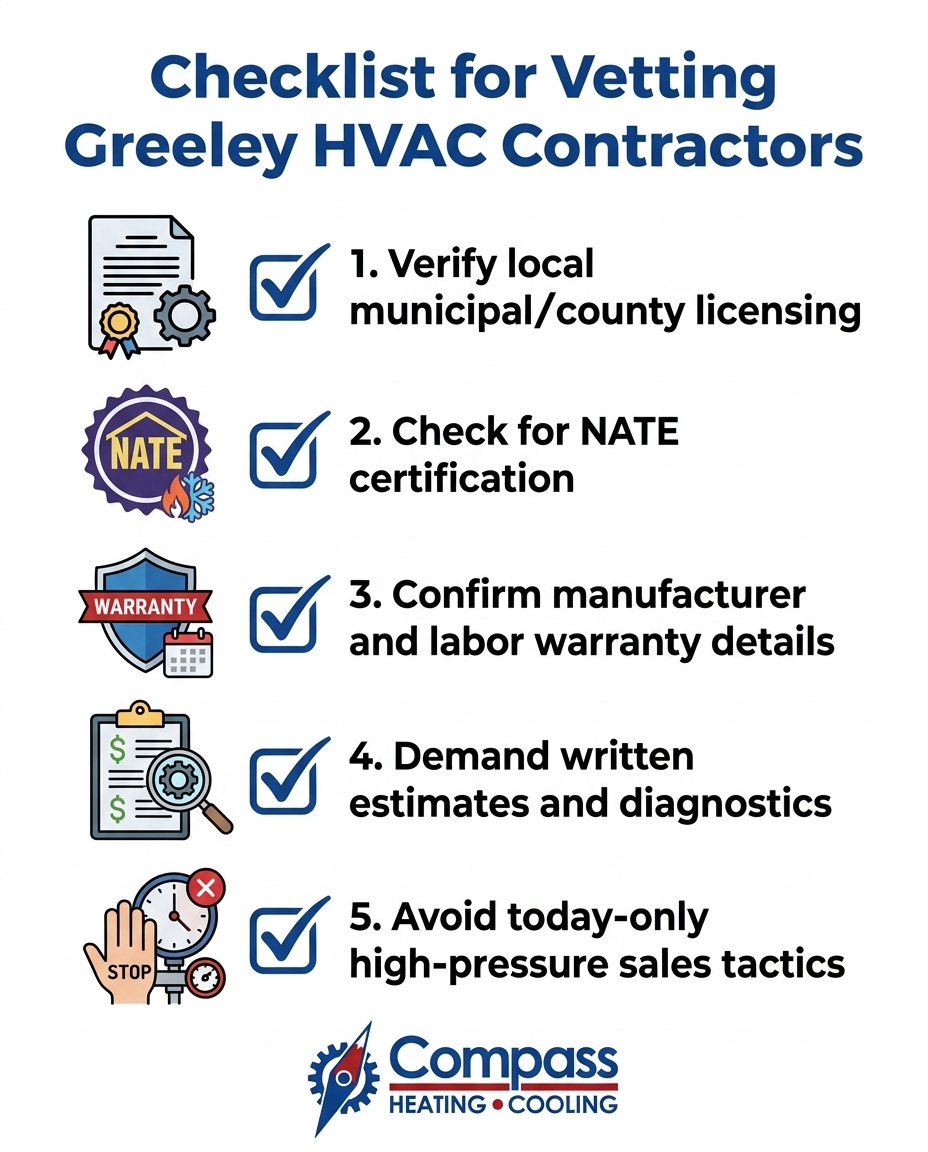
When it is late in the afternoon and your thermostat reads eighty-five degrees, patience is understandably thin. You want the problem solved immediately. However, this sense of urgency is exactly what less reputable companies rely on. When a homeowner is stressed and uncomfortable, they are far less likely to ask for proof of licensing, demand written estimates, or question a technician who claims the entire system needs to be replaced immediately.
Taking a step back to evaluate who you are letting into your home is an essential layer of protection. By understanding the local landscape of the HVAC industry, you can filter out the opportunists and partner with professionals who are invested in keeping your equipment running efficiently for years to come.
Spotting the 'August Replacement Push' and Aggressive Tactics
In our years servicing Northern Colorado neighborhoods, we've seen firsthand how air conditioners endure immense strain over the summer months. By the time the back-to-school transition arrives in late August, cumulative wear and tear peaks, leading to a massive spike in emergency service calls throughout the Greeley Area. Capacitors fail, blower motors overheat, and refrigerant leaks that started small in June suddenly cause the system to freeze up entirely. While many of these issues are straightforward fixes for an experienced technician, some companies view this surge in demand as a prime opportunity for the "August replacement push."
The quota-driven approach: Aggressive sales teams often use the immediate discomfort of a hot house to pressure homeowners into signing contracts for full-system replacements. Instead of performing a thorough diagnostic to find the root cause of the failure, these technicians are trained to look for any excuse to condemn the unit. They focus heavily on the age of the equipment rather than the actual condition of the components.
The genuine repair assessment: A reputable professional providing AC repair in Greeley will take the time to test electrical loads, check static pressure, and inspect individual parts. They will explain exactly what failed, why it failed, and provide a clear path to repair it. If a replacement is genuinely necessary due to catastrophic failure, they will show you the physical evidence, such as a grounded compressor or a severely cracked heat exchanger, rather than just telling you the system is "too old."
Red Flags in High-Pressure Sales Pitches
Recognizing the warning signs of a predatory sales pitch can save you from making a hasty, high-stakes decision. Watch out for these common tactics:
• Fear-based language: Claims that your family is in immediate, severe danger from a standard component failure without providing any tangible proof or testing data.
• Refusal of written diagnostics: Technicians who give verbal quotes but refuse to write down the exact parts that failed or the itemized cost of the repair.
• Today-only discounts: High-pressure offers that expire the moment the technician leaves the driveway, designed specifically to prevent you from getting a second opinion.
• Vague technical jargon: Using overly complex terms to confuse the homeowner, rather than breaking down the problem into understandable concepts.
Navigating Municipal Requirements for HVAC Contractors
One of the most frequent misconceptions among homeowners is assuming that the state handles all contractor oversight. In reality, Colorado does not issue a statewide HVAC contractor license. Instead, licensing, permitting, and code compliance are managed entirely at the municipal and county levels. This local governance structure means that vetting a contractor requires verifying their specific credentials for your exact location.
The importance of proper permitting: As a locally licensed team operating throughout Loveland and Greeley, we know that when a contractor holds valid local Northern Colorado HVAC licensing, they are authorized to pull the necessary permits for major repairs and installations. Pulling a permit is not just a bureaucratic formality; it is a critical safeguard for the homeowner. It ensures that a neutral, third-party city inspector will review the work to confirm it meets all current safety codes and efficiency standards.
Protecting yourself from liability: Hiring an unlicensed individual to perform complex electrical or refrigerant work exposes you to significant risk. If an unpermitted installation causes property damage, your homeowners insurance may refuse to cover the claim. Furthermore, if you decide to sell your home in the future, unpermitted modifications often surface during the buyer's inspection, forcing you to pay for retroactive permits and code corrections.
How to Verify Local Credentials
Do not hesitate to ask a contractor directly for their municipal license number before allowing them to begin work. A legitimate business will gladly provide this information. You can then cross-reference their license with the local city or county building department to ensure it is active and in good standing. Additionally, always confirm that they carry adequate general liability insurance and workers' compensation coverage to protect you in the event of an on-site accident.
Why NATE Certification and Regional Expertise Matter
Beyond basic municipal licensing, the technical proficiency of the individual working on your system is paramount. The HVAC industry standard for verifying real-world knowledge is NATE (North American Technician Excellence) certification. NATE-certified technicians have passed rigorous, specialized exams that test their ability to accurately diagnose and repair complex issues, rather than just guessing and swapping out parts until the system starts working again.
The value of diagnostic accuracy: Modern heating and cooling systems are highly advanced, featuring variable-speed motors, communicating thermostats, and intricate electronic control boards. A technician without proper certification may misdiagnose a faulty sensor as a failed compressor, leading to a massive, unnecessary expense. NATE certification indicates that the technician has the training required to pinpoint the exact point of failure.
Understanding Dual-Season Equipment Stress
Regional expertise is just as important as technical knowledge. In our daily operations at Compass Heating & Cooling, we see how the extreme hot-to-cold seasonal transitions in the Greeley Area put unique stress on HVAC components, making local diagnostic experience vital. Systems here endure intense summer heat followed rapidly by freezing winter conditions. This rapid cycling demands contractors who deeply understand both heating and cooling loads, as well as how altitude and dry air impact airflow and refrigerant pressures.
Out-of-town contractors or technicians flown in by national chains to handle summer demand surges often lack this nuanced understanding. They may apply coastal or southern diagnostic rules of thumb that simply do not work in our high-altitude, low-humidity environment. Partnering with a local expert ensures your system is calibrated specifically for the climate it operates in.
Evaluating Warranty Backing and Labor Guarantees
A contractor's true reliability is proven not on the day of the repair, but in the months and years that follow. Understanding how a company stands behind their work is a critical step in the vetting process. Homeowners often confuse the manufacturer's equipment warranty with the contractor's labor guarantee, but these are two entirely separate layers of protection.
Manufacturer equipment warranties: This covers the physical parts of the system, such as the compressor, coils, and blower motor, if they fail due to a factory defect. However, these warranties come with strict conditions. If the equipment is installed or repaired by someone without valid local Northern Colorado HVAC licensing, or if the system lacks a documented history of routine maintenance, the manufacturer can—and often will—void the warranty entirely.
Contractor labor guarantees: This covers the actual craftsmanship of the installation or repair. If a fitting is brazed improperly and leaks refrigerant two weeks later, the labor guarantee dictates whether you pay for the return visit.
• Manufacturer Warranty — What It Covers: Factory defects in physical parts (compressors, coils, boards). — Common Void Triggers: Unlicensed installation, lack of annual maintenance records, improper matching of components.
• Labor Guarantee — What It Covers: The contractor's craftsmanship, time, and installation methods. — Common Void Triggers: Hiring a third party to modify the system after the initial installation.
• Extended Coverage — What It Covers: Additional years of parts and sometimes labor, purchased separately. — Common Void Triggers: Failing to register the equipment within the manufacturer's specified timeframe (usually 60 days).
Beware of "tailgate guarantees": Fly-by-night operators are notorious for offering verbal promises that they will return if anything goes wrong. Unfortunately, when the system breaks down again, these individuals often stop answering their phones. Always demand a strong, transparent labor guarantee in writing before handing over any payment.
The Value of Transparent Diagnostics Over Sales Quotas
When you are vetting companies during the August end-of-season cooling rush, the most telling indicator of a trustworthy contractor is how they communicate their findings. There is a stark contrast between locally accountable businesses and massive national chains driven strictly by volume-based sales numbers.
Community trust vs. corporate volume: Locally-owned businesses rely heavily on community reputation, word-of-mouth referrals, and long-term relationships. They want to be the company you call for maintenance next spring, and the company you recommend to your neighbors. This business model requires honesty. National chains, conversely, often prioritize hitting monthly revenue quotas, which can lead to technicians being incentivized to push replacements over repairs.
Demanding an Honest Assessment
A transparent diagnosis means you are given the full picture of your system's overall health. The technician should explain the immediate problem, assess the condition of the remaining components, and provide a realistic estimate of the system's remaining lifespan. For more insights on evaluating a technician's approach, our guide to hiring an HVAC technician covers the specific questions you should ask during a service call.
At Compass Heating & Cooling, our commitment to honest assessments, transparent communication, and local expertise means you get a factual breakdown of your equipment, not a high-pressure pitch. If a repair is the most logical and cost-effective route, that is exactly what we will recommend. We believe that clear pricing and straightforward explanations are the foundation of building lasting confidence with every homeowner we serve. If a contractor's assessment feels rushed, overly aggressive, or vague, always trust your instincts and seek a second opinion.
Partner with a Trusted Local HVAC Authority
Thoroughly vetting a contractor is the most effective way to protect your home's comfort, your wallet, and your overall peace of mind. By demanding written diagnostics, verifying local municipal licenses, and refusing to bow to high-pressure sales tactics, you take control of the repair process. The Greeley Area climate is demanding, and your home deserves a team that understands those unique challenges.
When you need a reliable partner to navigate late-summer breakdowns or any seasonal transition, choose a locally licensed, transparent team that prioritizes your best interests. Reach out to the experts in the Greeley HVAC service area today to schedule an honest, comprehensive assessment of your home's heating and cooling systems.
Frequently Asked Questions
How do I verify an HVAC license in Greeley?
Because Colorado does not issue a statewide license, you must verify credentials locally. You can contact the Greeley or Weld County building departments directly to check if a contractor holds an active municipal license. Always ask the contractor for their specific license number and proof of liability insurance before allowing them to begin any work on your property.
What are common HVAC sales pressure tactics to avoid?
The most common tactic is the "today-only" discount, which is designed to rush your decision and prevent you from seeking a second opinion. Aggressive salespeople may also use fear-based language about immediate safety hazards without showing you tangible proof. If a technician refuses to provide a written, itemized diagnostic and instead pushes heavily for a full system replacement, that is a major red flag.
What should a valid HVAC warranty cover?
A robust warranty structure includes two separate components: the manufacturer's parts warranty and the contractor's labor guarantee. The manufacturer covers factory defects in the physical equipment, usually requiring proof of professional installation and annual maintenance. The contractor's labor guarantee covers the actual craftsmanship and installation work, ensuring you aren't charged for a return visit if a fitting or connection fails.
How do I know if an HVAC company is legit?
Legitimate companies operate with complete transparency regarding their licensing, insurance, and pricing structures. They will gladly provide references, pull the necessary municipal permits for major work, and employ technicians with industry-standard certifications like NATE. A trustworthy company focuses on educating the homeowner and providing clear, written estimates rather than relying on high-pressure verbal pitches.
Do HVAC contractors need to be licensed in Colorado?
Yes, but not at the state level. Colorado delegates HVAC licensing and code enforcement to individual municipalities and counties. This means a contractor must be licensed specifically in the city or county where the work is being performed in order to legally pull permits and complete installations up to local safety codes.
Why is NATE certification important for local HVAC technicians?
NATE (North American Technician Excellence) certification proves that a technician has passed rigorous, independent testing on real-world HVAC mechanics. It ensures they have the advanced knowledge required to accurately diagnose complex electrical and refrigerant issues. This expertise is especially vital in regions with extreme weather swings, as it prevents costly misdiagnoses and ensures your system is optimized for the local climate.
hear what our satisfied clients have to say
Our clients consistently praise our exceptional service and attention to detail. They appreciate the personalized approach we take to meet their unique needs, ensuring satisfaction every step of the way.
.png)