



The Hidden Cost of Ignoring a Squealing HVAC Blower Motor
Late Summer Squeals: Why That Noise Isn't Just an Annoyance
August is wrapping up, and your air conditioner has been working overtime for months to keep your home comfortable. You are sitting in your living room, enjoying the cool breeze from the vents, but there is a distinct, high-pitched squealing noise coming from your air handler. Because the air is still technically blowing cold, it is incredibly tempting to turn up the volume on the television and hope the sound resolves itself. However, the hidden cost of ignoring a squealing HVAC blower motor usually reveals itself when you least expect it.
That high-pitched shriek is not just a nuisance; it is a mechanical cry for help. By this time of year, your equipment is experiencing severe late August end-of-season cooling wear. Hundreds of hours of continuous operation have slowly degraded the mechanical lubrication inside your moving parts. Homeowners often view their HVAC system as a magic box that produces cold air, but it is actually a precisely calibrated, interconnected airflow loop. A seemingly isolated noise in one part of the cabinet is almost always the first warning sign of a cascading mechanical failure.
The danger of waiting: Treating the symptom by ignoring the noise is a dangerous gamble for your equipment. Your blower motor is the heart of your home's air circulation. When it struggles, every other component in the system has to work harder to compensate. Waiting for the system to break down completely before calling for a professional evaluation turns a straightforward component replacement into a catastrophic system failure. Understanding what is happening behind the metal panels of your air handler is the first step in protecting your investment.
Inside the Blower Cabinet: The Mechanics of a Failing Bearing
To understand why that squealing noise is so destructive, you have to look at the mechanics of the blower motor itself. The blower motor is responsible for spinning a large, cylindrical fan wheel that pulls warm air from your home and pushes conditioned air back through your ductwork. To allow the heavy motor shaft to spin at high revolutions per minute (RPM) with minimal resistance, the motor relies on heavy-duty steel bearings. These bearings are packed with factory lubrication to keep the metal surfaces gliding smoothly against one another.
The breakdown of lubrication: Prolonged operation eventually breaks down this critical factory grease. This is especially true in our region. With Loveland's rapid diurnal temperature shifts and intense peak afternoon heat, your blower motor is forced to run continuously for hours on end to keep up with the thermostat. This heavy workload accelerates the breakdown of the bearing lubrication. Once the grease degrades, you are left with raw metal-on-metal friction. That high-pitched squeal you hear is the sound of steel grinding against steel at high speeds.
This friction is not just an auditory annoyance; it is a physical force. The grinding resistance actively slows the motor down, forcing it to consume more electrical power just to keep spinning. This excess energy is converted into heat, which bakes the motor windings and further degrades whatever lubrication remains. Because these modern motors are sealed units, this specific mechanical failure cannot be reversed or "fixed" with a simple spray of household lubricant. Resolving the friction requires professional AC repair to safely remove and replace the failing component before it seizes entirely.
The Difference Between Belt Squeals and Bearing Squeals
If you live in an older home, you might have heard that a squealing noise just means you need a new fan belt. While this was true decades ago, modern HVAC technology has evolved.
• Belt-driven systems: Older air handlers used a separate motor connected to the fan wheel via a rubber belt. When the rubber dried out or stretched, the belt would slip on the pulleys, creating a loud squeal.
• Direct-drive motors: Most modern systems use direct-drive motors, where the fan wheel is mounted directly to the motor shaft. There are no belts to slip. If a modern unit is squealing, it is almost certainly a failing bearing.
• The progression of the noise: A bearing squeal often starts as an intermittent chirp or grind only on startup. As the friction worsens, it quickly transitions into a constant, agonizing shriek that lasts the entire cooling cycle.
The Chain Reaction: How Mechanical Friction Kills Airflow
The Problem: The mechanical friction of a bad bearing does more than just damage the motor itself; it fundamentally alters how your entire HVAC system operates. As the metal-on-metal grinding slows the motor's RPM, the blower wheel cannot scoop and push as much air as it was designed to. This directly correlates to a severe drop in the volume of air moved through your ductwork.
The Cause: HVAC professionals measure this air volume in Cubic Feet per Minute (CFM). Your system is engineered to maintain a very specific CFM to balance the heat transfer process. When a bearing fails, you lose that delicate balance. The motor is fighting against its own internal friction, working significantly harder, consuming more electricity, and generating excess heat, all while moving less air. This creates restricted CFM airflow across the evaporator coil, which is the exact opposite of what your system needs to function.
The Solution: The only way to restore the proper airflow and protect the system is to eliminate the friction. A professional technician must diagnose the exact source of the drag, verify the electrical draw of the motor, and replace the compromised unit. Restoring the motor to its proper RPM immediately corrects the CFM deficit, bringing the system back into its factory-calibrated balance.
• Operating Noise — Healthy Blower Motor: Smooth, quiet hum of rushing air — Failing Motor (Bad Bearing): High-pitched squealing or metal grinding
• Motor RPM — Healthy Blower Motor: Maintains factory-rated high speeds — Failing Motor (Bad Bearing): Noticeably slower due to friction drag
• Airflow (CFM) — Healthy Blower Motor: Optimal volume for heat transfer — Failing Motor (Bad Bearing): Severely restricted and sluggish
• Electrical Draw — Healthy Blower Motor: Normal amperage limits — Failing Motor (Bad Bearing): High amperage as motor fights resistance
• Motor Temperature — Healthy Blower Motor: Cool to the touch during operation — Failing Motor (Bad Bearing): Overheating, risking electrical short
Summer System Shock: The Path to a Frozen Evaporator Coil
When your blower motor slows down due to a failing bearing, the most immediate consequence happens right above the motor at the evaporator coil. The evaporator coil is the part of your system filled with super-chilled liquid refrigerant. Its entire job is to absorb the heat from your home's indoor air. However, the physics of this process require a very specific, constant volume of warm air to pass over the metal fins to keep the refrigerant above the freezing point.
Here is the exact sequence of how a squealing motor leads to a block of ice in the middle of summer:
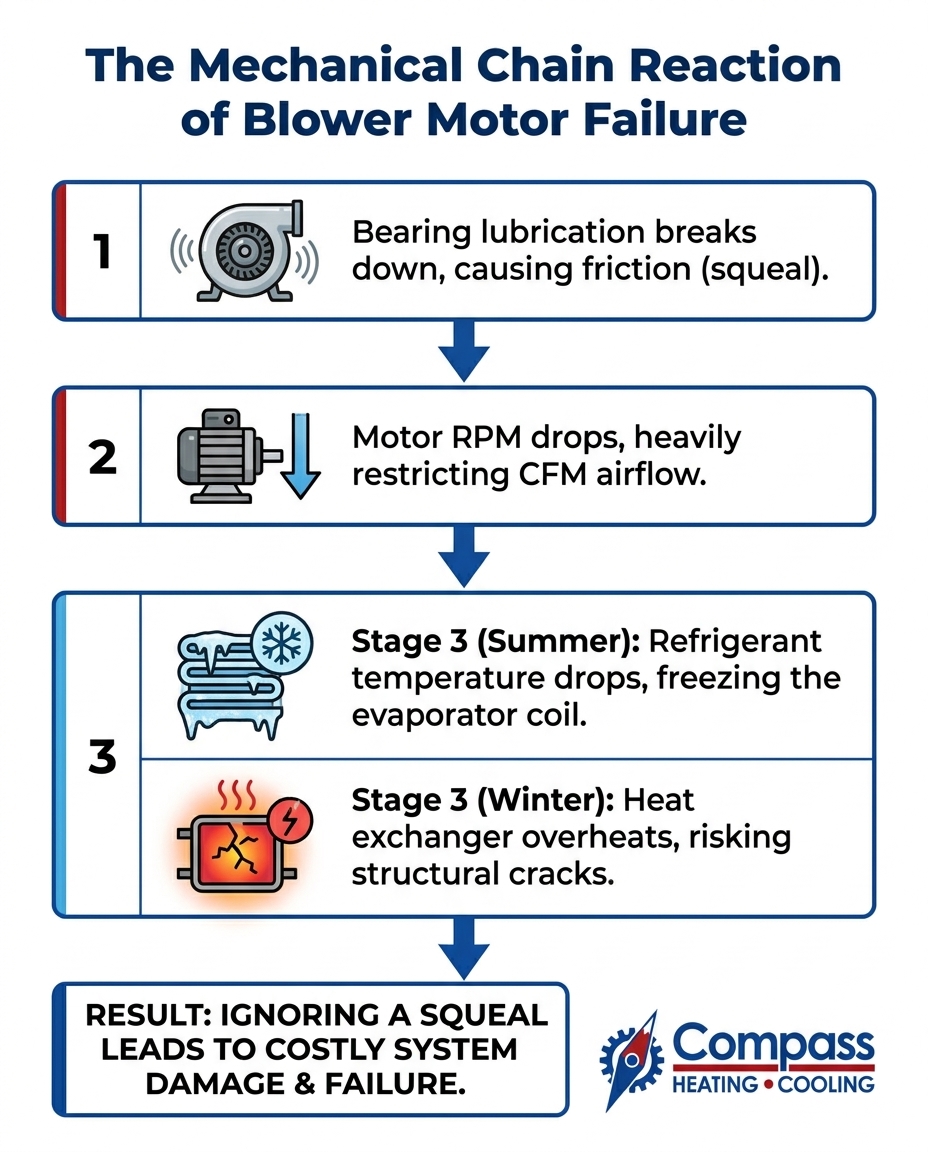
1. The Airflow Drops: The failing bearing reduces the motor's RPM, resulting in heavily restricted CFM airflow across the evaporator coil. The coil is no longer receiving enough warm indoor air to absorb.
2. The Temperature Plummets: Because the refrigerant is not absorbing enough heat, its temperature drops rapidly. The surface of the evaporator coil quickly falls below 32 degrees Fahrenheit.
3. Condensation Freezes: Normal cooling produces condensation on the coil (this is how your AC dehumidifies your home). When the coil drops below freezing, that liquid condensation instantly turns into frost.
4. The Compounding Loop: The layer of frost acts as an insulator and a physical barrier, blocking even more airflow. This causes the temperature to drop further, turning the frost into a solid block of ice.
5. The Compressor Threat: If the system continues to run, the refrigerant cannot boil off into a gas. Liquid refrigerant can then travel backward down the suction line into the outdoor compressor. Compressors are designed to pump gas, not liquid. This liquid slugging can destroy the compressor valves, ruining the most expensive component in your entire system.
Understanding this chain reaction is the key to knowing why your AC evaporator coil freezes even on the hottest days of the year. The squealing noise was your warning; the ice is the consequence.
Looking Ahead: How Summer Neglect Threatens Winter Heating
It is easy to view a squealing air conditioner as strictly a summer problem, but your HVAC system shares critical components between seasons. The exact same blower motor that pushes chilled air through your vents in August is responsible for distributing heated air throughout your home in December. If you ignore a failing bearing now because the cooling season is almost over, you are actively setting the stage for a dangerous heating failure when the cold weather arrives.
The danger of restricted airflow in winter: During the winter months, your furnace relies on the blower motor to push air over the heat exchanger. The heat exchanger is a series of metal tubes that contain the combustion gases from your burners. As the blower moves air over these hot tubes, the air warms up and travels into your home. Crucially, this airflow also keeps the metal heat exchanger from overheating.
If your blower motor is struggling with a bad bearing, it cannot move enough air to cool the metal. The heat exchanger will rapidly overheat, expanding the metal beyond its design limits. This extreme thermal stress can lead to a cracked heat exchanger. A cracked heat exchanger is not just a major repair; it is a critical safety hazard that can allow carbon monoxide to leak into your home's air supply. Fixing the blower motor now protects your heating equipment and ensures your home remains safe and warm when the seasons change.
The Diagnostic Advantage: Catching Airflow Issues Early
When faced with a strange noise from the HVAC cabinet, many homeowners take a reactive "wait until it breaks" approach. However, modern HVAC systems require proactive mechanical diagnostics to stay efficient and safe. Guesswork and simple parts-swapping often miss the underlying issues that caused the failure in the first place. A squealing motor is a symptom of a larger mechanical imbalance that requires professional tools to measure and correct.
The value of thorough diagnostics: A comprehensive diagnostic check goes far beyond just listening to the noise. A professional technician will use a multimeter to measure the electrical amperage draw of the motor, confirming exactly how much resistance the failing bearing is causing. They will also use a manometer to check the static pressure inside your ductwork, ensuring that the restricted airflow hasn't caused secondary issues. Measuring the actual CFM confirms the extent of the bearing failure and guides the repair process.
At Compass Heating & Cooling, we emphasize a thorough diagnostic approach. By accurately measuring electrical and airflow data, we ensure homeowners avoid cascading, expensive repairs through early detection. Catching a bad bearing before the motor seizes entirely allows professionals to replace the component before the evaporator coil freezes solid or the heat exchanger suffers thermal stress. Ultimately, scheduling routine HVAC maintenance is the best defense against surprise late-season mechanical failures, keeping your equipment running smoothly year-round.
Frequently Asked Questions About Blower Motor Noises
Is it safe to run my AC if it is squealing?
Running a squealing AC risks severe secondary damage to your system. The noise indicates intense mechanical friction that will eventually restrict airflow and freeze the system. Turning the unit off immediately is the best way to prevent a relatively straightforward motor replacement from turning into a catastrophic compressor failure.
What happens if a blower motor goes bad?
The motor will eventually seize entirely, stopping all air circulation throughout your home. Before seizing completely, the friction causes the motor to overheat and dramatically reduces the volume of air it can move. This lack of airflow leads to frozen evaporator coils in the summer and dangerously overheated heat exchangers in the winter.
Why does my HVAC squeal when it turns on?
Startup squeals usually indicate failing motor bearings or, in older belt-driven systems, a loose blower belt. The initial electrical torque required to spin the heavy blower wheel from a dead stop exposes the severe lack of lubrication inside the bearing housing. If the noise persists after startup, the bearing is actively grinding metal on metal.
Can a bad blower motor cause my evaporator coil to freeze?
Yes, a failing motor heavily reduces the CFM airflow moving over the evaporator coil. Without enough warm indoor air passing over the metal fins to transfer heat, the internal refrigerant temperature drops rapidly. Condensation on the coil then freezes into solid ice, which blocks airflow even further in a compounding loop.
How long does a failing blower motor bearing last?
Once a bearing starts squealing constantly, complete mechanical failure is imminent. It may continue to run for a few days or a few weeks, but it operates highly inefficiently and damages other components the entire time. Waiting for it to fail completely guarantees a sudden loss of heating or cooling when you need it most.
Protecting Your System Before the Season Ends
Ignoring a high-pitched squeal from your air handler is never a cost-saving measure. While it might seem easier to wait out the end of the cooling season, that mechanical friction is actively threatening the rest of your system. A failing bearing forces your equipment to work harder, consume more energy, and risk severe consequences like a frozen coil or a cracked heat exchanger.
Early intervention prevents these catastrophic system failures. If you hear unusual mechanical noises coming from your vents or indoor cabinet, do not wait for the airflow to stop entirely. Have your system evaluated by a professional technician to restore your airflow, protect your equipment, and secure your peace of mind before the harsh weather arrives.
hear what our satisfied clients have to say
Our clients consistently praise our exceptional service and attention to detail. They appreciate the personalized approach we take to meet their unique needs, ensuring satisfaction every step of the way.
.png)