



Why Bigger Isn't Better When Sizing a New Gas Furnace
The Common Misconception About Furnace Capacity
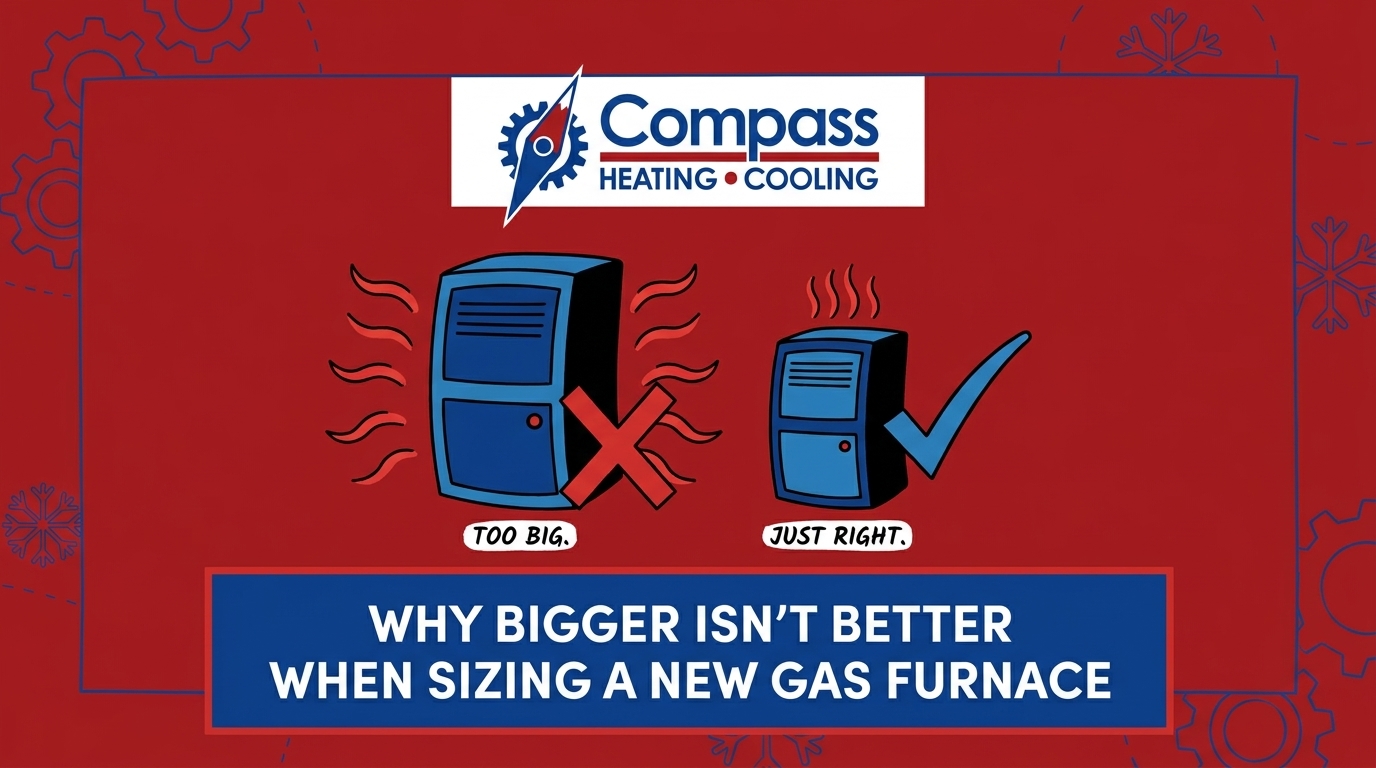
As you review quotes for a heating system replacement this early fall, you might find yourself wondering exactly why bigger isn't better when sizing a new gas furnace. It is an incredibly common assumption among the homeowners our team meets. If a 60,000 BTU (British Thermal Unit) furnace is capable of keeping your house warm, an 80,000 BTU unit should heat it up even faster, right? While that intuitive logic applies perfectly to things like car engines or internet speeds, heating systems operate on an entirely different set of physical rules.
When you partner with our crew for professional HVAC services to evaluate your home, our goal is never to install the largest piece of equipment that will fit in your utility closet. Instead, the objective is to precisely match the equipment's output to your home's specific rate of heat loss. Buying a furnace with excess capacity does not result in superior comfort. In fact, as we see all too often in the field, it triggers a destructive operational pattern known as "short-cycling."
Short-cycling occurs when a heating system blasts an overwhelming volume of hot air into the home, rapidly satisfies the thermostat, and abruptly shuts down before it has completed a full, healthy run cycle. To understand why this is problematic, it helps to look at the difference between what homeowners expect from an oversized furnace and what actually happens:
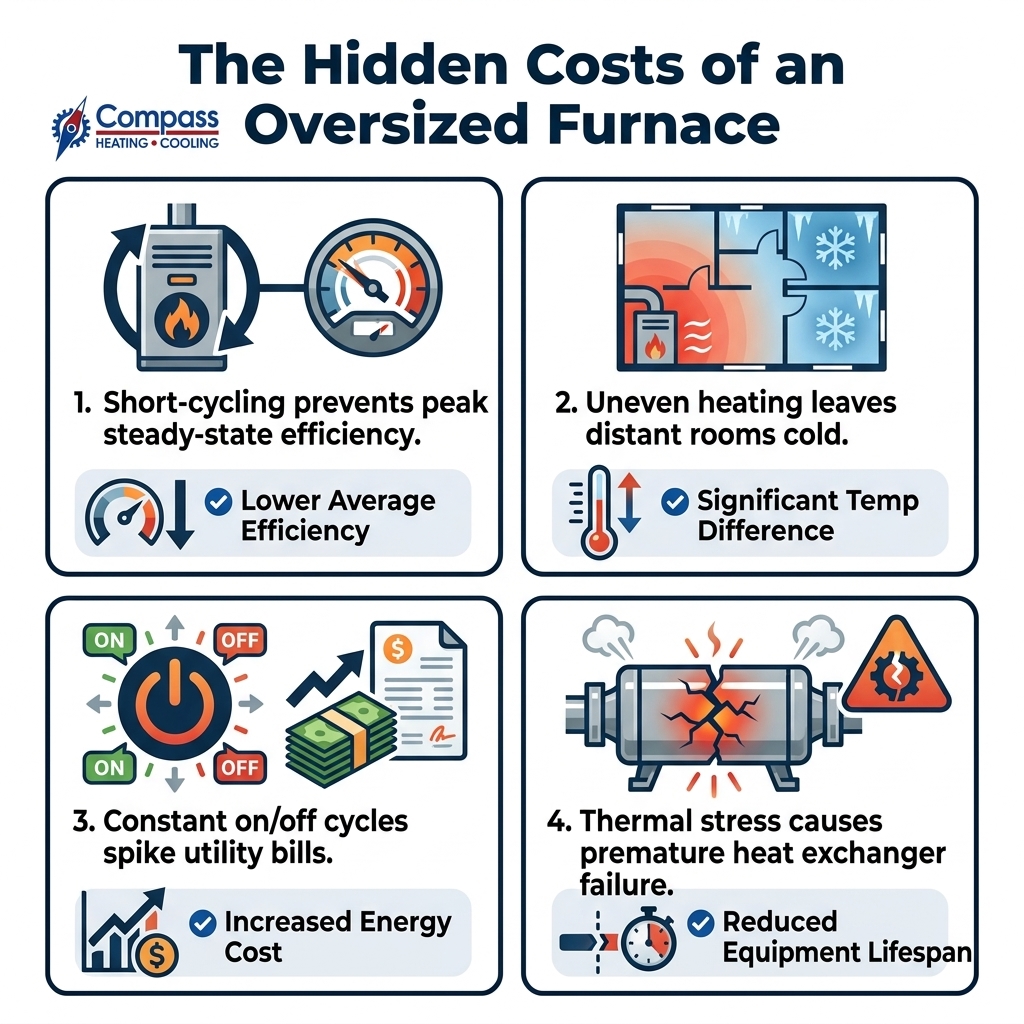
• The house will warm up evenly and quickly. — The Oversized Reality: The hallway gets hot immediately, while distant bedrooms remain freezing cold.
• A larger furnace won't have to work as hard. — The Oversized Reality: The system suffers severe mechanical stress from constantly turning on and off.
• Heating the house faster will save energy. — The Oversized Reality: Frequent start-up sequences consume significantly more fuel than steady operation.
Taking the time during the pre-heating-season to understand proper sizing ensures you are investing in a system that will actually deliver the comfort you expect, rather than one that will fight against your home's natural airflow.
Understanding Peak Operating Efficiency
To understand why proper sizing matters so much, we have to look at the physics of how a gas furnace actually works. Furnaces do not instantly reach their maximum efficiency the moment they ignite. Like a vehicle merging onto a highway, heating equipment requires a warm-up period to reach its optimal performance level.
When a new gas furnace installation is completed correctly by our technicians, the system is designed to run in long, steady cycles. During the first few minutes of operation, the burners ignite, the heat exchanger gradually warms up, and the blower motor engages to push air through the ductwork. It takes several minutes of continuous operation for the system to hit what engineers call "steady-state efficiency." This is the sweet spot where the furnace is extracting the maximum amount of heat from the gas it consumes.
The Efficiency of Long Run Cycles
In our years of serving the area, we've found that a properly sized furnace in a Loveland CO home will run for 15 to 20 minutes at a time during a typical winter day. These long, steady cycles allow the system to operate at its peak efficiency rating for the majority of its run time.
In contrast, an oversized unit acts like a sprinter in a marathon. It blasts a massive amount of heat into the ductwork, rapidly raising the temperature in the immediate vicinity of the thermostat. Within five to eight minutes, the thermostat registers that the target temperature has been reached and shuts the system down. Because the furnace spent its entire brief run cycle in the less-efficient warm-up phase, it never actually achieved its rated fuel efficiency.
The energy consumption reality: It takes a significant surge of energy to ignite the burners, start the inducer draft motor, and spin up the heavy blower fan. A furnace that runs for one 20-minute cycle consumes far less energy overall than a massive furnace that starts up and shuts down four separate times in that same 20-minute span.
The Short-Cycling Trap: When Faster Heating Backfires
The phenomenon of a furnace turning on, running for just a few minutes, and shutting off prematurely is the hallmark of short-cycling. It is the most immediate and noticeable consequence of installing an oversized heating system, and it destroys indoor comfort.
The root cause of this trap lies in how your thermostat interacts with the rest of your house. In most homes, the thermostat is located in a central hallway or a main living area. When an oversized furnace kicks on, it pushes an overwhelming volume of hot air through the vents closest to the unit. The hallway heats up incredibly fast. The thermostat reads this sudden spike in temperature, assumes the entire house is now warm, and turns the furnace off.
Our technicians know firsthand how Loveland's specific climate makes this problem unbearable. During our winter cold snaps, we experience rapid diurnal temperature drops. As the sun goes down, the outdoor temperature plummets. Your home is constantly losing heat to the outdoors. Because the oversized furnace only ran for five minutes, it only heated the air in the hallway—it didn't run long enough to actually warm up the walls, floors, and furniture.
As soon as the furnace shuts off, the heat in the hallway quickly dissipates into the freezing exterior walls. The thermostat registers the sudden drop and kicks the furnace right back on. This creates a severe "yo-yo effect" where your home rapidly swings from uncomfortably hot to uncomfortably cold.
• Constant noise disruption: You hear the loud rush of the burners and blower motor engaging every ten minutes.
• Temperature swings: The ambient temperature fluctuates by three to four degrees constantly, making it impossible to settle in comfortably.
• Spiking utility bills: The constant ignition sequences burn excessive amounts of gas, driving up your monthly energy costs without delivering actual comfort.
Why Oversized Units Leave You with Cold Rooms
When we get called out to investigate uneven heating, one of the most frustrating common HVAC sizing mistakes our team discovers is assuming a bigger furnace will finally push warm air into that one freezing back bedroom. The reality is exactly the opposite. Oversized units are the primary cause of stubborn cold spots in a home.
To eliminate cold rooms, you need consistent, sustained air circulation. The blower motor inside your furnace acts as the heart of your home's respiratory system. Its job is to push freshly heated air through the supply ducts while simultaneously pulling cold air back through the return vents to be heated. This process takes time. It requires the blower motor to run continuously to establish proper air pressure throughout the entire ductwork network.
When an oversized furnace short-cycles and shuts off after just five minutes, the blower motor stops running. It never had enough time to push warm air all the way to the furthest reaches of the home, such as an upper-level master suite or an addition over the garage. The hallway gets perfectly warm, but the distant rooms are left freezing.
The impact on air quality: Proper air distribution isn't just about temperature. During the early fall and pre-heating-season, your home relies on the furnace blower to circulate air through your HVAC filter. If the system only runs in brief five-minute bursts, the air in your distant bedrooms remains stagnant. Dust, pet dander, and allergens are never pulled back to the filter, leading to noticeably poorer indoor air quality and uneven humidity levels.
Hidden Damage: Premature Wear on Heat Exchangers
Beyond the daily frustration of uneven temperatures and high utility bills, installing a furnace that is too large carries a severe long-term financial penalty. Heating equipment is built to run continuously, not to start and stop endlessly. The startup and shutdown phases are the most mechanically stressful periods for any HVAC system.
The most critical component inside your furnace is the heat exchanger. This is a series of metal tubes or coils that safely transfer the heat from the combustion gas into the air you breathe, while keeping the toxic exhaust fumes completely separated. When the burners ignite, the metal of the heat exchanger rapidly heats up and expands. When the cycle ends and the burners shut off, the metal cools down and contracts.
If a properly sized furnace in Loveland CO runs three long cycles in an hour, the heat exchanger expands and contracts three times. If an oversized furnace short-cycles ten times in that same hour, the metal undergoes more than triple the thermal stress. Over the lifespan of the equipment, this constant, rapid expansion and contraction fatigues the metal.
The result of chronic short-cycling: Premature heat exchanger failure is one of the most common outcomes of an oversized unit. When a heat exchanger cracks from thermal fatigue, the furnace is no longer safe to operate and often requires a complete replacement. Furthermore, the constant starting and stopping places immense electrical and physical strain on the blower motor, the inducer draft motor, and the electronic igniter, leading to a much higher need for preventative furnace maintenance and frequent component repairs—a pattern our service crews see constantly.
The Science of Comfort: Manual J Load Calculations
If "rule of thumb" sizing based solely on the square footage of a home is outdated and dangerous, how do professionals determine the correct capacity? The answer lies in an industry-standard protocol known as an ACCA-approved Manual J load calculation.
At Compass Heating & Cooling, our technicians have spent years perfecting honest, custom load calculations. We believe in providing expert second opinions rather than simply upselling larger, unnecessary units. Sizing a furnace is a matter of science, not guesswork. A proper Manual J calculation evaluates the precise amount of heat your home loses to the outdoors during the coldest days in Loveland CO.
To perform this calculation accurately, our professional technicians will assess several critical variables:
1. Square footage and volume: Measuring not just the floor space, but the cubic volume of air that needs to be heated, including vaulted ceilings.
2. Insulation values (R-value): Evaluating the thickness and quality of insulation in your attic, walls, and crawlspaces to determine how quickly heat escapes.
3. Window quality and placement: Documenting the number of windows, whether they are single or double-pane, and their U-factor (how well they prevent heat loss).
4. Home orientation and solar gain: Factoring in how much natural radiant heat your home receives from the sun based on which direction the largest windows face.
5. Air infiltration rates: Assessing how tightly sealed the home is against outdoor drafts.
By inputting these specific measurements into specialized software, we determine the exact BTU capacity required to keep your home at a comfortable 70 degrees, even when the outdoor temperature drops to its lowest historical average. This meticulous calculation is the ultimate protection for your investment, ensuring you buy exactly what you need—nothing more, nothing less.
Timing Your Replacement Before the Winter Rush
Understanding the importance of load calculations highlights exactly why our team always recommends proactive planning. Rushing a furnace replacement during a mid-winter breakdown is a recipe for sizing errors. When a heating system fails entirely in January, the primary focus is simply getting the heat back on as fast as humanly possible to prevent frozen pipes.
Under that kind of emergency pressure, it is very common for contractors to skip the meticulous Manual J calculation and simply swap out the broken unit for a new one of the exact same size. If the original builder installed an oversized furnace twenty years ago, that mistake simply gets duplicated, locking the homeowner into another decade of short-cycling and cold spots.
This is why scheduling an assessment with us during the early fall or pre-heating-season is the smartest move a homeowner can make. During the milder transition months, contractors have the time to sit down, measure the home properly, evaluate the ductwork, and run accurate calculations. Deliberate planning gives you the space to review different efficiency options, explore whether generic federal tax credits or local utility incentive programs may apply to qualifying installations, understand the data behind the sizing recommendation, and make a decision that yields better comfort and long-term savings.
Frequently Asked Questions About Furnace Sizing
What happens if my furnace is too big?
It will heat the space immediately around the thermostat too quickly and shut off prematurely, a process known as short-cycling. This leads to severe temperature swings, uneven heating where distant rooms remain cold, noticeably higher energy bills, and premature wear and tear on critical mechanical components.
Why does my furnace turn on and off so quickly?
This rapid on-and-off operation is called short-cycling. While our service technicians frequently find it's caused by an oversized heating unit that satisfies the thermostat too fast, it can also be triggered by a severely clogged air filter restricting airflow or a malfunctioning thermostat.
How do I know if my furnace is oversized?
The most obvious signs include run cycles that last less than 10 minutes, noticeable cold spots in distant bedrooms, and unusually high utility bills. You may also notice that your home feels stuffy or clammy, as the system does not run long enough to properly circulate and filter the air.
Is it better to oversize or undersize a furnace?
Neither is ideal; a furnace must be precisely sized to match your home's specific heat loss. Oversizing causes destructive short-cycling and mechanical damage, while undersizing causes the unit to run continuously without ever quite reaching your desired indoor temperature during extreme cold snaps.
What is a Manual J calculation?
A Manual J calculation is an industry-standard protocol used by HVAC professionals to determine the exact heating and cooling loads of a home. Instead of guessing based on square footage, our team uses specific structural factors—like insulation levels, window quality, and local Loveland CO climate data—to recommend the perfect equipment capacity.
Take the Guesswork Out of Your Next Heating Upgrade
Ultimately, determining the right furnace size is about relying on hard science, not outdated assumptions. A properly sized unit guarantees the best possible comfort, eliminates stubborn cold spots, and ensures your equipment reaches its maximum lifespan without suffering from premature thermal fatigue.
If your current system is showing its age this early fall, don't wait for an emergency breakdown to force a rushed decision. Reach out to our heating experts in Loveland at Compass Heating & Cooling to schedule a comprehensive evaluation. By insisting on a professional, data-backed load calculation, you can invest with confidence knowing your new system will deliver perfect, efficient warmth for years to come.
hear what our satisfied clients have to say
Our clients consistently praise our exceptional service and attention to detail. They appreciate the personalized approach we take to meet their unique needs, ensuring satisfaction every step of the way.
.png)