


Why Waiting Until the First Freeze for a Furnace Check Guarantees a Delay
The Hidden Cost of Waiting for Winter Weather
September in Northern Colorado brings crisp mornings and mild afternoons, making it easy to see why waiting until the first freeze for a furnace check guarantees a delay. When the weather is still comfortable, your heating system is likely the last thing on your mind. However, this predictable seasonal shift creates a massive logistical bottleneck for homeowners who put off their annual system inspections.
A typical pattern we see is that homeowners assume they can simply call for a quick tune-up the moment their home feels chilly. The reality is far more complicated. The decision you make during the September pre-heating season—whether to schedule your inspection now or gamble on the first cold night—directly determines how long your family will wait for service.
When the first major temperature drop hits, local dispatch boards are instantly overwhelmed by an influx of "no heat" emergency calls. This sudden surge means that routine maintenance requests are immediately pushed to the back of the line. If you wait until your indoor temperature drops to seek heating services, you are no longer booking a simple tune-up; you are joining a massive queue of unprepared households all competing for the same limited number of technicians.
The Dispatch Board Reality
To understand the delay, you have to look at the numbers. A typical HVAC company might handle a steady, manageable flow of calls during the early fall. But on the morning of the first freeze, that call volume can spike by hundreds of requests within a few hours. The hidden cost of waiting isn't just a slight inconvenience—it is the very real possibility of spending days or even weeks in a freezing home while technicians work through a massive backlog of emergencies.
The Psychological Trap of Mild Autumn Afternoons
It is entirely human nature to ignore your heating system when you don't actively need it. Comfortable early autumn weather creates a false sense of security. When the sun is shining and the windows are open, the urgency of winter preparation feels miles away. This "out of sight, out of mind" mentality is the primary reason the eventual scheduling bottleneck occurs.
The final weeks of mild weather are actually the most critical window for preparation, not a time for relaxation. The September pre-heating season is the last reliable opportunity to have your system evaluated before the triage protocols take effect. When you delay maintenance because the weather is nice, you are inadvertently setting yourself up for a highly stressful situation later.
Proactive vs. Reactive Scheduling Mindsets
Understanding the difference between proactive and reactive scheduling can help you avoid the autumn trap. Here is how the two approaches typically play out:
• Proactive — Action Taken: Books inspection in September while system is dormant. — Result During First Freeze: System runs flawlessly on the first cold night; zero wait time.
• Reactive — Action Taken: Waits until the house is freezing to turn on the thermostat. — Result During First Freeze: Discovers a failure, calls for service, enters a multi-week waitlist.
• Indifferent — Action Taken: Skips maintenance entirely, assuming the system is fine. — Result During First Freeze: Risks mid-winter breakdown when emergency rates and wait times peak.
Reiterating the facts: waiting until indoor temperatures drop means joining a massive queue of unprepared homeowners. The psychological comfort of a warm autumn afternoon is temporary, but the frustration of a broken furnace during a freeze can last for weeks.
The Anatomy of a Sudden October Freeze
To fully grasp why scheduling delays are so severe in this region, you have to look at the specific climate patterns of Loveland and the Front Range. We do not typically experience a slow, gentle glide into winter. Instead, early-to-mid October often brings sudden, aggressive weather shifts.
It is incredibly common to see rapid temperature drops of 30 to 40 degrees within a single 24-hour period. You might go to sleep with the windows cracked and wake up to frost on the ground and freezing winds. This specific weather pattern is the catalyst for the dispatch chaos. Because the temperature plummets so quickly across the entire Loveland area, thousands of households walk over to their thermostats and switch them from "Cool" to "Heat" at the exact same moment.
The Regional Stress Test
In regions with more gradual seasonal transitions, heating systems are turned on sporadically over several weeks, which spreads out the inevitable repair calls. On the Front Range, the first major cold snap acts as a simultaneous stress test for every dormant system in the area.
• Instant Demand: Thousands of ignitors, blower motors, and gas valves are activated simultaneously after months of inactivity.
• Concentrated Failures: The systems that were going to fail do so all at once, creating a concentrated spike in service requests.
• Resource Strain: Local supply houses and technician schedules are instantly stretched to their absolute limits.
This rapid plunge in temperature explains why the local rush is so severe. The climate itself dictates the urgency of your preparation.
Behind the Scenes: How HVAC Dispatch Triage Actually Works
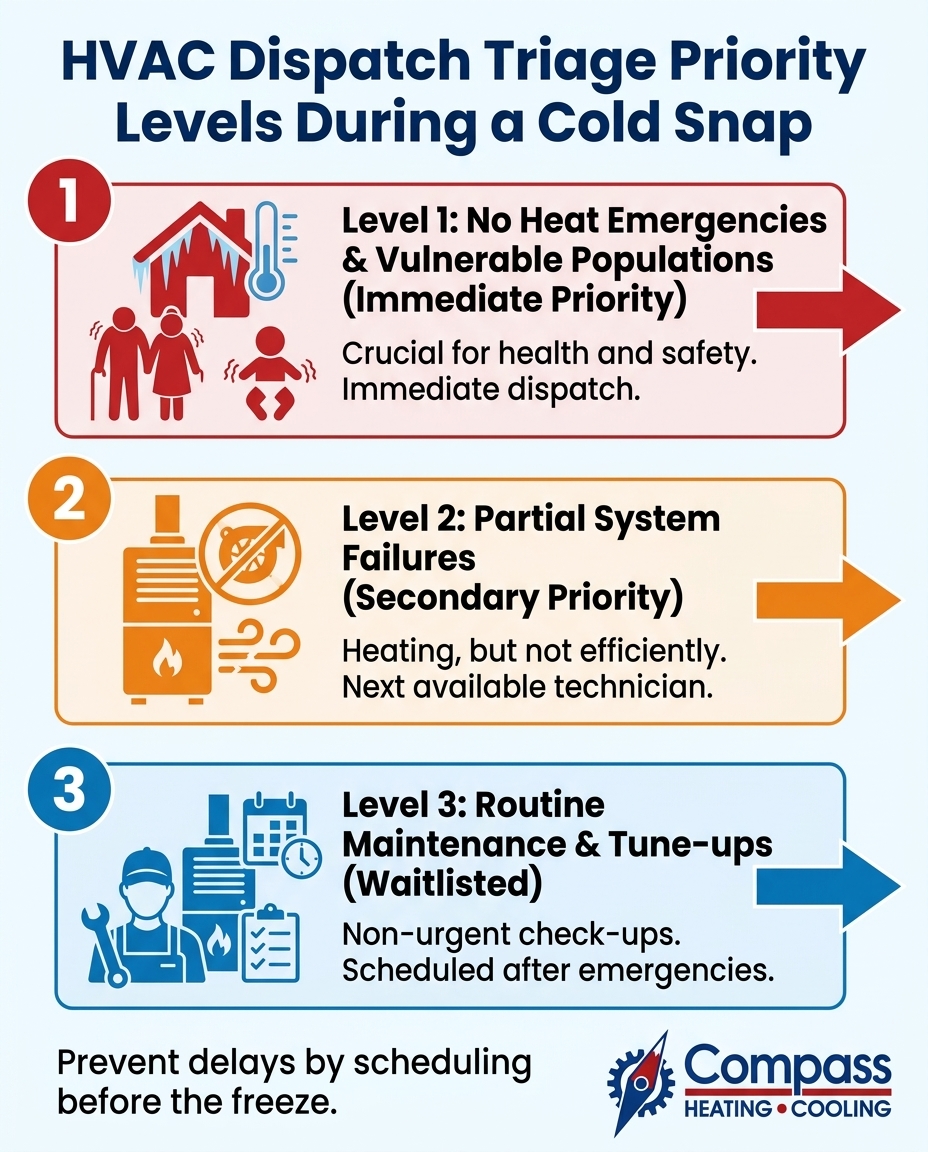
A common misconception is that HVAC companies operate on a strict "first come, first served" basis, regardless of the weather. During extreme weather events, this is simply not true. When temperatures drop below freezing and call volumes explode, dispatchers must implement an industry-standard triage hierarchy.
This triage system is a safety necessity, not a punishment for those seeking routine care. When a dispatcher in Loveland and the Front Range looks at a board with 150 pending calls, they have to prioritize situations where property damage or human health is at immediate risk. As a result, routine checks are automatically pushed to the bottom of the list.
Level 1: Total System Failures and Safety Risks
These are the absolute highest priority calls and will always bump lesser issues down the schedule. Level 1 situations require immediate dispatch to prevent severe consequences.
1. Complete "No Heat" Scenarios: Homes that have entirely lost heating capacity while outside temperatures are at or below freezing.
2. Vulnerable Populations: Households with elderly residents, infants, or individuals with specific medical needs that make cold exposure dangerous.
3. Safety Hazards: Reports of natural gas odors, sparking electrical components, or suspected carbon monoxide leaks.
Level 2: Partial Failures
Once the Level 1 emergencies are assigned, dispatchers move to Level 2. These homes have some heat, but the system is failing and requires diagnostic attention before it completely breaks down.
1. Struggling Systems: Furnaces that are running constantly but blowing lukewarm air, unable to maintain a safe indoor temperature.
2. Mechanical Distress: Systems making loud grinding, squealing, or banging noises that indicate an impending mechanical failure.
3. Intermittent Operation: Furnaces that short-cycle (turn on and off rapidly) without properly heating the space.
Level 3: Routine and Preventive Care
This is where standard seasonal checks and tune-ups fall. While preventive care is vital for long-term system health, it is not a life-safety emergency.
1. Standard Tune-Ups: Annual cleaning and inspection requests.
2. Non-Emergency Upgrades: Requests for new thermostat installations or filter changes.
3. The Bump Effect: These calls are automatically bumped down the schedule every time a new Level 1 or Level 2 call comes in.
Why Dormant Systems Often Fail on Their First Cycle
You might wonder why so many Level 1 and Level 2 calls happen on the exact same day. The answer lies in what happens inside a furnace that has sat idle for several months. During the summer, your heating equipment is essentially a magnet for household dust, pet dander, and stagnant moisture.
The Problem: When you skip your September pre-heating season check and wait for the first freeze, you are demanding immediate, high-capacity performance from a machine that hasn't stretched its mechanical legs in half a year. Dust has settled on sensitive electronic components, lubricants in the blower motor may have settled, and the flame sensor is likely coated in a microscopic layer of oxidation.
The Cause: The most common culprit for a first-cycle failure is a dirty flame sensor. When the thermostat calls for heat, the system ignites the gas. The flame sensor's job is to detect that fire and keep the gas flowing. If the sensor is dirty, it cannot feel the flame, so it shuts the system down as a safety precaution. You are left with a furnace that clicks, fires for three seconds, and then goes completely dead.
The Solution: These minor, easily preventable issues are the primary drivers of the massive emergency call volume. A proactive fall furnace tune-up resolves these invisible issues before the thermostat is ever switched to "heat." A technician cleans the sensor, tests the ignition sequence, and verifies airflow, ensuring the system fires up perfectly on the first try.
How a 24-Hour Waitlist Snowballs into Several Weeks
To truly understand the inevitability of the delay, we have to break down the math of a typical dispatch board during a sudden weather event in Loveland and the Front Range. The backlog does not just happen on day one; it compounds exponentially.
The Daily Capacity: A local HVAC branch has a fixed number of technicians. Let's say a team can safely and thoroughly complete 40 service calls in a standard workday. During a mild week, they might receive 30 calls a day, leaving plenty of room for routine maintenance.
The Cold Snap Surge: On the morning of the first major freeze, the office receives 150 calls before noon. Even with technicians working overtime and skipping lunches, they might only clear 60 of those calls. That leaves 90 households rolling over to the next day.
The Compounding Backlog:
• Day 1: 150 calls received, 60 completed. 90 roll over.
• Day 2: 100 new calls received, plus the 90 from yesterday. The board now has 190 calls. Techs clear 60. 130 roll over.
• Day 3: 80 new calls received, plus the 130 from yesterday. The board has 210 calls.
By the end of the first week of freezing temperatures, the backlog is so deep that a routine check requested during this period might not be fulfilled until late November. The technicians are physically incapable of clearing the emergency queue fast enough to get back to Level 3 routine maintenance.
Bypassing the Chaos with Proactive Scheduling
The only guaranteed way to avoid the waitlist is to book your service before the triage system is ever activated. Once the cold snap hits and the board lights up, control is out of your hands. But during the September pre-heating season, you have complete control over your scheduling.
This is where a transparent approach to scheduling makes a massive difference. Compass Heating & Cooling utilizes transparent scheduling practices to protect homeowners from being left in the cold. We believe you should know exactly where you stand and how to secure your spot. We actively encourage early booking because it allows our technicians to perform thorough, unhurried inspections without the pressure of an emergency backlog looming over them.
The Power of Priority Status
One of the most effective ways to bypass the standard first-freeze waitlist is by joining a maintenance plan. Members of these plans receive priority scheduling. This means that if a freak weather event does cause an unexpected issue with your system, your call jumps ahead of the standard non-member queue.
Positioning early action as your ultimate peace-of-mind strategy is just good homeownership. By securing your inspection while the weather is mild and leveraging the benefits of a maintenance membership, you completely remove the stress of the October rush.
Common Questions About Early Fall Heating Preparation
Many homeowners in Loveland and the Front Range have the same concerns when we discuss early preparation. Understanding the logistics behind these common questions can help you make a better decision for your home.
The Timing of Your Maintenance
Homeowners frequently wonder when the exact right time is to make the call. The most strategic window is late August through September. During this period, dispatch boards are calm, technicians have flexible availability, and any necessary replacement parts can be ordered and installed long before the overnight lows drop below freezing.
The Mechanics of the Waitlist
People are often shocked by how fast wait times spike. It is a simple matter of supply and demand colliding with extreme weather. The sudden, simultaneous failure of hundreds of dormant systems overwhelms the fixed supply of local technicians. The triage system then forces all non-emergency calls to wait until the life-safety issues are resolved.
The Risks of Skipping the Check
Some homeowners decide to skip the check entirely if they can't get an immediate appointment. This is a dangerous gamble. Skipping maintenance allows minor issues—like a failing capacitor or a hairline crack in a heat exchanger—to escalate into catastrophic breakdowns right in the middle of winter, when wait times and stress levels are at their absolute highest.
Secure Your Spot Before the Cold Snap Hits
Acting while the weather is still cooperative is the smartest move you can make for your home's comfort. Avoiding the emergency queue and the stress of a sudden breakdown is entirely within your control, provided you take action during the September pre-heating season.
Do not wait for the frost to appear on your windows to test your system. Secure your peace of mind today. We invite you to discuss your options and learn more about how a furnace maintenance plan can guarantee your priority status before the cold snap hits.
Frequently Asked Questions
Why does it take so long to get an HVAC technician in the fall?
Wait times increase dramatically because the first major cold snap causes hundreds of dormant heating systems to fail simultaneously. This sudden surge in emergency "no heat" calls overwhelms local dispatch boards. Because companies must prioritize total failures and safety risks, routine maintenance requests are pushed to the back of the line.
When should I schedule my fall furnace tune-up?
The ideal time to schedule your inspection is in September, before the overnight temperatures drop. Booking during this pre-heating season ensures you get an appointment quickly and on your schedule. It also guarantees that any necessary repairs are completed long before you actually need to rely on your furnace for warmth.
What happens if I don't get my furnace checked before winter?
Skipping your annual check leaves your system vulnerable to sudden breakdowns during peak winter months. Dust buildup on sensors, stiff motor bearings, and unchecked ignition systems are the leading causes of mid-winter failures. Furthermore, skipping maintenance can void active manufacturer warranties and allow safety issues, like carbon monoxide leaks, to go undetected.
Will turning my furnace on early damage it if the weather gets warm again?
No, briefly running your furnace for a test cycle during mild weather will not harm the equipment. In fact, running it for 15 to 20 minutes allows you to verify that the burners ignite and the blower motor engages properly. If the weather warms back up, you can simply switch your thermostat back to cooling mode without any negative impact on the system.
Do maintenance plan members really get faster service during a freeze?
Yes, priority scheduling is a standard benefit of a maintenance membership. While severe life-safety emergencies always take top priority in a triage situation, plan members are moved to the front of the line ahead of non-members for standard service calls. This priority status significantly reduces your wait time during the chaotic first weeks of freezing weather.
hear what our satisfied clients have to say
Our clients consistently praise our exceptional service and attention to detail. They appreciate the personalized approach we take to meet their unique needs, ensuring satisfaction every step of the way.
.png)