



Behind the Scenes of a Compass Heating Fall Furnace Tune-Up
Preparing for the Front Range Freeze: Why September Timing is Critical
When the September pre-heating season transition arrives, taking a journey Behind the Scenes of a Compass Heating Fall Furnace Tune-Up reveals exactly what it takes to protect your home from the unpredictable Colorado cold. The early days of autumn often bring a false sense of security, with mild afternoons masking the rapid overnight temperature drops that are right around the corner. If your heating equipment has been sitting dormant since spring, forcing it to suddenly handle a freezing night without proper preparation is a recipe for unexpected breakdowns.
There is a massive difference between a rapid, superficial visual inspection and a rigorous, professional calibration. A quick glance might confirm that the unit turns on, but it does nothing to measure the internal stresses placed on the system. Whether you rely on traditional natural gas units or complex heating systems, proactive scheduling protects your equipment from unnecessary wear and tear. By booking your service early and securing your spot on the Compass Club Maintenance Plan, you ensure your system receives this rigorous testing before the first hard freeze hits.
The Danger of the Superficial Visual Inspection
A typical pattern we see across the region is homeowners assuming that because the furnace turns on, it is ready for winter. However, rapid temperature drops in early fall place extreme stress on uncalibrated ignition systems. When a furnace fires up, the sudden introduction of high heat against cold metal causes rapid expansion. If the system is not perfectly calibrated, this expansion creates microscopic stresses that compound over time.
"A clean, calibrated furnace isn't just about seasonal energy efficiency; it is the absolute baseline requirement for safe, reliable winter operation when the temperatures plummet."
By scheduling during the September pre-heating season transition, technicians have the time to perform a comprehensive diagnostic check. This proactive approach catches minor friction points, electrical anomalies, and airflow restrictions before they escalate into full system failures on a freezing January night.
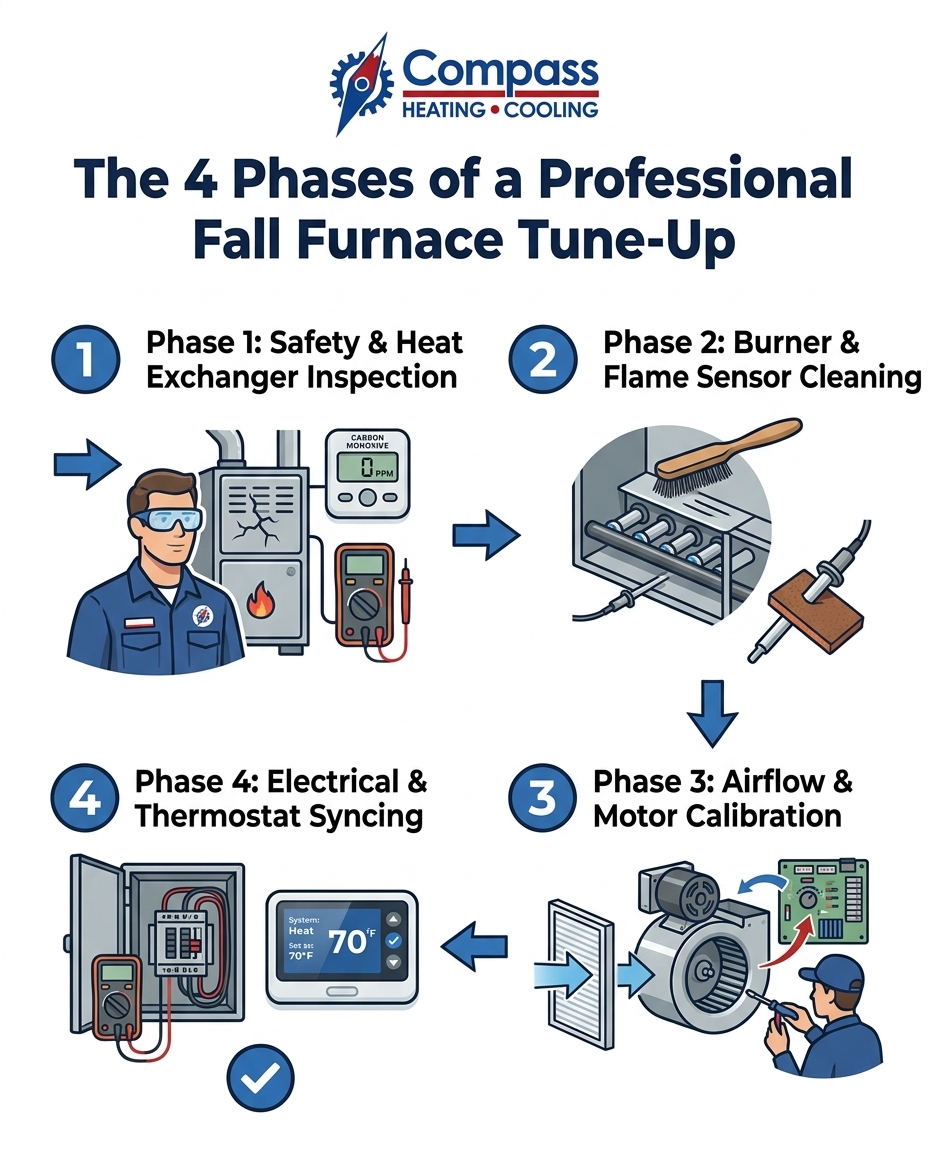
Phase 1: The Safety-First Heat Exchanger and Carbon Monoxide Inspection
The most critical phase of any professional heating maintenance visit revolves around safety. Natural gas furnaces create heat through combustion, and a natural byproduct of that combustion is carbon monoxide. The heat exchanger is the metal barrier that separates this toxic exhaust gas from the clean air circulating through your home's ductwork. Over the years, the constant cycle of heating up and cooling down causes metal fatigue, making the heat exchanger vulnerable to microscopic cracks.
Because these fractures are often invisible to the naked eye, a professional tune-up in Loveland CO and the Front Range requires specialized diagnostic tools. Technicians never rush this step, as confirming the structural integrity of the heat exchanger is non-negotiable for indoor safety.
What the Technician Tests and Verifies
• Visual chamber inspection: Using high-definition inspection cameras, the technician scopes the internal curves of the heat exchanger to look for rust, soot buildup, or visible stress fractures.
• Combustion analysis: A digital combustion analyzer is inserted into the exhaust flue to measure the exact chemical makeup of the gases leaving the system, ensuring they meet strict EPA guidelines.
• Carbon monoxide detection: Ambient and targeted carbon monoxide readings are taken around the furnace cabinet to detect any trace amounts of gas that might be escaping before reaching the flue.
• Draft pressure testing: The technician verifies that the exhaust gases are drafting properly up and out of the home, rather than spilling back into the utility room due to negative pressure.
This level of thoroughness simply cannot be performed without professional diagnostic equipment. By prioritizing the heat exchanger inspection, the technician ensures that your family's safety is verified before any performance optimizations begin.
Phase 2: Precision Cleaning of Burners and Flame Sensors
While the furnace sits idle during the spring and summer months, dust, pet dander, and airborne debris settle onto the internal components. In basements and utility closets, it is also common for small spiders to build webs inside the burner orifices. When the system fires up for the first time in the fall, this debris can interfere with the ignition sequence, causing delayed ignition or poor combustion.
During the September pre-heating season transition, technicians focus heavily on removing this summer buildup. A clean burner assembly ensures that the natural gas mixes perfectly with oxygen, creating a steady, efficient blue flame rather than a lazy, yellow flame that produces excess soot.
The Technical Cleaning Process
1. Isolating the gas supply: The technician begins by safely shutting off the gas valve and disconnecting the power to ensure the system cannot fire during the cleaning process.
2. Extracting dormant debris: Using specialized brushes and high-powered vacuums, all dust, cobwebs, and buildup are carefully removed from the burner assembly and surrounding cabinet.
3. Polishing the flame sensor: The flame sensor is a critical safety device that proves a flame is present. The technician uses a specialized abrasive pad to gently remove the microscopic layer of oxidation that forms on the sensor rod over the summer.
4. Verifying the microamp signal: Once reassembled, the technician uses a multimeter to measure the electrical current (measured in microamps) traveling through the flame sensor to guarantee it will not cause the system to short-cycle.
5. Observing the flame characteristics: The system is test-fired so the technician can visually confirm a crisp, blue flame that travels smoothly across all burner ribbons without hesitation.
When these components are meticulously cleaned, the system uses less fuel to generate the same amount of heat. This direct connection between clean internal components and seasonal energy efficiency is why proactive maintenance is highly recommended by the Department of Energy.
Phase 3: Airflow Calibration and Blower Motor Optimization
Heat generation is only half of the equation; delivering that heat evenly throughout the home is equally important. The blower motor is the workhorse of your HVAC system, responsible for pushing conditioned air through the ductwork and pulling return air back through the filter. For Loveland homeowners, the local elevation and dry climate increase the workload on blower motors, making fall calibration an absolute necessity.
When a blower motor struggles against dirty filters or restrictive ductwork, it has to work significantly harder. This extra effort requires more electricity, which generates excess heat within the motor itself. Over time, this combination of heat and friction leads to premature motor failure.
Measuring the System's Blood Pressure
Static pressure testing is a critical part of airflow calibration. You can think of static pressure as the blood pressure of your HVAC system. The technician inserts digital manometers into the supply and return plenums to measure how much resistance the air is facing. If the static pressure is too high, it indicates a restriction—often caused by an excessively dense air filter, closed vents, or undersized ductwork.
Next, the technician assesses the amp draw of the blower motor. By clamping a multimeter around the motor's power wires, they can measure exactly how much electricity the motor is pulling while under load. If the amp draw is approaching the manufacturer's maximum limit, it is a clear warning sign that the motor is failing or struggling against severe airflow restrictions.
For older systems equipped with non-sealed motors, the technician will also perform a precise lubrication process. Adding the correct amount of specialized oil to the motor ports reduces internal friction, allowing the bearings to spin freely and extending the operational lifespan of the equipment. Finally, the filter housing is inspected to ensure a tight seal, preventing unconditioned, dusty air from bypassing the filter and coating the blower wheel.
Phase 4: Electrical Connection Testing and Thermostat Syncing
Furnaces are powerful machines that vibrate slightly every time they run. Over months and years of operation, this constant, subtle vibration can cause wire nuts, spade terminals, and grounding screws to slowly back out. A loose electrical connection is more than just a nuisance; it creates electrical resistance. Resistance generates heat, which can lead to voltage drops, blown fuses, or even melted wiring harnesses.
Securing these connections is a vital step in preparing for the September pre-heating season transition. A technician will methodically trace the internal wiring diagram, testing and tightening every connection to ensure flawless communication between the system's components.
Safeguarding the Furnace's Internal Logic
• Tightening terminal blocks: The technician secures all high-voltage and low-voltage connections on the main control board to prevent intermittent power loss.
• Testing the high limit switch: This crucial safety device shuts down the burners if the internal temperature of the furnace gets too high. The technician tests its responsiveness to ensure it will trip exactly when it is supposed to.
• Testing the rollout switch: If a blockage in the flue causes flames to roll backward out of the combustion chamber, this switch instantly cuts the gas supply. Verifying its operation is a mandatory safety check.
• Measuring capacitor capacitance: For systems with blower motor capacitors, the technician measures the microfarad rating to ensure the capacitor is delivering the proper voltage jolt to start the motor.
• Thermostat calibration: The technician verifies that the indoor temperature displayed on the thermostat perfectly matches the actual room temperature, ensuring the firing sequence aligns with your comfort settings.
Precise electrical syncing does more than prevent unexpected winter breakdowns; it extends the lifespan of the entire HVAC unit by ensuring that every component operates in perfect harmony, exactly as the manufacturer intended.
The Compass Heating Difference: Radical Transparency Over Shortcuts
The HVAC industry is unfortunately filled with "tune-up" specials that amount to little more than a technician shining a flashlight into the cabinet and changing the air filter. A generic 10-minute visual check provides zero diagnostic data and offers no real protection against the harsh winter weather typical of Loveland CO and the Front Range.
Radical transparency is the core differentiator of a true professional service. By providing this exact, step-by-step checklist, homeowners are empowered to understand the profound value of the work being performed. When a technician spends 60 to 90 minutes testing, cleaning, and calibrating, they are gathering measurable data that proves the system is safe and efficient. If you find yourself wondering, "do I really need a furnace tune-up?", the answer lies in the data. No corners are cut, and no safety checks are skipped.
Comparing the Maintenance Approaches
• Heat Exchanger — Generic 10-Minute Check: Quick visual glance with a flashlight. — Compass Heating Calibration: Digital combustion analysis and camera inspection.
• Burners & Sensors — Generic 10-Minute Check: Left untouched unless visibly failing. — Compass Heating Calibration: Precision cleaning and microamp testing.
• Airflow — Generic 10-Minute Check: Swapping the air filter. — Compass Heating Calibration: Static pressure testing and motor amp draw measurement.
• Electrical Safety — Generic 10-Minute Check: Assuming connections are fine if the unit runs. — Compass Heating Calibration: Tightening all terminals and testing limit switches.
This documented, data-driven approach builds lasting trust. Homeowners receive a clear baseline of their system's health, making it easier to track wear and tear over the years and plan for future upgrades without being caught off guard.
Frequently Asked Questions About Fall Furnace Maintenance
What does a professional furnace tune-up consist of?
A professional furnace tune-up consists of a comprehensive, multi-point calibration of your entire heating system. It begins with comprehensive safety testing of the heat exchanger to rule out carbon monoxide leaks. The technician then performs precision cleaning of the burners and flame sensors, followed by electrical testing and airflow calibration to ensure the system operates at peak seasonal efficiency.
What is the difference between a furnace inspection and a tune-up?
The short answer is that an inspection is primarily a visual check for obvious safety hazards or immediate failures. A tune-up, on the other hand, is a deep mechanical intervention that includes proactive cleaning, lubrication, and mechanical adjustments to actively improve performance. While an inspection tells you if the system is currently broken, a tune-up helps prevent it from breaking in the future.
How long does a furnace tune-up take?
A thorough, professional tune-up typically takes 60 to 90 minutes to complete properly. This timeframe allows the technician to perform rigorous testing of all safety and performance metrics without rushing. If a maintenance visit is completed in 15 minutes, it is highly likely that critical diagnostic steps and internal cleanings were skipped.
Do I really need a furnace tune-up every year?
Yes, annual maintenance is strongly recommended by the Department of Energy and nearly all equipment manufacturers. Yearly service maintains your system's energy efficiency, prevents unexpected mid-winter breakdowns, and ensures that dangerous issues like cracked heat exchangers are caught early. Furthermore, skipping annual maintenance can often void the manufacturer's warranty on the equipment.
Why is fall the best time for furnace maintenance?
Fall is the ideal time because it allows technicians to clear out the summer dust buildup before the system is forced to run continuously. Scheduling during the September pre-heating season transition ensures your system is safe, calibrated, and fully operational before the freezing overnight temperatures arrive. It also allows you to address minor repairs before the peak winter rush when service schedules are heavily booked.
Secure Your Winter Comfort Before the Temperature Drops
Understanding what happens during a professional maintenance visit provides incredible peace of mind. For homeowners in Loveland CO and the Front Range, knowing that every electrical connection is tight, every sensor is clean, and the heat exchanger is structurally sound means you can face the winter weather with complete confidence. Radical transparency in this process proves that thoroughness and expertise are the best defenses against unexpected cold-weather breakdowns.
Do not wait until the first hard freeze forces your system to struggle. Take control of your home's comfort and safety by scheduling your comprehensive fall calibration today. By enrolling in an ongoing maintenance plan, you guarantee that your heating system will always receive the rigorous, data-driven attention it needs to keep your family warm, safe, and comfortable all season long.
hear what our satisfied clients have to say
Our clients consistently praise our exceptional service and attention to detail. They appreciate the personalized approach we take to meet their unique needs, ensuring satisfaction every step of the way.
.png)