



Modulating vs Two-Stage Furnaces for Consistent Comfort in Multi-Story Homes
The Myth of the "Bigger" Furnace for Multi-Story Homes
A pervasive myth among homeowners is that if the downstairs is freezing while the upstairs is sweltering, the solution is simply a larger capacity system. When evaluating Modulating vs Two-Stage Furnaces for Consistent Comfort in Multi-Story Homes, the truth is often the exact opposite. Many homeowners assume that cold lower levels and excessively warm upper floors indicate an undersized heating unit struggling to keep up with the square footage. In reality, temperature imbalances in multi-level architectures are rarely a capacity issue; they are almost always a symptom of poor staging and inadequate continuous airflow.
Solving this frustrating dynamic requires shifting the focus away from raw heating power and toward advanced technologies designed to manage air distribution continuously. Standard single-stage systems blast heat at maximum capacity and then shut down entirely, allowing the air to separate by temperature. Addressing this requires choosing the right hardware to keep the air mixed. Taking action and planning your heating installation and replacement during the early fall pre-heating season allows for a proactive approach. By evaluating your options before freezing temperatures arrive, you can address these architectural flaws without the pressure of an emergency breakdown.
The Physics of Heat Stratification in Multi-Level Architecture
To understand why specific furnace technologies are necessary for homes with more than one floor, it helps to examine the underlying physics of how heat moves through a building. Advanced hardware like a modulating gas valve is engineered specifically to combat the natural behavior of heated air in complex architectural spaces.
Understanding the Stack Effect
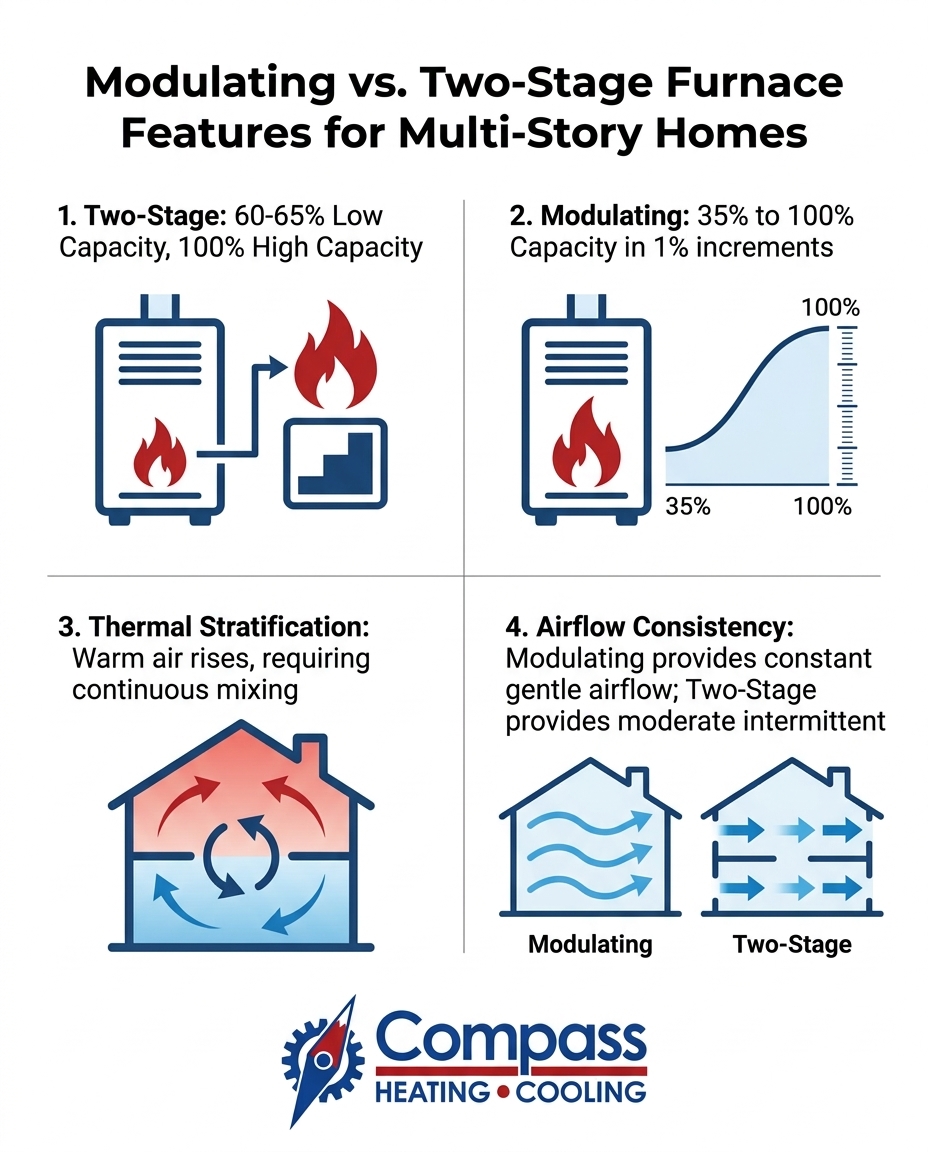
Thermal stratification, often referred to in residential architecture as the stack effect, is the scientific principle driving multi-story temperature imbalances. Because warm air is less dense than cold air, it naturally rises to the highest possible point in an enclosed space. In homes with open stairwells, vaulted ceilings, or two-story foyers, these architectural features act like massive internal chimneys. The warm air generated by the furnace bypasses the ground floor and pools at the highest ceilings, leaving the basement and main living areas feeling drafty and cold, while the bedrooms upstairs become uncomfortably hot.
The Problem with Intermittent Airflow
Traditional single-stage furnaces exacerbate the stack effect rather than solving it. A standard unit operates on a simple on/off paradigm: it runs at 100% capacity until the thermostat registers the target temperature, and then it shuts off completely. This intermittent airflow creates a cycle of extremes. You get a sudden blast of heat, followed by a long period of silence where the air is allowed to settle. During the off-cycle, the warm air rises and the cold air sinks, completely undoing whatever minor mixing occurred while the blower was running. When diagnosing temperature imbalances in tri-level homes, this lack of continuous air mixing is almost always the primary culprit.
How Two-Stage Furnaces Operate: The High/Low Approach
As the baseline upgrade from standard single-stage equipment, two-stage furnaces introduce a new level of control over how heat is delivered throughout the house. Instead of a simple on/off switch, these systems feature a gas valve and blower motor capable of operating at two distinct levels of output.
1. The Low Stage (60-65% Capacity): Under normal winter conditions, the furnace will activate its first stage. Operating at roughly two-thirds of its total capacity, the system produces a gentler, quieter flow of warm air. Because the output is lower, the furnace must run for a longer duration to meet the thermostat's demand.
2. Extended Air Mixing: These longer run cycles are the key to reducing temperature imbalances. By keeping the blower motor running for extended periods, the system continuously pushes air through the ductwork, forcing the warm air upstairs to mix with the cooler air downstairs.
3. The High Stage (100% Capacity): The second stage is held in reserve for extreme conditions. If the outdoor temperature drops sharply, or if the system needs to recover from a deep overnight setback where the thermostat was lowered significantly, the furnace will engage full capacity to heat the home rapidly.
4. Proactive Evaluation: Assessing the benefits of this high/low approach during the early fall pre-heating season gives homeowners the necessary time to weigh the cost-to-benefit ratio of upgrading their staging technology.
While a two-stage system is a massive improvement over single-stage units, it still relies on distinct steps in heating output, which may not be enough to completely equalize temperatures in highly complex floor plans.
The Mechanics of a Modulating Gas Valve
For homes where thermal stratification is severe, a modulating gas valve represents the pinnacle of residential heating technology. Unlike a two-stage unit that only has two gears, a modulating furnace operates much like the accelerator pedal in a car, providing a continuous, highly precise output of heat.
A modulating gas valve adjusts its heating capacity in increments as small as 1%, typically ranging from roughly 35% to 100% of its total power. This micro-adjustment capability means the furnace can perfectly match the exact heat loss of the home at any given moment. In regions like Northern Colorado, where rapid temperature shifts caused by Chinook winds are common, this real-time adaptability is vital. A standard furnace might short-cycle—turning on and off rapidly—when the outdoor temperature spikes unexpectedly. A modulating system simply dials back its output to a low, continuous hum, preventing short-cycling while maintaining the indoor temperature within half a degree of the thermostat setting.
Continuous Air Mixing
The true power of a modulating gas valve is realized when it is paired with a variable speed ECM (Electronically Commutated Motor) blower. Because the gas valve can operate at such low capacities, the blower motor can also run at a continuous, ultra-low speed. This constant, gentle air circulation actively fights thermal stratification. By never allowing the air to sit still, the system prevents the warm air from pooling upstairs and the cold air from settling in the basement. This continuous operation virtually eliminates the noticeable temperature swings and drafts that occur between the heating cycles of lesser units.
Side-by-Side Comparison: Modulating vs Two-Stage Furnaces for Consistent Comfort in Multi-Story Homes
When bottom-funnel readers are preparing to make a significant investment in their home's infrastructure, understanding the direct differences between these two advanced staging technologies is critical. Both offer substantial improvements over basic single-stage models, but they serve different levels of architectural complexity.
• Heating Capacity Control — Two-Stage Furnace: Two fixed settings (typically 65% and 100%). — Modulating Furnace: Continuous adjustments in 1% increments (35% to 100%).
• Temperature Consistency Across Floors — Two-Stage Furnace: Moderate improvement; longer cycles mix air better than single-stage. — Modulating Furnace: Exceptional; continuous low-speed operation actively prevents stratification.
• Energy Efficiency (AFUE) — Two-Stage Furnace: High efficiency, often reaching 90% to 96% AFUE. — Modulating Furnace: Maximum efficiency, frequently achieving 97% to 98.5% AFUE.
• Handling Rapid Weather Shifts — Two-Stage Furnace: Good, but may occasionally short-cycle during mild temperature swings. — Modulating Furnace: Superior; real-time micro-adjustments prevent short-cycling entirely.
• Best Architectural Fit — Two-Stage Furnace: Standard two-story homes with moderate temperature imbalances. — Modulating Furnace: Complex multi-level homes, open floor plans, and vaulted ceilings.
Ultimately, while a two-stage unit is an excellent upgrade that provides reliable comfort, the modulating gas valve remains the ultimate solution for complex multi-level architectures that suffer from severe heat stratification.
Why Proper Sizing and Airflow Diagnostics Matter More Than the Unit
It is a hard truth in the HVAC industry that simply installing a high-end furnace will not fix fundamental airflow restrictions or poorly designed ductwork. The most advanced staging technology in the world cannot deliver consistent comfort if the underlying delivery system is compromised.
• Comprehensive Airflow Diagnostics: Before selecting a unit, a thorough assessment of the existing ductwork is necessary. Static pressure tests reveal if the ducts are too small, blocked, or leaking, all of which will throttle the performance of a new system.
• Precise Manual J Load Calculations: Sizing a system correctly for a multi-story layout requires strict mathematical calculations. A Manual J calculation accounts for square footage, window quality, insulation levels, and the specific orientation of the house to determine the exact heating load required.
• Overcoming Architectural Challenges: Compass Heating & Cooling's deep expertise in diagnosing airflow issues and properly sizing systems ensures that the unique, multi-story architectures specific to Northern Colorado receive the exact equipment specifications needed for balanced comfort.
• Proactive Scheduling: Encouraging homeowners to schedule these complex diagnostics during the early fall pre-heating season ensures there is ample time to design a proper solution before emergency replacements force a rushed decision.
Without these critical steps, even a top-tier modulating system will fail to perform efficiently. Relying on professional heating services in Loveland guarantees that the equipment matches the precise physical requirements of your home.
Long-Term Efficiency and Energy Incentive Considerations
Upgrading to advanced staging equipment involves upfront considerations, but the long-term operational costs are where these systems truly prove their value. A common misunderstanding is that a furnace running continuously will result in massive utility bills. In reality, the continuous low-speed operation of advanced variable-speed blowers can actually reduce electrical consumption compared to traditional systems that constantly start and stop. The initial surge of electricity required to start a standard blower motor repeatedly throughout the day draws significantly more power than an ECM motor quietly maintaining a low-speed continuous fan setting.
Furthermore, a modulating gas valve maximizes fuel utilization. By only burning the exact amount of gas required to maintain the temperature, these systems waste virtually zero fuel, often achieving the highest possible Annual Fuel Utilization Efficiency (AFUE) ratings on the market. Because of this exceptional performance, qualifying high-efficiency furnace installations may be eligible for generic federal tax credits or local utility rebate programs aimed at reducing energy consumption. Homeowners are advised to consult with their HVAC technician during their routine furnace maintenance or speak with a tax professional to verify which current generic incentive programs might apply to their specific upgrade.
Frequently Asked Questions About Multi-Story Home Heating
What is the difference between a 2 stage and modulating furnace?
The primary difference lies in how they control their heat output. A two-stage furnace operates at two distinct levels—typically a low setting around 65% capacity and a high setting at 100%. A modulating furnace, however, adjusts its output continuously in increments as small as 1%, ranging from roughly 35% to 100% capacity. This allows the modulating system to match the home's heating needs precisely, resulting in smoother temperature control.
Which furnace is best for a multi-story home?
A modulating furnace is generally the best option for multi-story homes experiencing significant temperature imbalances. Because warm air naturally rises to upper floors, the continuous, low-speed air circulation provided by a modulating system actively mixes the air across all levels. This constant airflow prevents thermal stratification, ensuring the basement, main floor, and upper bedrooms maintain a consistent temperature.
How does a modulating gas valve work?
A modulating gas valve works by constantly communicating with the thermostat to monitor the exact temperature of the home. Instead of opening fully or closing completely, the valve opens and closes in tiny increments to restrict or increase the flow of gas to the burners. This means the furnace can produce a highly specific amount of heat, adjusting in real-time to subtle changes in indoor temperature or outdoor weather conditions.
Does a 2-stage furnace run all the time?
No, a two-stage furnace does not run all the time, but it does run for much longer cycles than a traditional single-stage furnace. When operating on its low stage, it produces less heat, which means it takes longer to satisfy the thermostat's setting. These extended run times are beneficial because they provide more consistent air filtration and better temperature distribution throughout the ductwork.
Is a modulating furnace worth the investment for a two-story house?
If your two-story house suffers from noticeable cold spots on the ground floor and excessive heat upstairs, a modulating furnace is often worth the investment. The enhanced comfort, elimination of drafty periods, and reduction in operational noise provide a significantly improved living environment. Additionally, the long-term energy savings from the highly efficient variable-speed motor and precise fuel usage help offset the initial installation costs over the lifespan of the unit.
How does variable speed blower technology complement furnace staging?
Variable speed blower technology is the critical partner to advanced furnace staging. While the gas valve controls the amount of heat generated, the variable speed blower controls how that heat is distributed. By adjusting its fan speed to match the heat output perfectly, it ensures a constant, whisper-quiet flow of air that keeps temperatures perfectly balanced across every room without the sudden, noisy rush of air associated with older systems.
Secure Consistent Comfort Before Winter Arrives
Achieving perfectly even temperatures across multiple floors requires moving beyond basic heating solutions and investing in the right staging technology. Whether you choose the reliable high/low operation of a two-stage unit or the ultra-precise control of a modulating gas valve, upgrading your system is the most effective way to combat the natural physics of heat stratification in complex homes.
Taking action during the early fall pre-heating season ensures your home is fully prepared before sudden temperature drops put your comfort at risk. If you are tired of freezing downstairs while sweltering upstairs, schedule a professional evaluation of your entire HVAC system. A thorough diagnostic of your ductwork and architectural layout will determine exactly which staging option will finally deliver the consistent, balanced warmth your multi-story home deserves.
hear what our satisfied clients have to say
Our clients consistently praise our exceptional service and attention to detail. They appreciate the personalized approach we take to meet their unique needs, ensuring satisfaction every step of the way.
.png)