



What to Do When Your AC Condensate Drain Line Clogs and Overflows
Discovering a Puddle Around Your Furnace in Peak Cooling Season
Knowing exactly what to do when your AC condensate drain line clogs and overflows is critical when you suddenly find water pooling around your basement furnace. You walk downstairs to grab something from storage, only to step into a growing puddle spreading across the concrete floor right next to your HVAC equipment. The immediate reaction is often panic. Because the water is pooling near the base of the furnace, many homeowners assume their heating system has suffered a catastrophic failure or that a major plumbing pipe has burst behind the drywall.
If you are dealing with a sudden overflow, securing professional air conditioning services is the safest way to resolve the underlying blockage before secondary damage occurs.
However, during the peak of the cooling season, this specific type of indoor leak often stems from a much different source: a backed-up air conditioning system. Throughout August late-summer heavy condensation periods, your central AC works overtime to pull heat and humidity out of your home's air. All that extracted moisture has to go somewhere. It drips into a drain pan and flows outside through a narrow PVC pipe. When that pipe becomes obstructed, the water backs up, overflows the pan, and cascades down the side of your furnace cabinet onto the floor.
Why It Looks Like a Heating Problem
The confusion happens because the air conditioner's indoor component—the evaporator coil—usually sits directly on top of or right next to the furnace blower motor. They share the same ductwork and the same cabinet space. When the AC drain pan overflows, gravity pulls that water straight down the exterior (and sometimes interior) of the furnace. While the puddle looks like a heating disaster, it is actually a cooling system drainage failure.
The good news: While an overflowing drain line is stressful and requires immediate attention, it is a highly common issue that can be resolved without replacing major equipment—provided you take the right triage steps and avoid making the problem worse with risky do-it-yourself repair attempts.
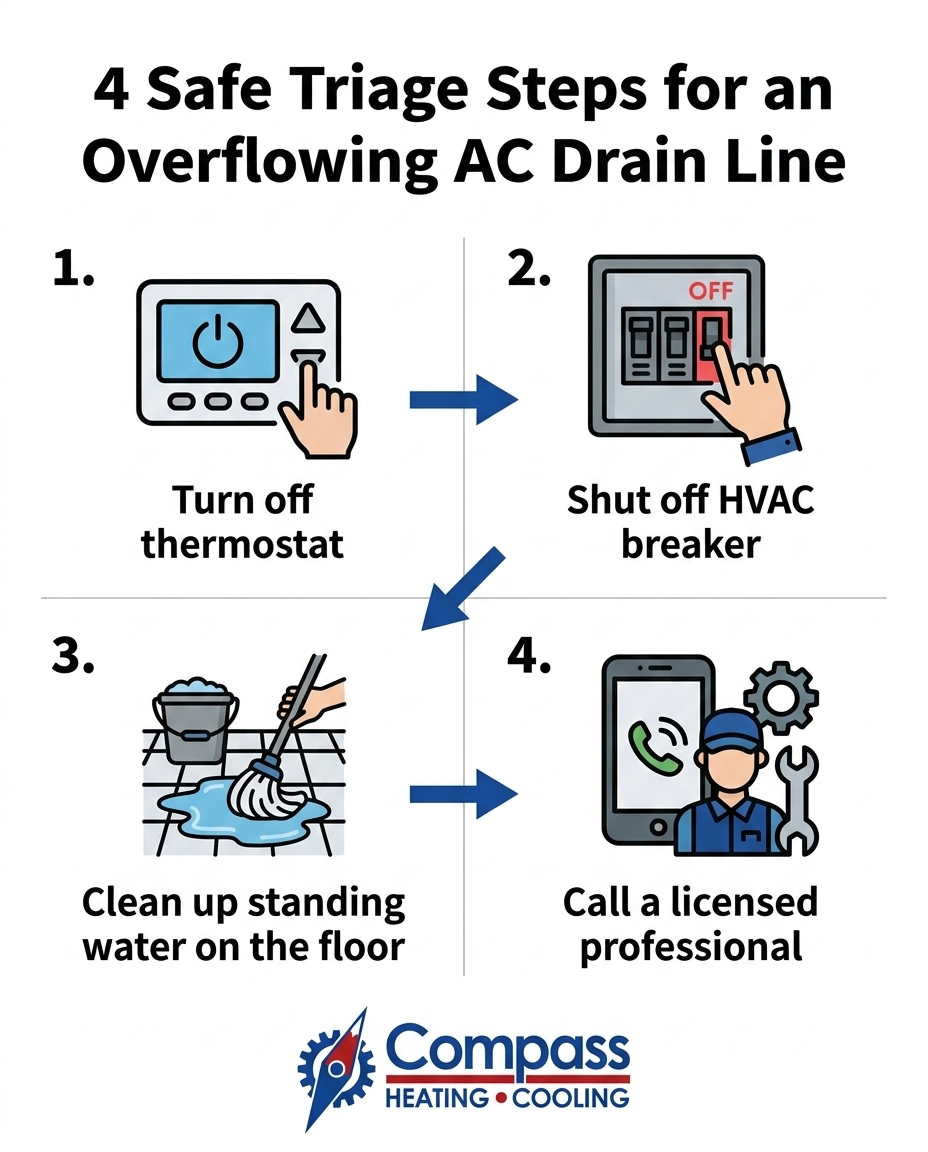
4 Immediate Safe Actions for an Overflowing AC Drain Line
When you discover standing water near your HVAC equipment, your primary goal is safe damage mitigation. You need to stop the flow of water and protect your basement without attempting to disassemble the air conditioner or force the clog out yourself. The following four steps will help you stabilize the situation while you wait for professional HVAC technicians in Loveland to arrive.
1. Step 1: Turn off the AC at the thermostat immediately.
The very first thing you must do is stop the system from producing more moisture. As long as the air conditioner is running, it will continue to extract humidity from the air and dump it into the overflowing drain pan. Switch your thermostat from "Cool" to "Off." Do not simply raise the temperature setting; turn the system completely off to ensure the cooling cycle stops instantly.
2. Step 2: Shut off the breaker to the HVAC system.
Water and high-voltage electricity are a dangerous combination. Your furnace and air handler operate on dedicated electrical circuits. Because water is pooling around the base of the unit, you need to eliminate any risk of electrical shock before you begin cleaning up the puddle. Go to your home's main electrical panel and flip the breaker for the HVAC system to the "Off" position.
3. Step 3: Clean up the standing water on the floor.
Once the power is safely disconnected, focus entirely on removing the standing water from the basement floor. Use heavy absorbent towels, a mop, or a standard wet/dry shop vacuum to extract the puddle. Crucial rule: Only use the vacuum on the floor. Never attempt to apply a wet/dry vacuum to the PVC drain pipe, the drain pan, or any part of the mechanical equipment itself. Your goal is simply to dry the concrete or flooring to prevent water from wicking into nearby drywall or personal belongings.
4. Step 4: Contact a licensed professional.
With the water cleaned up and the system safely powered down, it is time to call in the experts. Compass Heating & Cooling provides rapid, professional expertise to quickly diagnose the blockage, clear the line safely, and resolve water issues before secondary basement damage occurs. A licensed technician has the specialized suction tools and knowledge required to clear the obstruction without cracking the delicate plastic fittings or damaging the evaporator coil.
Why DIY Drain Line Clearing Hacks Risk Your HVAC System
If you search online for solutions to a clogged condensate line, you will quickly find hundreds of videos and articles recommending various do-it-yourself "hacks." These range from pouring harsh chemicals down the access port to attaching a high-powered shop vacuum directly to the delicate PVC piping. While these methods might seem like a quick way to save time, they introduce severe risks to your HVAC system, your indoor air quality, and your wallet.
Routine AC maintenance performed by a licensed professional is the only safe way to keep these lines clear. Attempting mechanical repairs yourself often crosses the line from safe homeowner triage into dangerous territory.
The Danger of Harsh Chemicals
One of the most common myths is that pouring bleach or concentrated vinegar into the drain line will dissolve the clog. Here is why professionals strongly advise against this:
• Material degradation: The condensate drain line is made of thin PVC plastic. Over time, pouring concentrated bleach into this pipe can cause the plastic to become brittle, crack, and fail, leading to leaks hidden inside your walls.
• Indoor air quality risks: The drain pan is located inside your air handler, directly in the path of the air blowing into your home. If you pour harsh chemicals into the pan or the access pipe, the fumes can be picked up by the blower motor and circulated through every room in your house.
• Corrosion of metal parts: If bleach splashes onto the aluminum fins of the evaporator coil, it can cause rapid corrosion, leading to refrigerant leaks and catastrophic system failure.
The Risks of Using a Wet/Dry Vacuum on the Unit
Another popular DIY tip suggests hooking a wet/dry vacuum to the outside termination point of the drain pipe to suck the clog out. This is highly risky for an untrained homeowner. The PVC joints are often not glued at the access points to allow for professional servicing. Applying intense suction can pull these joints apart inside the wall or cabinet, causing the pipe to disconnect entirely. Furthermore, if you accidentally apply suction or pressure to the wrong port, you can damage the drain pan itself.
• Turning off the thermostat — Homeowner Safety Level: Completely Safe — Risk to HVAC System: None (Protects the system)
• Wiping up water on the floor — Homeowner Safety Level: Completely Safe — Risk to HVAC System: None (Prevents property damage)
• Pouring bleach into the drain pipe — Homeowner Safety Level: Dangerous — Risk to HVAC System: High (Chemical corrosion, brittle PVC)
• Using a shop vac on the AC piping — Homeowner Safety Level: Dangerous — Risk to HVAC System: High (Cracked pipes, disconnected joints)
Finally, performing unlicensed mechanical repairs on your air conditioning system can void your manufacturer's warranty. If a DIY clearing attempt damages the evaporator coil or the control board, you will be entirely responsible for the replacement costs. Stick to safe water cleanup and leave the mechanical line clearing to the professionals.
The Science of the Clog: Summer Dust and Condensation
To understand why your drain line suddenly backed up, it helps to look at the science of how your air conditioner operates, particularly in the context of the local climate. An air conditioner does not just cool the air; it conditions it by removing humidity. As warm indoor air blows across the freezing cold evaporator coil, the moisture in the air condenses into water droplets, much like water forming on the outside of a cold glass of iced tea on a hot day.
During peak operation, a standard residential central AC unit can produce anywhere from 5 to 20 gallons of condensation per day. That is a massive volume of water flowing through a pipe that is usually only three-quarters of an inch wide.
The Role of the Local Climate
In Loveland CO, the hot, dry summer climate plays a surprising role in this process. Because the environment is dusty and dry outside, a significant amount of airborne particulate matter—dust, pollen, and microscopic dirt—makes its way inside the home and is drawn into the HVAC system's return vents. Even with a good air filter in place, some of these ultra-fine particles bypass the filter and settle onto the wet evaporator coil.
As the condensation drips off the coil and into the drain pan, it washes this dust down with it. Over the course of the summer, this mixture of water and dirt creates a muddy sludge. Because the drain pan is dark and constantly damp, it also becomes an ideal breeding ground for algae and biological growth.
The Cumulative Effect
A clog rarely happens overnight. It is the result of a cumulative buildup. By the time August late-summer heavy condensation periods arrive, months of continuous AC operation have deposited maximum dust and moisture into the drain pan. The sludge and algae slowly thicken, restricting the flow of water through the narrow PVC pipe until a complete blockage occurs. This is why late-summer overflows are so common—the system has simply reached its capacity for handling the seasonal debris buildup.
Hidden Costs of Ignoring Basement Condensate Overflows
When you clean up the initial puddle around the furnace, it is easy to assume the crisis is averted. However, if you leave the system off and delay calling a professional, or if you fail to thoroughly dry the surrounding area, you open your home up to a host of hidden secondary costs. Standing water in a basement is never a minor issue, especially when it occurs repeatedly due to a struggling HVAC system.
According to data from the Federal Emergency Management Agency (FEMA), standing water or excessive moisture can begin to grow mold and mildew within 24 to 48 hours if not properly dried. The dark, relatively cool environment of a basement utility room provides the perfect conditions for these spores to multiply.
The Chain Reaction of Water Damage
If the water from an overflowing condensate line is allowed to sit, it will inevitably begin to spread. Concrete floors are porous, but the bigger danger lies at the edges of the room. Here is what happens when basement moisture is ignored:
• Drywall wicking: Drywall acts like a sponge. If the puddle reaches the baseboards, the water will wick upward into the walls, destroying the structural integrity of the gypsum and creating a massive surface area for mold growth.
• Flooring destruction: If your basement is finished, water seeping under laminate, carpet, or engineered wood flooring will cause warping, delamination, and permanent damage that requires complete replacement.
• Damage to stored belongings: Many homeowners store cardboard boxes, seasonal decorations, and family keepsakes near their HVAC equipment. A sudden flood can ruin these irreplaceable items in a matter of hours.
Beyond the structural damage, lingering moisture negatively impacts your home's overall indoor air quality. As mold and mildew take hold in the damp basement, the HVAC system's return ducts can pull those spores in and distribute them throughout your living spaces. Prompt professional intervention prevents a minor HVAC drainage issue from escalating into a major, costly home restoration project.
Frequently Asked Questions About AC Leaks and Clogs
While you might be tempted to research how to fix common AC problems on your own, a clogged drain line causing a basement flood requires specific, professional handling. The internet is full of conflicting advice, so we have compiled the most accurate, safe answers to the questions homeowners ask when facing this stressful situation.
Can I run my AC if the condensate drain line is clogged?
No, continuing to run the AC will produce more condensation. Because the water has nowhere to drain, it will simply continue to overflow the drain pan. This will worsen the puddle on your floor and significantly increase the risk of electrical damage to your furnace or severe water damage to your basement. You must keep the system turned off until the line is cleared.
Why is my furnace leaking water when the AC is on?
The AC evaporator coil sits above or alongside the furnace inside the same ductwork system. When the AC drain line clogs, the condensation pan overflows, dripping water directly down the furnace cabinet and onto the floor. It looks like a furnace leak, but it is actually a backup of the air conditioning system's drainage mechanism.
How do professionals clear a clogged AC drain line?
Professionals use specialized suction equipment and safe, industry-approved solutions to break up the sludge without damaging the delicate PVC pipes. They also inspect the evaporator coil and drain pan for secondary issues, ensuring that the entire drainage system is clean, properly pitched, and free of cracks before turning the system back on.
What happens if an AC drain line is completely clogged?
Water backs up into the drain pan, which may trip a safety float switch and shut down the system automatically to prevent flooding. However, if the float switch fails, is installed incorrectly, or isn't present at all, the water will overflow the pan, cascade down the equipment, and flood the surrounding floor.
Is a tripped AC float switch an emergency?
It is an urgent issue because you will lose cooling capabilities during hot weather until the problem is resolved. However, the switch tripping is actually a safety mechanism doing exactly what it was designed to do: shutting off the equipment to prevent a massive indoor flood. You still need professional service, but the switch has saved you from extensive water damage.
Stop the Leak and Protect Your Basement Today
Discovering water pooling around your basement furnace is a stressful experience, but knowing how to react makes all the difference. By immediately turning off the thermostat, shutting off the breaker, and cleaning up the standing water on the floor, you can protect your home from severe secondary damage. Remember that a clogged line is often the natural result of cumulative summer wear, especially during August late-summer heavy condensation periods when dust and moisture mix into thick sludge.
Instead of risking your equipment and your warranty with dangerous DIY hacks, trust the experts to restore your system safely. Reach out to local professionals to have your condensate drain line properly cleared, your drain pan inspected, and your home's comfort fully restored.
hear what our satisfied clients have to say
Our clients consistently praise our exceptional service and attention to detail. They appreciate the personalized approach we take to meet their unique needs, ensuring satisfaction every step of the way.
.png)