


Why Upgrading to a MERV 11 Filter Before Winter Might Actually Suffocate Your Older Furnace
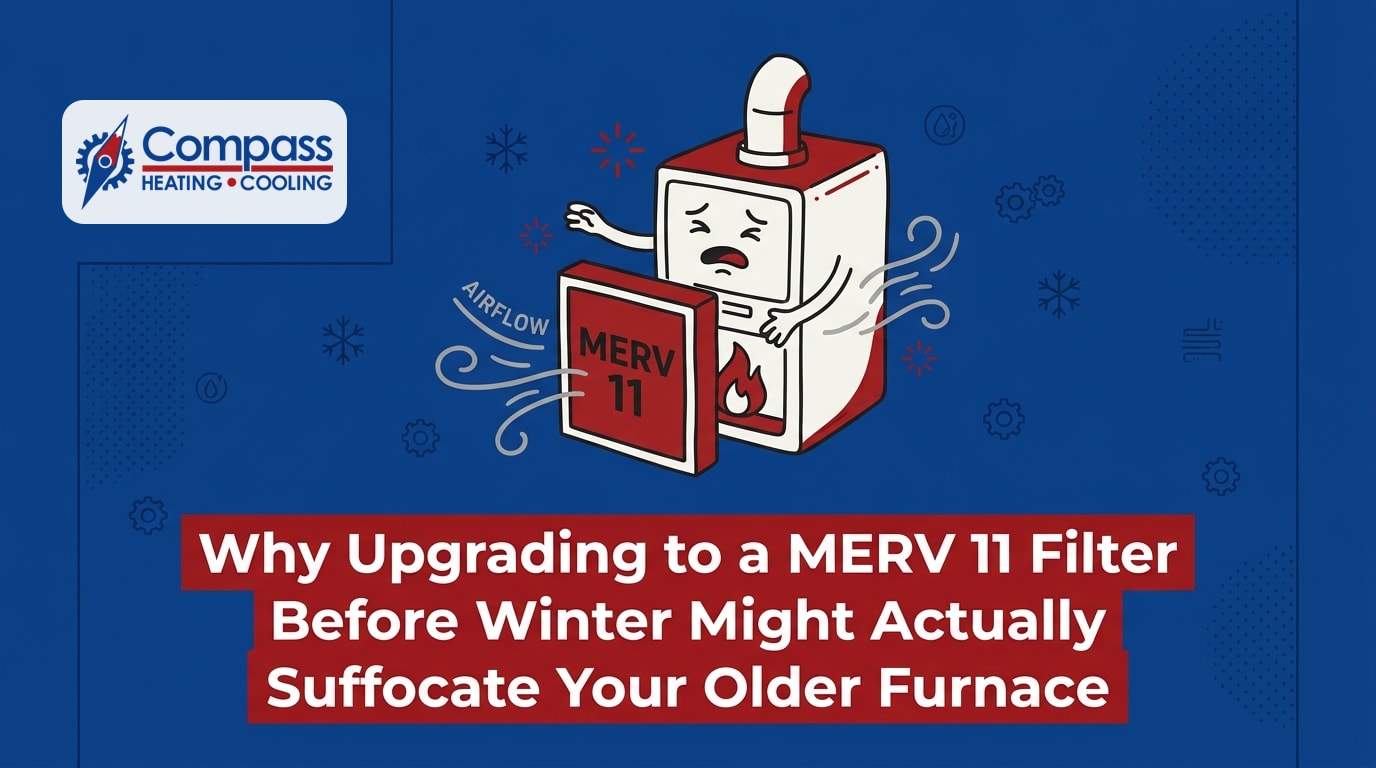
The Hidden Winter Danger of Upgrading Your Furnace Filter
As the November pre-winter heating season kicks into gear, many homeowners rush to the hardware store to improve their indoor air quality. But before you swap out your standard filter for a thicker, high-efficiency option, you need to understand the merv 8 vs merv 11 pressure drop. Homeowners frequently upgrade their filters as temperatures drop, hoping to trap more dust, pet dander, and allergens while the house is sealed up tight. While higher filtration certainly traps more microscopic particles, it also fundamentally changes how your furnace breathes.
If you want to ensure your system is ready for the cold and need professional heating services, our team is here to help.
Every furnace is designed to move a specific volume of air. When you place a highly restrictive filter into the system, you introduce a mechanical factor known as pressure drop. This is not just an HVAC industry buzzword; it is a physical measurement of how hard your blower motor has to work to pull air through the filter media. Establishing a balance between pristine indoor air quality and reliable equipment longevity is the absolute key to preventing premature breakdowns during the coldest months of the year.
Understanding Static Pressure and Airflow Restriction
To understand why a simple filter upgrade can cause so much trouble, we first need to look at static pressure. In accessible terms, static pressure is the resistance to airflow within your ductwork and filter system. Think of it like drinking a thick milkshake through a straw. If you use a wide straw, you can pull the liquid through easily. If you switch to a tiny coffee stirrer, you have to work much harder to get the same amount of liquid. Your furnace blower motor experiences the exact same struggle when forced to pull air through a highly restrictive filter.
The furnace blower must work against this resistance to distribute warm air throughout your home. Every single component in your duct system—from the bends in the sheet metal to the registers in your floor—adds a little bit of resistance. However, the air filter is almost always the single largest source of airflow restriction in the entire system.
Every filter on the market has an initial static pressure rating, which professionals measure in inches of water column (in. w.g.). This measurement tells us exactly how much resistance the filter adds to the system before it even collects a single speck of dust. A furnace and its filter do not operate independently; they function as a single, interdependent breathing system. When you look at the static pressure drop differences between MERV 8 and MERV 11, you begin to see why older furnaces often fail when forced to breathe through a denser filter.
MERV 8 vs. MERV 11: Breaking Down the Pressure Drop Numbers
It is easy to see why homeowners gravitate toward MERV 11 filters. They do an excellent job of capturing finer particles, which is a major draw for families dealing with respiratory sensitivities. If you are curious about the specific health benefits, you can read more about the differences between MERV 8 and MERV 11 filters for allergies. However, that enhanced filtration comes with a significant mechanical trade-off.
A standard MERV 8 filter typically has a starting pressure drop of roughly 0.10 to 0.15 in. w.g. This is generally considered the sweet spot for most residential heating systems, allowing enough airflow to keep the furnace cool while still protecting the blower motor from dust buildup. In contrast, a MERV 11 filter often starts with a pressure drop of 0.20 to 0.25 in. w.g. or even higher, depending on the brand and pleat design.
• MERV 8 — Initial Pressure Drop (in. w.g.): 0.10 - 0.15 — Airflow Restriction Level: Low to Moderate — Impact on Older Blower Motors: Safe, maintains proper airflow
• MERV 11 — Initial Pressure Drop (in. w.g.): 0.20 - 0.25+ — Airflow Restriction Level: High — Impact on Older Blower Motors: Causes strain, risk of overheating
This mathematical difference might look small on paper, but it represents a massive increase in workload for the blower motor. Doubling the resistance at the filter slot forces the furnace to work exponentially harder just to move the baseline amount of air required to keep the heat exchanger from overheating.
The Initial Resistance Factor
The most critical thing to remember about these numbers is that they represent the filter when it is brand new out of the plastic wrap. The static pressure drop differences between MERV 8 and MERV 11 only widen as the filter does its job. As the MERV 11 media captures debris, the pathways for air to flow become smaller and smaller. The resistance only goes up from that initial 0.25 in. w.g. rating, quickly pushing older heating systems past their safe operating limits.

Why Older Furnaces Struggle with High-Efficiency Filters
The Problem: Older furnaces were simply not engineered to handle the severe airflow restriction caused by modern, tightly woven air filters. The core issue lies in the type of blower motor installed inside the cabinet.
The Cause: The vast majority of older heating systems utilize a PSC (Permanent Split Capacitor) blower motor. A PSC motor is a fixed-speed device. It operates at a consistent power level regardless of what is happening inside the ductwork. Because a PSC motor lacks the ability to adjust its speed or torque to overcome increased resistance, placing a highly restrictive MERV 11 filter in the system results in an immediate and dangerous drop in total airflow. The motor keeps pushing with the same amount of force, but far less air actually makes it through the dense filter media.
The Solution: Modern high-efficiency furnaces often feature ECM (Electronically Commutated Motor) or variable-speed blowers. These "smart" motors can sense when resistance increases and will automatically ramp up their RPMs to push through restrictive filters. However, if you have an older furnace with a PSC motor, you must stick to a filter that allows the system to breathe easily, such as a MERV 8, to ensure adequate airflow over the heat exchanger.
Continuous Operation Strain
During the November pre-winter heating season, furnaces run for extended periods to combat the dropping outdoor temperatures. This continuous operation compounds the mechanical strain on older PSC motors. When airflow is heavily restricted by a MERV 11 filter, the motor runs hotter than it should. The lack of rest periods between long heating cycles prevents the motor from cooling down naturally, accelerating wear and tear on the internal bearings and electrical windings.
How Regional Environments Accelerate Filter Clogs
Theoretical pressure drop numbers are helpful, but real-world environmental factors dictate how quickly a filter moves from its initial pressure drop to a critical, system-choking restriction level. The static pressure drop differences between MERV 8 and MERV 11 become a practical emergency much faster in specific geographic regions.
In Northern Colorado, the dry, dusty climate introduces a remarkably high volume of airborne particulates into the return ducts. Between agricultural dust, dry winds, and a lack of humidity to weigh particles down, the air circulating through your home carries a heavy load of debris. Because a MERV 11 filter is highly efficient, it acts like a microscopic net, catching nearly all of this regional dust.
While that sounds like a good thing for your lungs, it is a nightmare for your furnace. A MERV 11 filter will clog exponentially faster in these conditions than a standard MERV 8. What might take three months to clog in a mild, humid climate can turn into a total blockage in just a few weeks here. Ultimately, our regional climate turns a minor airflow restriction into a severe mechanical hazard rapidly, especially when the furnace is running non-stop during cold snaps.
Warning Signs Your Furnace Is Suffocating
When a high-MERV filter begins to cause mechanical distress to your furnace, the system will usually try to warn you before a total failure occurs. Recognizing these observable symptoms early can save you from a freezing night without heat.
1. Short-Cycling Behavior: This is the most common symptom of a suffocating furnace. Short-cycling occurs when the furnace shuts down prematurely before reaching the temperature set on the thermostat, only to turn back on a few minutes later. This constant on-and-off cycling is a direct result of the system trying to protect itself from overheating due to low airflow.
2. Tripping the High Limit Switch: The high limit switch is a crucial safety sensor located near the heat exchanger. Its job is to prevent a fire. When airflow is too low to carry heat away from the heat exchanger and into your home, the internal temperature of the furnace spikes. The limit switch detects this dangerous heat and instantly cuts power to the gas burners.
3. Unusually Hot Furnace Cabinets: If you place your hand on the exterior metal cabinet of your furnace and it feels uncomfortably hot to the touch, heat is being trapped inside rather than distributed through your ductwork.
4. Weaker Airflow at the Vents: A dense filter physically blocks air. If you notice that the air coming from your supply registers feels like a weak trickle rather than a steady stream, the filter is likely the culprit.
5. Strange Blower Noises: A struggling blower motor will often hum loudly, whine, or vibrate as it fights against the high static pressure of a clogged filter.
Ignoring these signs during the November pre-winter heating season almost always leads to catastrophic damage, including cracked heat exchangers or completely burnt-out blower motors.
The Danger of Overheating
Trapped heat is the enemy of any mechanical system. When airflow is restricted, the heat exchanger expands beyond its designed tolerances. Over time, this repeated overheating and rapid cooling causes the metal to stress, warp, and eventually crack. Safety lockouts—like the high limit switch tripping—are the system's way of protecting your home from this restricted airflow, but relying on safety switches to manage daily operation will eventually destroy the furnace.
The Importance of Professional Static Pressure Testing
Determining whether your specific furnace can handle the static pressure drop differences between MERV 8 and MERV 11 is not a guessing game. Internal static pressure measurement requires specialized diagnostic tools, specifically a digital manometer, and must be performed by a licensed professional. You should never attempt to drill test ports into your ductwork or measure pressure drops yourself.
When a technician evaluates your system, they are looking for the Total External Static Pressure (TESP). They measure the pressure on the return side (before the blower) and the supply side (after the furnace) and combine those numbers. They then compare your system's actual TESP against the manufacturer's maximum allowable rating printed on the furnace data plate. If your system is already running near its maximum pressure limit with a standard filter, upgrading to a MERV 11 will push it over the edge.
Leveraging Compass Heating & Cooling's local diagnostic experience in the Front Range allows homeowners to get neutral, expert advice. A professional can determine the exact filter threshold your specific furnace can handle without overheating. By balancing your indoor air quality goals with the mechanical realities of your equipment, you ensure reliable operation all winter long. We highly recommend scheduling a comprehensive evaluation before making drastic changes to your filtration strategy, perhaps by taking advantage of our fall furnace specials.
Frequently Asked Questions About Furnace Filters and Airflow
Does a MERV 11 filter restrict airflow too much?
For many older furnaces, a MERV 11 filter does restrict airflow too much. Because the filter media is woven tightly to catch microscopic particles, it creates a high level of resistance that standard PSC blower motors struggle to overcome. If your ductwork is already undersized or your system is older, this restriction can lead to overheating and system lockouts. Always consult a professional to check your system's static pressure before upgrading.
Will a MERV 11 filter damage my older furnace?
Yes, a MERV 11 filter can damage an older furnace if the system cannot handle the increased pressure drop. The severe airflow restriction causes the heat exchanger to retain too much heat, which can lead to metal fatigue and cracking over time. Additionally, the blower motor can burn out prematurely because it is forced to work against excessive resistance without adequate airflow to keep itself cool.
What is the pressure drop difference between MERV 8 and MERV 11?
The pressure drop difference between a MERV 8 and a MERV 11 filter is typically around 0.10 in. w.g. when brand new. A standard MERV 8 usually starts at 0.10 to 0.15 in. w.g., while a MERV 11 often starts at 0.20 to 0.25 in. w.g. While that sounds like a tiny fraction, doubling the initial resistance places a massive and immediate strain on older HVAC blower motors.
Is MERV 8 or 11 better for a furnace?
MERV 8 is generally better for the mechanical health of an older furnace because it provides excellent airflow while still protecting the equipment from dust and debris. MERV 11 is better for indoor air quality and capturing allergens, but it should only be used in modern systems with variable-speed motors or systems that have been professionally verified to handle higher static pressures.
How often should I change a MERV 11 filter during continuous heating operation?
During continuous heating operation, a MERV 11 filter should be checked at least once a month and replaced every 30 to 60 days. Because it captures much finer particles than a lower-rated filter, it clogs significantly faster. In dry, dusty regions, you may find that a high-efficiency filter reaches a critical level of airflow restriction in just a few weeks.
Protect Your Furnace Airflow This Winter
Understanding the merv 8 vs merv 11 pressure drop is essential for keeping your heating system running safely and efficiently. Higher MERV ratings aren't universally better for older equipment, and forcing a furnace to breathe through a restrictive filter will only lead to premature breakdowns. We encourage proactive maintenance to ensure your furnace breathes easily throughout the November pre-winter heating season and beyond. To safeguard your system and keep your airflow optimized, consider enrolling in the Compass Club Maintenance Plan for comprehensive, year-round protection.
hear what our satisfied clients have to say
Our clients consistently praise our exceptional service and attention to detail. They appreciate the personalized approach we take to meet their unique needs, ensuring satisfaction every step of the way.