


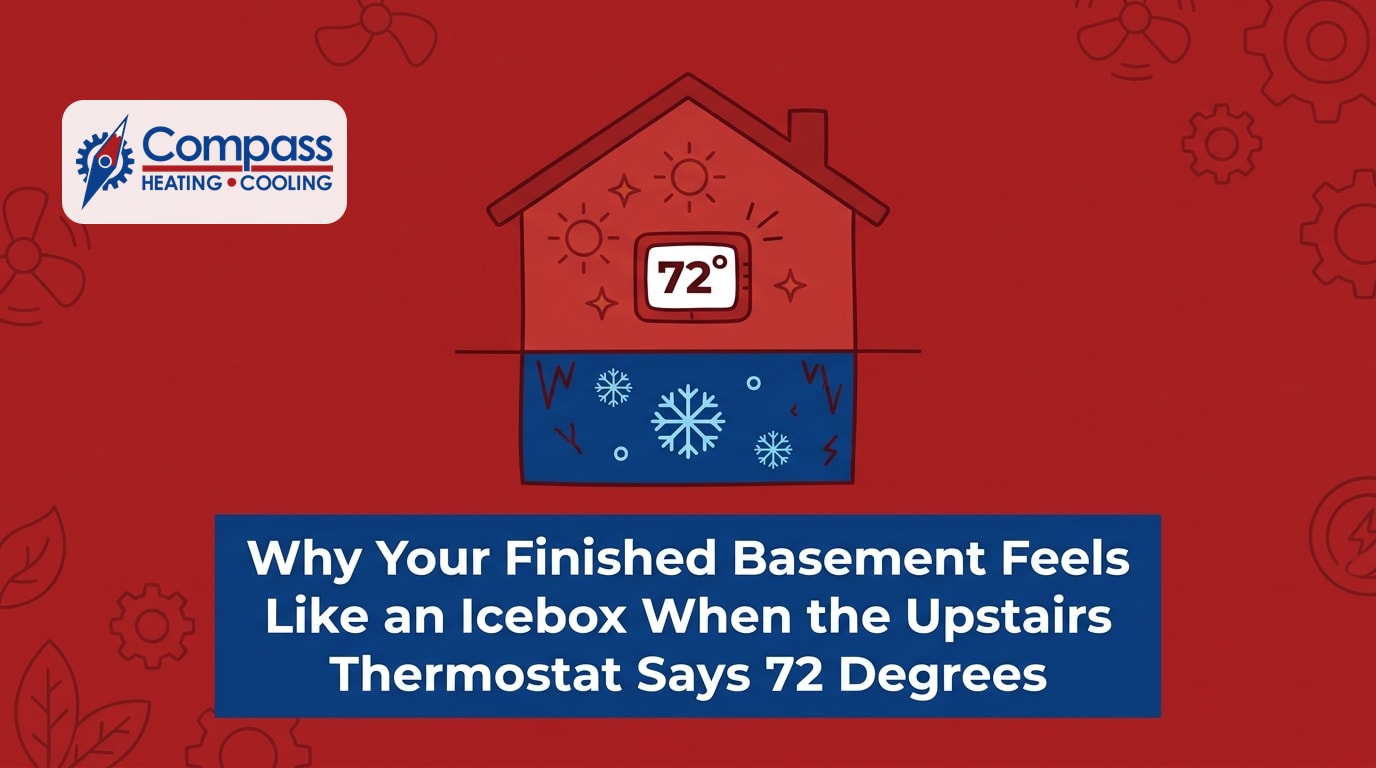
Why Your Finished Basement Feels Like an Icebox When the Upstairs Thermostat Says 72 Degrees
The Frustration of a Freezing Basement While the Upstairs is Perfectly Warm
You turn on the furnace for the first time in late fall, and within an hour, your main floor feels perfectly cozy. But when you walk down the stairs, you hit a literal wall of cold air. In our years of serving the Loveland area at Compass Heating & Cooling, we find that dealing with a basement freezing while upstairs is hot is one of the most common and frustrating realities of owning a multi-level home. The thermostat clearly reads a comfortable 72 degrees upstairs, yet the lower level remains completely unusable for family movie nights or a home office.
Here is the thing: this extreme temperature imbalance rarely means your furnace is broken. Instead, it is a symptom of how air moves, where your thermostat is located, and the physical realities of below-grade spaces. As a homeowner, you are faced with a distinct decision point. You must identify whether the issue stems from basic airflow restrictions you can fix yourself, or if your home requires ductwork and zoning modifications. Masking the chill with portable space heaters is only a temporary band-aid.
To truly solve the problem, you need to understand the physics behind why your heating system behaves this way. By addressing the root cause, you can upgrade your home's comfort safely and efficiently. Whether you need comprehensive professional heating services to evaluate your system or dedicated basement finish HVAC solutions, the first step is knowing exactly what you are dealing with.
The Physics of Heat Stratification in Multi-Level Homes
To understand why your basement feels like an icebox during November pre-winter prep, you have to look at the fundamental science of airflow. Air is not static; it constantly moves and shifts based on its temperature and density. When your furnace produces warm air, that air naturally wants to rise. This physical reality constantly fights against your HVAC system's attempts to push warm air downward into the lowest levels of your house.
At the same time, cold air is dense and heavy. It naturally sinks and pools in the lowest available space—which is always your basement. This creates a phenomenon known as severe temperature stratification, where distinct layers of hot and cold air separate across the different levels of your property.
Open stairwells act almost exactly like a chimney in this scenario. They provide a wide, unobstructed path for whatever warm air does make it into the basement to immediately escape back up to the main floor. Our team frequently sees this in local neighborhoods; if you are also dealing with fixing hot and cold spots in tri-level homes, you will notice this chimney effect is even more pronounced due to the staggered floor plans.
Understanding the Stack Effect
The core driver of this problem is called the "stack effect." This is the natural buoyancy of heated air moving upward through a building. As warm air rises and eventually leaks out of the upper levels of your home (through the attic or roof), it creates a negative pressure zone in the lower levels. This negative pressure pulls cold exterior air into the basement through tiny cracks in the foundation or rim joists.
How the Stack Effect Impacts Your Comfort:
• Buoyancy: Heated air from your basement supply registers immediately floats upward toward the ceiling and up the stairs.
• Displacement: As warm air leaves the basement, heavy, unconditioned cold air settles in to replace it.
• Furnace strain: Your blower motor has to work incredibly hard to force warm air down into a high-pressure zone of dense, cold air.
How Your Main-Floor Thermostat Gets 'Tricked'
The physics of heat stratification directly connect to the limitations of a standard HVAC system. Most homes are built with a single-zone heating system. This means that one piece of equipment (the furnace) is controlled by one single sensor (the thermostat) located in one specific spot (usually the central hallway of the main floor).
Your thermostat is essentially blind to the rest of the house. It only monitors the temperature of the air immediately surrounding it. When the furnace runs, heat rises quickly to the main floor. The thermostat registers that the area has reached a comfortable 72 degrees upstairs, and it promptly shuts the entire system off.
The problem is that the system turns off long before the basement receives enough sustained airflow to warm up. The furnace simply does not run long enough to push the dense, heavy cold air out of the lower level. At Compass Heating & Cooling, we constantly remind our customers that this is a design limitation of single-zone systems, not necessarily a sign of a failing furnace.
The Single-Zone Dilemma
A single-zone system is fundamentally mismatched with the heating demands of a multi-story layout. The heating load required for a below-grade space is entirely different from the heating load required for a sunlit main floor.
• Main Floor — Heating Demand: Moderate (benefits from rising heat and sunlight) — Thermostat Behavior: Satisfies quickly and signals the furnace to stop.
• Upper Floor — Heating Demand: Low (collects all rising heat from below) — Thermostat Behavior: Often overheats before the main floor reaches its set point.
• Finished Basement — Heating Demand: High (fights cold concrete and sinking dense air) — Thermostat Behavior: System shuts down before the space ever gets warm.
Turning the thermostat up even higher is not the answer. If you set the dial to 78 degrees in an attempt to push heat downstairs, you will simply overheat the main floor, waste significant energy, and leave the basement only marginally warmer.

The Concrete Factor: Below-Grade Heat Loss
Even if your furnace manages to push warm air into the basement, environmental and structural factors are actively working to steal that heat away. The biggest culprit is the foundation itself. Concrete has a high thermal mass, meaning it can absorb and store a massive amount of temperature energy.
Because your basement walls are surrounded by cold earth, the concrete constantly pulls heat out of the indoor air. Our technicians see this phenomenon accelerate dramatically with Northern Colorado's rapid late-fall temperature drops into the 20s and 30s. This heat loss through below-grade concrete walls intensifies the imbalance between your floors.
If your finished basement lacks adequate insulation behind the drywall, the problem is magnified. The warm air that finally reaches the lower level is rapidly cooled by the sheer radiant cold of the foundation walls. By the time November pre-winter prep is underway, the soil surrounding your home is cold enough to turn your basement walls into a giant heat sink.
Thermal Mass and Your Foundation
Thermal mass is a simple concept: heavy, dense materials absorb heat. Think of how a brick patio stays warm long after the sun goes down. Your basement walls do the exact opposite in the winter. They absorb the heat from your indoor air and transfer it outward into the frozen soil.
This is why basements feel inherently colder even when the HVAC is running. The ambient air temperature might briefly rise while the furnace is blowing, but the radiant surface temperature of the walls and floor remains freezing. As soon as the blower turns off, the concrete immediately chills the air back down.
Why Space Heaters Aren't the Long-Term Solution
When faced with a freezing lower level during late fall pre-winter prep, the most common immediate reaction is to plug in a portable space heater. While a space heater can take the edge off in a small, enclosed room, it is a poor strategy for warming an entire finished basement.
First, relying on space heaters is incredibly inefficient. Electric resistance heating uses a massive amount of electricity. Running multiple space heaters to warm a large basement living room will cause a significant spike in your monthly utility bills. They are designed for localized, temporary comfort, not for sustained whole-room climate control.
More importantly, space heaters introduce significant safety risks if used improperly. Running portable heaters unattended, leaving them on overnight, or using them as a primary heat source over the winter is a known fire hazard. Cords can overheat, and units can be tipped over by pets or children. Instead of relying on a temporary band-aid, homeowners should look toward systemic HVAC solutions that provide safe, whole-home comfort.
Safe Troubleshooting: What Homeowners Can Check First
Before assuming you need a major system overhaul, there are several safe, straightforward checks you can perform. Sometimes, a freezing basement is exacerbated by simple airflow restrictions that you can resolve without tools. However, it is critical to recognize the boundary between safe homeowner maintenance and work that requires a licensed professional. Never attempt to manually adjust internal ductwork dampers or modify your furnace's blower settings yourself.
Clearing the Path for Airflow
To give your basement the best chance of reaching that comfortable 72 degrees upstairs, verify that the air has a clear path in and out of the space.
1. Inspect all basement supply registers: Walk through the lower level and ensure every single supply vent is fully open. Move any furniture, rugs, or storage boxes that might be blocking the airflow. Even a partially covered vent restricts the volume of warm air entering the room.
2. Locate and clear the return vents: Return vents are crucial. They pull the dense, cold air out of the basement so that warm air has room to replace it. If your basement return vents are blocked, the furnace cannot circulate the air effectively. Make sure these grilles are completely unobstructed.
3. Replace the furnace filter: A dirty, clogged air filter forces the blower motor to work harder. When airflow is restricted at the furnace, the furthest points in the ductwork—which is almost always the basement—suffer the most. Install a fresh filter to ensure maximum air volume.
4. Check for drafts around basement windows: Inspect the seals around any egress windows or window wells. Drafts can introduce freezing air directly into the space, fighting the furnace's efforts.
Permanent Fixes: Upgrading Your Basement's Climate Control
If you have cleared the vents, changed the filter, and your basement still feels like an icebox during November pre-winter prep, it is time to look at permanent solutions. A single-zone system simply cannot overcome the physics of a multi-level home on its own. Professional HVAC upgrades are required to properly distribute and manage the heat.
Because our team at Compass Heating & Cooling has deep expertise in Northern Colorado home architecture, specifically providing tailored HVAC solutions for finished basements and tri-level homes common in the Loveland area, we know that standard fixes rarely work. The solution usually involves taking control of how and where the air is delivered.
HVAC Zoning Systems
HVAC zoning is one of the most effective ways to solve severe temperature imbalances. A professional technician installs motorized dampers inside your ductwork and wires them to a central control panel. You then get multiple thermostats—one for the main floor and one dedicated to the basement.
When the basement thermostat calls for heat, the system can close the dampers leading to the upstairs and force all the warm air directly into the lower level. This completely solves the "thermostat trick." The furnace will continue to run until the basement reaches the desired temperature, independent of what the upstairs requires.
Ductless Mini-Split Solutions
If your existing ductwork is undersized or inaccessible, bypassing the main system entirely is often the best choice. A ductless mini-split installation provides dedicated, highly efficient heating directly to the finished basement.
These systems consist of an outdoor compressor and an indoor wall-mounted air handler. They do not rely on your furnace at all. Mini-splits use heat pump technology to pull heat from the outside air and deliver it directly into the room. This allows you to keep the basement perfectly warm without overheating the rest of the house. As an added benefit, federal tax credits and local utility rebates may apply to qualifying heat pump installations, making this upgrade a smart long-term investment for your home's comfort and energy efficiency.
Take Control of Your Lower-Level Comfort This Winter
You do not have to accept a freezing basement as an unavoidable part of winter. By understanding the physics of heat stratification and the limitations of your main-floor thermostat, you can stop wasting money on inefficient space heaters. Once you have checked your vents and replaced your filter, the next step is to consult with professionals who understand the specific airflow challenges of multi-level homes. Reach out to your local Loveland heating technicians to explore zoning or ductless solutions, so you can finally enjoy every square foot of your home comfortably.
Frequently Asked Questions
Why is my basement so cold when the heat is on?
Your basement stays cold because warm air naturally rises to the upper floors, while dense cold air sinks to the lowest level. Additionally, your main-floor thermostat usually shuts the furnace off as soon as the upstairs is warm, leaving the basement starved for heat. The cold concrete foundation also absorbs whatever warmth does manage to reach the lower level.
Is it safe to close upstairs vents to push heat downstairs?
No, closing multiple upstairs vents is not a safe long-term solution. Shutting vents increases the static pressure inside your ductwork, which can overwork the blower motor and potentially damage the heat exchanger. Instead of closing vents, a professional zoning system uses bypass dampers to safely redirect airflow without harming the equipment.
How can I balance the heat between upstairs and downstairs?
Balancing the heat requires managing the airflow and temperature readings for each level independently. The most effective methods are installing an HVAC zoning system with multiple thermostats or adding a dedicated ductless mini-split to the basement. Simple steps like keeping all return vents unobstructed and changing the furnace filter regularly also help maintain proper air circulation.
Does keeping the furnace fan set to 'ON' help warm the basement?
Setting the thermostat fan to 'ON' instead of 'AUTO' can help mix the air throughout the house, slightly reducing temperature differences between floors. It keeps the air circulating even when the furnace burners are off. However, this will not overcome severe heat loss from uninsulated concrete walls, and it will increase your monthly electricity usage.
How much insulation does a finished basement need to retain heat?
A finished basement requires continuous insulation along the exterior foundation walls to prevent the concrete from pulling heat out of the room. Proper insulation acts as a thermal break between the cold earth outside and the conditioned air inside. Without it, even the most powerful heating system will struggle to keep the space comfortable during cold weather.
hear what our satisfied clients have to say
Our clients consistently praise our exceptional service and attention to detail. They appreciate the personalized approach we take to meet their unique needs, ensuring satisfaction every step of the way.