


Why August is the Best Time to Plan Your Fall Furnace Replacement
The Hidden Risks of Waiting for the First September Freeze
August afternoons along the Front Range still feel like peak summer, but at Compass Heating & Cooling, our team knows the late-summer to early-fall Front Range transition is already knocking at our doors. If you are wondering why August is the best time to plan your fall furnace replacement, the answer comes down to timing and preparation. In our years of serving the community, we have seen too many homeowners face a sudden cold snap with an aging heating system that simply will not wake up from its summer hibernation.
When you rely on a furnace that is 15 to 20 years old, you are taking a massive gamble with your home's comfort. Our technicians frequently observe the rapid shift from hot August days to freezing September nights placing immense stress on older mechanical components. Heat exchangers expand and contract, blower motors pull heavy electrical loads, and ignition systems are forced to fire up after months of inactivity. This sudden demand is exactly when older systems tend to fail.
By acting now, you gain a significant logistical advantage. You beat the inevitable rush of emergency no-heat calls that flood our dispatchers the morning after the first hard freeze. Securing your professional HVAC services early means you are in control of the process. Proactive scheduling ensures your family stays comfortable, gives you the freedom to choose the exact system you want, and provides confidence knowing your home is ready for whatever the Colorado weather delivers.
Navigating HVAC Supply Chain Realities This August
The heating and cooling industry operates on strict seasonal cycles, and local warehouses simply cannot stock every size and model of furnace at all times. Waiting until September means you are competing with a massive regional surge in equipment orders, which can lead to frustrating delays.
Here are the primary logistical reasons our team recommends securing your equipment during the late summer:
• Avoiding regional backorders: As temperatures drop across Loveland CO and the surrounding Front Range, local distribution centers quickly sell out of the most common furnace sizes.
• Securing exact sizing: A proactive order guarantees you get the specific unit matched to your home's square footage, rather than settling for whatever oversized or undersized unit is left on the shelf.
• Preventing shipping delays: Getting your order in before the fall rush means your equipment is on a truck before national supply chains get bogged down by seasonal demand.
• Aligning multiple components: If you are upgrading your thermostat, ductwork, or adding a whole-home humidifier at the same time, ordering early ensures all parts arrive together for a single installation day.
Understanding these supply chain bottlenecks is part of our local expertise at Compass Heating & Cooling. We navigate these variables daily to guarantee your installation is completed long before the first freeze forces you into a panic.
Why High-Efficiency Models Take Longer to Arrive
Advanced multi-stage and variable-speed units are in incredibly high demand because of their superior comfort and energy performance. However, these units are not standard off-the-shelf purchases. Custom sizing and specific configurations require precise ordering from the manufacturer. If you want a top-tier system that quietly ramps up and down to match your home's exact heating needs, you must account for the extra weeks it takes to ship these advanced models. You can learn more about preparing your home for these transitions by reviewing our seasonal HVAC maintenance tips.
Capitalizing on the Late-Summer Scheduling Lull
There is a brief, golden window in the home service industry that happens every year. As the intense cooling needs of July wind down, but before the heating emergencies of late September begin, contractor schedules open up. Our team considers this late-summer lull the absolute best time to book a major installation.
Flexible, convenient appointments: During the back-to-school transition, you can easily secure flexible installation dates that fit your busy family calendar. We pride ourselves on our scheduling reliability, offering exact appointment windows during this period. You will not have to take a random Tuesday off work just hoping a technician shows up.
Avoiding the emergency waitlist: Contrast an August scheduled installation with the reality of a late September breakdown. When the late-summer to early-fall Front Range transition brings that first bitter cold front, hundreds of homeowners discover their heaters are dead on the same morning. Emergency waitlists can stretch for days. When you act in August, you completely bypass this stressful waiting game.
Better working conditions: There is also a practical benefit to the actual labor. Having our installation crews working in comfortable late-summer weather means they are not rushing through extreme cold to get your heat turned back on. They can take their time, ensuring every wire, duct connection, and safety sensor is calibrated perfectly.
Gaining Time for Proper Research and Rebate Exploration
The Problem: When a furnace dies in the middle of a freezing night, homeowners are forced to make a rushed decision. Emergency furnace replacements often result in panic-buying, where you simply accept whatever unit the contractor has in their truck, regardless of its long-term efficiency or suitability for your home.
The Cause: Desperation removes your ability to research. You cannot wait two weeks for a highly efficient model when your family is shivering. This urgency skips what our installers consider the most critical step of any furnace replacement and heating installation: the Manual J load calculation. This calculation measures your home's exact thermal characteristics—windows, insulation, square footage, and layout—to determine the precise size furnace you need. Rushed jobs often just swap a like-for-like box, which means if your old unit was incorrectly sized, your new one will be too.
The Solution: Using the August window allows you to slow down. You have the time to sit with a Compass Heating & Cooling professional, review the load calculations, and explore high-efficiency options that make sense for Loveland CO and the surrounding Front Range. Furthermore, acting early gives you time to research generic federal tax credits and utility rebates that may apply to qualifying high-efficiency installations. You can verify current incentive programs with your utility provider or a tax professional without the pressure of a broken system hanging over your head.
Avoiding the Emergency Replacement Premium
Emergency installations limit your ability to compare efficiency ratings and system features. Taking your time in August ensures you are making a choice that will yield long-term energy savings over the next 15 to 20 years.
• Plenty of time to compare variable-speed vs. single-stage options. — The Reactive September Reality: Forced to accept whatever standard unit is currently in stock.
• Proper load calculations ensure exact system sizing. — The Reactive September Reality: Rushed like-for-like swapping risks oversized, inefficient equipment.
• Time to consult tax professionals about available energy rebates. — The Reactive September Reality: No time to research incentives before signing the paperwork.
• Scheduled installation at your convenience. — The Reactive September Reality: Waiting days on an emergency list while the house stays freezing.
The Step-by-Step August Furnace Replacement Timeline
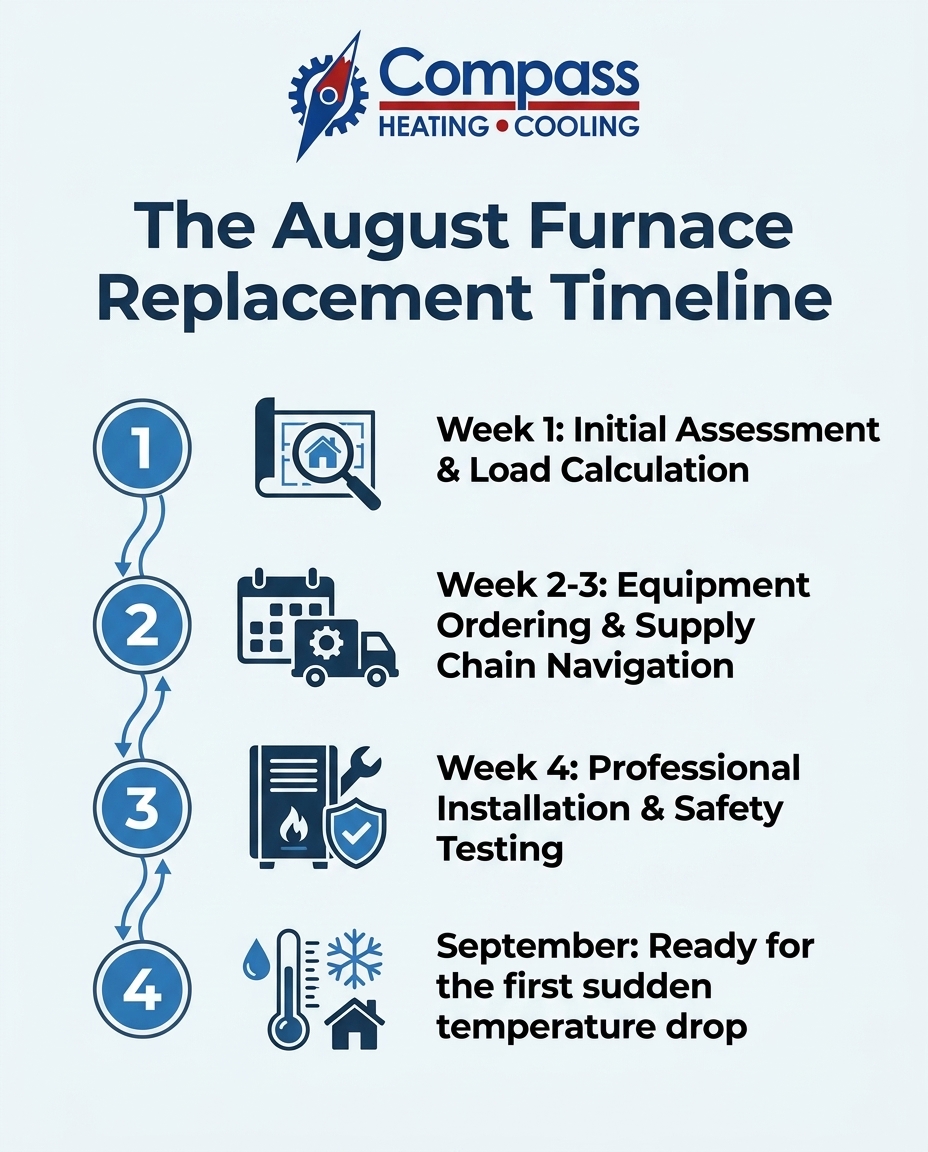
A professional installation is a multi-step process. When you initiate this project before the weather turns, the timeline is relaxed, organized, and entirely focused on quality. Here is what you can expect when you start the process with our team during the late-summer to early-fall Front Range transition:
1. Week 1: Initial Assessment & Load Calculation. A technician visits your home to evaluate your current ductwork, assess your insulation, and perform a detailed heating load calculation. You will review different system options, from standard units to high-efficiency variable-speed models.
2. Week 2-3: Equipment Ordering & Supply Chain Navigation. Once you select your ideal system, the ordering process begins. Because you are acting in August, any supply chain delays for specific models are easily absorbed into the schedule without causing you discomfort.
3. Week 4: Professional Installation & Safety Testing. Your new system arrives and is installed by certified technicians. This includes removing the old equipment, fitting the new unit to your existing ductwork, upgrading the venting if necessary, and performing rigorous safety tests on the gas lines and exhaust flues.
This smooth, predictable timeline is only possible when you start early. If you need reliable Loveland heating services, getting on the calendar for Week 1 right now is the smartest move you can make.
Protecting Your Investment Before Winter Hits
Once your new furnace is installed, the final step is ensuring it is fully protected and optimized for the upcoming season. The most significant benefit of an August installation is having the time to test the newly installed furnace thoroughly before your family actually needs it for survival.
The initial break-in period: New heating equipment often produces a slight burning smell the first time it runs, as manufacturing oils burn off the heat exchanger. Our technicians recommend running the system for a few hours in late summer with the windows open, so you clear out these odors long before you are locked inside for the winter. This is also the time when we calibrate your thermostat and ensure the blower motor is pushing the correct volume of air to every room.
Ongoing maintenance strategy: A new installation is a major investment in your home. To protect that investment across Loveland CO and the surrounding Front Range, you need a proactive care plan. Pairing your new system with a comprehensive ongoing maintenance strategy ensures the manufacturer warranties remain valid and the system retains its high-efficiency rating year after year. Joining the Compass Club Maintenance Plan takes the guesswork out of this process, providing routine tune-ups that catch minor adjustments before they turn into mid-winter breakdowns.
Common Questions About Timing Your Furnace Replacement
What is the best month to replace a furnace?
August is widely considered the best month to replace a furnace. During this late-summer to early-fall Front Range transition, contractor schedules are highly flexible, and local supply houses are fully stocked ahead of the winter rush. Our team highly recommends acting before September to carefully research your options and avoid the stress of an emergency installation during a freeze.
Why is it hard to get an HVAC appointment in the fall?
It is difficult to secure an appointment in the fall because the first major drop in temperature triggers thousands of emergency service calls simultaneously. HVAC companies prioritize families without heat, meaning routine replacements or non-emergency upgrades get pushed down the schedule. By late September, waitlists for installations can stretch for weeks.
How long does it take to get a new furnace ordered?
Ordering a new furnace can take anywhere from a few days to several weeks, depending on the specific model. Standard units are often available locally, but high-efficiency, variable-speed, or custom-sized systems must be shipped from regional hubs or directly from the manufacturer. Supply chain bottlenecks frequently extend these timelines as winter approaches.
Should I replace my 20-year-old furnace before it breaks?
Yes, replacing a 20-year-old furnace proactively is always safer and more cost-effective than waiting for a catastrophic failure. Systems of this age have exhausted their expected lifespan and often suffer from cracked heat exchangers or failing blower motors. Replacing it on your own terms prevents sudden breakdowns and protects your home from the dangers of carbon monoxide leaks.
How long does the actual furnace installation process take?
Our crews typically complete the physical installation of a new furnace in one full day. However, this assumes the equipment is already in hand and the ductwork requires only minor modifications. If extensive sheet metal work, new venting, or thermostat rewiring is needed, the process can spill into a second day. This is why scheduling during comfortable weather is so advantageous.
Secure Your Home's Comfort Before the Fall Rush
The peace of mind that comes from acting during the back-to-school transition cannot be overstated. By addressing your aging heating system now, you completely eliminate the anxiety of hoping it survives one more season. You secure the best equipment choices, enjoy convenient scheduling, and ensure your home in Loveland CO and the surrounding Front Range is prepared for anything.
Remember that sudden September temperature drops are a defining feature of our local climate, and they always trigger massive spikes in emergency calls. Do not wait until you are shivering in your living room to start making phone calls. Schedule your comprehensive heating assessment with Compass Heating & Cooling now, before the cold snaps begin, and lock in a warm, comfortable winter for your family.
hear what our satisfied clients have to say
Our clients consistently praise our exceptional service and attention to detail. They appreciate the personalized approach we take to meet their unique needs, ensuring satisfaction every step of the way.
.png)