



Understanding Fort Collins Venting Requirements for High-Efficiency Furnaces
The Surprise of Exterior Wall Venting During a Fall Furnace Upgrade
You are scheduling a routine system replacement, but suddenly you are faced with understanding Fort Collins venting requirements for high-efficiency furnaces because your installer says they need to drill holes in your home's exterior. At Compass Heating & Cooling, we see this jarring moment happen frequently with homeowners. You naturally assume a new heating unit will simply connect to your existing chimney flue, just like the old equipment did. However, upgrading your home's heating technology changes the fundamental mechanics of how exhaust gases safely leave your living space.
If you are planning a September pre-heating season installation, discovering that your property requires exterior wall modifications can feel like an unexpected and frustrating hurdle. Many homeowners worry about the aesthetic impact or wonder if our technicians are simply adding unnecessary steps to the job. The reality is quite the opposite. This transition is a non-negotiable safety mandate dictated by modern building standards. To ensure your home is prepared for winter safely, it helps to explore our heating services and understand the exact reasons behind these structural changes.
The shift in heating technology:
• Older 80% AFUE units: These traditional systems lose about 20% of the heat they generate straight up the chimney. That wasted heat keeps the exhaust gases incredibly hot, allowing them to rise naturally through a vertical metal flue without turning into liquid.
• Modern condensing models: High-efficiency (90%+ AFUE) condensing furnaces are designed to extract almost all the heat from the combustion process. Because they are so efficient at capturing heat for your home, the leftover exhaust gases are significantly cooler.
This dramatic drop in exhaust temperature completely changes how the system must be vented. You are no longer dealing with hot, dry air rushing up a chimney. Instead, you are dealing with cool, wet vapor that must be pushed horizontally out of the building. Understanding this mechanical shift is the first step in recognizing why exterior wall venting is a vital requirement rather than an installer's whim.
Why Your Old Chimney Flue Can't Handle a 90%+ AFUE Furnace
In our experience assessing older homes throughout Loveland and Fort Collins, the core reason you must abandon your existing chimney when upgrading comes down to the physics of condensation. When high-efficiency (90%+ AFUE) condensing furnaces operate, they utilize a secondary heat exchanger to pull additional warmth from the combustion gases. By the time these gases are ready to exit your home, they have cooled down drastically.
Because the exhaust is so cool, it cannot naturally rise up a tall, vertical masonry or metal chimney. Instead, the vapor cools even further as it travels, turning into liquid condensation before it can escape the house. This is where the danger to traditional flues becomes a serious issue. The condensation created by a modern furnace is not just plain water; it is highly acidic. When combustion gases mix with moisture, they form carbonic acid. If you were to vent this acidic moisture into a standard galvanized metal flue or a clay-lined masonry chimney, the acid would rapidly corrode the materials from the inside out.
The consequences of improper venting materials:
• Rapid metal deterioration: Standard metal flues will rust and develop holes within a single heating season when exposed to acidic condensation.
• Carbon monoxide leaks: Once a metal flue rusts through, deadly carbon monoxide gas can easily escape into your attic, walls, or directly into your living space.
• Masonry damage: Acidic moisture will eat away at the mortar joints in a brick chimney, eventually causing structural failure and severe interior water damage.
To prevent these hazards, building codes mandate the use of corrosion-proof PVC piping for all high-efficiency exhaust venting. PVC is entirely immune to the acidic nature of the condensation, ensuring that the exhaust and moisture are safely directed outside without degrading the pipe. This is why securing professional HVAC services in Fort Collins is so critical; our trained technicians understand exactly how to handle this acidic byproduct safely.
Comparing Standard vs. High-Efficiency Venting Needs
• Standard (80% AFUE) — Exhaust Temperature: Very Hot (350°F+) — Primary Byproduct: Dry, hot combustion gases — Required Venting Material: Galvanized metal flue / Chimney
• High-Efficiency (90%+ AFUE) — Exhaust Temperature: Cool (100°F - 130°F) — Primary Byproduct: Acidic liquid condensation — Required Venting Material: Corrosion-proof PVC piping
This table illustrates exactly why the old infrastructure simply cannot support the new technology. The transition to PVC is the only safe, code-approved method to handle the unique demands of a modern condensing furnace.
Navigating Fort Collins Municipal Codes for PVC Vent Placement
Once you understand why PVC piping is required, the next challenge is determining exactly where those pipes can safely exit your home. This is not a matter of simply drilling a hole wherever it is most convenient. The International Residential Code (IRC) dictates strict guidelines for exhaust venting, and these rules are further adapted by local municipalities to address specific regional safety concerns. For Fort Collins and Loveland area homes, these local adaptations are strictly enforced.
The primary goal of these municipal codes is to prevent carbon monoxide from re-entering your home. High-efficiency systems typically use a two-pipe system: one pipe pulls fresh combustion air from outside, and the other pushes the toxic exhaust gases out. If the exhaust pipe is placed too close to a window, door, or the system's own fresh air intake, the toxic gases can be sucked right back into the living space.
Critical Clearance Requirements
Local inspectors will rigorously check the placement of your exterior vents. Some of the most critical clearance measurements our team adheres to include:
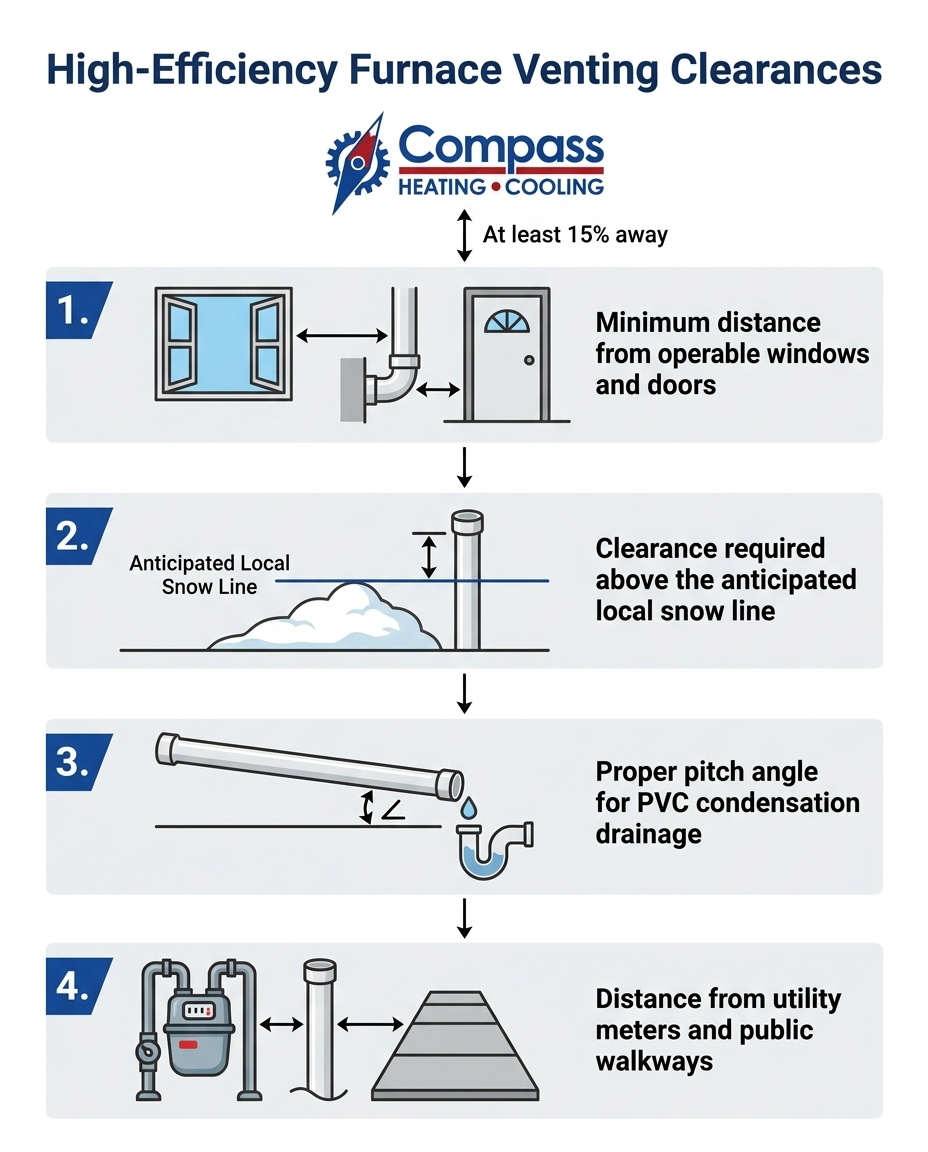
• Operable windows and doors: Exhaust vents must typically maintain a minimum distance (often 12 inches to 4 feet, depending on the specific equipment and local code adoption) from any window or door that can be opened.
• Utility meters: Vents must be kept a safe distance away from gas meters and electrical panels to prevent moisture damage and maintain safe access for utility workers.
• Public walkways: Exhaust cannot be directed over public sidewalks where the acidic moisture or freezing vapor could create a slipping hazard or nuisance for pedestrians.
• Soffits and overhangs: Vents must be positioned so that moisture does not accumulate under roof overhangs, which can cause severe wood rot and peeling paint over time.
Navigating these precise measurements requires significant experience. Working with our team at Compass Heating & Cooling brings deep local expertise in navigating Fort Collins municipal codes and permit requirements, ensuring your installation passes inspection the first time and saving you from costly rework and winter delays. Proper documentation is just as important as the physical work. You can learn more about the administrative side of this process by reviewing our guide on HVAC installation permits. Without the proper permits and final municipal inspections, your new system is not legally compliant, which can cause major headaches if you ever decide to sell your home.
Protecting Your Exhaust Vents from Northern Colorado Winters
Local municipal codes do not exist in a vacuum; they are heavily influenced by regional weather patterns. Having served Loveland and Fort Collins homes through countless brutal winters, we know exactly how freezing temperatures and heavy snowfall dictate precise PVC placement to prevent frost buildup and potentially dangerous exhaust blockages.
One of the most critical local requirements is installing the exterior vents well above the anticipated regional snow line. If a heavy February blizzard rolls through and snowdrifts cover your furnace exhaust pipe, the results are immediate. Modern high-efficiency furnaces are equipped with sensitive pressure switches. If the exhaust is blocked by snow or ice, the pressure switch senses the backup and automatically shuts the furnace down to prevent carbon monoxide from spilling into your house. While this safety mechanism protects your family from toxic gas, it also leaves your home completely without heat during a freezing winter storm.
The Importance of Pitch and Drainage
Beyond snow accumulation, the freezing temperatures themselves pose a massive threat to improper venting. Because the exhaust vapor is full of moisture, any liquid that pools near the exit of the pipe will rapidly turn to ice. To combat this, our installers must precisely pitch the horizontal PVC pipes back toward the furnace.
Why pipe pitch matters:
• Internal drainage: A proper pitch ensures that as the exhaust vapor cools and condenses into liquid, it flows backward into the furnace's internal condensate drain system, rather than dripping outside.
• Preventing ice dams: If the pipe is perfectly level or pitched slightly outward, the slow drip of water will freeze at the pipe's exit. Over a few cold days, this creates an ice plug that will completely choke off the exhaust and trigger a system shutdown.
• Protecting the exterior siding: Proper internal drainage keeps acidic water from constantly dripping down your exterior walls, which would otherwise stain brick and rot wood siding.
By strictly adhering to these weather-specific installation codes, our professionals ensure your heating system remains reliable and safe, even when the temperature drops below zero and the snow starts piling up.
Bridging the Gap Between Home Aesthetics and Heating Safety
A pattern we see often at Compass Heating & Cooling is the initial hesitation homeowners feel about altering their home's exterior. Nobody inherently wants visible white PVC pipes protruding from their siding, brick, or stucco. The aesthetic impact is often the biggest hurdle homeowners face when upgrading to high-efficiency (90%+ AFUE) condensing furnaces. However, bridging the gap between how your home looks and how safely it operates is a standard part of our professional installation process.
Our professional installers do not simply punch a hole in the most obvious spot on the front of your house. We strategically map out the venting route to minimize visual disruption while still strictly adhering to local clearance codes.
Strategies for minimizing visual impact:
• Routing through joist spaces: Whenever possible, our technicians will run the PVC piping through basement ceiling joists to exit on a less visible side or rear wall of the property.
• Utilizing low-profile vent covers: Instead of two separate pipes sticking straight out, we can often use concentric vent kits. These kits combine the intake and exhaust into a single, cleaner-looking exterior termination point.
• Strategic landscaping: While you must keep vegetation a safe distance away to allow for airflow, strategic planting of small shrubs further out in the yard can help break up the sightline to the vents.
Ultimately, this modification is a permanent safety upgrade. The minor visual change of adding PVC venting is vastly outweighed by the major leap in energy efficiency, lower utility usage, and the absolute peace of mind knowing your household is protected from carbon monoxide hazards. Once the installation is complete, the new vents quickly blend into the background of your home's exterior features.
What to Expect During Your Pre-Winter Furnace Replacement
Understanding the "why" behind exterior venting is important, but knowing what actually happens on installation day helps alleviate the stress of a major home upgrade. If you are aiming for a September pre-heating season installation, here is exactly what you can expect from our professional replacement process.
1. Securing permits and planning the route: Before any work begins, our team will finalize the venting route and secure all necessary municipal permits. Doing this before the first major freeze ensures there are no administrative delays leaving you without heat.
2. Decommissioning the old flue: We will safely disconnect your old furnace from the existing metal or masonry chimney. If your water heater also uses that chimney, we ensure it is properly re-lined or adjusted to vent safely on its own.
3. Precision core drilling: Using specialized tools, our team will drill precise holes through your home's rim joist and exterior siding. This is exact, calculated work designed to create the smallest possible footprint for the PVC pipes.
4. Routing and pitching the PVC: The new intake and exhaust pipes are mapped through your basement or crawlspace, ensuring the exact required pitch back to the furnace for safe condensate drainage.
5. Exterior weather-sealing: Once the pipes are pushed through to the outside, the exterior gaps are meticulously sealed with high-grade, weather-resistant caulking to prevent drafts, moisture intrusion, and pest entry.
6. Testing and safety verification: The system is fired up, and we verify that the pressure switches operate correctly, the condensate drains properly, and no exhaust gases are lingering near windows or intakes. During this phase, we also encourage you to check with your utility provider or a tax professional, as federal tax credits or local energy rebates may apply to qualifying high-efficiency installations.
Because this process involves altering the structural envelope of your home and handling toxic combustion gases, it requires specialized tools and strict code compliance. Once the installation is complete, ongoing professional care is the best way to keep the new PVC venting clear of debris and functioning perfectly. We highly recommend enrolling in a comprehensive HVAC maintenance plan. During annual visits, our technicians will inspect the exterior vents, clear out any spider webs or debris, and verify that the condensate drain remains free-flowing. As a homeowner, your only ongoing job is to periodically check the exterior vents during heavy winter snowstorms to ensure snowdrifts have not blocked the airflow.
Frequently Asked Questions
Why does a high-efficiency furnace need PVC pipes?
High-efficiency models extract so much heat during operation that their exhaust gases cool down significantly before leaving the house. This cool exhaust forms an acidic liquid condensation that would rapidly rust and destroy standard metal pipes. PVC is completely immune to this acidic moisture, making it the only safe material to transport the exhaust outside.
Why can't I use my chimney for a new furnace?
Your existing chimney was designed to handle the hot, dry exhaust of older, less efficient heating systems. If you force the cool, wet, and highly acidic exhaust of a modern condensing furnace up a traditional masonry or metal chimney, the acid will eat away at the mortar and metal. This leads to severe structural damage and creates a high risk of carbon monoxide leaking into your home.
What are the local code requirements for furnace venting in Colorado?
Local codes require exterior vents to maintain specific distances from operable windows, doors, utility meters, and public walkways to prevent toxic gases from re-entering the building. Additionally, Colorado requirements strictly mandate that vents be placed high enough above the anticipated regional snow line to prevent winter blockages.
How far from a window does a furnace exhaust need to be?
While exact measurements can vary slightly based on the specific equipment and the latest local municipal code updates, exhaust vents generally must be kept a minimum of 12 inches to 4 feet away from any window or door that can be opened. This strict clearance ensures that shifting winds do not blow carbon monoxide back into your living space.
Does high efficiency furnace exhaust need to be insulated?
In most standard residential setups where the PVC runs through a conditioned or semi-conditioned basement, insulation is not required. However, if the PVC piping must be routed through an unconditioned, freezing space like a ventilated attic or a very cold crawlspace, insulation may be required by code to prevent the internal condensation from freezing before it can drain.
Who handles the permits for a new furnace installation in Fort Collins?
Your licensed HVAC contractor should manage the entire permitting process on your behalf. Our team at Compass Heating & Cooling will submit the required technical drawings, secure the permit from the Fort Collins Building Services department, and schedule the final municipal inspection to ensure all exterior venting meets local safety standards.
Ready to Upgrade Your Heating System Safely?
Navigating new venting requirements doesn't have to be a stressful experience when you have the right team managing the details. At Compass Heating & Cooling, we ensure every high-efficiency installation meets strict local codes, protecting your Loveland or Fort Collins home from winter freezing and carbon monoxide risks. Reach out today to schedule your pre-winter replacement, and enjoy a clear, reassuring explanation of every step we take to keep your family safe and comfortable.
hear what our satisfied clients have to say
Our clients consistently praise our exceptional service and attention to detail. They appreciate the personalized approach we take to meet their unique needs, ensuring satisfaction every step of the way.
.png)