



How Often to Change Air Filters in Dry, Dusty Northern Colorado
How Often to Change Air Filters in a Dry, Dusty Northern Colorado Environment
How often to change air filters in a dry dusty northern Colorado environment is a question every Front Range homeowner should know the answer to — because the standard 90-day advice most manufacturers print on the box simply does not account for what your filter faces here.
Here is a quick-reference guide based on filter size and local conditions:
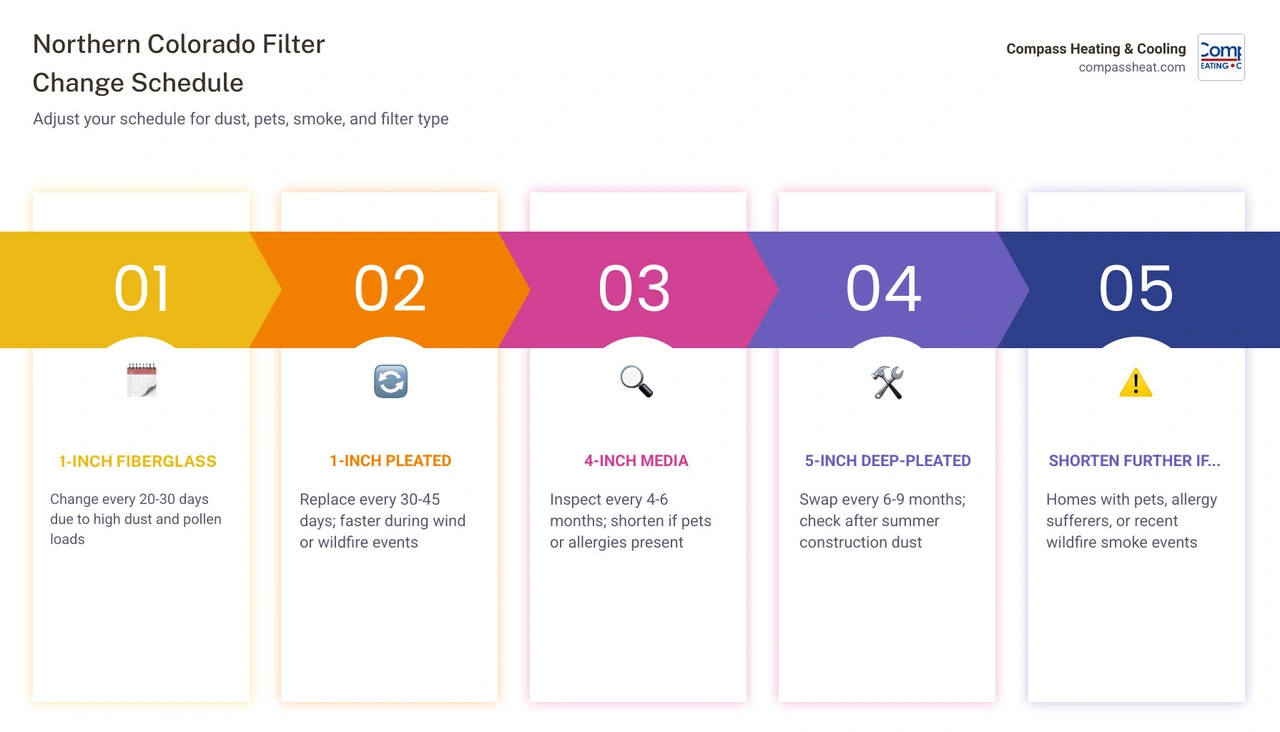
• 1-inch fiberglass — Standard Recommendation: Every 30 days — Northern Colorado Recommendation: Every 20-30 days
• 1-inch pleated — Standard Recommendation: Every 30-90 days — Northern Colorado Recommendation: Every 30-45 days
• 4-inch media filter — Standard Recommendation: Every 6-12 months — Northern Colorado Recommendation: Every 4-6 months
• 5-inch deep-pleated — Standard Recommendation: Every 9-12 months — Northern Colorado Recommendation: Every 6-9 months
Adjust your interval even shorter if you have:
• Pets in the home
• Allergy or asthma sufferers
• Active wildfire smoke events (check weekly)
• Recent home renovation or construction nearby
Northern Colorado's semi-arid climate, high altitude, and relentless wind create a constant stream of fine dust, pollen, and — increasingly — wildfire smoke that loads up filters far faster than homes in less demanding climates. If your energy bills have crept up or your home feels dustier than it should, a clogged filter is often the first place to look. A dirty filter forces your HVAC system to work harder, and according to the U.S. Department of Energy, replacing a clogged filter can improve system efficiency by 5 to 15 percent.
The good news: staying on top of filter changes is one of the simplest and most affordable things you can do to protect your system and your family's air quality.
Why Colorado’s Climate Demands More Frequent Filter Changes
When you live in Fort Collins, Loveland, Windsor, or any of the surrounding communities, you quickly learn that our environment is uniquely beautiful—but incredibly tough on mechanical systems. Our semi-arid climate means we experience very low humidity year-round. While this makes our hot summers much more comfortable than the humid Midwest, dry air has a major side effect: it keeps dust airborne much longer. In more humid climates, moisture binds to dust particles, weighing them down so they settle onto floors and furniture. Here, fine dust remains suspended in the air, floating straight into your return vents.
High altitude compounds this challenge. At 5,000 feet and above, the air is thinner. Because the air density is lower, your heating and cooling systems have to move a larger volume of air to achieve the same heating or cooling effect as a system at sea level. This means your HVAC blower motor is working harder and running longer, pulling more dust-laden air through your filter every single hour it operates.
Furthermore, we cannot ignore our seasonal air quality disruptors:
• The Front Range Winds: High-wind events frequently sweep across Wellington, Severance, and Timnath, kicking up fine agricultural dust and topsoil.
• Cottonwood Season: From late May through June, cottonwood trees release a blizzard of fluffy seeds that can quickly carpet outdoor condenser units and completely choke return air grilles.
• Wildfire Smoke: Summer and fall often bring drifting smoke from regional wildfires. This fine soot and particulate matter (PM2.5) is highly concentrated and can clog a standard filter in a matter of weeks.
To keep track of how these seasonal shifts impact your home comfort systems, refer to our Seasonal HVAC Maintenance Tips Calendar to stay ahead of the weather.
How Often to Change Air Filters in a Dry Dusty Northern Colorado Environment
To truly understand how often to change air filters in a dry dusty northern colorado environment, we have to look at the physical thickness and material of the filter itself. A standard 1-inch fiberglass filter has very little surface area. It is designed primarily to keep large debris, like hairballs and toy soldiers, out of your furnace cabinet. Because they have minimal holding capacity, these cheap filters can fill up with Front Range dust in as little as three weeks.
In contrast, thicker pleated media filters (4 to 5 inches thick) are folded like an accordion. This design vastly increases the surface area of the filter media. While a 1-inch pleated filter might have 4 or 5 square feet of surface area, a 4-inch deep-pleated media filter can have over 30 square feet of surface area packed into the same frame size. This extra surface area allows the filter to trap significantly more dust before it begins to restrict airflow.
However, even these heavy-duty filters do not last as long in Colorado as they would in other states. While a manufacturer might claim a 4-inch filter lasts a full year, our local wind, dry soil, and agricultural activity in areas like Johnstown and Greeley mean you should realistically plan to swap them out every 4 to 6 months. Neglecting this simple chore can lead to serious wear and tear on your furnace or air conditioner. For practical advice on how consistent upkeep keeps your system running smoothly, check out our Reduce Repair Costs with Consistent Furnace Maintenance Tips.
Standard Guidelines vs. How Often to Change Air Filters in a Dry Dusty Northern Colorado Environment
If you read standard online advice, you will constantly see the "90-day rule" tossed around. While a 90-day replacement cycle might work perfectly for a home in a humid, forested region with minimal wind, it is often a recipe for system strain along the Front Range.
During our peak usage seasons—the freezing winter months when your furnace runs around the clock, and the hot summer weeks when your air conditioner is working overtime—your HVAC system is circulating air constantly. In these high-demand periods, we recommend checking your 1-inch filter every 20 to 30 days. If you hold it up to a light source and cannot see light passing through the fibers, it is fully loaded and needs to be replaced immediately, regardless of what the calendar says.
Household Factors That Shorten How Often to Change Air Filters in a Dry Dusty Northern Colorado Environment
No two homes are identical, and your indoor lifestyle plays a massive role in how quickly your air filter fills up. The presence of pets is the number-one accelerator of filter clogging. Pet dander, fine fur, and outdoor dirt tracked in by dogs and cats are pulled directly into your return vents, creating a thick, felt-like layer over your filter media.
Allergy and asthma sufferers also require a much stricter replacement schedule. When a filter becomes loaded with dust, it can no longer efficiently capture new particles. Instead, the high pressure can cause fine allergens to bypass the filter edges or blow straight through the media, circulating back into your living spaces and triggering respiratory symptoms.
• Single occupant, no pets, low dust area — 1-Inch Filter Lifespan: 60–90 days — 4- to 5-Inch Filter Lifespan: 6–9 months
• Average family, 1 pet, normal activity — 1-Inch Filter Lifespan: 30–45 days — 4- to 5-Inch Filter Lifespan: 4–6 months
• Multiple pets, active kids, high dust zone — 1-Inch Filter Lifespan: 20–30 days — 4- to 5-Inch Filter Lifespan: 3–4 months
• Allergy sufferers or active wildfire season — 1-Inch Filter Lifespan: 15–30 days — 4- to 5-Inch Filter Lifespan: 2–3 months
Choosing the Right MERV Rating and Filter Thickness
When shopping for a new air filter, you will encounter the MERV (Minimum Efficiency Reporting Value) rating scale, which ranges from 1 to 16 for residential systems. Understanding this rating is crucial for balancing indoor air quality with system health:
• MERV 1–4: Typically basic fiberglass filters. They capture large particles but let fine dust, pollen, and pet dander pass right through.
• MERV 5–8: Standard pleated filters. These are excellent for capturing mold spores, pollen, and dust mite debris without putting excessive strain on your blower motor.
• MERV 9–11: High-efficiency pleated filters. This is the "sweet spot" for most homes in Northern Colorado, especially in dustier areas like Evans and Berthoud. They trap fine dust, pet dander, and automotive emissions.
• MERV 12–13: Superior filtration. These filters are capable of trapping very fine particles, including bacteria, cooking smoke, and wildfire smoke.
At high altitudes, choosing a filter with a MERV rating that is too high can actually harm your system. Because the air is already thin, a highly restrictive MERV 14 or 16 filter acts like a wall, creating massive static pressure (airflow resistance). This starves your blower motor of air, causing it to run hot, consume more electricity, and potentially burn out prematurely.
If you are wondering whether your system is currently suffering from poor airflow or if it is overdue for a professional assessment, read our guide: Do I Really Need a Furnace Tune-Up? to understand how we test static pressure and system balance.
Signs It Is Time to Replace Your HVAC Filter
You do not always have to wait for a specific date on the calendar to know when your filter is spent. Your home and your HVAC system will drop several clear hints that it is time for a fresh filter:
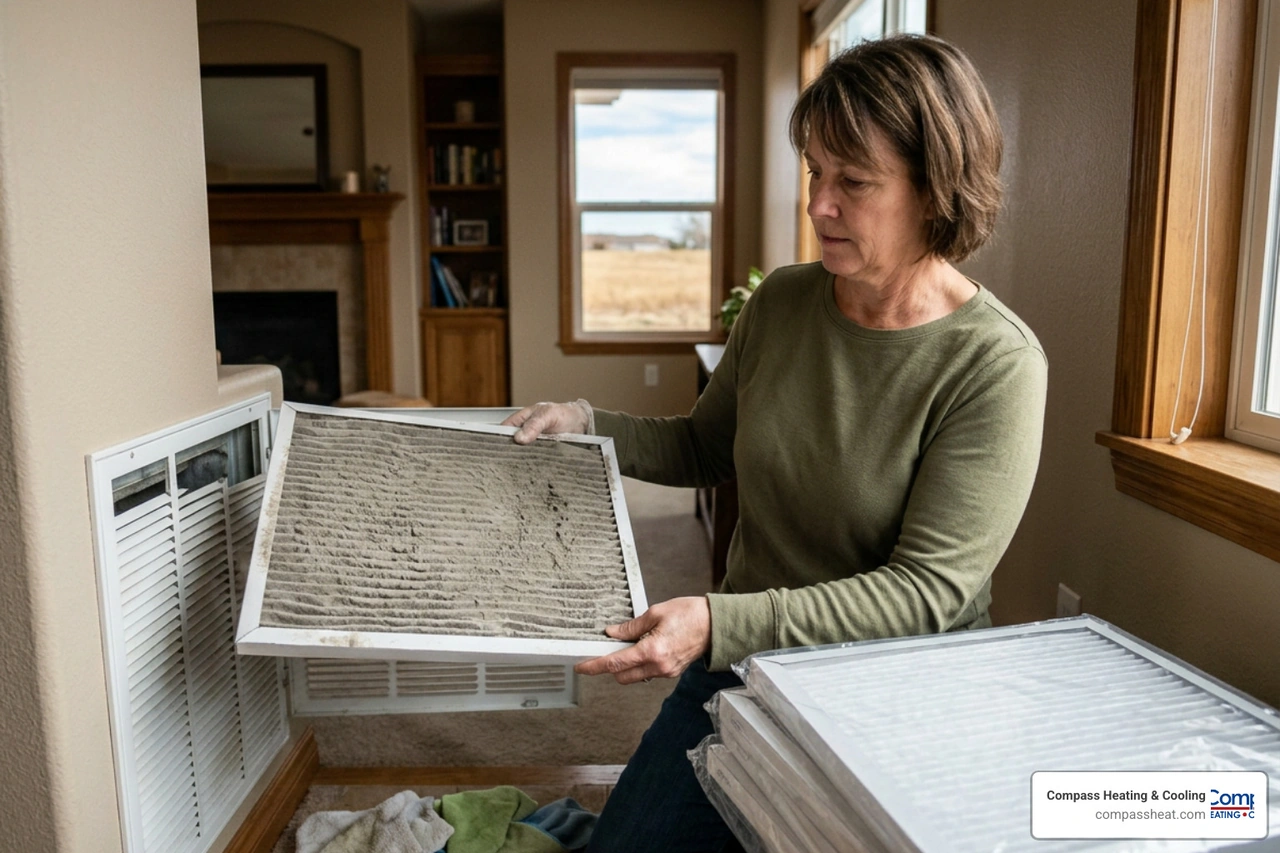
• The Visual Dust Test: Take the filter out and hold it up to a bright light or window. If the filter media looks dark gray, fuzzy, or completely opaque, it is time for a change.
• Weak Airflow from Vents: If you notice that the air blowing out of your registers feels weak or lukewarm compared to its usual performance, a clogged filter is likely choking the system's intake.
• Rapid Dust Accumulation: If you dust your shelves in the morning and notice a fine layer of gray powder resettling by the evening, your filter has reached its holding capacity and is simply letting dust bypass the system.
• A Sudden Spike in Energy Bills: When a filter is clogged, your furnace or air conditioner has to run longer cycles to reach the temperature set on your thermostat, driving up your monthly utility bills.
• Strange Whistling or Whining Noises: A restricted filter forces air through tiny gaps around the filter frame, which can create a distinct whistling sound when the system kicks on.
Frequently Asked Questions About Colorado Air Filters
Can a dirty air filter damage my furnace or AC?
Yes, absolutely. A dirty air filter restricts the vital airflow your heating and cooling equipment needs to operate safely. In the winter, without enough cool air passing over your furnace's heat exchanger, the heat exchanger can quickly overheat. This triggers a safety limit switch, causing the system to shut down (known as short cycling). Over time, this constant overheating and cooling causes the metal of the heat exchanger to expand and contract violently, leading to cracks that can leak dangerous carbon monoxide into your home.
In the summer, restricted airflow causes the temperature of your air conditioner's evaporator coil to drop below freezing. Moisture in the air then freezes directly onto the coil, turning it into a solid block of ice and completely halting the cooling process. If you are experiencing heating issues or want to prevent cracked heat exchangers, scheduling routine Heating Maintenance is the best insurance policy.
Should I use a high-MERV filter during wildfire season?
Yes, but you must monitor it closely. During active wildfire events, switching to a MERV 11 or MERV 13 filter is highly recommended to capture fine soot and smoke particles (PM2.5). However, because smoke particles are microscopic and incredibly dense, they will clog a MERV 13 filter very quickly.
If you are running your system on the "Fan On" setting to continuously clean your indoor air during a smoke event, check the filter every single week. If your home relies on a heat pump for year-round comfort, keeping that airflow moving is critical. You can learn more about protecting these specialized systems by reading up on Heat Pump Maintenance.
Can I vacuum or wash a disposable air filter?
No. Disposable pleated filters are manufactured with a specialized electrostatic charge that helps them attract and hold microscopic dust particles. Vacuuming a disposable filter might pull off the large, visible dust bunnies on the surface, but it will not remove the deeply embedded microscopic particles. Furthermore, the suction from a vacuum can tear the delicate paper and synthetic fibers, creating microscopic holes that let dust pass straight through.
Washing a disposable paper filter will ruin it instantly, causing the media to turn to mush and mold. Always replace disposable filters with brand-new ones.
Conclusion
Keeping your air filters fresh is the simplest, most effective way to protect your home's indoor air quality and keep your heating and cooling systems running efficiently. In our dry, windy, and dusty Northern Colorado climate, sticking to a generic, three-month replacement schedule is rarely enough to keep system strain and high energy bills at bay.
At Compass Heating & Cooling, we are proud to serve homeowners across Fort Collins, Loveland, Windsor, Wellington, Severance, Timnath, Johnstown, Greeley, Berthoud, and Evans. We make professional home comfort maintenance effortless. Our expert team specializes in maximizing your system's performance and helping you navigate and secure valuable utility rebates up to $8,000+.
To take the guesswork out of your seasonal maintenance and filter checks, consider joining our Maintenance Plan, which provides you with priority service, exclusive discounts, and peace of mind. Whether you need a seasonal checkup or comprehensive Air Conditioning Maintenance, we are here to help.
Unsure how to choose the right service provider for your home? Read our expert guide on How to Hire an HVAC Technician: A Guide for Homeowners to make an informed decision, or contact our friendly team today to schedule your next visit!
hear what our satisfied clients have to say
Our clients consistently praise our exceptional service and attention to detail. They appreciate the personalized approach we take to meet their unique needs, ensuring satisfaction every step of the way.
.png)