



How Leaky Attic Ducts Steal Your Winter Heat and Inflate Energy Bills

The Hidden Cost of Early Fall Furnace Starts
September in Loveland brings those first crisp evenings where the house feels just a little too cold, prompting you to finally switch the thermostat from cool to heat. However, before the deep winter freeze sets in, our team at Compass Heating & Cooling wants you to understand exactly how leaky attic ducts steal your winter heat and inflate energy bills. You hear the furnace fire up and the blower motor engage, but the air coming out of your living room vents barely feels warm. The concrete problem we see many homeowners face during this September pre-heating season is that their system is dumping perfectly good heated air straight into a freezing, unconditioned attic before it ever reaches the living space.
This hidden delivery failure forces your system to run longer, drastically increasing your energy consumption without actually improving your indoor comfort. If you want to ensure your delivery system is as efficient as the rest of your home heating systems, scheduling a professional inspection with our technicians is the next logical step.
The Physics of Thermal Loss in Unconditioned Spaces
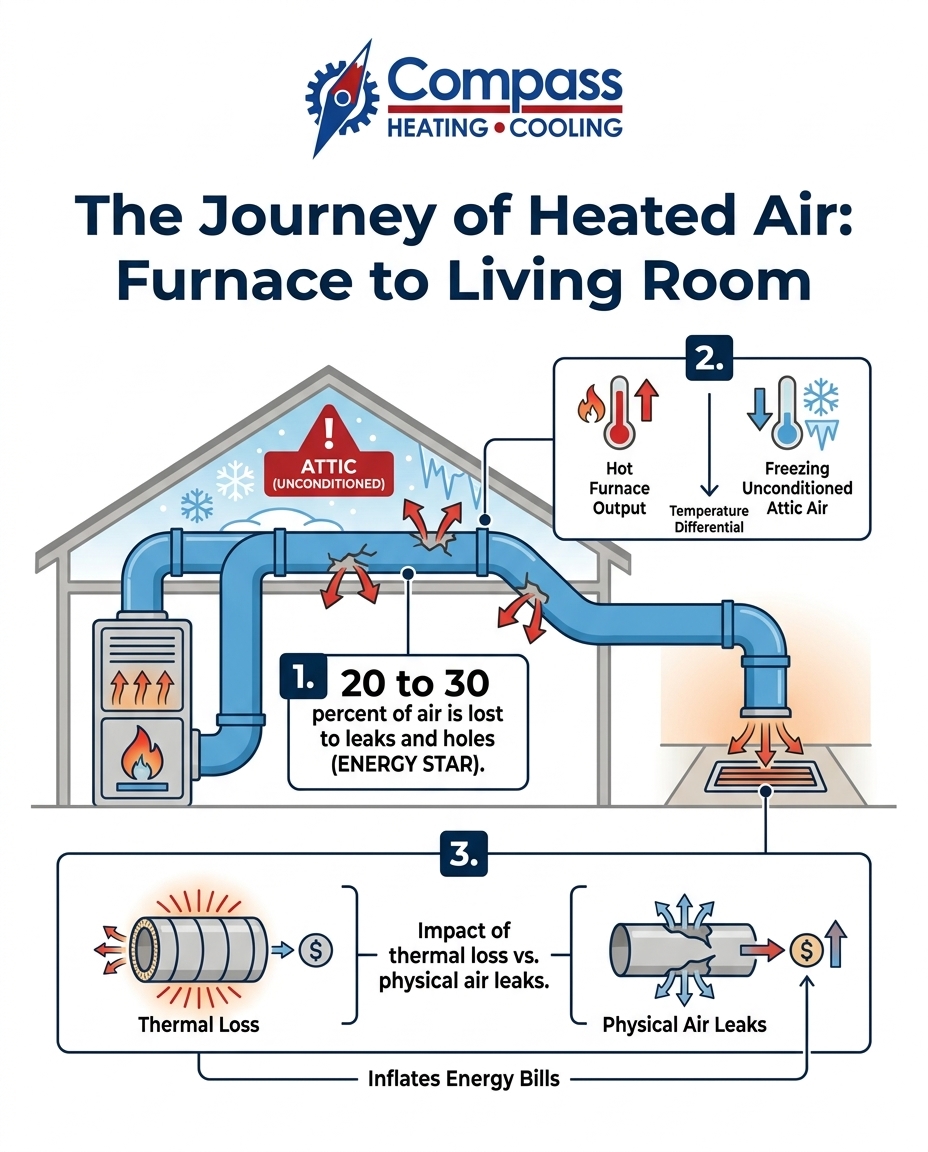
To understand why so much energy goes to waste in the attic, you have to look at the massive temperature differential between the air inside your ductwork and the ambient air surrounding it. When we inspect homes throughout the area, we routinely find that when a furnace operates, it typically produces heated air at temperatures between 120 and 140 degrees Fahrenheit. Meanwhile, an unconditioned attic during a chilly Loveland night might drop into the 30s or lower. This extreme contrast creates an environment where heat naturally wants to escape the confined ductwork and dissipate into the freezing surrounding air.
According to ENERGY STAR data—which aligns perfectly with what our technicians see in the field every week—in a typical house, about 20 to 30 percent of the air that moves through the duct system is lost due to leaks, holes, and poorly connected joints. That means a significant portion of the energy your furnace consumes is completely wasted on heating the rafters and roof decking instead of your living room.
In our experience, this inefficiency generally happens in two distinct ways, both of which compound to force your heating equipment to run longer cycles:
• Thermal Heat Loss — How It Happens: Heat radiates directly through thin sheet metal or degraded insulation materials. — The Impact on Your Home: Air reaches the vents, but it feels lukewarm instead of hot, reducing overall comfort.
• Physical Air Leaks — How It Happens: Pressurized heated air blows out through disconnected joints, torn flex ducts, or failed mastic seals. — The Impact on Your Home: Air volume is drastically reduced, meaning weak airflow at the registers and longer heating cycles.
Why Unconditioned Attics Are the Biggest Culprit
An unconditioned space is any area of your home that sits outside the primary thermal envelope—meaning it is not actively heated or cooled, and it lacks the heavy insulation required to maintain a stable indoor temperature. Because of local architectural designs, miles of ductwork are often routed through these vulnerable zones to save interior space.
When you combine freezing ambient temperatures with a network of aging metal and flexible tubing under high static pressure, you create the perfect storm for energy waste. The compounding effect of freezing temperatures on compromised duct seals means that even a minor gap can siphon off a massive volume of expensive heated air before it ever reaches your bedroom or kitchen.
How Drastic Fall Temperature Swings Damage Metal Ductwork
The transition into fall along the Front Range is notoriously unpredictable. It is incredibly common to experience warm, sunny afternoons in the 70s followed immediately by rapid temperature drops that plunge below freezing overnight. While you might just put on a heavier coat, our team has seen firsthand how your home's HVAC infrastructure experiences severe physical stress from these drastic fluctuations.
Metal ductwork is highly reactive to temperature changes. During the heat of the day, the sheet metal expands. As the sun sets and the attic temperature plummets, the metal rapidly contracts. This daily cycle of expansion and contraction exerts immense physical force on the joints, seams, and connections holding your delivery system together.
Over several seasons of servicing local homes, we've noticed this constant mechanical movement weakens mastic seals, causes foil tape to dry out and peel, and slowly pulls slip-joints apart. What started as a microscopic hairline crack last winter can easily expand into a half-inch gap by this September pre-heating season. Because this degradation happens out of sight in a dark attic, most homeowners are completely unaware that their ductwork is slowly pulling itself apart until their utility usage suddenly spikes.
This seasonal degradation is exactly why we strongly recommend early fall inspections. By identifying and securing these expanding gaps before the deep winter freeze hits, you prevent the maximum level of thermal loss that occurs when the temperature differential is at its most extreme.
Telltale Signs Your Heated Air Isn't Reaching the Living Room
Because you rarely spend time in an unfinished attic, diagnosing a compromised delivery system usually requires paying close attention to the secondary symptoms occurring inside your living space. When our technicians respond to comfort complaints, we often find that if you notice any of the following patterns, your ductwork is likely struggling to contain the air your furnace is producing.
• Uneven heating across different rooms: If your master bedroom feels like an icebox while the central hallway is roasting, you likely have a massive leak on the branch line feeding that specific room. The heated air meant for the bedroom is being dumped into the attic instead.
• Excessive dust circulating through the home: When supply ducts leak air out, return ducts often pull air in. If your return ductwork has gaps in the attic, it will suck in fiberglass insulation particles, dust, and debris, distributing it directly into your living space.
• The furnace running constantly: If your thermostat is set to 70 degrees but the system runs continuously without ever reaching that target, it usually means the volume of heated air reaching the rooms is too weak to overcome the natural heat loss of the house.
• Unexplained spikes in energy consumption: If your utility usage is significantly higher this November than it was last November—despite similar weather patterns and thermostat settings—a sudden failure in an attic duct joint is a highly probable cause.
Why a Standard Furnace Tune-Up Doesn't Fix Delivery Leaks
We often encounter a common misconception among homeowners that having a technician clean the burners and check the heat exchanger will automatically lower energy consumption. While a standard furnace tune-up is absolutely essential for equipment longevity, safety, and preventing premature breakdowns, it only addresses the generation side of the equation. A perfectly tuned, highly efficient furnace still wastes a tremendous amount of energy if the delivery system is compromised.
We like to tell our customers to think of their HVAC system like a high-performance vehicle. Tuning the furnace is like putting premium fuel in the tank and tuning the engine. However, if your ductwork is full of holes, it is the equivalent of driving that tuned vehicle with four flat tires. The engine is working perfectly, but the power isn't reaching the road.
This represents a massive blind spot for many homeowners during the September pre-heating season. They focus entirely on the metal box in the basement or utility closet while completely ignoring the miles of vulnerable piping running through the harshest environment in their home. Comprehensive seasonal prep requires looking at the entire thermal loop. To truly secure your home's efficiency, evaluating your ductwork must become a core part of your seasonal HVAC maintenance tips and routine.
The Value of Local Expertise in Attic Diagnostics
When it comes to tracking down elusive airflow issues in unconditioned spaces, there is no substitute for locally owned expertise familiar with Northern Colorado home builds. Our team knows exactly how the architecture, insulation standards, and building codes specific to Loveland CO dictate exactly how ductwork is routed and where it is most likely to fail.
Attempting to diagnose or seal ductwork yourself is highly discouraged. Navigating an unfinished attic is inherently dangerous, requiring you to balance on narrow joists while avoiding exposed wiring, roofing nails, and deep insulation. Furthermore, the most significant leaks are rarely the ones you can see with a flashlight. They are often hidden beneath layers of blown-in fiberglass or tucked into tight architectural eaves.
Our professional diagnostics rely on specialized tools and a deep understanding of regional construction:
1. Static Pressure Testing: Our technicians use manometers to measure the exact pressure inside the duct system, instantly revealing if there is a massive volume of air escaping somewhere in the line.
2. Thermal Imaging: Infrared cameras can spot plumes of hot air leaking into a freezing attic, pinpointing exactly which joints have failed beneath the insulation.
3. Airflow Balancing: By measuring the cubic feet per minute (CFM) at the registers, professionals can calculate exactly how much air is being lost between the furnace and the living room.
By relying on our Loveland heating professionals at Compass Heating & Cooling, you ensure that the specific vulnerabilities of your home's construction are accurately identified and permanently secured using professional-grade mastic and specialized sealants that withstand extreme temperature swings.
Frequently Asked Questions About Duct Leaks and Heating Bills
When exploring HVAC efficiency services, our customers often have pressing questions about how their ductwork impacts their overall comfort and energy usage. Here are the most common inquiries we receive regarding attic heat loss.
How do leaky ducts affect heating?
Leaky ducts prevent the heated air generated by your furnace from actually reaching your living spaces. When hot air escapes into an unconditioned attic, the volume and pressure of the air arriving at your vents drop significantly. This forces your furnace to run much longer heating cycles just to maintain the baseline temperature set by your thermostat, causing unnecessary wear and tear on the equipment.
What are the signs of leaky ductwork in an attic?
The most common signs we see include uneven temperatures between rooms, weak airflow coming from specific vents, and an HVAC system that seems to run continuously on cold days. You might also notice an increase in airborne dust inside the home, as negative pressure can pull attic debris into the duct system. Sudden, unexplained increases in your winter utility usage are also a major red flag.
How much energy is lost through unsealed ducts?
According to ENERGY STAR, a typical home loses between 20 and 30 percent of the air moving through its duct system due to leaks, holes, and poor connections. When ductwork is located in a freezing, unconditioned attic, the thermal loss is exacerbated, meaning you are paying to heat a significant amount of air that never benefits your family's comfort.
Can leaky ducts cause high heating bills?
Yes, compromised ductwork is one of the leading causes of inflated winter energy consumption. Because a large percentage of the heated air is lost to the attic, the furnace must consume significantly more fuel or electricity to compensate for the loss. Sealing these leaks is one of the most effective ways to lower monthly utility usage without sacrificing indoor warmth.
Why is fall the best time to inspect attic ductwork in Colorado?
Early fall provides a critical window to address delivery system flaws before the deep sub-freezing temperatures of winter arrive. During the fall, the temperature differential is already wide enough to easily detect thermal leaks, but the weather hasn't yet reached the extreme lows that maximize energy waste. Pre-winter prep ensures your system operates at peak efficiency from the very first freeze.
What is the difference between thermal heat loss and physical air leaks in ductwork?
Thermal heat loss occurs when heat radiates through the thin metal walls of the ductwork into the cold attic space, cooling the air inside before it reaches the vents. Physical air leaks happen when pressurized, heated air physically escapes through broken seals, disconnected joints, or torn flexible tubing. Both issues drastically reduce the efficiency of your heating system and require professional sealing to correct.
Secure Your Ductwork Before the Deep Winter Freeze
As the September pre-heating season gives way to the harsh realities of a Colorado winter, our team wants to ensure your home's thermal delivery system is airtight. Allowing perfectly good heated air to escape into an unconditioned space is a frustrating and entirely preventable waste of energy. By addressing these hidden vulnerabilities now, you can drastically improve your indoor comfort, eliminate cold spots, and reduce the heavy workload placed on your furnace.
Don't wait until the middle of a January blizzard to discover how leaky attic ducts steal your winter heat and inflate energy bills. Taking proactive steps today ensures a warmer, more efficient home all season long. To keep your entire system running flawlessly year-round, consider securing your comfort with the Compass Club Maintenance Plan, designed to catch these hidden inefficiencies before they impact your daily life.
hear what our satisfied clients have to say
Our clients consistently praise our exceptional service and attention to detail. They appreciate the personalized approach we take to meet their unique needs, ensuring satisfaction every step of the way.
.png)