



How a Dirty Flame Sensor Causes Your Furnace to Shut Off Prematurely
The Frustration of a Furnace That Starts and Immediately Stops
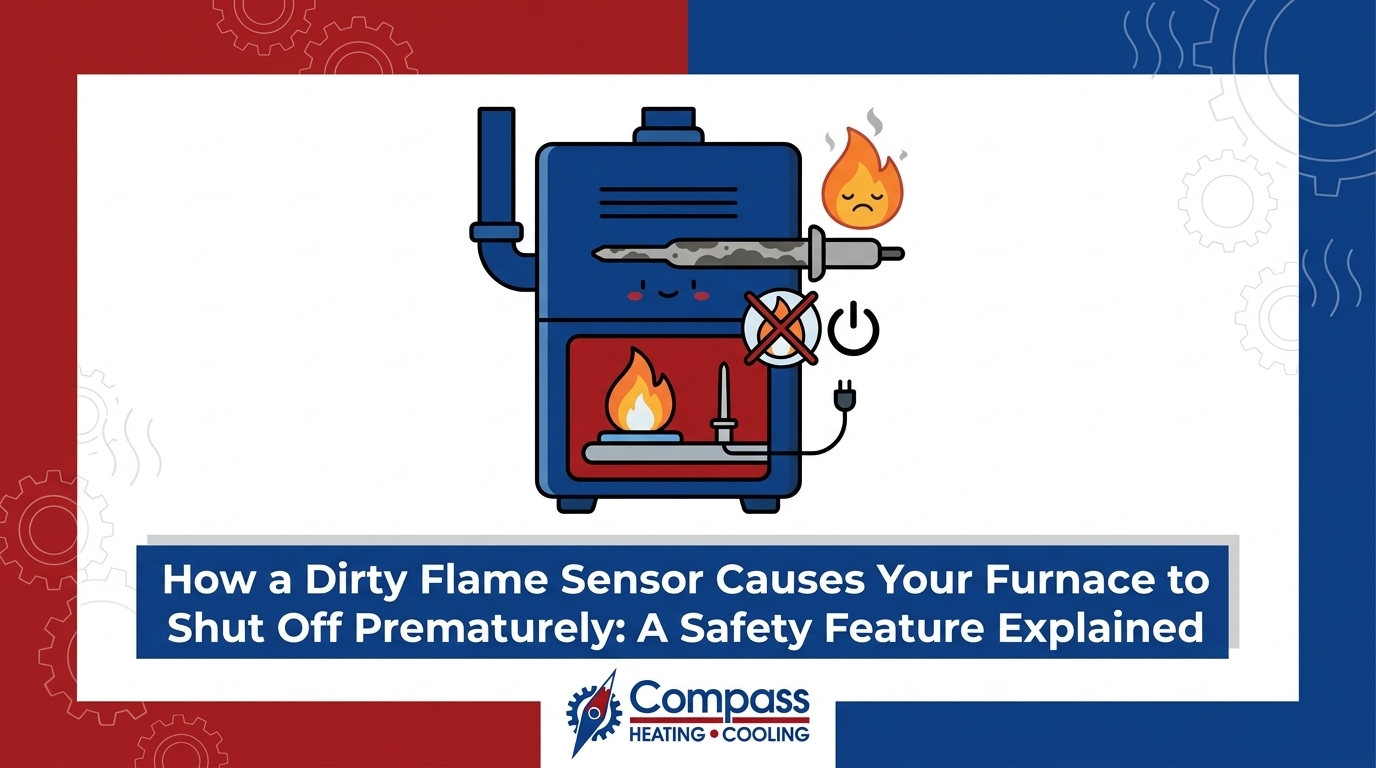
Your thermostat clicks, the draft inducer motor whirs to life, and the burners ignite with a reassuring whoosh—but within three seconds, the entire system shuts down completely. If you are experiencing this exact sequence, you are likely wondering how a dirty flame sensor causes your furnace to shut off prematurely. This sudden shutdown is incredibly frustrating, especially when it happens during unexpected temperature drops. At Compass Heating & Cooling, we often hear from Loveland homeowners who assume their entire heating system is permanently broken and brace themselves for a worst-case scenario.
When your equipment refuses to stay running during early fall cold snaps in September, understanding the root cause is the first step toward restoring reliable comfort. For homeowners relying on modern heating systems, this specific shutdown sequence is actually a critical safety feature working exactly as intended. The true culprit is rarely a catastrophic mechanical failure. Instead, it is usually a tiny, metal safety component reacting to an invisible, insulating layer of dirt. Before you attempt any fixes or reset the system repeatedly, you need to understand why this mechanism is intervening in the first place.
Recognizing the Symptoms of a Flame Sensor Lockout
To properly identify the issue, you need to watch your furnace closely during its startup cycle. A heating system operates in a very specific, sequential order. If the sequence breaks at the exact same moment every time, you are likely dealing with a sensor failure rather than a broader mechanical issue. Our team typically sees these lockouts spike during the first use of the season when Northern Colorado temperatures drop rapidly, catching homeowners off guard.
The Standard Ignition Sequence
When you call for heat, your system follows these exact steps. Watch your equipment to see where the process stops:
1. The Draft Inducer Starts: A small fan turns on to clear residual gases out of the heat exchanger.
2. The Igniter Glows: The hot surface igniter heats up, glowing bright orange.
3. The Gas Valve Opens: You will hear a distinct click as gas flows into the burner assembly.
4. The Burners Light: The gas meets the igniter, creating a steady row of blue flames.
5. The Three-Second Rule: The flames burn for roughly three seconds before the entire system suddenly shuts down.
If your system completes steps one through four, but immediately fails at step five, you are witnessing a textbook sensor failure. After the furnace attempts this sequence a few times (usually three to five tries), the control board will enter a hard "lockout" mode. It will refuse to attempt another ignition for several hours to keep you safe.
Scheduling routine furnace maintenance is the most effective way to prevent this sequence from ruining a cold evening. It is also important to differentiate this specific short-cycling behavior from other common heating issues.
• Shuts down 3 seconds after flames appear — Typical Cause: Dirty Flame Sensor — Timing of Shutdown: Immediate (during ignition)
• Shuts down after 5-10 minutes of heating — Typical Cause: Overheating / Dirty Filter — Timing of Shutdown: Mid-cycle (while heating the house)
• Burners never light at all — Typical Cause: Bad Igniter or Gas Valve — Timing of Shutdown: Before flames are established
The Science of Flame Rectification: How Your Sensor Detects Fire
To understand why a tiny bit of dirt causes such a massive disruption, you have to look at the science of flame rectification. The flame sensor itself is not a complex computer chip or a mechanical valve. It is simply a thin, metallic rod with a ceramic base, positioned directly in the path of the burner flame. Despite its simple appearance, it performs a highly advanced electrical process.
The Process of Flame Rectification
When the furnace control board sends an alternating current (AC) to the sensor rod, that current needs a pathway to return to the ground. Fire is actually conductive. When the burners ignite, the flames engulf the metal rod. The unique properties of the fire convert the alternating current into a direct current (DC). This converted DC signal travels through the flame, to the metal burner assembly, and back to the control board.
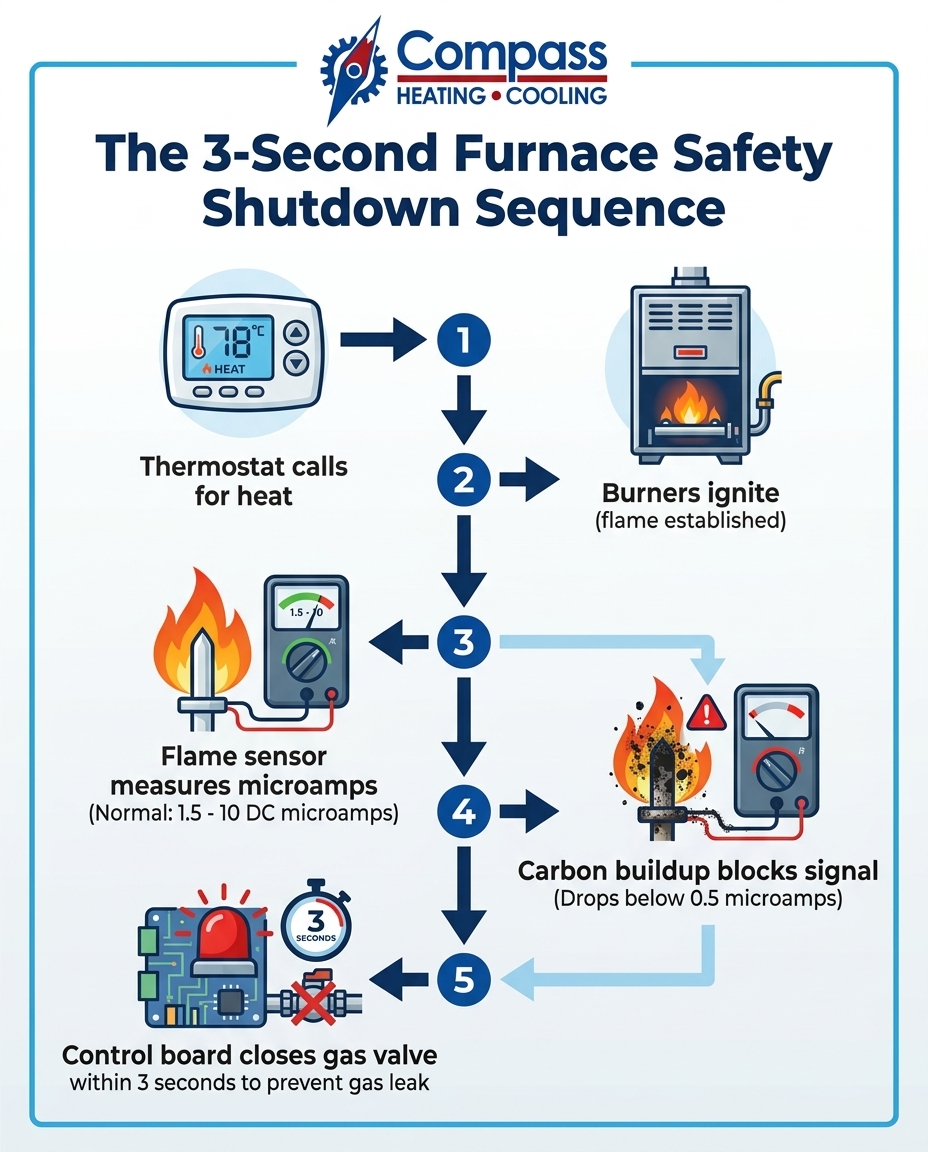
This process is called flame rectification. The furnace control board constantly monitors this tiny electrical current to verify that a live flame is present. The measurements are incredibly small, recorded in microamps (millionths of an amp).
• Normal Operation: A clean sensor in a healthy flame usually registers between 1.5 and 10 DC microamps.
• Warning Zone: If the reading dips below 1.0 microamp, the system is struggling to read the flame.
• Failure Threshold: If the signal drops below 0.5 microamps, the control board registers a total failure.
Because the electrical current is so weak, the pathway must be absolutely clear. Even microscopic carbon buildup on the surface of the metal rod is enough to disrupt the flow of microamps, stopping the electrical signal dead in its tracks.
How Microscopic Carbon Buildup Triggers a System Shutdown
The transition from a perfectly functioning furnace to an immediate lockout does not happen overnight. It is a gradual process that accelerates during the summer months when your heating system sits idle. Understanding this timeline explains why the system fails right when you need it most.
The Summer Dust Effect
Throughout the spring and summer, your heating equipment sits completely dormant. During these months, airborne dust, pet dander, and household particulates circulate through your ductwork and settle inside the furnace cabinet. A fine layer of this debris coats the metallic sensor rod. When the cooler weather arrives and you turn on the heat for the first time, the burners ignite and instantly bake that settled dust directly onto the metal surface.
The Chemical Reaction of Combustion
Beyond household dust, the natural combustion process itself contributes to the problem. Burning natural gas or propane creates trace amounts of soot and carbon. Over hundreds of heating cycles, these byproducts bond to the heated metal rod. This creates a hard, nearly invisible shell over the sensor.
The Insulating Effect:
This baked-on layer acts as a powerful electrical insulator. Remember that the control board is looking for a signal measured in millionths of an amp. The microscopic carbon buildup acts like a rubber glove over the metal rod, preventing the fire from conducting the electrical current.
When the burners light, the flame engulfs the rod, but the carbon barrier stops the microamp signal from reaching the control board. The board waits for roughly three seconds. When it reads less than 0.5 microamps, its programming dictates that there is no flame present, triggering an immediate and complete system shutdown.
A Vital Safety Mechanism: Preventing Unburned Gas Accumulation
It is easy to view a short-cycling furnace as a broken appliance that is failing to do its job. However, the reality is exactly the opposite. When the control board shuts down the system after three seconds, it is successfully executing its most important programming. It is protecting your home from a severe combustion hazard.
The Danger of an Open Gas Valve
Consider the alternative scenario. If the flame sensor did not exist, or if the control board ignored a weak microamp reading, the gas valve would remain wide open regardless of whether the burners were actually lit. If a gust of wind down the flue pipe blew out the flames, or if the igniter failed to spark, raw natural gas would continue pouring into the combustion chamber.
That unburned gas would quickly flood the heat exchanger, spill into your ductwork, and accumulate throughout your living spaces. The next time the system attempted to spark, or if the gas reached a pilot light on a water heater, the results would be catastrophic.
Reliable, safe heating is critical for overnight safety during freezing Loveland winter nights. The immediate shut-off is the control board doing exactly what it was designed to do: assuming the worst and cutting the fuel supply to keep your household safe. In our experience serving Northern Colorado, we've seen firsthand why this safety shut-off is so crucial. This is why you should always rely on professional furnace repair in Loveland rather than trying to bypass safety controls.
The Risks of DIY Flame Sensor Repairs
If you search online for solutions to a furnace that shuts off after three seconds, you will undoubtedly find dozens of tutorials suggesting you clean the sensor yourself. Many of these videos advise homeowners to remove the rod and scrub it with emery cloth, sandpaper, or steel wool. Our technicians at Compass Heating & Cooling highly discourage attempting this repair without professional training, as we frequently see it lead to more expensive damage.
The Danger of Abrasive Materials
The metallic rod is highly sensitive. When you use abrasive materials like sandpaper or harsh steel wool to scrub away the soot, you leave behind microscopic scratches in the metal. These tiny grooves create the perfect textured surface for future soot and dust to cling to. By scratching the rod, you dramatically accelerate the rate of microscopic carbon buildup. A sensor that used to require cleaning once a year will suddenly start failing every few months.
The Fragility of the Ceramic Insulator
The metal rod is housed in a white ceramic base that isolates the electrical current from the metal furnace cabinet. This ceramic is incredibly brittle. If you apply too much pressure while unscrewing the component, or if you bump the base while scrubbing the rod, the ceramic will develop hairline cracks. Once the ceramic is cracked, the electrical current will ground out to the furnace cabinet instead of traveling back to the control board. This permanently destroys the sensor, requiring a full replacement.
Handling gas appliances, opening sealed combustion chambers, and interacting with high-voltage electrical control boards requires licensed professional expertise. Bypassing or damaging a primary safety sensor puts your entire household at risk.
Proactive Prevention: The Value of Pre-Season Maintenance
The best way to handle a sensor lockout is to prevent it from happening in the first place. You do not have to wait for your system to fail on a freezing night to address this issue. Flame sensor cleaning, microamp calibration, and full safety checks are standard procedures during professional fall tune-ups.
When a certified Compass Heating & Cooling technician inspects your system, they use specialized, non-abrasive materials to safely remove the insulating carbon layer without scratching the metal. They also use a multimeter to test the exact DC microamp reading, ensuring the signal is strong and the control board is reading it accurately. Catching this buildup before the cold weather hits guarantees your system will run uninterrupted when you need it most.
Taking advantage of fall furnace specials allows you to get this vital maintenance completed affordably. For maximum peace of mind, the Compass Club Maintenance Plan includes proactive cleaning of microscopic carbon buildup to prevent these specific breakdowns entirely. By following a regular schedule of seasonal HVAC maintenance tips, you ensure your equipment operates safely and efficiently year after year.
Do not wait until early fall cold snaps in September force your system into an emergency lockout. Having your equipment professionally cleaned and calibrated before the deep winter weather sets in permanently is the smartest way to protect your home and your comfort.
Frequently Asked Questions
Why does my furnace shut off after 3 seconds?
Your furnace shuts off after three seconds because the control board cannot detect a live flame. This is almost always caused by a dirty flame sensor failing to send the proper microamp signal. The system immediately closes the gas valve to prevent raw gas from accumulating in your home.
What happens when a flame sensor gets dirty?
When a flame sensor gets dirty, a layer of soot and dust acts as an electrical insulator. This barrier blocks the tiny direct current (DC) from traveling through the flame and back to the control board. Without that electrical signal, the furnace assumes the fire has gone out and triggers a safety shutdown.
Can a dirty flame sensor cause the furnace to stop working completely?
Yes, a dirty flame sensor will cause the furnace to stop working completely after multiple failed ignition attempts. The control board will enter a "hard lockout" mode to protect the home from potential gas leaks. The system will refuse to turn on again until it is reset or professionally serviced.
How do I know if my flame sensor is bad or just dirty?
Our professional technicians determine this by testing the electrical current with a specialized multimeter. If the sensor is cleaned but still fails to produce a reading between 1.5 and 10 DC microamps, or if the ceramic base is cracked, the sensor is bad and must be replaced. In most cases, it simply needs a professional cleaning.
Why does my furnace short cycle only during the first use of the season?
Your furnace short cycles during the first use of the season because months of airborne dust have settled on the sensor rod over the summer. When the burners ignite for the first time, that dust instantly bakes onto the metal, creating an immediate insulating barrier that blocks the safety signal.
Understanding exactly how a dirty flame sensor causes your furnace to shut off prematurely takes the mystery out of early season heating failures. Instead of panicking over a broken system, you can recognize this as a safety feature doing its job. Schedule your pre-season tune-up with our certified professionals today to ensure a clear sensor, a strong microamp signal, and a warm, safe home all winter long.
hear what our satisfied clients have to say
Our clients consistently praise our exceptional service and attention to detail. They appreciate the personalized approach we take to meet their unique needs, ensuring satisfaction every step of the way.
.png)